1.75*3200 = 5,600: The Answer and How to Calculate It
4th Oct 2026

The answer is 5,600. So, 1.75*3200 = 5,600, even if multiplying a decimal by a whole number isn’t immediately obvious. The key is to break the calculation into simple steps and keep track of place value.
If you’re looking for a quick answer, you’ve got it. To verify the result, work through 1.75 × 3,200 and check it using division or an estimate. You’ll also see how to interpret 5,600 when the numbers represent quantities or measurements.
For example, if 1.75 represents units per item and 3,200 is the number of items, the product is 5,600 units. The expression itself doesn’t specify a unit, so use the context of your calculation to label the result correctly. The steps below show how to calculate the product, check whether it’s reasonable, and use it in a larger calculation.
Key Takeaways
- Read the asterisk in 1.75*3200 as a multiplication sign, not an exponent or a label dimension.
- Use a two-step decimal method to calculate the product without losing track of place value.
- Check your work by reversing the operation, then estimate to spot an answer that seems out of range.
- Record the original inputs and attach the correct units to the result when using it in a calculation or workflow.
What Is 1.75*3200? The Exact Answer
1.75 × 3,200 = 5,600. The product of 1.75 and 3,200 is 5,600.
The query 1.75*3200 uses an asterisk to indicate multiplication, a common way to write the operation when a multiplication symbol isn’t available. The result, 5,600, is a number without units. Its meaning depends on what 1.75 and 3,200 represent in the original problem.
If the values describe a rate and a count, the product gives a total in the units implied by that rate. Without that context, read 5,600 simply as the numerical result. For more background, see this overview of multiplication.
How should you read 1.75*3200?
Read the expression as “1.75 multiplied by 3,200.” The asterisk (*) and the multiplication sign (×) represent the same operation here, so 1.75*3200 and 1.75 × 3,200 mean the same thing. The comma in 3,200 separates the thousands for easier reading; it doesn’t change the value. The expression doesn’t imply a unit or real-world meaning unless the original problem supplies one.
What is the product of 1.75 and 3,200?
The product is 5,600, shown as 1.75 × 3,200 = 5,600. “Product” is the name for the result of multiplication. You can use this equation as the direct answer, then interpret the number using the quantities or measurements in your situation. The result could be counted in items, units, or another measure, but only if that unit fits the inputs.
When recording the result, keep the factors alongside 5,600. That makes clear which calculation produced the number and helps prevent confusion with a different total. The next step is to work through the multiplication and check it.
How to Calculate 1.75 × 3,200 Step by Step
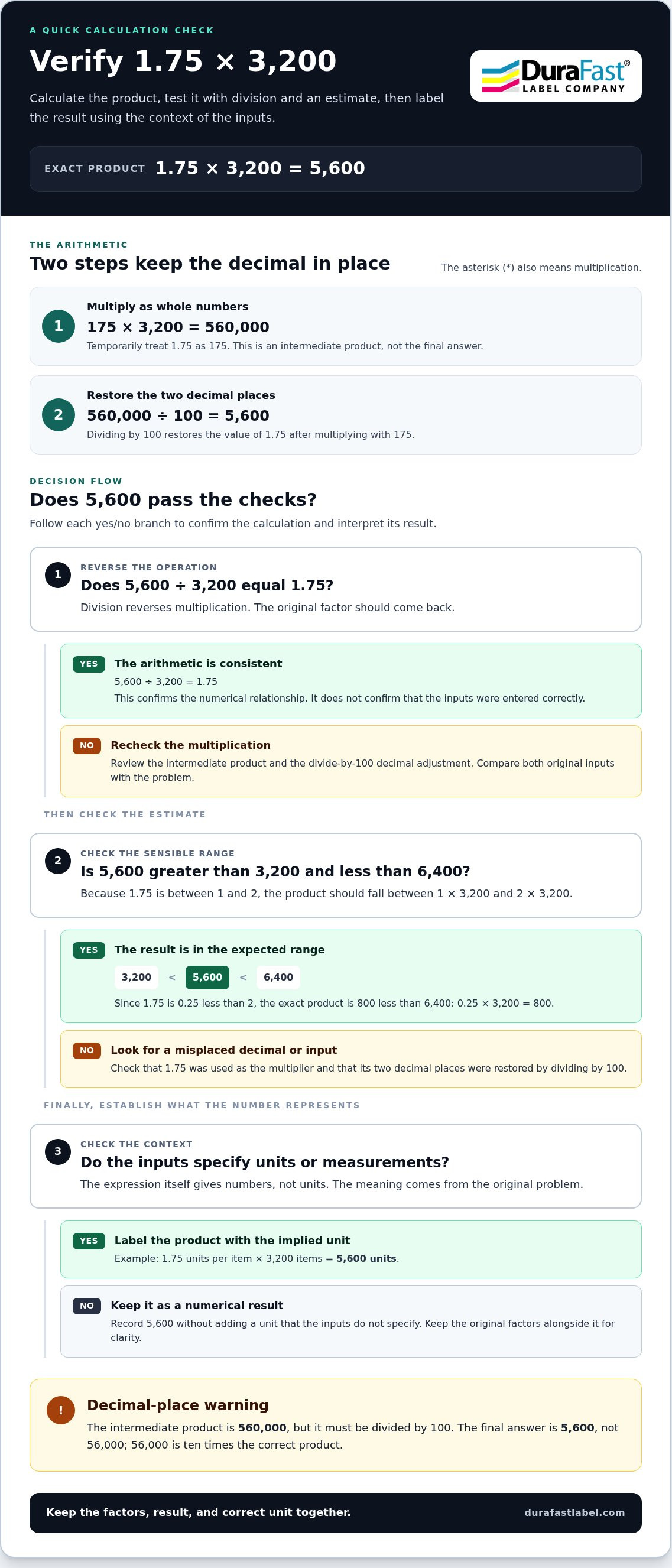
To work out 1.75*3200, temporarily remove the decimal point, multiply the resulting whole numbers, then adjust the product to account for the two decimal places in 1.75. This keeps the arithmetic manageable while preserving the value of the original expression.
Use a whole-number method to multiply
First, treat 1.75 as 175. This is a temporary change for the calculation, not a change to the value of the multiplier. Multiply 175 by 3,200:
175 × 3,200 = 560,000
Keep 560,000 as the intermediate product. The decimal adjustment hasn’t been made yet, so this isn’t the final answer.
Put the decimal point back in the right place
There are two digits after the decimal point in 1.75. Since 1.75 is equal to 175 hundredths, divide the whole-number product by 100 to restore the multiplier’s original value:
560,000 ÷ 100 = 5,600
Because 1.75 has two decimal places, divide 175 × 3,200 by 100 to get 5,600.
Here’s the method in two steps:
- Multiply without the decimal: 175 × 3,200 = 560,000.
- Divide by 100 to account for the two decimal places: 560,000 ÷ 100 = 5,600.
You can also picture the adjustment as moving the decimal point in 560,000 two places to the left, giving 5,600. The division method shows why: changing 1.75 to 175 made the multiplier 100 times larger, so the intermediate product must be divided by 100 to return to the original calculation.
As a final check, compare the result with the original multiplier. Multiplying 3,200 by 1.75 should give a product greater than multiplying by 1, but less than multiplying by 2. The answer, 5,600, falls between 3,200 and 6,400.
If this calculation is part of planning for label-printing equipment or supplies, DuraFast Label Company offers color and thermal printers, label media, and ribbons. Find information about label-printing equipment and supplies.
How to Check 5,600 and Understand the Result
A product that looks right still deserves a quick check, especially if you’ll use it in another calculation or workflow. For 1.75*3200, reverse the multiplication with division, then compare the answer with a rough estimate. These checks can confirm the arithmetic and help catch a misplaced decimal point.
Can you verify the answer with division?
Divide the product by one of the original factors: 5,600 ÷ 3,200 = 1.75. Division reverses multiplication, so getting the original factor back confirms that 5,600 and 3,200 are consistent with a product of 1.75. This verifies the arithmetic using the numbers shown. It can’t confirm that 1.75 or 3,200 was entered correctly in the first place, so compare both inputs with the original problem too.
An estimate provides a separate reasonableness check. Since 1.75 is close to 2, multiplying 3,200 by 1.75 should give a result near 3,200 × 2, or 6,400. The exact product, 5,600, is 800 less than that estimate. This is reasonable because 1.75 is 0.25 less than 2, and 0.25 × 3,200 is 800.
| Check | Calculation | What it shows |
|---|---|---|
| Exact product | 1.75 × 3,200 = 5,600 | The calculated result |
| Reverse operation | 5,600 ÷ 3,200 = 1.75 | The product returns the original factor |
| Estimate | 2 × 3,200 = 6,400 | The exact answer is in a sensible range |
What does 5,600 mean when units are involved?
The expression gives numbers, not units. If 1.75 is a rate measured in units per item and 3,200 is a count of items, the product is 5,600 units. If the inputs represent something else, label the product according to that context. The arithmetic check confirms the numerical relationship; checking the units and original inputs is a separate step.
Common Mistakes When Calculating 1.75 × 3,200
The arithmetic is manageable, but a misplaced decimal or misread symbol can change the result. For 1.75*3200, keep the operation, number formatting, decimal adjustment, and original units clear as you work.
How can decimal placement change the answer?
Because 1.75 has two digits after the decimal point, the intermediate product 175 × 3,200 = 560,000 must be divided by 100. The result is 5,600, not 56,000. That larger figure is ten times the correct product, which may indicate that the decimal adjustment went wrong. Estimate before accepting an answer: since 1.75 is near 2, the product should be near 6,400, not 56,000.
How can you avoid misreading the expression?
In this expression, the asterisk means multiplication. It doesn’t mean an exponent or identify a label dimension. The comma in 3,200 separates the thousands in this number format, so read it as three thousand two hundred. Number-separator conventions can vary, so check the source context if the value comes from a format you don’t recognize. Carry forward only the units provided by the original problem.
Use this quick checklist for this calculation and similar decimal multiplication problems:
- Read the symbols: Confirm that the asterisk is being used as a multiplication sign.
- Read the number: Check that 3,200 means three thousand two hundred in the format you’re using.
- Count decimal places: 1.75 has two, so divide the whole-number product by 100.
- Check the scale: Compare the result with an estimate to spot a misplaced decimal.
- Keep the context: Attach the units from your original problem rather than guessing them from the expression.
These checks catch common entry and calculation errors, but they can’t verify whether the original numbers were recorded correctly. Compare both factors with their source before relying on the result. If the calculation relates to label-printing equipment or supplies, DuraFast’s label equipment and supply information can help you explore products for an in-house workflow.
Using the 1.75 × 3,200 Result in Your Next Step
The product gives you a number to carry forward, but its practical meaning comes from the task that produced the calculation. Before using 5,600, return to the original problem and identify what each input represents. The expression 1.75*3200 alone doesn’t tell you whether those values describe a rate, a count, or something else.
What should you do after getting 5,600?
Check the source of both values, confirm that multiplication is the intended operation, and attach only the units supported by the original task. If 1.75 is a rate per item and 3,200 is a number of items, for example, the result is a total expressed in the corresponding units. If the inputs describe a different relationship, interpret 5,600 accordingly rather than assuming a unit.
For a calculation you’ll use again, record the equation and its inputs together. A note such as “1.75 × 3,200 = 5,600” preserves how the result was produced. Add the unit or a short description of the inputs if the source provides one. This makes the value easier to understand later and easier to review if something changes.
If either source value is updated, or the original task calls for a different operation, recalculate instead of carrying the old answer forward. Keep the calculation separate from assumptions about what the numbers mean. That way, you can review both the arithmetic and its context.
When might label-printing equipment be relevant?
A calculation can be one input when planning an in-house label workflow, but it doesn’t define printer specifications or label dimensions. Keep quantities and units tied to their source so they aren’t mistaken for equipment requirements. DuraFast supplies label printers, labels, ribbons, and software for businesses managing their own label production.
When considering equipment or supplies for an in-house label workflow, DuraFast’s product information is a useful next step.
Put the Result to Work with Confidence
The answer to 1.75*3200 is 5,600. To calculate it, multiply 175 by 3,200, then divide the intermediate product by 100 to account for the two decimal places in 1.75. Check the result by dividing 5,600 by 3,200 or estimating whether it makes sense before using it.
Keep the context in view, too. The calculation provides a numerical result, but the units and meaning come from the original problem. Record the equation and input values together, and confirm those inputs before carrying the result into a workflow.
If your next step involves planning an in-house label workflow, DuraFast offers label-printing equipment and supplies, including printers, labels, ribbons, and BarTender Professional software. Explore DuraFast’s label-printing products.
With the arithmetic checked and the context clear, you’re ready to move forward confidently.
Frequently Asked Questions
What is 1.75 multiplied by 3,200?
1.75 multiplied by 3,200 equals 5,600. To calculate it without changing the decimal during multiplication, write 1.75 as 175 ÷ 100. Then multiply 175 by 3,200 to get 560,000 and divide by 100. The result is numerical only. Its units depend on what the original values represent, so use the context of your problem to interpret the answer correctly.
How do you calculate 1.75 × 3,200 without a calculator?
Rewrite 1.75 as 175 ÷ 100, then calculate 175 × 3,200 = 560,000. Divide that intermediate product by 100 to get 5,600. To check the arithmetic, reverse the operation: 5,600 ÷ 3,200 should equal 1.75. This method works because removing the decimal point makes the multiplier 100 times larger, so the product must also be divided by 100.
Can 1.75*3200 be written as 1.75 × 3,200?
Yes. In 1.75*3200, the asterisk is a text-based way to represent multiplication. The symbol × shows the same operation in standard mathematical notation, and the comma makes 3,200 easier to read. Both expressions mean 1.75 multiplied by three thousand two hundred, and both equal 5,600. The asterisk doesn’t specify a unit, measurement, or label size by itself.
What happens if you move the decimal point incorrectly in 1.75 × 3,200?
An incorrect decimal adjustment can make the result too large or too small. Since 1.75 has two digits after the decimal point, the product 175 × 3,200, or 560,000, must be divided by 100. That gives 5,600, not 56,000. Estimate the answer as a check: 1.75 is close to 2, so the product should be near 2 × 3,200, or 6,400.
Is 5,600 the answer if the numbers represent measurements?
The numerical product remains 5,600, but its measurement units depend on what the original values mean. The expression alone doesn’t tell you whether the numbers refer to length, quantity, a rate, or another measure. For example, if one input is a rate per item and the other is a count of items, interpret the product using the units specified by that rate. Preserve the source context.
How can I check whether 1.75 × 3,200 equals 5,600?
Divide the proposed product by one of the factors: 5,600 ÷ 3,200 = 1.75. Getting the original factor back confirms the arithmetic relationship. You can also estimate: because 1.75 is slightly less than 2, the product should be somewhat below 6,400. Both checks support 5,600, but they don’t verify whether the original inputs or units were recorded correctly, so check those against the source.