Afinia X350 Ink Cost per Label: A Complete ROI Guide
19th Jul 2026
What if the most expensive piece of equipment in your warehouse actually paid for itself in less than a year just through ink savings? If you're currently outsourcing your labels or constantly swapping out tiny cartridges on a desktop printer, you already feel the sting of high per-unit costs. It's frustrating to watch your profits disappear into someone else's pocket or into a waste bin of empty plastic. This guide provides a deep dive into the Afinia x350 Digital Label Press Ink Cost per Label so you can stop guessing and start planning.
You likely know that moving production in-house is the key to scaling, but the initial investment requires clear math. We'll provide you with a transparent breakdown of expenses, from high-coverage designs to light text-only labels. You'll see how the massive 2-liter ink tanks and durable pigment ink technology compare to other industrial solutions on the market. By the end of this article, you'll understand the exact ROI timeline and have the confidence to decide if this high-speed press is the right engine for your business growth.
Key Takeaways
- Learn why aqueous pigment ink provides the water and UV resistance needed for industrial applications without sacrificing high-speed production.
- Discover how to calculate your exact Afinia x350 Digital Label Press Ink Cost per Label by balancing print resolution with specific substrate absorption rates.
- Identify the ideal production volume for this press, which is optimized for high-efficiency runs of 20,000 to 500,000 labels.
- Follow a simple step-by-step framework to compare your current outsourcing expenses against in-house costs to determine your precise ROI timeline.
- Understand the benefits of sourcing 2-liter ink tanks from an authorized North American dealer to maintain low costs and minimize downtime.
Understanding the Afinia X350 Ink System and Technology
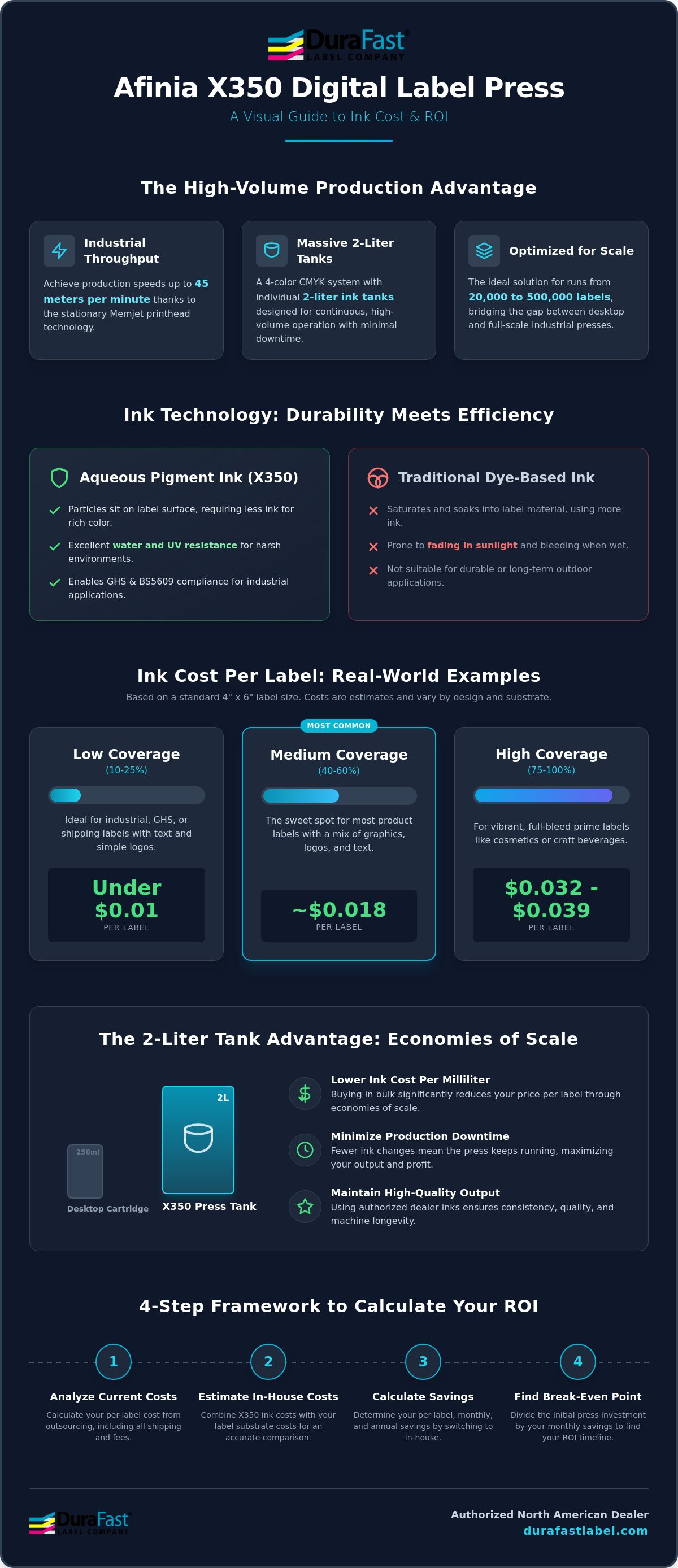
The Afinia X350 isn't just another printer. It's a high-speed press built on Memjet stationary printhead technology. Unlike older systems where the head moves back and forth, this stationary design allows the media to flow continuously at speeds up to 45 meters per minute. This evolution in digital printing technology means you get industrial-grade output without the complexity or slow speeds of traditional desktop units.
At the heart of this machine is a 4-color CMYK system powered by massive 2-liter individual tanks. These aren't your standard desktop cartridges. They're designed for high-volume environments where stopping to change ink every hour isn't an option. When you analyze the Afinia x350 Digital Label Press Ink Cost per Label, these large tanks are the primary reason the numbers look so good for your bottom line. You get the benefit of a commercial press with the ease of use found in smaller systems.
Pigment Ink vs. Dye Ink: Cost and Performance
Most entry-level printers use dye-based inks. They look great but fade fast and bleed when wet. The X350 uses aqueous pigment inks. These ink particles sit on the surface of the label material rather than soaking in. This requires less physical ink to achieve deep, rich colors. Beyond aesthetics, pigment ink is essential for durability. It provides the water and UV resistance required for GHS and BS5609 compliance. You get labels that stay legible in harsh environments, which is a non-negotiable for industrial applications.
The 2-Liter Advantage: Lowering the Price per Milliliter
Why does tank size matter so much? It's all about economies of scale. When you buy Afinia ink cartridges in the 2-liter format, your price per milliliter drops significantly compared to small 250ml alternatives. You also reduce environmental waste by using less plastic packaging over the life of the machine. There's a massive operational ROI here too. Fewer tank changes mean your press stays running longer. In a high-volume shop, every minute spent swapping cartridges is a minute of lost production. This ensures your Afinia x350 Digital Label Press Ink Cost per Label remains low while your throughput stays high.
Afinia X350 Ink Cost per Label: Real-World Examples
The Afinia X350 is built for high-speed, high-volume production. When looking at the Afinia x350 Digital Label Press Ink Cost per Label, you have to consider three main variables: the physical size of the label, the percentage of ink coverage, and the print resolution. While smaller printers are fine for boutique runs, the X350 is optimized for short to medium runs ranging from 20,000 to over 500,000 labels. For a standard 4" x 6" label, you can expect a typical cost range between $0.01 and $0.04 USD. The average cost for a 50% coverage 4x6 label is roughly $0.018.
Design Coverage Breakdown
How much ink you use depends entirely on your artwork. Not every label requires the same amount of saturation, so it's helpful to categorize your designs by coverage levels:
- High Coverage (75-100%): These are your vibrant, full-bleed prime labels. Think of high-end cosmetic or craft beer labels where every millimeter is covered in color. These typically cost between $0.032 and $0.039 per label.
- Medium Coverage (40-60%): This is the sweet spot for most product labels. They feature a mix of graphics, logos, and text. These hover around the $0.018 mark.
- Low Coverage (10-25%): Common for industrial or GHS labels that rely heavily on white space. These often cost under $0.01 per label.
Cost Comparison: Afinia X350 vs. Desktop Printers
Many businesses start with a desktop unit like the Afinia L801. It’s a great machine, but as your volume scales, the economics change. While the L801 is efficient, the X350 uses larger 2-liter tanks that drive the price per milliliter down significantly. This shift reduces the overall Afinia x350 Digital Label Press Ink Cost per Label for high-output operations.
Similarly, users moving from an Epson ColorWorks C6000A will find that the X350 is better suited for high-speed, roll-to-roll environments. The C6000A is reliable for on-demand tasks, but it cannot match the throughput or the bulk-ink savings of a dedicated press. When determining your Return on Investment (ROI), look for the break-even point. This usually occurs when your monthly volume justifies the capital expenditure through massive ink savings. If you aren't sure where your business falls on this curve, you can request a custom cost analysis from our team to see your potential savings.
Factors That Influence Your Total Printing Cost
While the Afinia x350 Digital Label Press Ink Cost per Label is inherently low due to its bulk ink system, several operational variables determine your final bill. It's not just about the hardware; it's about how you manage your media and artwork. Your choice of substrate is the first major factor. Matte materials often act like a sponge, requiring more ink to reach deep saturation. Glossy materials are less absorbent, which can actually save you money on ink volume even if the media itself carries a higher price tag.
Print resolution also plays a massive role in your budget. If you print every job at 1600 x 1600 dpi, you're using the maximum amount of pigment for every square inch. For many industrial labels, switching to a lower resolution mode provides excellent clarity while cutting ink consumption by a significant margin. You should also account for maintenance ink. Every inkjet system uses a small amount of ink for printhead cleaning and priming. In low-volume desktop printing, this can be a large percentage of your total cost. On the X350, you're printing so many labels that maintenance ink becomes a negligible fraction of your total overhead.
Finally, consider your label layout. The X350 features a 12.77-inch print width. If you're printing small 3-inch labels, running them four-across maximizes the media and ensures the printhead works efficiently across the entire web. This reduces media waste and optimizes the Afinia x350 Digital Label Press Ink Cost per Label by spreading the fixed costs of a print run over more units.
Choosing the Right Inkjet Media
To get the best results, your Afinia L801/X350 labels must be specifically inkjet-receptive. Using "ink-starved" media that isn't designed for pigment ink results in dull colors and poor durability. Conversely, over-saturated media wastes money. We've found that DuraFast Label Company matte chemical labels are specifically engineered to optimize pigment ink usage. They provide the perfect balance of absorption and surface hold, ensuring your GHS and industrial labels remain compliant without wasting expensive fluid.
Optimizing Designs for Ink Economy
Your design team can be your biggest ally in cost-saving. Using vector graphics instead of high-density raster images reduces the amount of data and ink required for sharp edges. White space is also a powerful tool. By incorporating the natural color of the label material into your design, you reduce the total cost per thousand (CPT). Utilizing professional RIP software allows you to implement ink limiting and precise color matching, ensuring you don't use a drop more than necessary to achieve your brand colors.
Calculating ROI: Afinia X350 vs. Outsourcing
Deciding to move label production in-house is a significant financial step. To make an informed choice, you need to look past the hardware price and focus on the total cost of ownership. Start by auditing your current outsourcing invoices. Don't just look at the price per label. You must include setup fees, which often range from $50 to $100 per SKU, and the cost of expedited shipping when you run low on stock. These "soft costs" quickly inflate your true outsourcing expense.
Once you have a baseline, calculate your projected in-house costs. Take your total monthly label volume and apply the Afinia x350 Digital Label Press Ink Cost per Label using the averages we discussed earlier. Add the cost of blank inkjet labels and a small margin for labor. When you compare this to your current spend, the monthly savings will reveal your payback period. Many high-volume businesses find that the equipment pays for itself in less than 18 months just through the reduction in per-unit costs.
The Hidden Costs of Outsourcing
Outsourcing creates a cycle of waste that many businesses accept as a "cost of doing business." Minimum Order Quantities (MOQs) often force you to buy 10,000 labels when you only need 2,000. If your branding or regulatory requirements change, that excess inventory becomes trash. By printing in-house, you eliminate inventory obsolescence. You print exactly what you need, exactly when you need it. This keeps your capital liquid and your warehouse clear of dead stock.
Scaling with the X350
The 45 meters per minute speed of the X350 allows you to handle seasonal demand spikes without paying "rush" fees to a print house. You can scale even further by connecting the press to a finisher like the DLF-350L for a complete, automated workflow. If you're comparing this press to other options, check out our industrial label printer roundup for 2026 to see how it stacks up. The durability of the pigment ink also ensures your labels meet BS5609 standards for chemical labeling, a feature that typically carries a heavy premium when outsourced. If you're ready to see the numbers for your specific business, you can request a custom ROI analysis from our specialists today.
Next Steps: Securing Your Afinia X350 and Supplies
Investing in a digital press is a major milestone for your business. Partnering with an authorized North American dealer like DuraFast Label Company ensures you get more than just a piece of equipment. We provide the expert support and specialized knowledge required to maximize your investment. Our team understands the technical nuances of the Afinia x350 Digital Label Press Ink Cost per Label. We don't just sell printers; we help you build a reliable production workflow that scales with your growth.
Maintaining a low cost per unit requires a steady supply of genuine consumables. We stock the full range of Afinia ink cartridges and the high-capacity 2-liter pigment tanks. Because we ship directly from North America, you can avoid the long lead times and customs headaches associated with international orders. We keep these supplies ready for immediate shipping so your press never sits idle.
DuraFast Label Company Support and Expertise
We provide a total solution that covers every aspect of your printing operation. This includes the press hardware, the pigment ink, and the specialized inkjet labels required for industrial durability. Our specialists have helped countless businesses transition from learning how to print your own product labels on desktop units to managing full-scale industrial production. We understand the challenges of high-volume printing and offer the guidance needed to ensure a smooth transition.
If you're still on the fence, we encourage you to request a free printed sample. We'll use your actual artwork to demonstrate the exceptional ink density and color quality the X350 provides. This allows you to verify the durability of the pigment ink on your specific materials before you make a final decision.
Get a Custom Quote
Every label design is different. To get an exact estimation of your Afinia x350 Digital Label Press Ink Cost per Label, you can submit your artwork for a professional analysis. Our specialists will run your files through our estimation software to provide a precise cost-per-label breakdown. This data-driven approach removes the guesswork from your ROI calculations.
We also offer various financing options to help you integrate the Afinia X350 into your warehouse without a massive upfront capital drain. Our goal is to make the move to in-house printing as simple and stress-free as possible. When you're ready to take control of your production and lower your costs, we're here to help. Shop Afinia X350 Inks and Supplies Today to get started.
Take Control of Your High-Volume Production
Transitioning to an industrial press is about more than just speed; it's about reclaiming your profit margins. We've explored how the 2-liter tank system and advanced pigment technology significantly lower the Afinia x350 Digital Label Press Ink Cost per Label compared to any desktop solution. By moving production in-house, you eliminate the hidden fees of outsourcing and the waste of high minimum order quantities. You gain the flexibility to print what you need without the burden of inventory obsolescence.
As an Authorized Afinia Dealer, DuraFast is ready to support your transition with in-stock 2L pigment ink tanks and expert North American support. We've helped many businesses move from small-scale printing to full industrial efficiency with confidence. The math is clear, but seeing the results on your own artwork is the final piece of the puzzle. We're here to simplify the process and ensure your equipment pays for itself through consistent, long-term savings.
Ready to see your exact savings? Request a Custom Ink Cost Analysis for the Afinia X350 today. We're excited to help you take the next step toward a more profitable and efficient labeling operation.
Frequently Asked Questions
How much does Afinia X350 ink cost per milliliter?
The cost per milliliter is significantly lower than desktop printers because the X350 uses large 2-liter bulk tanks. While specific market prices vary, buying in this volume typically reduces your fluid expense by roughly 50% compared to standard 250ml cartridges. This bulk pricing structure is the primary reason the Afinia x350 Digital Label Press Ink Cost per Label is so competitive for high-volume users.
Is the X350 ink water-resistant?
Yes, the aqueous pigment ink used in the X350 is highly water-resistant and durable. Unlike dye-based inks that bleed when exposed to moisture, pigment particles bond to the surface of the media. This technology ensures that your labels stay legible even when exposed to condensation, spills, or outdoor environments.
Can I use third-party inks in the Afinia X350?
You should not use third-party inks in this press. The stationary Memjet printheads are precision-engineered to work with specific ink viscosities and formulations found in genuine Afinia tanks. Using non-genuine ink often leads to head clogs and poor print quality, and it will also void your manufacturer's warranty.
What is the average ink cost for a 4x6 shipping label?
A standard 4x6 label with 50% ink coverage costs approximately $0.018 in fluid. If your design features lower coverage, such as simple black text and a small logo, the cost can drop below $0.01 per unit. This low Afinia x350 Digital Label Press Ink Cost per Label makes it an excellent choice for businesses looking to scale their shipping operations.
Does the Afinia X350 require specialized labels?
Yes, the X350 requires inkjet-receptive media to ensure the pigment ink bonds and dries correctly. Using standard thermal or offset labels will result in ink smearing and poor color density. We recommend using specialized inkjet labels to maintain high print quality and ensure the long-term health of your printheads.
How long do the 2-liter ink tanks last in a high-volume environment?
In a high-volume shop, 2-liter tanks can often print hundreds of thousands of labels before needing a replacement. For example, a single set of CMYK tanks can potentially produce over 100,000 4x6 labels at medium coverage levels. This massive capacity drastically reduces the frequency of ink changes compared to desktop printers.
Is the Afinia X350 ink food-safe?
The pigment ink used in the X350 is safe for indirect food contact applications. It's an aqueous-based formula that's more environmentally friendly and safer than solvent-based inks. This makes it ideal for food and beverage packaging where the label is applied to the outside of a container or wrapper.
What is the difference between X350 pigment ink and Memjet dye ink?
Pigment ink offers superior UV and water resistance, while traditional Memjet dye ink is often chosen for its slightly higher vibrancy on glossy media. The X350 uses pigment ink specifically to meet industrial durability standards like BS5609. This ensures your labels don't fade or wash away when exposed to chemicals or harsh weather conditions.