Afinia X350 vs L901: Scaling Label Production in 2026
24th Aug 2026
Sticking with your reliable desktop printer might be the most expensive mistake your production line makes this year. You've likely felt the frustration of watching a shift stall because of a mid-run cartridge swap or a media change that takes too long. High-volume orders should feel like a win for your business, but they often expose the bottlenecks in your current equipment. When production speeds can't keep up with demand, your total cost of ownership starts to climb.
We understand that choosing between the Afinia X350 vs Afinia L901 is about more than just speed. It's a strategic decision to lower your cost-per-label and improve your turnaround times. Whether you need the industrial flexibility of the L901 or the high-speed digital press power of the X350, finding the right fit is essential for scaling in 2026. This guide breaks down the key differences in ink capacity, durability, and throughput. You'll discover which machine eliminates your specific production pains and delivers the chemical-resistant, professional results your customers expect.
Key Takeaways
- Understand the technical shift from Memjet Sirius to AstraJet and how it drives faster turnaround times for high-volume orders.
- Explore why a 13-inch media width is the secret to doubling your output through efficient multi-up printing.
- Compare the Afinia X350 vs Afinia L901 to identify the specific production thresholds where 2-liter ink tanks significantly lower your cost-per-label.
- See how the 21-inch touchscreen interface and BarTender Professional workflow reduce shift bottlenecks and simplify media changes.
- Learn to identify the durability benefits of pigment inks that meet BS5609 standards for harsh environmental and chemical conditions.
Why Businesses are Moving Beyond the Afinia L901 in 2026
The Afinia L901 has served as the industrial desktop standard for years. It's a favorite for businesses that need professional results without the footprint of a full digital press. This machine bridges the gap between entry-level desktop units and massive industrial equipment. It offers reliability and ease of use that few other printers can match. But as we move through 2026, many growing businesses find themselves at a crossroads.
The most obvious hurdle is speed. While 12 inches per second is impressive for a desktop unit, it creates a significant bottleneck when you're trying to scale. If your growth requires printing tens of thousands of labels weekly, a desktop unit simply can't keep pace. This often leads to a hidden "outsourcing tax." You might find yourself sending large jobs to external print houses because your internal capacity is maxed out. This adds lead times, reduces your profit margins, and strips away the control you gained by bringing printing in-house.
Managing multiple desktop units to compensate for speed isn't a sustainable solution. Five separate printers mean five times the maintenance and five different workflows to monitor. Transitioning to a centralized digital press simplifies your operations. When evaluating the Afinia X350 vs Afinia L901, the decision often comes down to whether you want to manage a fleet of small machines or one high-performance powerhouse. Both systems utilize advanced Memjet print engine technology, but they apply that power at very different scales.
The Limitations of Desktop Media Handling
Labor efficiency is the hidden cost of desktop printing. The L901 uses smaller internal rolls that require frequent changes. If your operator has to stop the machine every 20 minutes to load new media, you're losing hours of productive time every week. Managing tension and alignment on these smaller rewinders also requires more manual intervention. For those learning how to print your own product labels, these small operational friction points can quickly add up to significant labor costs that eat into your ROI.
Cost-Per-Label Thresholds
Ink consumption is another critical factor for scaling. High-coverage designs on the L901 use 250ml cartridges. While these are efficient for mid-volume runs, they can't compete with the bulk ink systems of a larger press. The 2026 market demands faster on-demand turnaround times. If you're manually intervening in desktop workflows to swap cartridges or clear media paths, you aren't just losing time. You're increasing your total cost per label. The breakeven point where the Afinia X350 vs Afinia L901 comparison tips in favor of the press is often lower than most businesses realize.
Memjet Sirius vs. AstraJet: Comparing the Print Engine Technology
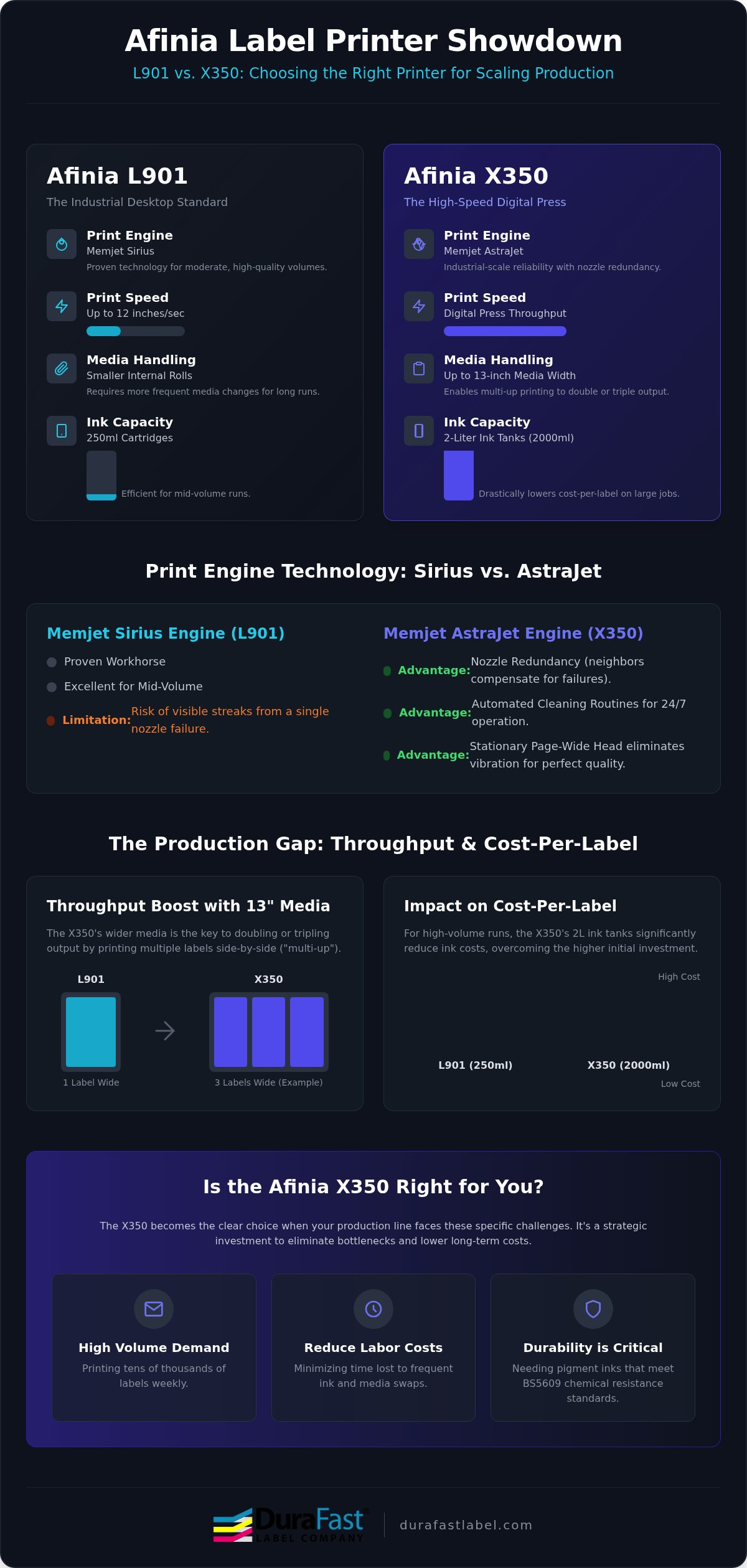
The heart of any digital press is its print engine. While both machines deliver stunning results, the underlying hardware represents two different eras of inkjet innovation. The Afinia L901 relies on the Memjet Sirius engine. It's a proven workhorse for businesses that need high-quality labels in moderate volumes. In contrast, the Afinia X350 utilizes Memjet AstraJet technology. This isn't just a minor iteration. It's a complete shift toward industrial-scale reliability.
One major advantage of the AstraJet engine is nozzle redundancy. In the Afinia X350 vs Afinia L901 debate, this feature often seals the deal for high-volume users. If a single nozzle fails during a long run on the L901, you might see a visible streak. The X350's AstraJet system uses multiple nozzles for every dot of color. If one nozzle stops firing, its neighbors take over seamlessly. This ensures your production stays perfect across thousands of linear feet without manual restarts.
Maintenance cycles also differ significantly. The X350 features automated cleaning routines designed for 24/7 environments. This allows businesses to keep up with the surging importance of personalization and short-run diversity without constant downtime. The L901 is efficient, but it requires more frequent oversight to maintain its peak performance during heavy shifts. If you're unsure which technology fits your specific media, you can always talk to an expert about your production goals.
AstraJet Page-Wide Performance
AstraJet is a stationary, page-wide printhead technology that enables 1600 dpi at industrial speeds. This fixed position eliminates the mechanical vibration often found in moving printheads. It allows the X350 to maintain perfect color consistency throughout a massive roll. You won't see the slight color shifts that can occur when desktop units heat up during extended operation. This stability is critical for brands that demand exact color matching across every batch.
Pigment Ink Durability Standards
Ink chemistry is the final piece of the puzzle. The L901 uses dye-based or Watershield inks, which are excellent for retail appeal. However, the X350 uses advanced pigment ink sets. These inks meet BS5609 standards for GHS chemical labeling, making them resistant to water, UV exposure, and harsh chemicals. Pigment ink has become the 2026 standard for food and beverage labels because it won't smudge or fade in moist environments. You can find the right supplies for both systems in our selection of Afinia Ink Cartridges to ensure your labels remain durable from the warehouse to the shelf.
The Production Gap: Speed, Media Width, and Ink Capacity
Throughput is the most visible difference when evaluating the Afinia X350 vs Afinia L901. The L901 operates at a respectable 12 inches per second. This speed is perfect for mid-volume runs where precision is key. However, the X350 leaps into a different category with speeds reaching 45 meters per minute. When you convert those numbers, the X350 is more than twice as fast as its desktop counterpart. This speed allows you to clear a backlog in hours that might have previously taken a full shift.
Ink economy also dictates your long-term success. The L901 utilizes 250ml cartridges, which are convenient for smaller footprints. The X350 shifts to 2-liter bulk ink tanks. These massive reservoirs don't just lower your cost-per-label; they significantly increase your unattended run time. You won't have to stop the press every few hours to swap out a single color. This is especially vital for businesses navigating the complex FDA regulation of printing inks in food and beverage packaging. Having a high-capacity, pigment-based system ensures you stay compliant while maintaining high-speed output.
Media capacity completes the production picture. The X350 handles larger roll diameters, allowing for thousands of additional labels per roll. This reduces labor costs associated with frequent media loading. If you're currently managing a high volume of Afinia L701/L801/L901 Labels, you know how quickly roll changes can eat into your day. Moving to a larger media path changes that dynamic entirely.
Multi-Up Printing Efficiency
The 13-inch media width of the X350 is a secret weapon for doubling production. Instead of printing one label at a time, you can layout your designs side-by-side. Printing two or three labels across a single web effectively multiplies your speed without increasing the machine's mechanical velocity. This optimized layout also reduces media waste, as you're using more of the available surface area on every linear foot. For a broader look at how this compares to other hardware, check out our Industrial Label Printer Roundup.
Continuous vs. Die-Cut Media Handling
While the L901 excels at die-cut labels for immediate application, the X350 is a true roll-to-roll press. It's designed to handle continuous rolls of synthetic stocks and flexible packaging materials. This versatility makes it ideal for industrial applications where labels must survive harsh handling. The tension control systems on the X350 are built for these heavy-duty rolls, ensuring perfectly aligned printing from the first inch to the last. This level of control is essential for professional-grade finishing in a high-demand environment.
Operational Excellence: Media Handling and Workflow Integration
Operational efficiency is where the Afinia X350 vs Afinia L901 comparison shifts from technical specs to daily reality. The L901 offers a straightforward interface that's perfect for small teams. It's built for simplicity. But the X350 takes a massive leap forward with its 21-inch touchscreen command center. This interface provides a level of visibility that desktop units can't match. It allows operators to monitor job status and ink levels from across the factory floor. Precision matters here.
For businesses running 24/7 shifts, the X350 is built for unattended printing. Its industrial frame and heavy-duty rewinder systems ensure the media stays aligned during long runs. This reliability is essential when pairing the press with digital label finishers. These systems allow you to laminate and cut labels in one continuous process. It saves time. By automating these steps, you eliminate the labor-intensive manual finishing that often slows down L901 workflows.
Software Integration with BarTender
Your workflow is only as strong as your software. Integrating BarTender Professional with the Afinia X350 allows you to connect your press directly to your ERP databases. This enables automated serialization for high-speed runs. You can generate thousands of unique labels without manual errors. It's efficient. To prevent lag, it's vital to optimize your print files for the AstraJet engine. This ensures the data flows as fast as the ink, maintaining the 45 meters per minute pace required for modern production.
Media Loading and Tension Control
Managing 13.75-inch media rolls requires specialized handling. The X350 features sophisticated tension control systems that prevent media from drifting. This is a significant step up from desktop units with smaller internal rewinders. Precise rewinding is the key to successful downstream application. If your labels aren't wound correctly, they won't feed into your automatic applicators. You can also utilize remote monitoring to check job status on your color label printer from a mobile device. It keeps you in control.
Scaling your production requires more than just a faster machine. It requires a complete workflow solution that integrates software and hardware. If you're ready to see how these systems fit into your facility, you should contact our team for a workflow consultation.
The ROI Verdict: When Does the Afinia X350 Pay for Itself?
Deciding between the Afinia X350 vs Afinia L901 isn't just about speed. It's a calculation of your business's future profitability. While the L901 is an excellent entry point for industrial quality, the X350 is designed for those who have outgrown desktop limitations. The primary driver of ROI in this comparison is the shift from standard cartridges to a bulk ink system. This change impacts your bottom line every time the printhead fires.
The 2-liter ink tanks on the X350 represent a massive leap in economy. By moving away from 250ml cartridges, you can slash your cost-per-label by up to 50%. This saving becomes undeniable once your monthly volume exceeds 20,000 labels. Beyond ink, labor savings play a critical role in your return on investment. The X350 reaches speeds of 45 meters per minute. This means your staff spends less time monitoring the machine and more time on high-value tasks. Fewer roll changes also mean less physical intervention. It reduces the risk of human error during long production shifts.
Calculating the breakeven point requires looking at your total volume. For businesses printing between 10,000 and 100,000 labels per month, the L901 remains a strong contender. But if your projections show steady growth toward 500,000 labels, the X350 pays for itself through ink savings and labor efficiency much faster than you might expect. It's about choosing the tool that matches your ambition.
Cost-Per-Label Comparison
The cost efficiency of 2-liter pigment tanks far exceeds that of standard 250ml desktop cartridges, especially on high-coverage designs. You also need to factor in printhead longevity and maintenance costs. The AstraJet technology is built for industrial endurance. This lowers your long-term maintenance costs compared to desktop units pushed beyond their intended limits. If you aren't yet at the volume required for a full press, we offer a wide range of Color Label Printers to suit mid-volume needs.
Future-Proofing Your Brand
Scalability is the final piece of the puzzle. Can your current equipment handle your 2030 production projections? The X350 is built for the long haul. It provides the durability and throughput needed to grow with your brand as you expand into new markets. At DuraFast Label Company, we provide expert guidance for North American industrial producers looking to make this transition. We don't just sell hardware. We partner with you to ensure your equipment delivers real results. For a detailed look at your specific numbers, you can Contact DuraFast Label Company for a Custom ROI Analysis.
Ready to Scale Your Production to Industrial Levels?
Deciding on the Afinia X350 vs Afinia L901 is a pivotal step toward future-proofing your business. While the L901 remains a reliable choice for mid-volume production, the X350 digital press offers the speed and ink economy needed for true industrial scale. You've seen how the 2-liter ink tanks and AstraJet technology can lower your total cost of ownership while meeting strict durability standards. The 13-inch media width acts as a multiplier, allowing you to double your output through multi-up printing layouts.
Scaling doesn't have to be complicated. As an Authorized Afinia Label Partner, we provide specialized media and ink support to ensure your transition is seamless. Our expert North American logistics team is ready to help you implement a workflow that eliminates bottlenecks and maximizes profit. We value your time and peace of mind during this transition.
Don't let equipment limits slow your growth. If you're ready to see how these systems perform with your specific designs, contact our experts for a personal Afinia X350 consultation. We look forward to helping you build a more efficient and profitable labeling operation.
Frequently Asked Questions
How fast can the Afinia X350 print compared to the Afinia L901?
The Afinia X350 prints at a maximum speed of 45 meters per minute, which is significantly faster than the Afinia L901. The L901 operates at 12 inches per second, which is roughly equivalent to 18 meters per minute. This speed gap allows the X350 to handle high-volume industrial runs in a fraction of the time. When comparing the Afinia X350 vs Afinia L901, the throughput advantage of the digital press becomes a deciding factor for scaling operations.
Does the Afinia X350 use pigment or dye-based ink?
The Afinia X350 uses advanced pigment-based inks, providing superior durability compared to the dye-based inks often found in desktop units. These pigment inks are water and UV resistant, making them ideal for labels that face harsh environmental conditions. They also meet BS5609 standards for chemical labeling. While some L901 models offer water-resistant technology, the X350 pigment set is the 2026 standard for long-term industrial resistance and chemical stability.
What is the maximum label width for the Afinia X350?
The Afinia X350 supports a maximum print width of 12.77 inches on media rolls up to 13.75 inches wide. This is a substantial increase over the 8.5-inch maximum width of the Afinia L901. The extra width is a strategic advantage for growing businesses. It enables multi-up printing, where you can layout multiple labels side-by-side. This process effectively doubles or triples your production capacity without needing to increase the actual mechanical speed of the press.
Can the Afinia L901 handle roll-to-roll production?
Yes, the Afinia L901 is fully capable of roll-to-roll production when paired with an optional unwinder and rewinder system. This setup allows for continuous printing on large media rolls, which is essential for finishing labels on a separate digital cutter. While it handles roll-to-roll work well for mid-volume batches, it lacks the heavy-duty tension control and large-diameter roll capacity found in the industrial-scale Afinia X350 digital press.
Is the Afinia X350 compatible with BarTender software?
The Afinia X350 is fully compatible with BarTender Professional software, which we recommend for managing complex industrial workflows. Using BarTender allows you to automate serialization and integrate your label designs with existing ERP or inventory databases. This integration is crucial for high-speed runs where variable data is required. It ensures that your data processing keeps pace with the AstraJet engine, preventing any lag or production downtime during critical production shifts.
What is the ink capacity of the Afinia X350?
The Afinia X350 features massive 2-liter ink tanks for each color, providing a total capacity of 8 liters. In contrast, the Afinia L901 uses 250ml cartridges. The larger tanks on the X350 significantly reduce the frequency of ink changes during long production runs. This bulk system also lowers the total cost of ownership by slashing the cost-per-label. It allows for extended periods of unattended printing, which is vital for maintaining 24/7 production readiness.
How does Memjet AstraJet technology improve print quality?
Memjet AstraJet technology improves print quality through enhanced nozzle redundancy and a stationary, page-wide printhead design. Unlike moving printheads that can cause mechanical vibration, the AstraJet engine remains fixed while delivering 1600 dpi resolution. If a single nozzle fails, neighboring nozzles automatically compensate to prevent visible streaking. This ensures consistent color and sharp text across thousands of linear feet. It provides a level of reliability that is essential for professional-grade packaging.
Which industries benefit most from upgrading to the Afinia X350?
Industries requiring high-volume, durable labels benefit most from the Afinia X350. This includes chemical manufacturers who need GHS-compliant, BS5609-certified labels and food producers who require moisture-resistant pigment inks. The ability to handle 13-inch wide media also makes it a perfect fit for flexible packaging and large-format industrial labeling. When evaluating the Afinia X350 vs Afinia L901, businesses in these sectors find the X350's industrial throughput and durability essential for 2026 growth.