Best Epson C6500 GHS Labels: 2026 Professional Guide
9th Aug 2026
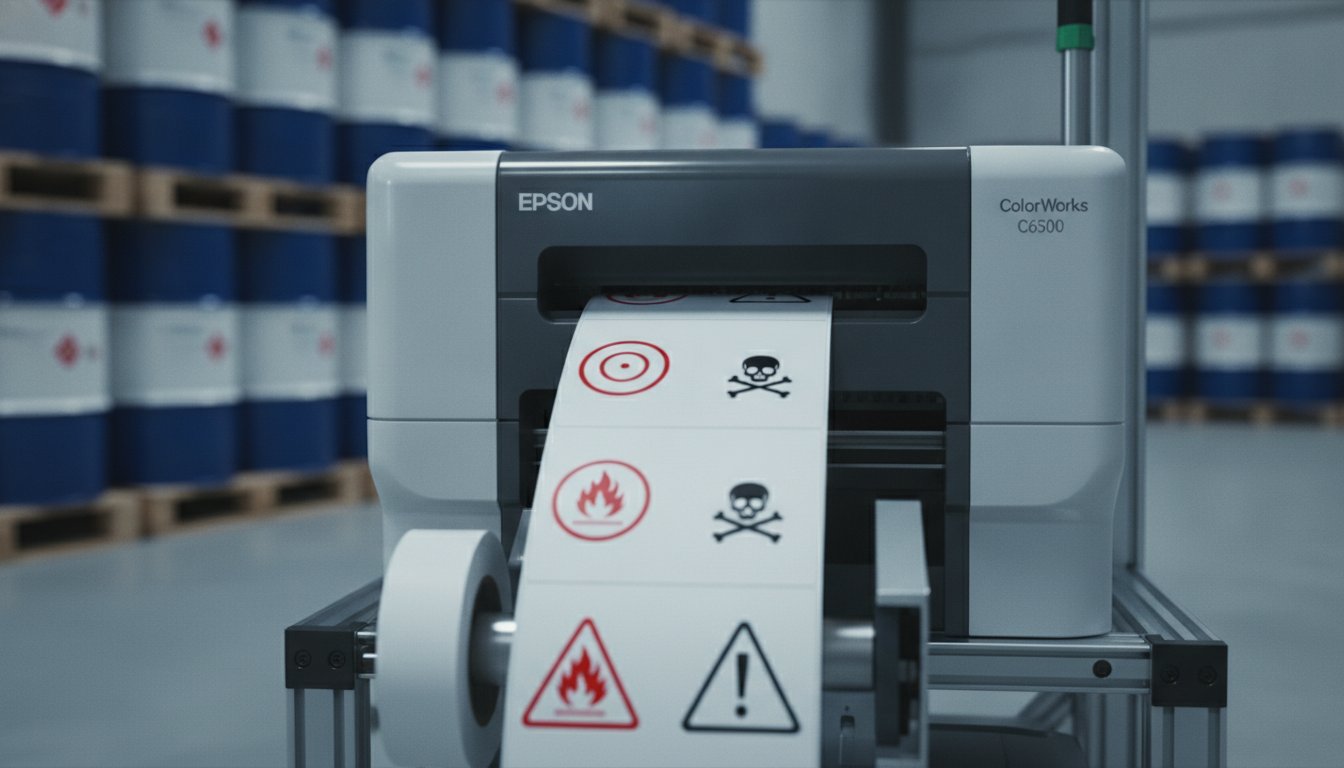
Did you know that an OSHA violation for improper hazard communication can now cost your business up to $15,625 per instance? With the May 19, 2026, deadline for chemical substance labeling already passed and the November workplace deadline fast approaching, the pressure to stay compliant is higher than ever. You need a solution that stops ink from smudging when exposed to solvents and prevents labels from peeling off in rough seas. Finding the best labels for Epson C6500 GHS compliance is the only way to ensure your drums remain legible after three months in salt water.
We understand how confusing it is to juggle GHS Revision 7 requirements alongside the updated BS 5609:2024 standards. It's frustrating when technical jargon gets in the way of simple business operations. This guide will simplify your decision-making process by showing you exactly how to pair your printer with certified media. You'll learn about the latest regulatory shifts, the importance of Section 3 durability, and the specific DuraFast Matte Chemical Labels designed to keep your facility safe and your shipments moving. We have done the heavy lifting of vetting these products so you can focus on your core business.
Key Takeaways
- Understand the critical differences between GHS Revision 7 requirements and BS 5609 marine standards to avoid costly OSHA fines.
- Discover why matte synthetic materials are the best labels for Epson C6500 GHS compliance because of their superior ink absorption and barcode scanability.
- Learn how to achieve BS 5609 Section 3 certification by pairing Epson pigment inks with chemical-resistant DuraFast media.
- Master your printer settings and pictogram management with BarTender Professional to ensure every label is durable and fully compliant.
- Simplify your workflow by switching to in-house GHS label production that withstands three months of saltwater exposure and harsh chemical contact.
What Makes a Label GHS Compliant for the Epson C6500?
GHS isn't just a suggestion; it's a global safety mandate. The Globally Harmonized System (GHS) ensures that hazard communication is consistent across international borders. For 2026, the regulatory stakes have shifted significantly. OSHA is currently aligning its Hazard Communication Standard with GHS Revision 7, introducing updated classifications for aerosols and flammable gases. To stay compliant, your Epson C6500 must produce labels where the "Red Diamond" pictograms remain sharp and unmistakable. Standard inkjet labels fail this test because they lack the specialized coatings needed to survive chemical contact. Finding the best labels for Epson C6500 GHS compliance is the only way to prevent your critical safety data from washing away.
The Chemistry of Chemical Resistance
The Epson C6500 uses advanced pigment-based inks. Unlike dye inks that simply stain the surface, pigment particles are solid colorants that must be physically anchored to the label material. This requires a specialized chemical top-coat. This coating acts as a microscopic matrix that traps the pigment, shielding it from aggressive industrial solvents like alcohols, oils, and brake fluids. Without this bond, the ink will smudge or run the moment it touches a chemical spill.
- Solvent Resistance: High-quality Epson C6500 labels prevent ink from smearing when exposed to harsh industrial substances.
- Thermal Stability: These materials won't yellow or become brittle in high-heat environments like shipping containers.
- Pictogram Permanence: The red ink used for hazard borders remains vibrant and legible even under heavy UV exposure.
Regulatory Stakes in 2026
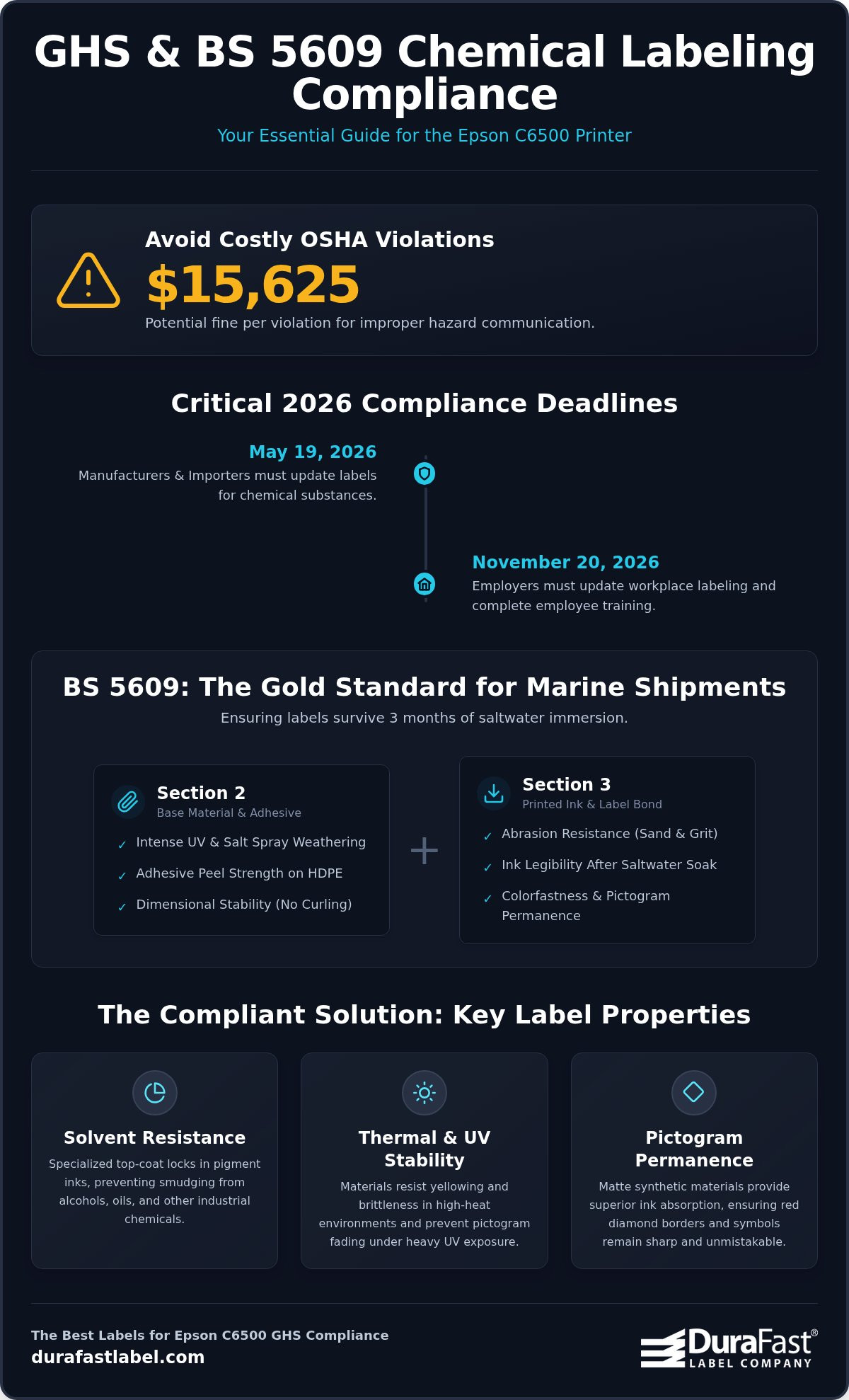
Compliance timelines are non-negotiable. Manufacturers and importers were required to update labels for chemical substances by May 19, 2026. Employers have until November 20, 2026, to update workplace labeling and employee training. Falling behind these deadlines carries a heavy price tag. OSHA penalties for non-compliance can reach $15,625 per violation. It's a risk that most businesses can't afford to take.
Beyond the risk of fines, shipment rejections are a major concern. If a label fails to meet GHS or BS 5609 standards during sea transit, your entire cargo can be turned away at the port. The Epson C6500 has become the industry standard because it provides the color precision and durability needed to meet these international standards on demand. It eliminates the need for pre-printed labels, allowing you to adapt to new hazard classifications instantly and accurately.
Understanding BS 5609: Section 2 vs. Section 3
Shipping chemicals by sea? You need more than just the right pictograms. While GHS dictates what information appears on your label, the BS 5609 testing standard ensures that information stays there. This British Standard is the benchmark for marine immersion. If your chemical drums are headed for international waters, your labels must survive three months of saltwater exposure. Understanding the distinction between Section 2 and Section 3 is vital for choosing the best labels for Epson C6500 GHS compliance.
Section 2: The Adhesive and Base Material
Section 2 focuses entirely on the blank label material and its adhesive. It doesn't matter how good your printer is if the label floats away in the middle of the Atlantic. To pass this section, the base material must undergo rigorous weathering tests, including intense UV exposure and artificial salt spray. The adhesive is tested for its "peel" strength on various surfaces. The recent BS 5609:2024 update now emphasizes mandatory testing on High-Density Polyethylene (HDPE) surfaces in addition to traditional aluminum. This ensures that whether you use plastic drums or metal containers, the label remains permanently bonded. Dimensional stability is also key; the material cannot shrink or curl when the temperature fluctuates during transit.
Section 3: The Critical Ink-Label Bond
Section 3 is where your hardware comes into play. This part of the standard tests the final printed label. It evaluates how well the Epson C6500 pigment ink bonds with the specialized top-coat of the media. A label might pass Section 2 as a blank, but fail Section 3 if the ink rubs off or fades. During testing, the printed surface is subjected to sand and grit abrasion while submerged in salt water. This simulates the harsh friction labels experience on a ship's deck.
The Epson C6500 is specifically engineered to "lock" its pigment particles into compatible chemical media. This creates a finished product that remains legible even after extreme physical abuse. Using certified Epson C6500 labels is the only way to guarantee this bond. For full maritime compliance under the International Maritime Dangerous Goods (IMDG) Code, your printing system must pass both sections. If you are unsure which certification applies to your specific application, you can speak with our compliance specialists for direct confirmation. We have already done the heavy lifting of vetting these materials to ensure they meet the latest 2024 standards.
Best Label Materials for Epson C6500 GHS Printing
Choosing the right substrate is the final piece of the compliance puzzle. Finding the best labels for Epson C6500 GHS compliance requires looking beyond simple paper options. For chemical labeling, you must use synthetic materials that can withstand environmental stress without tearing or degrading. Matte finishes are the industry standard for GHS because they eliminate glare. This ensures that hazard pictograms and barcodes remain scanable under the harsh lighting of a warehouse or the bright sun on a shipping dock. Reflective glossy labels often fail barcode verification tests, which can lead to logistical delays and compliance issues.
Synthetic Polypropylene (BOPP) Labels
BOPP is the most popular choice for general chemical labeling. It offers excellent flexibility, making it ideal for curved surfaces like small bottles or rounded jugs. These labels provide strong resistance to moisture, oils, and many common industrial cleaners. Because BOPP is more cost-effective than polyester, it's often the preferred material for high-volume production where extreme heat isn't a primary concern. When paired with the C6500’s pigment ink, our matte BOPP media provides a durable, smudge-proof finish that meets most workplace safety requirements.
High-Performance Polyester (PET) Labels
When your chemicals face extreme conditions, polyester (PET) is the superior choice. PET labels offer maximum tear resistance and dimensional stability. They won't shrink or stretch even when exposed to fluctuating temperatures or intense UV rays during outdoor storage. If your products are stored in environments reaching high temperatures, PET remains stable where other synthetics might fail. While slightly less flexible than BOPP, its ruggedness is unmatched for heavy-duty industrial drums and long-term marine transit. It's the reliable choice for shipments that must endure the roughest handling.
Adhesive selection is equally critical for long-term reliability. Most GHS applications utilize permanent acrylic adhesives. These are engineered to "wet out" on the surface of plastic or metal drums, creating a bond that grows stronger over time. For rougher or oxidized surfaces, high-tack rubber adhesives may be necessary. Since the Epson C6500 is an 8-inch wide printer, you can take full advantage of large-format media. We offer Epson C6500 labels in specialty sizes up to 8 inches wide. This allows you to print full-size drum labels in a single pass without the need for multiple smaller stickers, saving time and reducing the risk of application errors.
Optimizing Your C6500 for GHS Label Production
Hardware and media are two halves of a whole. Even the best labels for Epson C6500 GHS compliance won't perform if the printer isn't dialed in. Optimization ensures that your hazard pictograms are vivid, your text is crisp, and your ink is fully cured. This process protects your operations and keeps your facility safe. You must align your software and hardware to create a seamless, compliant workflow.
Software Integration: BarTender and GHS
Manual data entry is a significant risk factor. One typo can lead to a mislabeled chemical drum. This creates a massive safety hazard. We recommend using BarTender Label Software for Compliance to automate your printing process. This software pulls hazard data directly from your chemical database. It ensures that the correct pictograms and signal words are applied every time. It's the most efficient way to manage GHS Revision 7 requirements without slowing down your production line.
Hardware Configuration for Durability
Your driver settings dictate how the ink interacts with the label’s top-coat. When using chemical-resistant media, the "Matte" setting in the Epson C6500 driver is non-negotiable. This setting optimizes ink laydown for pigment absorption. It prevents pooling or smudging. You should also adjust the drying time between labels when printing high-saturation red diamonds. This allows the ink to set properly before the labels are wound onto a finished roll. Consistent color accuracy is also vital. Perform regular printhead cleanings to ensure your red pictograms stay bright and compliant.
For high-volume operations, handling large rolls is a logistical challenge. The C6500’s internal capacity works for many, but an external unwinder allows you to use larger rolls. These rolls are more cost-effective. They also reduce downtime by requiring fewer roll changes. Finally, always verify your output. Use a 2D barcode scanner to ensure every printed code is readable. If you need help fine-tuning your setup, contact our experts today for a personalized configuration review. We'll help you match your driver settings to your specific media for flawless results.
Why DuraFast Matte Chemical Labels are the Best Choice
Generic labels are a gamble your business can't afford. While many products claim to be compatible, DuraFast Matte Chemical Labels are specifically engineered for the unique chemistry of Epson pigment inks. This precision engineering ensures that the ink doesn't just sit on the surface; it anchors deep into the specialized top-coat. This bond is what makes our media the best labels for Epson C6500 GHS compliance. You get a finished product that resists smudging, bleeding, and fading even when drenched in industrial solvents or exposed to harsh weather.
Our labels aren't just theoretically durable. They have proven BS 5609 Section 3 performance when paired with the Epson C6500. This means the entire printing system, including the ink and the substrate, has survived rigorous sand and saltwater abrasion tests. We understand that chemical containers come in all shapes and sizes. That's why we offer custom sizes and shapes beyond standard drum labels. Whether you need small labels for laboratory vials or large-format wraps for 55-gallon drums, we provide the exact fit for your application. You can Shop Epson C6500 Certified Labels today to find the perfect match for your inventory.
The DuraFast Advantage for Industrial Users
We do more than just sell rolls of paper. As an authorized Epson dealer, we provide expert support to help you navigate the complexities of GHS and BS 5609:2024 certification. We know that compliance deadlines like the November 2026 workplace update are critical. To help you stay on track, we maintain deep stock levels for immediate shipping. You won't have to worry about backorders stalling your production line. DuraFast Matte Chemical Labels represent the industry benchmark for 2026 GHS printing, offering unmatched durability and pigment ink stability. Our team is here to ensure your transition to in-house printing is smooth and stress-free.
Get a Compliant Solution Today
Don't wait for an OSHA inspection to find out your labels aren't up to par. We make it easy to verify our quality before you commit to a large order. You can request sample rolls to test in your specific environment and with your particular chemicals. This hands-on testing gives you the peace of mind that your labels will survive the journey from the factory floor to the end user. If you're overwhelmed by the latest regulatory changes, our specialists are available for a one-on-one consultation. We'll help you audit your current labeling process and identify the most cost-effective path to full compliance. Contact us for a GHS compliance audit and let us simplify your labeling workflow today.
Secure Your Compliance Strategy for 2026
Achieving regulatory peace of mind requires the perfect synergy between your printer, ink, and media. You now understand that GHS compliance isn't just about the design on the screen; it's about how that design survives the harshest maritime conditions. By choosing certified materials that pass both Section 2 and Section 3 of the BS 5609 standard, you protect your business from costly OSHA fines and shipment rejections. DuraFast Matte Chemical Labels are specifically engineered to provide the best labels for Epson C6500 GHS compliance, ensuring your hazard communication remains legible for the long haul.
As an authorized Epson ColorWorks partner, we provide more than just supplies. We offer specialized North American support to help you navigate the 2026 regulatory shifts with confidence. Our BS 5609 certified media is the benchmark for durability in the chemical industry. Don't leave your compliance to chance when expert help is just a click away. Contact our GHS experts to find your perfect label match and streamline your labeling workflow today. It's time to transform a technical requirement into a seamless part of your business success.
Frequently Asked Questions
Is the Epson C6500 GHS compliant out of the box?
The Epson C6500 is not GHS compliant on its own because compliance is a system-wide requirement. While the printer provides the necessary pigment ink technology, you must pair it with certified media to meet OSHA standards. Compliance is only achieved when the printer, ink, and substrate work together to pass durability tests. This ensures your labels remain legible and attached during harsh chemical exposure or transit.
Do I need a special ink for GHS compliance on the C6500?
You don't need specialized GHS ink because the standard Epson pigment ink is already designed for high durability. These pigment particles anchor into the label's top-coat to resist smudging and chemical breakdown. However, this durability is only realized when you use the best labels for Epson C6500 GHS compliance. Pairing the right ink with the right media is the only way to guarantee a compliant, long-lasting result for your chemical drums.
What is the difference between GHS and BS 5609?
GHS is a global system that defines how hazards are classified and communicated through specific pictograms and signal words. BS 5609 is a technical testing standard that measures the physical durability of a label in marine environments. Think of GHS as the content of the label and BS 5609 as the survival standard for the material itself. Both are essential for international chemical shipping and workplace safety standards.
Can I use glossy labels for GHS compliance?
Glossy labels are rarely used for GHS compliance because they often fail barcode scanability tests due to surface glare. Matte finishes are the industry benchmark because they provide a non-reflective surface that ensures pictograms and 2D barcodes are easily read by scanners. For industrial environments, the matte top-coat also helps the pigment ink dry faster and bond more securely, which is critical for maintaining chemical resistance over time.
How long do GHS labels last in outdoor storage?
When you use high-performance synthetic media, GHS labels can withstand outdoor storage for 12 to 24 months or longer. BS 5609 certification specifically guarantees that the label will remain legible and attached after three months of continuous immersion in salt water. This high level of durability ensures that your hazard communication stays intact even if containers are stored on docks or exposed to extreme weather during international transit.
Does the Epson C6500 require a laminator for GHS labels?
A laminator is unnecessary when you use specialized media designed for pigment ink absorption. The Epson C6500 creates a permanent bond between the pigment and the label's chemical-resistant top-coat. This locked-in finish provides the abrasion and solvent resistance required by GHS standards without the extra cost or labor of lamination. Using certified DuraFast Matte Chemical Labels allows you to achieve a professional, compliant finish in a single print pass.
What happens if my GHS labels are not BS 5609 certified?
Shipping chemicals by sea without BS 5609 certified labels can lead to rejected shipments at international ports. Under the International Maritime Dangerous Goods (IMDG) Code, labels must survive three months in salt water. If your labels fail, your cargo stays at the dock, leading to massive logistical costs. Additionally, uncertified labels that smudge or peel off in the workplace can result in OSHA fines of up to $15,625 per violation.
Where can I find GHS label templates for the Epson C6500?
You can find compliant GHS templates within professional software like BarTender. These templates are pre-configured with the correct pictogram sizes and signal word placements required by GHS Revision 7. By connecting this software to your chemical database, you can automate the printing process. This reduces the risk of manual entry errors and ensures every label printed on your C6500 meets the latest workplace and international safety standards.