Best Industrial Color Label Printers for High-Volume Needs
13th Jun 2026
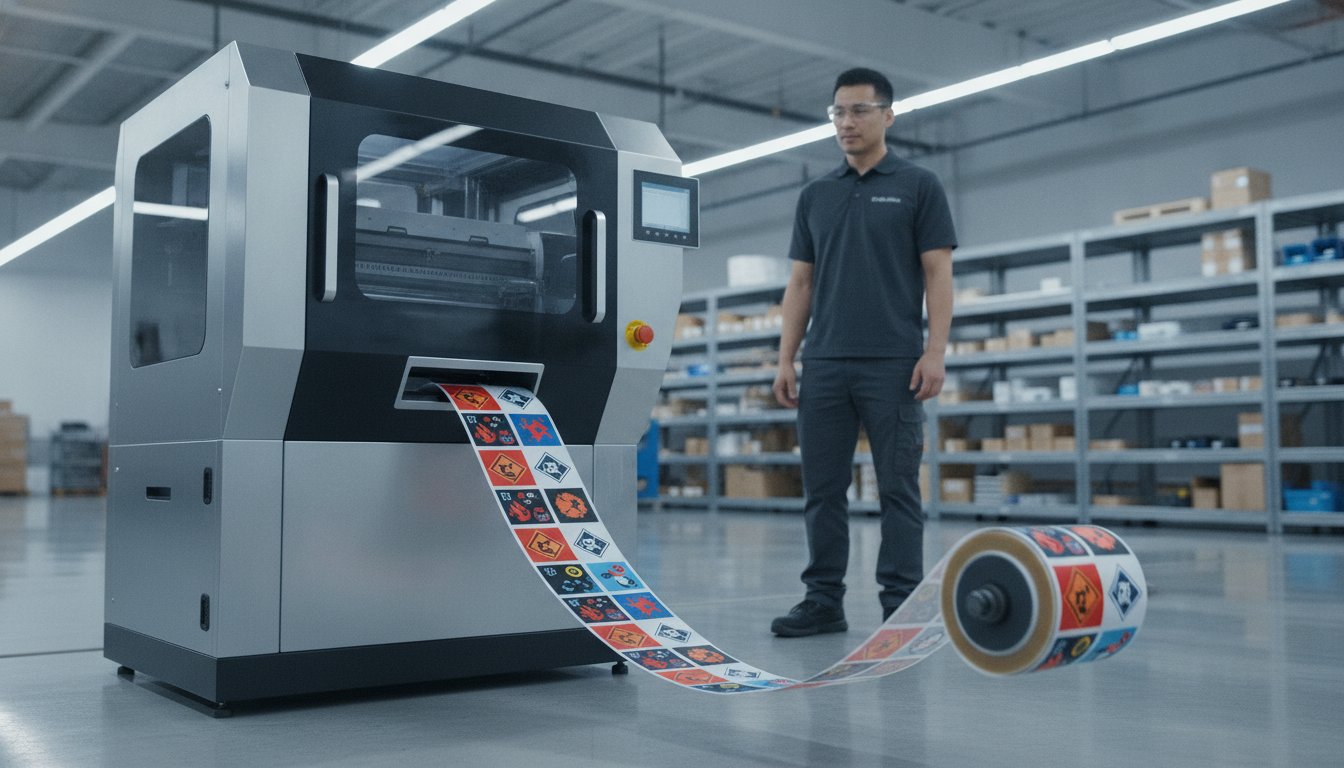
What if your biggest production bottleneck isn't the assembly line, but the two-week wait for a shipment of pre-printed labels? Relying on outside vendors often means dealing with high minimum orders and watching expensive inventory become obsolete the moment a regulation shifts. It's a common struggle for high-volume manufacturers who need to stay agile. Investing in a dedicated industrial color label printer can solve these headaches by putting the power of on-demand production directly on your warehouse floor.
You already know that professional, durable labels are non-negotiable for compliance and branding. We're here to help you eliminate lead times and significantly reduce your total labeling costs. This article explores the best high-performance printers on the market, from GHS-compliant powerhouses like the Epson ColorWorks series to the lightning-fast Afinia L801. You'll discover how to gain full control over your timeline while producing high-quality labels that meet every industry standard, ensuring your facility stays efficient and responsive to every new demand.
Key Takeaways
- Learn how switching to on-demand printing eliminates vendor lead times and reduces the waste of obsolete pre-printed labels.
- Understand the critical differences between pigment and dye-based inks to ensure your industrial color label printer produces durable, compliant results.
- Discover when to use full-color inkjet for safety and branding versus sticking with traditional thermal transfer for simple shipping tasks.
- Find out how to evaluate your facility’s humidity, temperature, and daily print volume to choose a machine that won't quit under pressure.
- Get a detailed look at top-rated models like the Epson ColorWorks C6000A and Afinia L801 to find the perfect fit for your specific speed and width requirements.
Why Modern Manufacturers are Switching to Industrial Color Label Printers
The traditional "order and store" model of label procurement is fading. For years, manufacturers had to order massive quantities from external converters to secure a reasonable price per label. This left warehouses full of pre-printed rolls that often became useless before they were ever applied. Today, an industrial color label printer changes the game. These are high-capacity, pigment-based inkjet or toner systems designed to handle the rigorous demands of a busy production floor. They bridge the gap between small desktop units and massive commercial presses, providing the durability and speed required for high-volume environments.
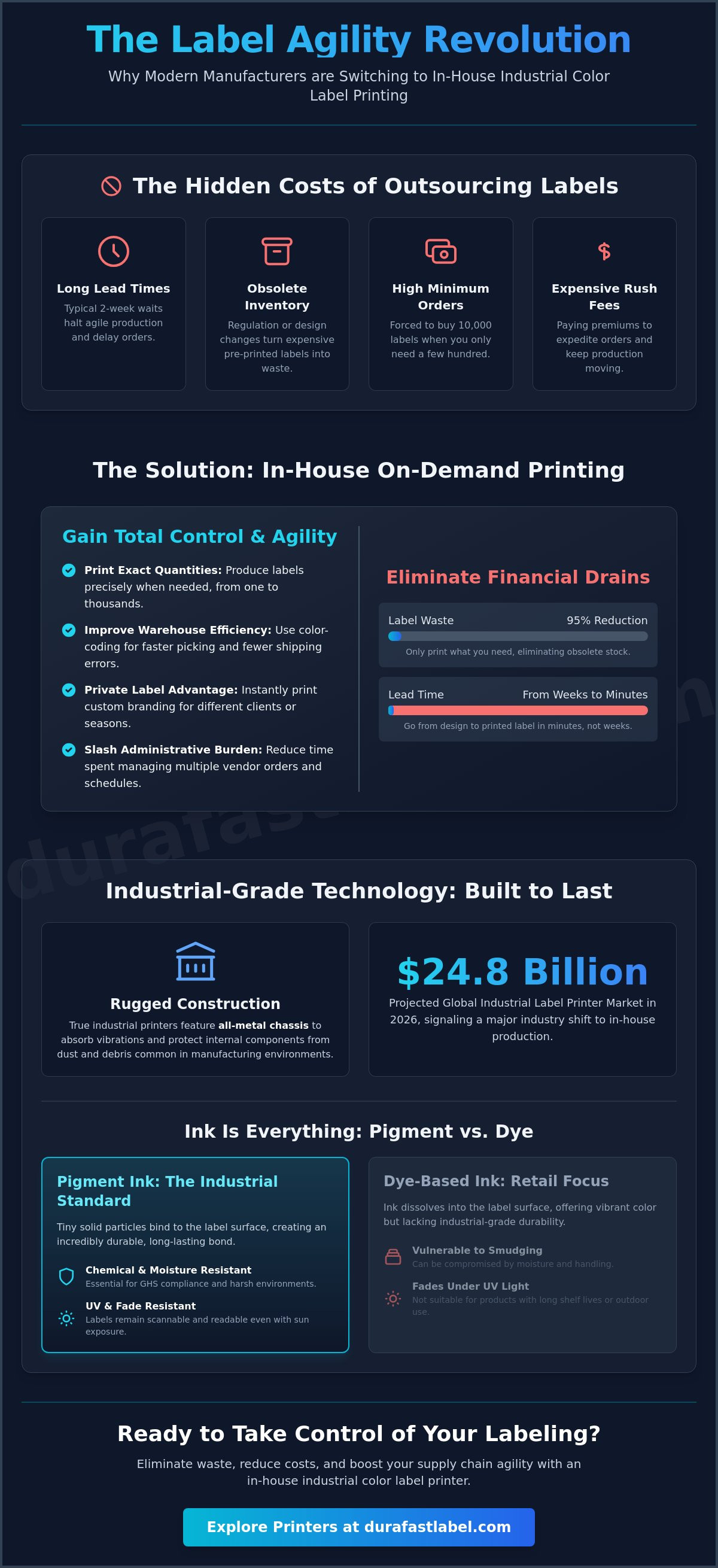
Success in 2026 manufacturing requires "Label Agility." This concept refers to a facility's ability to pivot production without being held hostage by a third-party printer's schedule. With the global industrial label printer market projected to reach USD 24.8 billion in 2026, it's clear that more businesses are choosing to own their timeline. Understanding different label printer technologies is the first step toward making this transition. By bringing printing in-house, you eliminate the Minimum Order Quantities (MOQs) that often plague small to mid-sized production runs. You don't have to buy 10,000 labels when you only need 450.
The Hidden Costs of Outsourcing Your Labels
Outsourcing often looks cheaper on a spreadsheet, but the hidden drains on your budget are significant. Obsolete inventory is the primary culprit. When product specifications change or a new government regulation takes effect, every pre-printed label in your storage room becomes trash. You're also likely familiar with the "Rush Fee" trap. If a surprise order comes in and your external supplier has a two-week lead time, you'll pay a premium just to keep your lines moving. Transitioning to an in-house industrial color label printer also slashes the administrative burden. Your procurement team can stop tracking dozens of vendor orders and focus on more productive tasks.
Boosting Supply Chain Agility with On-Demand Color
On-demand printing is the ability to produce exact label quantities at the precise moment they are required for production.
This capability does more than just save money; it improves warehouse efficiency. Using color-coding on labels helps staff identify products instantly, which significantly improves picking accuracy and reduces expensive shipping errors. If you work with private label customers, this technology is a competitive advantage. You can pivot to a customer’s specific branding or seasonal design immediately. There's no more waiting weeks for new stock to arrive before you can start a custom run. You simply hit print and stay ahead of the curve.
Key Technologies Powering Industrial-Grade Color Labeling
Selecting an industrial color label printer requires looking beyond the spec sheet. You need to understand the physical and chemical engineering that keeps these machines running in harsh environments. Unlike consumer-grade plastic units, true industrial printers feature all-metal chassis. This rigid construction absorbs the vibrations of high-speed printing, ensuring every barcode is crisp and scannable. It also protects sensitive internal components from the dust and debris common in large-scale manufacturing facilities.
The choice of ink is equally critical. While dye-based inks offer stunning vibrancy for retail displays, they often fail in industrial settings. They can smudge when touched or fade under UV light. To ensure proper ink adhesion and long-term durability, you must pair your machine with high-quality inkjet labels. These specialized materials feature coatings designed to lock in the ink and resist environmental stressors like oils and solvents.
The Science of Pigment Ink and Durability
Pigment ink is the gold standard for any application requiring resistance to moisture, chemicals, or sunlight. Unlike dye, which dissolves in a liquid carrier, pigment ink consists of tiny solid particles suspended in the ink. These particles bind to the surface of specialized media, creating a bond that is incredibly hard to break. This technology is why systems using Epson ink cartridges are so popular for compliance labeling. They provide the stability needed to meet OSHA's GHS labeling requirements, where labels must remain legible even after exposure to harsh chemicals or saltwater immersion.
High-Speed Workflows: Memjet vs. PrecisionCore
Speed is often the deciding factor for high-volume needs. Memjet technology, found in the Afinia L801, uses a "Waterfall" printhead that stays stationary while the media moves beneath it. This allows for incredible speeds without the mechanical wear of a moving head. In contrast, Epson’s PrecisionCore heads use a scanning method that provides unmatched reliability and color accuracy for consistent daily production. When comparing models, always check the "Duty Cycle." This number tells you how many labels the printer is designed to produce per month. For 24/7 operations, you need a machine built for a high duty cycle to avoid premature wear and costly downtime. If you're unsure which technology fits your volume, it's best to consult with a technical specialist to review your specific environment.
Industrial Color vs. Traditional Thermal Transfer: Choosing the Right Technology
Deciding between a thermal transfer system and an industrial color label printer depends entirely on your specific application. Monochrome thermal transfer remains the industry standard for high-speed, low-cost shipping labels where visual impact isn't a priority. If your primary goal is generating basic barcodes and destination addresses for logistics, industrial barcode printers are reliable, cost-effective workhorses. However, as supply chains grow more complex, the limitations of black-and-white printing become a bottleneck for many facilities.
The maintenance workflows also differ significantly between these two technologies. Ribbon-based systems require you to match the specific ribbon type to your label material, which adds a layer of complexity to your inventory management. Inkjet systems eliminate the physical struggle of threading ribbons. The real advantage of color is "Visual Communication." Color allows for instant recognition of safety warnings, product categories, and brand identity. This level of clarity helps your team work faster and reduces the risk of human error during fulfillment.
When to Choose Color Over Monochrome
Beyond safety, an industrial color label printer serves as a powerful marketing tool. High-resolution product images on secondary packaging help your brand stand out on a crowded retail shelf. For those who require complex structural designs alongside their labels, Print It ZA print and packaging offers high-quality litho and digital solutions that complement in-house production. It also enhances the e-commerce unboxing experience. A full-color, professional label makes your shipment feel like a premium product rather than just another generic box.
Total Cost of Ownership (TCO) Comparison
Evaluating the bottom line requires looking at more than just the initial equipment cost. While thermal transfer ribbons are inexpensive, the "One-Pass" efficiency of an inkjet system often wins on labor savings. With color inkjet, you print the entire design on plain white media in a single step. In contrast, using a thermal printer for color usually requires buying expensive pre-printed labels and then overprinting variable data. This dual-step process increases the risk of alignment errors and doubles your administrative tasks. High-capacity industrial units also feature larger ink tanks and media rolls. This means your staff spends less time on roll changes and more time focusing on production, leading to a much healthier TCO over the life of the machine.
How to Evaluate Your Production Environment and Label Requirements
Choosing the right hardware starts with a hard look at your facility's floor. Don't buy a printer based on a spec sheet alone. Environmental factors like high humidity or extreme temperatures can significantly impact ink drying times and adhesive performance. If your labels will be exposed to oils, solvents, or heavy abrasion, your industrial color label printer must use pigment-based inks to ensure the text remains legible. You should also consider your "Daily Print Volume." While an entry-level unit might handle a few hundred labels, high-speed presses are necessary for 24/7 operations where downtime isn't an option.
Label size is another critical variable. Your needs might range from tiny component labels for electronics to large decals for chemical drums. Ensure the printer you select can handle the maximum width you require without sacrificing speed. Finally, verify if your industry demands specific certifications. For example, chemical exports often require UL-recognized materials or BS5609-certified durability to survive harsh transit conditions.
Chemical and GHS Compliance Standards
GHS labeling is a global standard for hazard communication. If you ship chemicals by sea, you must meet the BS5609 standard. This certification involves a rigorous three-month saltwater immersion test to ensure labels stay attached and readable in maritime environments. The Epson ColorWorks C6000A is a top choice for these applications. When you pair this industrial color label printer with specific matte chemical labels, it achieves full compliance, allowing you to print GHS-compliant pictograms and safety data on demand.
Integrating Software with Your Hardware
A printer is only as good as the software driving it. BarTender Professional has become the industry standard for designing complex, data-driven labels. It allows you to create templates that pull information directly from your existing ERP or WMS databases, reducing the risk of manual entry errors. In modern manufacturing, "Print and Apply" automation is also becoming vital. This involves linking your color label printer to an automated applicator on the production line. This integration ensures that the right label is applied to the right product at the right time, maximizing throughput. If you need help mapping out your specific software and hardware integration, our technical team can guide you through the setup.
Top Industrial Color Label Printer Recommendations for 2026
Selecting the right hardware transforms your labeling from a logistical hurdle into a streamlined asset. Choosing the perfect industrial color label printer involves balancing your daily volume with the specific durability needs of your environment. Whether you need the rugged reliability of a traditional workhorse or the blistering speed of a digital press, the current market offers specialized solutions for every facility. We've vetted the top contenders to help you identify which machine fits your production line.
For businesses with diverse needs, the Epson ColorWorks C6000A is a standout for its versatility and 4-inch width capacity. If your application requires something more specialized, such as white ink on clear or dark media, the Afinia LT5C provides a unique laser-based solution. For those prioritizing a compact footprint without sacrificing quality, the VIPColor VP550 delivers high-resolution Memjet performance that fits easily into smaller workspaces.
The Epson ColorWorks C6000A: The Industrial Workhorse
The Epson ColorWorks C6000A is designed for manufacturers who need a seamless transition from monochrome to color. If you're already using Zebra thermal printers, this model is an easy upgrade because it integrates directly into existing ZPL II workflows. It features a built-in auto-cutter, which allows you to create custom-length labels from continuous rolls. This is a massive advantage for facilities handling multiple product sizes throughout the day. We highly recommend this model for GHS compliance and durable product labeling, as it produces smudge-proof results that withstand harsh handling.
The Afinia L801: Unmatched Speed for High-Volume Runs
When speed is your top priority, the Afinia L801 is the clear leader. It utilizes Memjet "Waterfall" technology to print at speeds up to 60 feet per minute. This industrial color label printer is built for high-volume runs where minimizing user intervention is key. It features large 250ml ink tanks, so your team spends less time swapping cartridges and more time shipping orders. It's the ideal choice for industries like food and beverage or high-growth e-commerce companies that need to produce thousands of professional labels every hour. By combining low ink costs with extreme throughput, the L801 helps you maintain a competitive edge in fast-moving markets.
Finding the right fit for your facility doesn't have to be complicated. If you're ready to take full control of your labeling timeline, you can explore our full range of color label printers to find the speed and durability your business deserves.
Take Control of Your Labeling Production
Bringing your printing in-house is about more than just saving money; it's about gaining the agility to respond to market changes instantly. You've seen how the right technology can eliminate the frustration of long lead times and expensive, obsolete inventory. By matching your specific environmental requirements with a high-performance industrial color label printer, you ensure that every label meets professional and regulatory standards without the wait.
We're here to simplify the transition for you. As an authorized dealer for industry leaders like Epson, Afinia, and Zebra, we specialize in providing BS5609 and GHS compliance solutions that keep your facility running efficiently. We offer a full ecosystem of printers, inks, and labels designed for long-term reliability in the most demanding environments. If you're ready to reduce your costs and regain total control over your production timeline, contact our team today to find the perfect solution for your high-volume needs. We look forward to helping you streamline your production floor and boost your bottom line.
Frequently Asked Questions
Can an industrial color label printer handle chemical-resistant labels?
Yes, an industrial color label printer can handle chemical-resistant labels when you use pigment-based inks and specialized media. These systems are specifically designed to create durable bonds that resist smudging and fading even when exposed to harsh solvents or moisture. This capability is essential for industries that must meet strict safety standards for chemical storage and transport. You'll get labels that stay legible in the toughest conditions.
How much does it cost to print labels in-house vs. outsourcing?
Printing in-house typically reduces costs by eliminating vendor markups and the waste of obsolete inventory. While outsourcing might seem cheaper for massive runs, it often involves high minimum order quantities and long lead times that disrupt your agility. By printing on demand, you only pay for the ink and media you actually use. This significantly lowers your total cost of labeling over time and keeps your budget predictable.
What is the difference between pigment and dye-based inkjet printers?
Pigment inks use solid particles that sit on the surface of the media, offering superior resistance to UV light, water, and chemicals. In contrast, dye-based inks are liquid-based and provide more vibrant colors for retail packaging but can smudge or fade easily. Most industrial applications require pigment ink to ensure labels remain legible throughout the product's entire lifecycle. It's the best choice for any environment where durability is a priority.
Do I need special software to run an industrial color label printer?
You don't necessarily need specialized software for basic printing, but professional design tools like BarTender are highly recommended for industrial workflows. These programs allow you to manage complex data, generate compliant barcodes, and automate your printing processes. Using the right software ensures that your hardware operates at its full potential while minimizing manual entry errors. It makes the entire labeling process much more efficient and reliable for your team.
Is it difficult to maintain an industrial inkjet printer?
Maintaining a modern industrial color label printer is straightforward thanks to automated cleaning cycles and user-replaceable components. Most routine maintenance involves simply replacing ink cartridges or maintenance boxes when prompted by the system's interface. These machines are engineered for high-duty cycles, so they require very little manual intervention compared to older generations of industrial equipment. You can focus on your production instead of worrying about constant technical adjustments.
Can these printers integrate with my existing warehouse management system?
Yes, most industrial color label printers integrate seamlessly with existing Warehouse Management Systems (WMS) or ERP platforms. By using standard Windows drivers or specialized middleware like Loftware, you can trigger print jobs directly from your database. This connection ensures that every label contains accurate, real-time information pulled straight from your supply chain records. It eliminates the need for manual data entry and helps prevent shipping errors during the fulfillment process.
Which industrial label printer is best for GHS compliance?
The Epson ColorWorks series is widely considered the best for GHS compliance because it's engineered to work with BS5609-certified materials. These printers produce labels that survive saltwater immersion and chemical exposure without losing legibility. They allow you to print the required red and black pictograms in a single pass with extreme durability. This setup ensures your facility meets international safety standards without needing a complex, multi-step printing process.
What is the maximum print speed for an industrial color label printer in 2026?
In 2026, the fastest industrial color label printers can reach speeds of up to 60 feet per minute. This translates to roughly 12 inches per second, which is fast enough to keep up with high-speed production lines. While speed varies by model and print resolution, these modern systems offer throughput that rivals traditional monochrome thermal printers. You don't have to sacrifice productivity to get the benefits of full-color labeling in your warehouse.