California Law Label Requirements: How to Stay Compliant
20th Oct 2026

Could a label look complete but still fall short because its wording, color, product category, or attachment method doesn’t match the applicable rule? California law label requirements can be difficult to interpret, especially for products with concealed filling materials, where product-specific provisions may affect what the label must show.
Before creating label artwork, identify which rules apply to the product. Then check the required wording and production details against current California requirements. A format used for one product or material may not work for another.
This guide explains which product categories may require law labels, what information and formatting details to review, and how attachment and registration considerations can affect preparation. It also outlines a review process to follow before printing and explains how blank law labels and in-house label-printing equipment can fit into production. Use it as a starting point, then verify the rules that apply to your product before approving the label.
Key Takeaways
- Start by identifying the product and its filling materials. California law label requirements depend on the applicable product rules, not one universal template.
- Review the required wording, material description, registry details, and color rules against current California requirements before preparing artwork.
- Check that the label is securely attached to the applicable article and remains visible, unobstructed, and durable.
- Use a step-by-step review before printing: identify the product, consult current rules, validate label fields, and approve the artwork.
- In-house law-label printers and blank law labels can support production, but equipment and supplies don’t determine whether a label meets legal requirements.
California law label requirements: which products and businesses are covered?
A law label discloses information about the filling materials in certain articles. It is different from a brand label, product description, or marketing claim. The products covered and the label rules depend on California’s current statutes and regulations, so don’t assume one template applies to every filled product.
For a product-specific review, start with the applicable California Code of Regulations provisions, including Section 1126 where relevant, and current guidance from the responsible state agency. Compare the rule’s defined scope with the product itself. This is a starting point, not a legal determination.
Which filled products may need a California law label?
Bedding products that may warrant review include pillows, mattresses, comforters, and sleeping bags—staples commonly supplied by home textile specialists like King of Cotton. Upholstered furniture and other articles containing concealed filling materials may also need consideration. These examples aren’t exhaustive, and a product name alone doesn’t establish whether a specific item is covered. Check the current rule’s definitions and any product-specific provisions before selecting a label format.
Review what the product contains and how it is made, not just what it’s called. A filling disclosure has a different purpose from branding or promotional copy. For example, a pillow’s brand label may identify its maker, while a law label may disclose information about its filling. Businesses reviewing pillow products can use the pillow law label category as a reference point, while verifying the applicable requirements separately.
Keep other labeling rules distinct. A warning label, including one associated with a separate consumer-warning requirement such as Proposition 65, isn’t automatically a law label for filling materials. The rules, purposes, and required content may differ.
Who should check the California requirements?
Manufacturers, importers, and sellers should assess whether the products they make, bring into the market, or offer for sale need review. The same duty doesn’t necessarily apply to every party in every case. Confirm who must act under the current rule for the specific product before assigning responsibility.
Build the review around the item and its sales context. Record the product type, filling materials, how the item is supplied, and where it will be sold. These details may affect which provisions apply, but their legal effect should be verified against current primary sources. Don’t assume that a label used for another state, or a general U.S. template, satisfies California’s requirements.
A scope check can help catch artwork mistakes early:
- Describe the finished product and its filling materials.
- Find the current California provision that addresses that product category.
- Check whether other states or sales channels require separate review.
- Document the rule and product details used to make the label decision.
Once you’ve established the scope, identify the exact wording and format required by the applicable rule.
What must a California law label say? Check wording, color, and registration
Build the label from the current rule that applies to the product, not an old sample or a template used for another item. California law label requirements can involve a prescribed heading, a description of filling materials, a registry number, certification language, and category-specific format details. Check each field against the current California Code of Regulations and applicable agency guidance.
Section 1126 is a useful starting point, but don’t fill gaps by guesswork. Confirm that the provision applies to your product and review the complete, current text before approving artwork. This is particularly important if the text you’re reviewing is truncated or leaves a size, wording, or certification detail unclear.
Required statements and filling-material descriptions
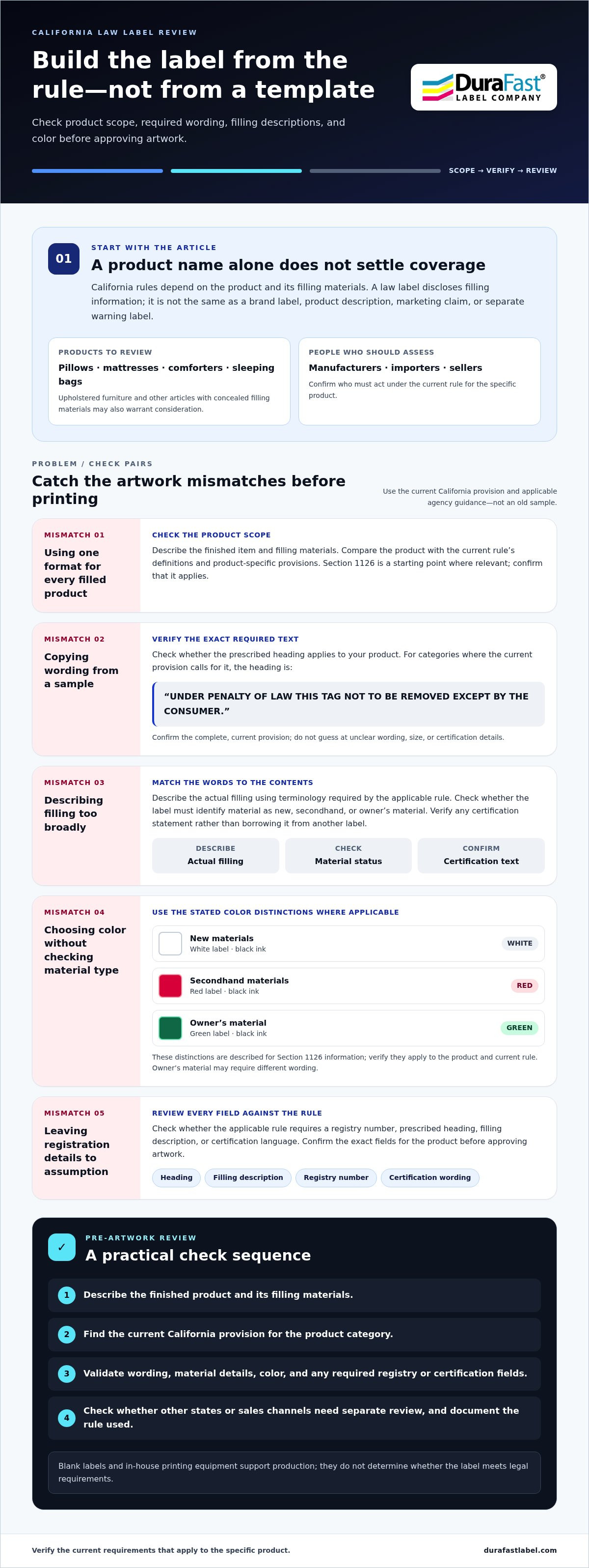
Check the applicable rule for the exact prescribed heading and reproduce it as required. For categories where the current provision calls for it, the heading is “UNDER PENALTY OF LAW THIS TAG NOT TO BE REMOVED EXCEPT BY THE CONSUMER.” Verify that this wording applies to your product before printing; don’t assume it fits every product or case.
A law label’s core purpose is to identify the article’s filling accurately, using the terminology required by the applicable rule.
Compare the description with the product’s actual contents and the categories in the rule. The label may also need to state whether material is new, secondhand, or an owner’s material. Don’t replace a required material description with broad marketing language or infer certification wording from another label. Confirm the exact certification statement for the product before adding it.
Label color, certification, and registry details
The Section 1126 information described here specifies color distinctions: white with black ink for new materials, red with black ink for secondhand materials, and green with black ink for owner’s material. Verify that these distinctions apply to the product and current rule. Owner’s material may also require different wording, so check the relevant provision rather than adapting text for new materials.
Use this field checklist to review a draft, not as a substitute for the rule:
- Heading: Include the prescribed statement if it applies, using the required wording.
- Filling: Describe the materials accurately and use the rule’s terminology.
- Registry: Confirm whether a registry number is required and that it corresponds to the applicable registration.
- Certification: Verify the exact certification element for the product and material category.
- Format: Check color, finished size, type size, and any other category-specific fields in the current text.
The Section 1126 information described here gives a minimum size of 2 by 3 inches and capital lettering at least one-eighth inch high. Confirm these specifications in the complete current provision before using them in a final sample. Once the artwork has been reviewed, law-label printing supplies can support an in-house workflow. For product-related information, visit the contact page.
Where and how must California law labels be attached?
Accurate text isn’t the only consideration. For products covered by California Code of Regulations Section 1126, placement and label material also matter. The rule calls for the label to be securely fastened to the applicable article, openly and easily visible, and not concealed or obstructed. It also describes a material standard that includes Bureau approval and resistance to tearing or defacement. Confirm the current provision and its application to your product before setting production specifications.
Use the checklist below to distinguish the rule from practical examples. The examples can help identify potential issues, but they don’t prescribe a universal location or attachment method.
Visibility and secure attachment
Review the label from a consumer’s perspective: can someone readily see and read it without moving another component or uncovering a blocked area? A label hidden beneath packaging or covered by a product feature could raise a visibility concern. These are examples for review, not legal conclusions. The applicable rule or product-specific direction determines acceptable placement.
| Requirement described in the rule | Practical review example, not a placement prescription |
|---|---|
| Securely fastened to the applicable article | Check that ordinary handling doesn’t leave the label loose or detached. |
| Openly and easily visible | View the finished product as a consumer would, and check that the label can be found and read. |
| Not concealed or obstructed | Look for packaging, product components, or other labels that block the required information. |
| Material approved by the Bureau and not easily torn or defaced | Assess the label material and printed information for durability in the product’s intended handling. |
Don’t assume a stitch, adhesive, hang-tag format, or location is acceptable for every article. Verify product-specific instructions in current regulations and agency guidance. The label should be securely attached to the item, visible, and unobstructed, using a method supported by the rule for that product.
Choosing label material for the intended use
The material standard is a regulatory requirement, not a stock description. A material that seems durable isn’t automatically Bureau-approved or compliant. Check approval and applicable rules, then consider whether the label remains legible and resists tearing or defacement during the product’s expected handling. Review the finished label on the article, not just a loose sample.
Once requirements are established, blank law labels are a relevant supply category to consider. Match stock and printing decisions to the reviewed artwork and intended attachment process. The california law label requirements checklist is complete only when content, visibility, attachment, and material have each been checked against the applicable current rule.
How to verify California law-label compliance before printing
Turn the rules into a documented review before sending artwork to a printer. Use the California Code of Regulations and current guidance from the responsible California agency as the basis for your check. Record the sources and the date you reviewed them, so your team can revisit the decision if a rule or product changes.
Check product-specific and current regulatory sources
Start with the article and its actual filling materials. Identify the provisions that apply to that product rather than relying on a general law-label sample. A pillow law-label guide provides a product-category example, but it doesn’t replace checking current rules for your specific item.
Use this sequence to keep the review focused:
- Identify the product and filling. Record what the finished article is, what materials it contains, and how it is supplied. Note details that could affect its classification.
- Find the current California rules. Search the California Code of Regulations for provisions covering the product. Review current agency guidance alongside the regulatory text, and note the source and review date.
- Resolve product-specific questions. Verify whether registration or a registry number applies, and whether an exemption or special provision changes the label. Treat imported products and sales across state lines as separate questions for source-specific review, not as assumptions.
- Validate each label field. Compare the required heading, filling description, certification, registry details, color, and format with the applicable rule. Confirm each element before adding it to the artwork.
- Review artwork, then print. Proofread the final file, check its readability and layout, and compare it with the verified requirements. Print only after the review is complete.
Proofread the label artwork before production
Compare the artwork with your source notes, field by field. Check every statement and material description. If the rule requires a percentage, certification, or registry detail, verify the value and wording against the applicable source. Don’t copy these details from another product’s label, even if the products appear similar.
Next, inspect the label at its intended size. Confirm that required text remains legible and that the layout leaves room for every required field. Review the color and placement specifications that apply to the product, then confirm that the printed version matches the approved file. Keep the final artwork and review record together for future checks.
California law label requirements can differ by product and applicable provision. If a source is unclear, incomplete, or inconsistent, resolve the question before production instead of filling gaps from a template. For information about label-printing products and supplies, visit the DuraFast Label Company contact page.
Print California law labels in-house with the right supplies
After reviewing the label requirements and artwork, in-house printing can support a consistent production workflow. The printer and supplies help produce the approved design, but they don’t determine whether its content or format meets the rules. Keep compliance review separate from equipment selection, and use current regulatory sources to approve the label before printing.
A repeatable process helps catch artwork changes before they reach a production run. Keep the approved file with the source references and review notes used to prepare it. If a product, filling description, required field, or applicable rule changes, pause and review the artwork rather than automatically reusing an older file.
Prepare a repeatable law-label printing workflow
Build a checkpoint between artwork approval and full production. Print a sample using the intended setup, then compare it with the approved file. Check that required wording and other fields are present, legible, and positioned as reviewed. Assess whether the sample suits the intended attachment process. A printer output check helps with production control, but it doesn’t replace checking the legal requirements.
Keep records organized so the next print run starts from the correct version. A practical file set can include:
- The approved artwork and its revision date.
- The product details and source references used during review.
- Notes on the final sample check and any approved changes.
Before printing a larger quantity, confirm that the selected file matches the reviewed version. This pause helps prevent an outdated draft from becoming the production standard.
Choose supplies around the approved label design
Start with the verified label format and the needs of your workflow. Consider the required layout and color, how the label will be printed, and how it will be attached to the applicable article. Then select label stock and printing equipment suited to that plan. No printer, label stock, or software guarantees regulatory compliance; the label still needs to meet the requirements verified for the product.
DuraFast Label Company offers blank law labels and law-label printers for in-house production. Choose these production options after reviewing the artwork and format. Keep a sample from the selected setup with the approved file so future runs can be compared with the intended output.
For product-related information about label-printing supplies, visit the DuraFast Label Company contact page. A clear workflow connects the california law label requirements you’ve verified with the artwork, equipment, and supplies used to produce the finished label.
Make your next label run easier to manage
Compliance review works best as an ongoing part of product and artwork control. Revisit your label when the product, materials, sales plans, or applicable rules change. Keep the approved file and source notes easy to find so your team can update the label deliberately instead of relying on an old template.
Use the california law label requirements you’ve verified as the starting point for a clear production process. Then match the approved artwork to supplies that fit your workflow. DuraFast Label Company offers blank law labels and law-label printers to support in-house production, while the product-specific rules still determine what the finished label must show.
Contact DuraFast Label Company about law-label printing supplies to plan your next production setup. Start with reviewed artwork and a consistent workflow.
Frequently Asked Questions
Does California law require a label on every pillow?
No. Don’t assume every pillow is covered just because it’s a pillow. Coverage depends on the product’s construction, filling, and the scope of the applicable California rule. A decorative pillow and a pillow made with different filling materials may need separate review. Identify the finished item and its contents, then compare them with current California provisions before deciding whether a law label is required.
Can one law label satisfy requirements in every U.S. state?
Not necessarily. States can have different rules for covered products, label wording, registration, and format. A label prepared for California may not meet another state’s requirements, and a multi-state template may need product- or state-specific fields. Before using one design across markets, compare the current rules in each destination state and document any differences. “U.S. law label” isn’t a single, universal standard.
Does a California law label replace a product care label?
No. A law label and a care label serve different purposes. The law label addresses filling-material disclosures for covered articles, while a care label gives instructions for cleaning or maintaining a product. For example, a pillow may need filling information and separate washing guidance. Review each label type under the rules that apply to it, and make sure required care instructions aren’t removed when updating law-label artwork.
Can a consumer remove a law label after buying the product?
For a label bearing the prescribed statement that it may not be removed except by the consumer, the consumer may remove it after purchase. That wording doesn’t mean a seller or manufacturer can remove the label before the item reaches the consumer. Check the current rule and exact wording for the product, and don’t treat a consumer’s ability to remove a tag as permission to omit it during sale.
Do imported bedding products need California law labels?
They may, if the product falls within California’s applicable requirements and is offered for sale in the state. Imported status alone doesn’t establish whether a particular article is covered or which party must act. Review the item’s materials, sales context, and current California provisions. Check import-specific or registration questions against current agency sources rather than assuming a label used in the country of origin will satisfy California rules.
Can a law label be attached with adhesive instead of stitching?
There isn’t a universal answer without checking the product-specific rule. The relevant question is whether the label is attached securely to the article and remains visible as required, not whether one fastening method is always acceptable. A loose sticker or removable hang tag may not meet that standard. Verify the current requirements for the product before choosing adhesive, stitching, or another attachment method.
Who assigns or approves a California law-label registry number?
The California Bureau of Household Goods and Services is the agency associated with registry numbers for covered articles. Don’t create a number or copy one from another product. Confirm the current registration process and the correct number for the responsible business and product category using agency sources. Requirements can depend on the business’s role and the item, so verify those details before placing a registry number in artwork.
Are secondhand products subject to the same California label requirements as new products?
Not always. Secondhand material can require different label wording and color treatment than new material, so don’t reuse a new-material label without checking the applicable provision. The label should accurately reflect the product and its filling. Confirm whether the article is covered, how the rule defines the material category, and what current requirements apply before preparing or updating its label.