Chemical Resistant Inkjet Labels: Debunking the Myths of Inkjet Durability in 2026
12th Jul 2026
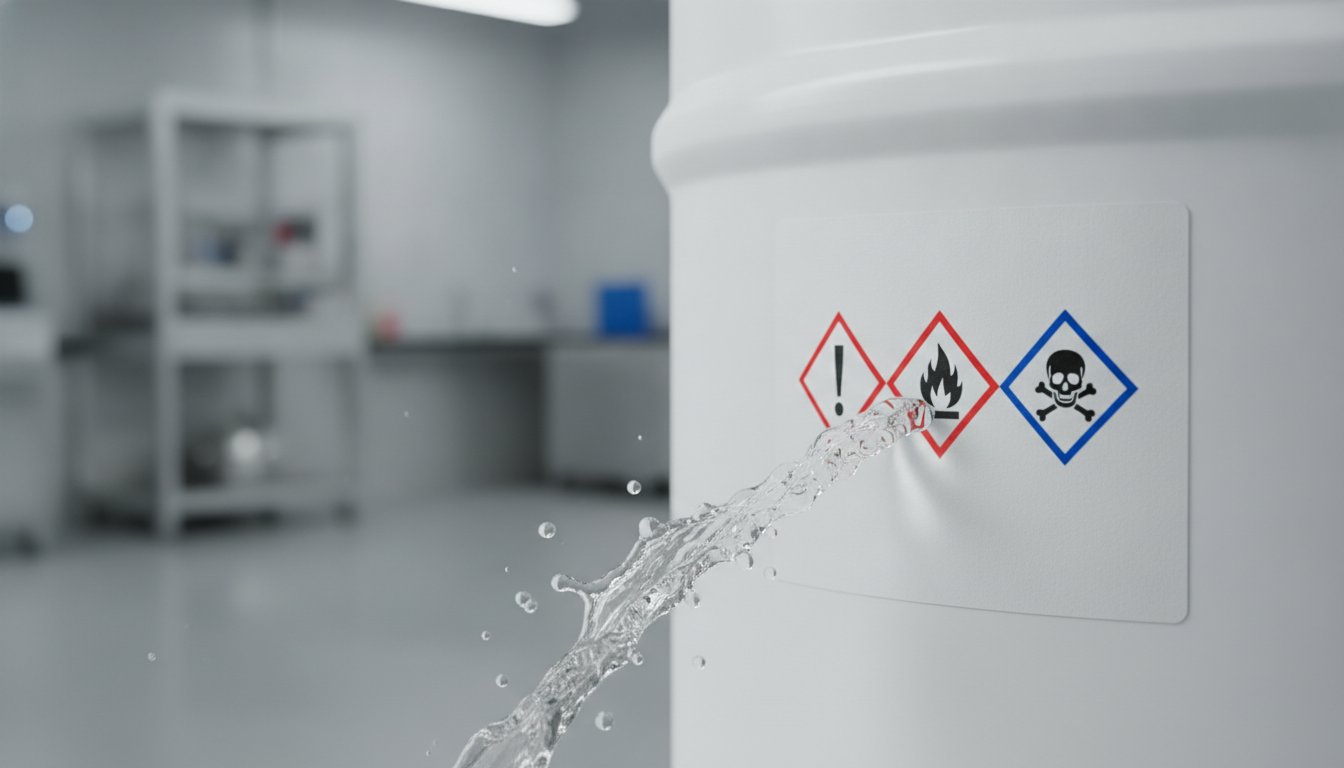
What if the printer sitting on your desk could actually outperform a heavy-duty thermal transfer system in a chemical splash test? For years, the industry assumed that inkjet technology was too fragile for industrial use. We know how frustrating it is to see labels peel or fade the moment they encounter a harsh solvent. It's a common struggle, especially as the May 19, 2026, OSHA deadline for re-classifying chemical substances draws near. If you're tired of the high costs and waste associated with pre-printed stock, it's time to reconsider chemical resistant inkjet labels.
You'll soon discover why modern pigment-based inkjet solutions are now the gold standard for GHS compliance and extreme durability. We'll show you how the latest BS 5609:2024 standards have changed the game for high-density polyethylene (HDPE) surfaces. This article previews the transition from messy thermal ribbons to flexible, in-house color printing. You'll learn how to meet strict safety regulations while finally reducing your label inventory waste for good.
Key Takeaways
- Learn why pigment inks and specialized top-coats create chemical resistant inkjet labels that outperform traditional dye-based systems.
- Understand the latest BS 5609:2024 standards and how to ensure your labeling system meets rigorous marine immersion requirements.
- Discover how switching from thermal transfer to inkjet reduces ribbon waste while providing the full-color flexibility needed for GHS pictograms.
- Identify the best hardware and media combinations, such as the Epson ColorWorks C6000A and DuraFast Matte Chemical Labels, for industrial-grade results.
Myth vs. Reality: Are Inkjet Labels Really Chemical Resistant?
Many industrial professionals still cringe when they hear the word "inkjet." They remember smudged holiday photos or home printers that leaked at the first sign of moisture. In 2026, that association is a dangerous myth. Modern chemical resistant inkjet labels are engineered specifically to thrive where traditional systems fail. This durability isn't accidental. It's the result of a precise chemical marriage between pigment particles and advanced synthetic surfaces. Inkjet isn't a toy anymore. It's a precision tool for safety.
Why is 2026 the turning point for in-house production? Regulatory pressure is mounting. With the May 19, 2026, OSHA deadline for substance re-classification, companies need a flexible way to update their Globally Harmonized System (GHS) labels without waiting weeks for a third-party print house. High-performance inkjet labels allow for immediate changes that maintain industrial integrity. You can print what you need, when you need it, without sacrificing the toughness your environment demands.
The Core Difference: Dye Ink vs. Pigment Ink
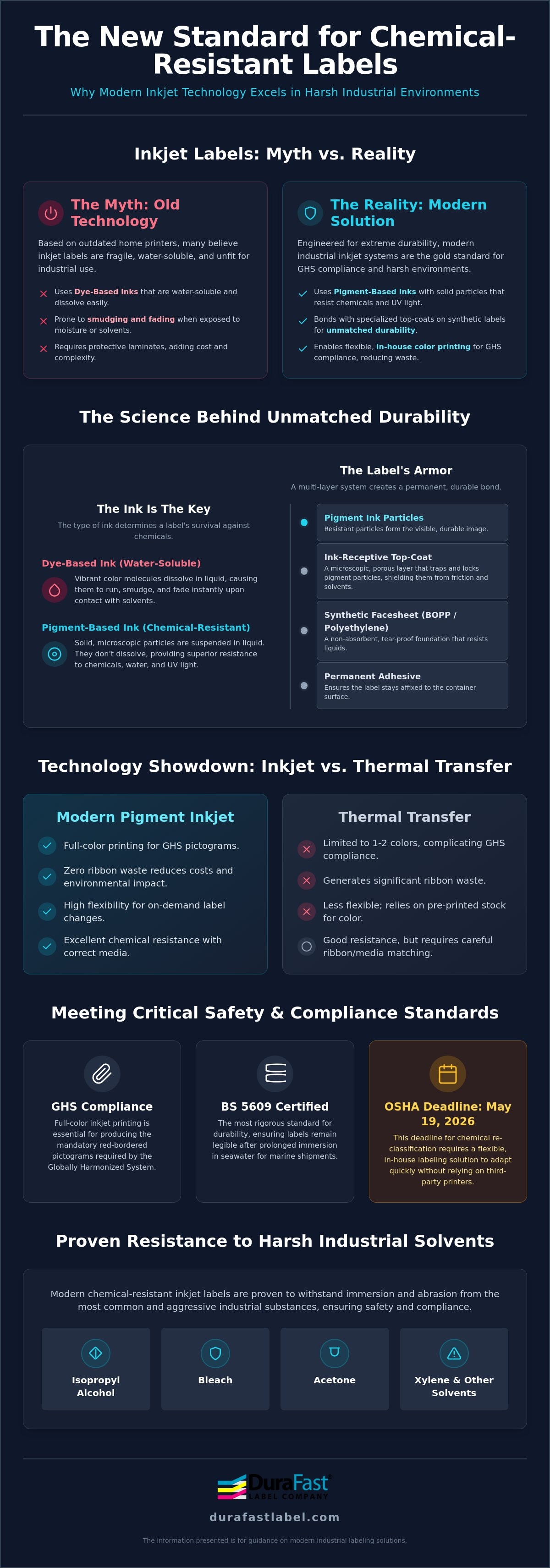
The confusion often stems from the type of ink used in older technology. Dye-based inks are vibrant and beautiful, but they're water-soluble. They break down almost instantly when exposed to alcohols or solvents. Pigment ink is different. It consists of solid particles suspended in liquid. Once printed, these particles don't just sit on the surface; they resist UV light and aggressive chemicals. For any application involving acetone, bleach, or isopropyl alcohol, pigment ink is non-negotiable. It provides the stay-put power that safety managers require.
Understanding the Top-Coat Technology
The ink is only half the story. To achieve true durability, you need a high-performance matte chemical label. These labels utilize synthetic face sheets like BOPP (Biaxially Oriented Polypropylene) or Polyethylene. These materials don't tear or absorb liquids like paper does. They provide a stable foundation for the most demanding environments.
The secret weapon is the ink-receptive coating. An ink-receptive coating is a microscopic, sponge-like layer that locks pigment particles into a permanent matrix to prevent solvent-induced smearing. This specialized, porous layer is designed to instantly trap pigment particles and shield them from external friction. It ensures that the bond remains intact even during marine immersion or harsh cleaning cycles. Without this specialized top-coat, even the best pigment ink would simply wipe away. When the two work together, the result is a label that stays legible for years.
The Science of Durability: How Inkjet Survives Harsh Solvents
Durability in 2026 isn't just about the label material; it's about the chemistry of the ink. While the previous section explained the physical structure of the top-coat, the true science happens at the molecular level. High-performance chemical resistant inkjet labels rely on a sophisticated interaction between pigment particles and synthetic resins. When the ink hits the surface, it doesn't just sit there. It becomes part of the label's architecture. This creates a finish that stands up to the most aggressive industrial substances.
Many managers still believe they need a protective laminate to keep their labels from smearing. That's a lingering myth from the days of dye-based printing. Modern pigment inkjet technology has rendered laminates optional for many applications. Because the pigment is trapped within the synthetic resin of the top-coat, the ink itself is shielded from friction and chemical attack. Whether your labels face Isopropyl Alcohol (IPA), Bleach, or even Acetone, the bond remains stable. This saves you time, reduces material costs, and simplifies your printing process.
Consider the difference between a laboratory slide and an industrial chemical drum. In a lab, labels must survive exposure to xylene and other solvents while remaining perfectly legible under a microscope. On a factory floor, a 55-gallon drum might face rough handling, salt spray, and outdoor storage. Modern inkjet solutions handle both. The same technology that ensures a tiny barcode remains scannable on a lab slide also keeps GHS warnings clear on a drum exposed to the elements. If you aren't sure which ink and media combination is right for your specific environment, feel free to contact us for expert advice.
Solvent Resistance Testing Protocols
How do we know these labels will last? We use the "Rub Test." This involves mechanical arms rubbing the printed surface with a solvent-soaked cloth for a set number of cycles. If the ink doesn't smear or transfer, it passes. Immersion testing goes further, submerging labels in chemicals for hours to check for adhesive failure or ink breakdown. Epson inks are specifically formulated for these industrial durability standards, ensuring your data stays put when it matters most.
Temperature and Environmental Factors
Chemical resistance is only one piece of the puzzle. Labels also face thermal stability challenges. High-quality inkjet labels survive extreme heat and cold cycles without cracking or peeling. UV resistance is equally critical for outdoor chemical storage. Modern pigments are lightfast, meaning they won't fade into illegibility after a few weeks in the sun. Finally, we account for humidity. A stable ink bond ensures that moisture won't cause the image to soften or bleed, even in damp warehouse conditions.
Inkjet vs. Thermal Transfer: A Practical Comparison
For decades, thermal transfer was the undisputed king of the warehouse. It's reliable. It's fast. But it's also limited. If you're looking for chemical resistant inkjet labels, you're likely realizing that the old way of printing has some significant drawbacks. Modern pigment inkjet systems have reached durability parity with resin-ribbon thermal transfer. They offer a "one-pass" advantage that saves hours of labor. You can print full-color GHS pictograms, variable data, and your company logo all at the same time.
Color flexibility is the biggest win for inkjet users. GHS standards require specific red borders on pictograms. With thermal transfer, you either buy expensive pre-printed labels or use a printer with multiple ribbon stations. Inkjet handles these color requirements effortlessly. You don't have to swap out ribbons or manage complex hardware setups. This flexibility allows your team to react instantly to new labeling needs without ordering new custom stock.
Total Cost of Ownership (TCO)
Managing ribbons is a logistical burden. You stock black, red, and perhaps other colors for branding. In a traditional industrial barcode printer workflow, you're also managing the disposal of used ribbons. Every inch of ribbon is waste. Inkjet changes this. You use only the ink required for the specific design. Consolidating your media inventory is easier when you use chemical resistant inkjet labels across your entire product line. Instead of stocking dozens of pre-printed rolls, you stock one high-quality blank roll. You print exactly what you need. This reduces waste and prevents your stock from becoming obsolete when regulations change.
Print Resolution and Legibility
Legibility is a core safety requirement. GHS labels often squeeze a lot of information into a small space. While a standard 200 dpi thermal printer might make 4pt text look like a collection of fuzzy blocks, a 1200 dpi inkjet printer delivers crisp, sharp characters that remain perfectly readable under a magnifying glass. This precision ensures your GHS pictograms have sharp, high-contrast borders. You won't have to worry about the "bleed" myth. Modern inkjet heads control droplet placement with extreme accuracy. This results in professional, compliant labels that stand up to industrial scrutiny.
Compliance Standards: BS5609 and GHS Requirements
Navigating international shipping regulations doesn't have to be a headache. If you're moving chemicals across the ocean, the British Standard 5609 (BS5609) is your primary benchmark for durability. This standard ensures that if a drum falls overboard, the label remains attached and legible for at least three months in salt water. It's a critical requirement for international shipping audits. While some legacy providers claim this standard is out of reach for inkjet, the BS 5609:2024 revision confirms that modern chemical resistant inkjet labels are more than capable of passing these rigorous tests.
Understanding the distinction between Section 2 and Section 3 is vital. Section 2 covers the blank label material itself, testing the adhesive and face sheet against the elements. Section 3 is where the real challenge lies. This section tests the entire system: the printer, the specific ink, and the label media together. You can't claim compliance with just a "certified" label. The final printed output must be tested as a complete unit. This is why using a vetted system like an Epson ColorWorks printer with pigment ink is so important for passing audits and avoiding costly fines.
The Globally Harmonized System (GHS) adds another layer of complexity to your workflow. It mandates high-contrast color pictograms with specific red diamond borders. As we discussed in previous sections, inkjet's ability to print these in a single pass makes it a superior choice for staying compliant with the May 19, 2026, OSHA re-classification deadlines. If your labels aren't up to code by these dates, you face significant legal and operational risks during inspections. New EU obligations taking effect on July 1, 2026, also require faster label updates when substances are reclassified, making in-house flexibility a necessity.
Achieving BS5609 Section 3 with Inkjet
To pass Section 3, you must use certified inkjet labels paired with genuine pigment inks. These systems undergo rigorous abrasion testing where the printed surface is scoured with sand and salt water. Many businesses try to cut costs by using "compatible" or third-party inks. These almost always fail compliance tests because they lack the specific molecular bonding agents found in OEM pigment formulations. If you need to verify your current system's certification status, contact our compliance experts today for a full review.
GHS Label Design Best Practices
Design is just as important as durability. Using BarTender software helps you create compliant layouts that automatically adjust pictogram sizes based on container volume. This is especially relevant for the January 1, 2027, EU requirements regarding minimum font and symbol sizes. Your software should also integrate variable data, like batch numbers or manufacture dates, directly with your static safety information. This ensures every label is accurate, fully traceable, and professional in appearance.
The Solution: Implementing In-House Chemical Labeling
Transitioning to an in-house labeling system is the most effective way to handle the 2026 regulatory shifts we've discussed. You're no longer at the mercy of a third-party printer's lead times or minimum order quantities. Instead, you gain total control over your inventory. Implementing chemical resistant inkjet labels in-house typically follows a 30-day roadmap. Week one focuses on hardware selection. Week two involves software integration with your ERP. Week three is for media testing on your specific containers. By week four, you're ready for a full production rollout. This print-on-demand workflow eliminates the waste of obsolete, pre-printed stock and ensures you're always ready for a surprise audit.
Hardware Spotlight: Epson ColorWorks C6000A
The Epson ColorWorks C6000A has earned its reputation as the gold standard for GHS compliance. It uses pigment-based UltraChrome DL ink, which we've established is essential for solvent resistance. One of its standout features is the peel-and-present capability. This allows for seamless integration into manual application lines. The printer also speaks the same language as your existing systems, offering native ZPL II support. This means you can often drop it into a workflow previously occupied by a thermal printer without a total software overhaul. If you need high-speed production for larger batches, the Afinia L801 offers a powerful alternative that balances throughput with professional-grade output. You can find these and other color label printers in our curated inventory.
Optimizing Your Label Media
The best printer in the world can't compensate for the wrong media. You must match your label adhesive to the container material. For example, plastic HDPE drums flex and breathe, requiring a different adhesive profile than a rigid stainless steel tank. DuraFast Matte Chemical Labels are engineered to bridge this gap. They provide the aggressive tack needed for industrial surfaces while maintaining a stable face sheet. We recommend a matte finish because it eliminates the glare often found in harsh warehouse lighting. This ensures your barcode scanners can get a clean read on the first try, every time. A matte surface also provides a better anchor for pigment inks, further enhancing the chemical resistance of the final print.
Ready to upgrade your durability? Shop our full range of chemical resistant inkjet labels to find the perfect match for your specific environment. Whether you're dealing with acetone splashes in a lab or salt spray on a shipping deck, the right combination of pigment ink and synthetic media will keep your business compliant and your workers safe.
Take Control of Your Chemical Labeling Compliance
The old myths about inkjet fragility are officially debunked. You now have the tools to produce professional, full-color labels that survive the harshest industrial environments without the complexity of thermal ribbons. By combining high-performance pigment inks with chemical resistant inkjet labels, your facility can achieve total GHS compliance while significantly reducing material waste. This shift to in-house production doesn't just save money; it ensures your operations are flexible enough to meet any regulatory deadline.
DuraFast has served as pigment ink specialists since 2012. We understand that your reputation depends on labels that stay legible during marine immersion or chemical splashes. That is why we offer BS5609 Section 3 certified media designed to work perfectly with your hardware. We provide North American wide shipping to ensure you get the supplies you need exactly when you need them. Our team has already done the heavy lifting of vetting these systems so you can print with confidence.
Don't leave your compliance to chance. See the durability for yourself and test our media in your specific environment. Request a Sample Pack of DuraFast Matte Chemical Labels today and start your transition to a more efficient, in-house labeling workflow. You'll be ready for whatever the 2026 regulations bring.
Frequently Asked Questions
Can inkjet labels really be BS5609 compliant?
Yes, inkjet labels are frequently BS5609 compliant when using the right combination of pigment ink and synthetic media. The BS 5609:2024 revision sets rigorous standards for marine immersion, and specific systems like the Epson ColorWorks series have passed these certifications. This ensures your labels stay attached and legible even after three months in salt water.
Do I need a laminate to make inkjet labels chemical resistant?
You don't always need a laminate with modern pigment inkjet technology. High-quality chemical resistant inkjet labels feature a specialized top-coat that locks the ink particles into a durable synthetic matrix. This resin-based shield protects the print from friction and solvents. Skipping the laminate saves you time and reduces your overall material costs without sacrificing safety.
Which chemicals can pigment inkjet labels withstand?
Pigment inkjet labels are engineered to withstand aggressive substances like Isopropyl Alcohol (IPA), bleach, and acetone. They also resist hydraulic fluids and certain industrial cleaners that would dissolve standard dye-based inks. Your specific resistance profile depends on the molecular bond between the pigment ink and the synthetic face sheet of the label.
Is inkjet more expensive than thermal transfer for chemical labels?
Inkjet is often more cost-effective because it eliminates the need for expensive multi-color thermal ribbons. You also reduce waste by printing only what you need, rather than managing a large inventory of pre-printed color stock. When you factor in the labor saved from ribbon changes and inventory management, the total cost of ownership is very competitive.
What is the difference between Section 2 and Section 3 of BS5609?
Section 2 tests the physical durability of the blank label material and its adhesive under marine conditions. Section 3 tests the legibility and abrasion resistance of the actual print. You must have a Section 3 certification for your specific printer, ink, and media combination to be fully compliant for international chemical shipping.
Can I use any inkjet printer for GHS labels?
You cannot use a standard home or office inkjet printer for GHS labels. These consumer models typically use dye-based inks that smear when exposed to moisture or chemicals. GHS compliance requires industrial pigment-based printers that can produce the high-contrast red pictograms and durable text required by OSHA and EU standards.
How do I test my labels for chemical resistance at my facility?
You can perform a basic "rub test" by wiping the printed label with a cloth soaked in your specific facility chemicals. For more formal testing, try a 24-hour immersion test to see if the adhesive holds or the ink softens. We always recommend testing chemical resistant inkjet labels on your actual containers to ensure the adhesive performs well on that specific surface.
What is the best printer for chemical resistant labels in 2026?
The Epson ColorWorks C6000A is widely considered the gold standard for GHS compliance in 2026. It offers a perfect balance of durability, ease of use, and system integration features. For high-volume environments that need faster throughput, the Afinia L801 is an excellent choice that handles large batches with industrial-grade efficiency and low ink costs.