Cost of Printing Labels vs Buying: Compare Printing Methods
4th Nov 2026
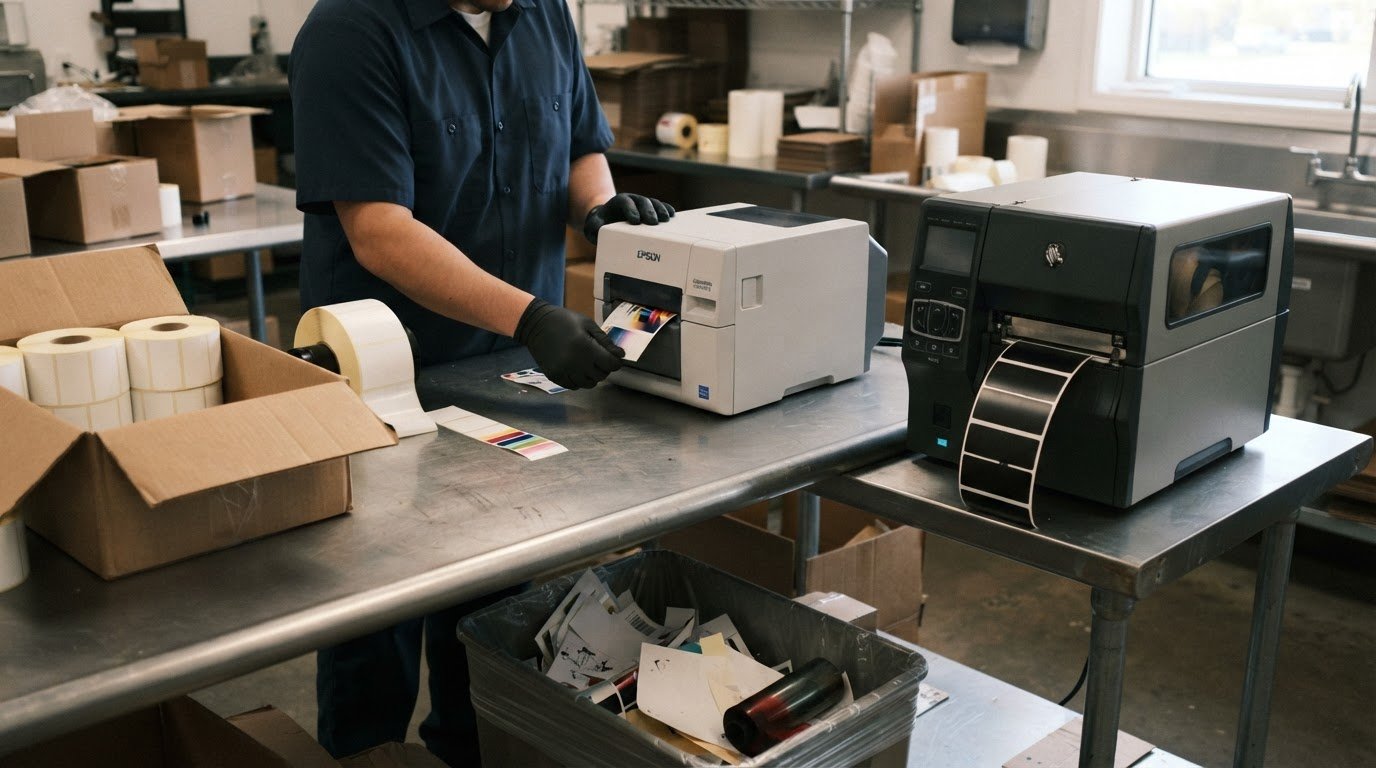
Buying labels isn’t always cheaper. The cost of printing labels vs. buying them depends on how many you use, how often the design changes, and which printing method suits the job. In-house printing can make sense for small, changing batches, while pre-printed labels may be more practical for large quantities of a consistent design.
The price per label is only part of the comparison. In-house printing also involves equipment, supplies, setup time, and potential waste from misprints. Buying labels avoids operating a printer, but minimum order quantities and unused stock can affect the total cost.
This guide compares common printing methods and explains how volume, flexibility, and waste affect the decision. You’ll learn what to include in a cost calculation, when on-demand printing can help, and why the lowest per-label cost may not be the best fit for your business.
Key Takeaways
- Build an in-house cost estimate around equipment, supplies, setup, maintenance, misprints, and wasted labels, not just the cost of each blank label.
- Compare thermal transfer with other methods by considering both ribbon and label costs and the durability your application needs.
- Factor minimum order quantities, setup fees, and the risk of unused stock into the real cost of buying pre-printed labels.
- Use on-demand printing to make small batches or design changes without committing to a large run of labels that may become obsolete.
- Match the method to your label volume, design stability, and material needs to find a practical balance of cost, flexibility, and waste.
How much does it cost to make your own stickers and labels?
To estimate the cost of printing labels in-house, account for setup, supplies, labor, and waste, not just the blank labels. Separate one-time equipment costs from the ongoing cost of each usable label.
Thermal Transfer Costs and Durability
Thermal transfer printing uses heat to transfer ink from a ribbon onto a label. Its ongoing supply costs include both ribbon and label stock. Direct thermal printing, by contrast, doesn’t require ink or toner. Thermal-transfer labels are more resistant than standard thermal labels to water, oil, scratches, alcohol, and temperature changes. That durability can matter for barcode labels that are handled frequently or used in demanding conditions.
Printer Setup Costs and Return on Investment
Setup costs include the printer, compatible supplies, label design, and time spent configuring the workflow. These tools can suit sticker production, but an industrial label workflow may require different equipment. Estimate payback by comparing the full setup cost with the savings per label over the expected period of use.
In-House Printer and Per-Label Costs
Each usable label has material and printing costs. A small barcode with limited coverage uses supplies differently from a large, full-color product label. Calculate the cost per label by dividing the cost of labels and printing supplies by the number of acceptable labels produced. Then account for misprints and unused stock.
Use this comparison to identify which costs to consider for each method:
| Printing option | Setup cost | Ongoing supplies | Durability and cost considerations |
|---|---|---|---|
| Thermal transfer | Printer and workflow setup | Labels and ribbon | More resistant than standard thermal labels to several common exposures |
| Direct thermal | Printer and workflow setup | Thermal labels | No ink or toner; label durability depends on the application |
| Color inkjet | Printer and design setup | Labels and ink | Per-label cost varies with size, coverage, and stock |
| Pre-printed labels | Order and artwork preparation | Finished labels | Bulk quantities may leave unused stock after design changes |
Printer Maintenance and Labor
In-house printing also takes staff time for design, setup, loading stock, and checking output. Maintenance can involve resolving dried ink, print-head alignment, or paper jams. Each interruption adds labor and may lead to reprints or wasted labels. Track setup and troubleshooting time alongside supply use: frequent errors or hands-on work can offset a low material cost per label.
Choose a print method that matches the label’s durability requirements, design, and expected volume, then compare the full setup and running costs.
Is It Cheaper to Print Your Own Labels or Buy Them?
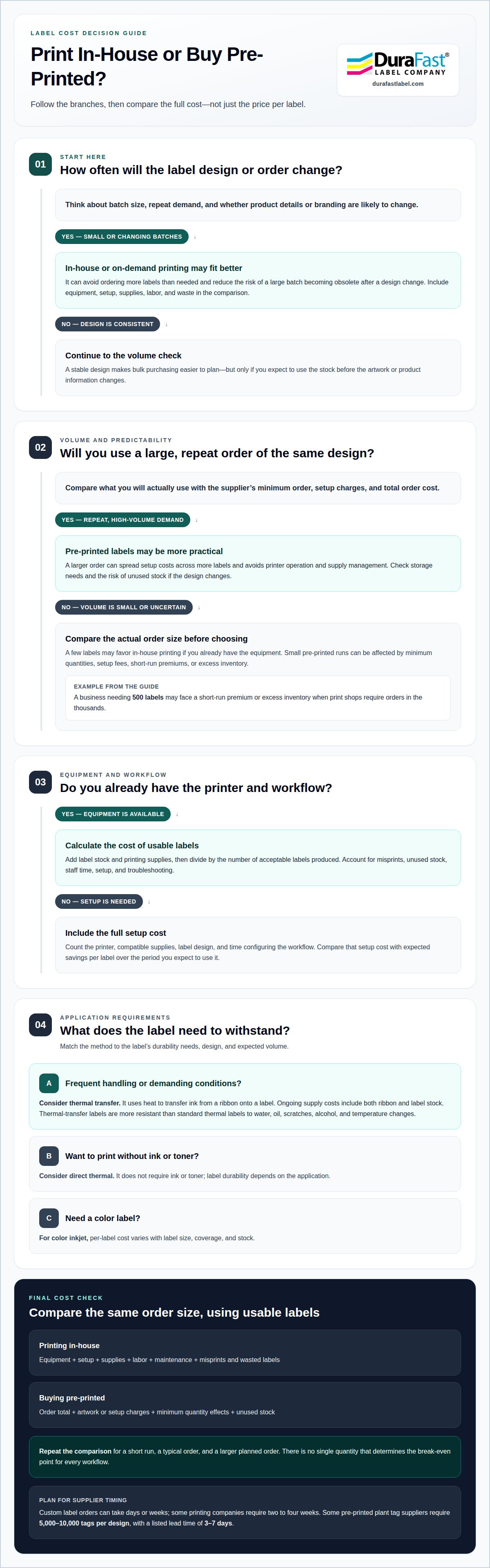
For small, changing batches, in-house printing can avoid ordering more labels than needed. For repeat, high-volume orders, pre-printed labels may be more practical. Compare the full costs at each quantity, including setup, supplies, labor, minimum orders, and unused stock.
Minimum Orders and Setup Fees
Pre-printed labels may involve artwork preparation and a minimum order quantity, so a small run can be less economical than its per-label price suggests. Some print shops commonly require orders in the thousands, while a business needing 500 labels may face a short-run premium or excess inventory. Setup fees, where charged, add to the initial order cost; include them in the comparison rather than treating them as recurring label costs.
Commercial Pricing and Bulk Orders
Bulk orders can be practical when the design stays consistent and quantities are predictable. A larger order spreads setup costs across more labels, but savings depend on using the stock before the artwork or product information changes. Compare the total order cost with the quantity you’ll actually use, not just the quoted price per label. Buying pre-printed labels also avoids printer operation and supply management.
Buying Labels for Regular or Large Orders
Regular orders suit businesses that use the same label design steadily and can plan inventory. Buying pre-printed labels in bulk may reduce the time spent printing, especially when demand is stable. The trade-off is storage and obsolescence: a change to pricing, product details, or branding can leave unused labels behind. Some suppliers of pre-printed plant tags require 5,000-10,000 tags per design, with a listed lead time of 3-7 days.
Costs at Different Order Quantities
How do label printing costs compare at different order quantities? A few labels may favor in-house printing if you already have the equipment, while bulk orders of an unchanged design may favor pre-printing. If you use hundreds or thousands of labels each month, compare bulk-order costs with equipment, supplies, labor, and waste. There’s no single quantity that determines the break-even point for every workflow.
Use the same calculation for each order size: add the full cost of in-house equipment and supplies, then divide by the number of usable labels. For buying, include the order total and setup charges, then account for any unused labels. Repeat the comparison for a short run, a typical order, and a larger planned order. This shows whether low-volume convenience or bulk purchasing matters more for your actual demand.
Lead time also affects the decision. Custom label orders can take days or weeks, and some printing companies require two to four weeks. In-house printing gives you control over when to produce a batch, while pre-printed labels require planning around supplier timing. If you’re weighing quantities against a changing design or schedule, get help evaluating your label-printing needs.
In-house label printing flexibility and waste reduction
In-house printing offers flexibility and supports smaller, on-demand batches. Buying pre-printed labels can be more cost-effective for large runs of stable designs. The trade-off is control over quantities and updates versus the equipment, supplies, and labor required to print.
A pre-printed order of 5,000 labels can become waste if product information, pricing, or artwork changes. In-house printing lets a business update the file and produce only the next needed batch. That can reduce obsolete packaging labels and the material discarded with unused stock. It doesn’t remove waste from misprints, so careful setup and proofing still matter.
Batch size changes the comparison. A business with printing equipment can produce a few labels or a run of ten thousand without meeting a supplier’s minimum order. This flexibility helps with short-term promotions, special editions, and products with changing details. For example, a seasonal packaging design can be printed only while it’s current, rather than ordering a large quantity that may go unused.
Buying can cost less when the design stays consistent and demand is high. Pre-printed labels are often more cost-effective for bulk orders, while outsourcing may make sense for tens of thousands or more labels per month when designs rarely change. In-house printing can suit frequent short runs, but include equipment use, supplies, labor, reprints, and label waste in the calculation.
Durability also affects whether an in-house option suits the job. A professional label must match its use, including the surface, handling, and conditions it faces. Compare available stock and printing methods with those requirements before focusing on price. A low-cost label that fails during use can lead to replacement work and more waste.
For a practical comparison, group labels by how often their content changes and how regularly each design is used. Separate a stable, high-volume design from a product label that changes often. If demand is predictable, consider buying the first in bulk, then printing the second on demand. This hybrid approach can limit surplus while keeping reliable designs in stock.
In-house printing is most economical when you use existing equipment regularly, print small or changing batches, and avoid obsolete stock through timely updates. Buying is more practical when a design stays unchanged and you use large quantities consistently. Compare the cost of usable labels, including waste and labor, rather than treating flexibility or bulk pricing as the only deciding factor.
On-demand label printing
On-demand printing means producing labels as needed instead of committing to a large pre-printed order. Starting with one sheet can suit a small business testing a custom design, while in-house equipment supports changes without a supplier minimum order. The trade-off is that each batch still uses supplies and staff time.
This approach is useful when product details, branding, or packaging change often. For example, a seasonal product can use updated artwork without leaving a stack of labels with outdated information. Print only the version needed for the current run. This can reduce surplus, although setup errors and misprints can still create waste.
On-demand customization can also support variable information. With the right technical setup and staff time, in-house printing can produce barcode labels, QR codes, or serialized numbering. This is useful when each item needs a distinct identifier. A static pre-printed design may be less suited to that task because changing the data requires an updated production file or another order.
Before printing, separate fixed artwork from information that changes. Keep the logo, layout, and product identity consistent, then update fields such as a batch code or product detail as needed. Review the file, print a sample, and check the content and alignment before starting the full run. This can catch errors before they consume more stock.
Compare on-demand costs with a large-quantity order by considering how many labels will remain usable. A low price per label doesn’t help if a design update makes unused stock obsolete. Conversely, repeated small batches may require more staff time and supplies than a planned order. Include design time, printer setup, reprints, and remaining stock in the comparison.
On-demand printing suits short runs, special editions, and products with frequently changing details. Buying pre-printed labels can be more practical when large quantities share one stable design. Some print companies require two to four weeks for custom-label orders, so factor production time into stock planning. Match the method to how quickly each design changes and how reliably the labels will be used.
Use this decision sequence for each label design:
- Identify whether the design or product information changes between runs.
- Estimate the quantity likely to be used before the next update.
- Include printing time, supplies, reprints, and leftover stock in the in-house estimate.
- Compare that total with the supplier’s order quantity and timing.
Choose on-demand printing when quick updates and smaller batches help prevent surplus. Choose pre-printing when demand is predictable and the same artwork stays current. For labels with barcodes or serialized numbers, also consider whether you have the technical setup and staff time to manage variable information accurately.
Cost comparison by printing method
The cheapest method depends on whether your main costs are equipment, consumables, labor, or excess inventory. Compare the same quantity of usable labels across methods, then include setup, reprints, and stock that may become obsolete after a design change.
| Printing method | Equipment and setup | Ongoing supplies | Best cost fit |
|---|---|---|---|
| Direct thermal | Thermal printer | Thermal labels | Simple black-and-white information without ink or toner |
| Thermal transfer | Thermal-transfer printer | Labels and ribbon | Durable labels where resistance matters |
| Color inkjet | Color printer and setup | Ink and blank labels | In-house color runs with changing designs |
| Sheet printing | Existing compatible printer | Ink or toner and label sheets | Small batches using equipment already owned |
| Pre-printed orders | Artwork and order setup | Finished labels | Large quantities of stable designs |
| Print-shop short runs | Order preparation | Finished labels | Limited runs without buying equipment |
| Die-cut stickers | Printer and cutting equipment | Sticker stock and printing supplies | Custom-shaped designs |
| Hybrid production | In-house printer plus supplier orders | Supplies and selected bulk stock | Stable designs in bulk, changing labels on demand |
Direct thermal printing has a simpler supply list because it requires no ink or toner. Thermal transfer adds ribbon to the calculation, but its labels are more resistant than standard thermal labels to water, oil, scratches, alcohol, and temperature changes. That difference can make thermal transfer better value where durability affects how often labels need replacing.
Color inkjet has a different cost profile. Blank labels and ink drive ongoing spending, while the printer and setup are initial costs. Compare the cost of acceptable labels, not every label printed. Misprints and setup tests reduce the number of usable labels from each supply purchase.
When comparing a print shop, include minimum quantities and leftover inventory alongside the quoted price. A short run can avoid owning equipment, while large quantities of an unchanged design can spread production costs across more labels. Custom-shaped stickers also require cutting, so compare the cost of that equipment and material use with buying finished shapes.
For a clear comparison, use one intended batch size and one label specification. Calculate in-house supplies, labor, maintenance, and waste, then compare them with the full purchase cost and any unused stock. A hybrid approach can keep high-volume, stable designs in inventory while printing variable labels as needed.
Choose by the dominant cost: direct thermal for ink-free printing, thermal transfer for durability, color inkjet for flexible color work, or pre-printing for stable bulk demand. Discuss label printing options for your workflow.
DuraFast Label Company: Afinia L801 Color Label Printer
DuraFast Label Company offers label-printing equipment and supplies for businesses weighing in-house production against buying finished labels. For businesses considering in-house color printing, the Afinia L801 Color Label Printer and Epson ColorWorks C6000A are options to compare with your label workflow. For thermal-transfer printing, the Zebra ZT411 Thermal Transfer Printer and DuraFast Matte Chemical Labels provide another equipment-and-material pairing to evaluate.
Start with the label type, design stability, print volume, and durability needs established in your cost comparison. These factors help narrow the choice between color and thermal-transfer equipment, and between printing labels in-house or purchasing supplies for an existing workflow. DuraFast Label Company can help you explore its label-printing options. Contact DuraFast Label Company to discuss your printing needs.
Turn Your Label Comparison Into a Practical Plan
A sound decision about the cost of printing labels vs. buying them starts with the label you use most. Map its design, material, print method, and expected demand to your actual workflow. Then choose an approach your team can maintain, not just one that looks attractive in a single cost estimate. Revisit the decision when packaging, product information, or order patterns change.
For in-house color production, DuraFast Label Company offers the Epson ColorWorks C6000A and Afinia L801 Color Label Printer. DuraFast Matte Chemical Labels are another option to consider when selecting label stock. Match each option to the label’s purpose and your production needs before settling on a workflow.
Use that plan to decide what you’ll print internally and what you’ll purchase. If you’re ready to discuss suitable options for your label workflow, contact DuraFast Label Company. A clear next step can make your label process easier to manage.
Frequently Asked Questions
When Should You Buy Labels Instead?
Buy labels when you use a consistent design in large quantities and can plan inventory around demand. Pre-printed stock can also suit a label that needs a finish or material your in-house process doesn’t produce. For example, a product with stable artwork and consistent orders may be easier to stock than to print repeatedly. Buying is less suitable when frequent information changes could make unused labels obsolete.
Which Option is More Cost-Effective?
The cost of printing labels versus buying them depends on order volume, design changes, and total production costs. In-house printing involves equipment, supplies, maintenance, and labor. Buying involves order, setup, and inventory costs. Compare the cost per usable label for the quantity you’ll use, including misprints and leftover stock. A method suited to a short run may not be the best fit for repeat bulk orders.
How much does it cost to print product labels at home per label?
Calculate the cost per usable label by adding label material and printing supplies, then accounting for rejected prints. Include ink or ribbon when the method uses it. If you already own a compatible printer, don’t count its purchase cost again, but include setup and maintenance when estimating ongoing production. Label size, printed coverage, stock, and error rates all affect the final unit cost.
What is the cost of buying preprinted labels per label?
Divide the full order cost by the number of labels received. For example, an order of 1,000 custom preprinted labels costing $150 breaks down to $0.15 per label before shipping, while an order of 5,000 labels costing $300 reduces the unit price to $0.06 per label. These figures serve as sample calculations rather than universal rates. Setup, shipping, material, and unused stock can change the effective cost.
What are the costs of label printers, ink, toner, and supplies?
Separate equipment costs from recurring supplies. A printer is an initial investment; ongoing expenses can include blank labels, ink or toner, or ribbon, depending on the method. Thermal printing doesn’t require ink or toner, while thermal transfer uses ribbon. Also account for maintenance, setup, and unusable output. The right estimate depends on printer type, label stock, coverage, and how regularly the equipment is used.
What are typical prices for custom labels from online and local printing services?
There isn’t one typical rate that applies across online and local printing. Quotes depend on label dimensions, material, finish, color coverage, quantity, and design preparation. A sample order for 100 white-vinyl stickers measuring 5x5 cm works out differently per label than an order for 500. Treat such examples as specific order scenarios, not a price promise for other sizes, materials, or suppliers.
How much do label materials cost for paper, waterproof, and specialty labels?
Material costs depend on the label’s size, construction, and intended use. Paper labels and waterproof or specialty stocks aren’t interchangeable, so compare the material with the conditions the label must handle. A larger label uses more stock, while a specialty requirement can narrow the suitable materials. Include adhesive and any needed coating or finish in the comparison, along with stock lost to setup or misprints.
How do setup fees, shipping, and design costs affect label pricing?
These costs increase the total order expense but don’t necessarily change the number of labels delivered. To compare orders fairly, add artwork preparation, setup charges, and shipping to the invoice total, then divide by the number of usable labels. Design changes can also make existing inventory unusable. For in-house production, include staff time spent preparing files and configuring a print run. Compare the total landed cost, not just the price per label.