Cost Per Label: How Much Does It Cost to Manufacture a Label
8th Nov 2026
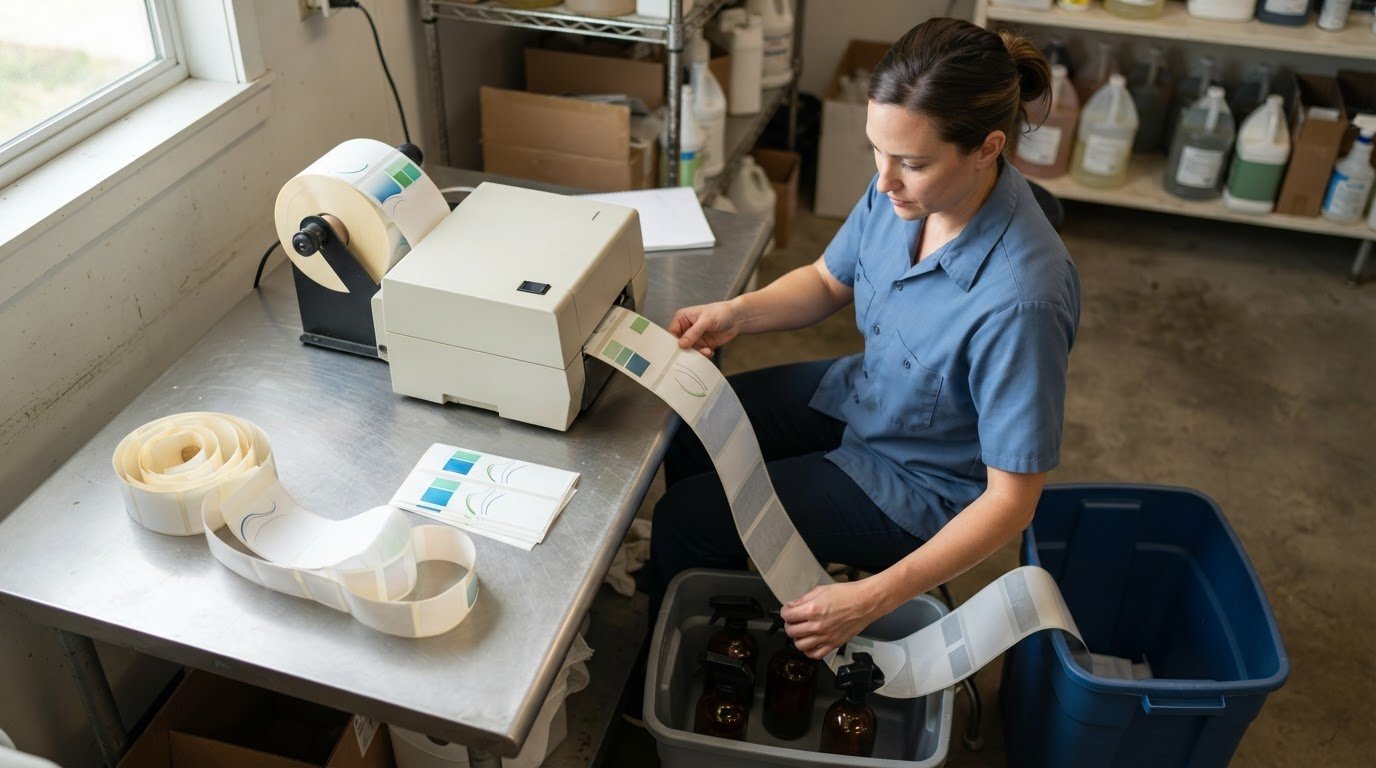
The printer is only part of a label’s cost. To understand how to calculate cost per label, divide the total manufacturing cost by the number of saleable labels produced. That total can include materials, ink, setup, labor, equipment, energy, and waste, so the result is more useful than a material-only estimate.
Ink deserves a closer look, especially when you print color labels. Ink cost depends on the design and how much ink each color uses, so two labels printed on the same machine can have different per-label ink costs.
Order size also affects the calculation: fixed setup costs are spread across the saleable labels in a run, while monthly and annual usage show the broader budget impact. This article explains how materials, ink, quantity, and usage periods shape your per-label cost, with examples to help you estimate it.
Key Takeaways
- Separate fixed production expenses from per-label expenses to see which costs change with order size.
- For color labels, design complexity affects ink use, so a single ink estimate may not fit every design.
- Compare order quantities with setup costs in mind; larger runs can spread fixed costs across more saleable labels.
- Use monthly usage to understand ongoing spend, then extend the estimate across the year for a broader budget view.
- Include material waste in your estimate so the cost reflects labels you can actually use, not just theoretical output.
How Much Does It Cost to Manufacture a Label?
There is no single cost per label. Materials, printing, equipment, labor, and setup all contribute. To calculate cost per label, identify the expenses for a specific job and divide them by the number of saleable labels.
Printer Prices and Ink Consumption
A label printer affects unit cost through its purchase price and ongoing use of ink or other supplies. Treat equipment as a fixed investment allocated across expected production, and ink as a variable cost tied to the labels printed.
For in-house printing, include equipment, ink, labels, labor, energy, and maintenance. For outsourced printing, use the supplier’s per-label quote. To estimate cartridge cost, divide its price by its stated yield, then account for every cartridge used by the design. Yield is an estimate, and actual consumption varies with print coverage.
Label Material and Size Costs
Material cost per label depends on the stock and the amount each label uses. A larger label uses more material than a smaller one printed on the same stock. Material choice also affects suitability for the packaging and use environment. Include production waste, then divide material expense by saleable output, not the planned quantity.
This example depends on its specific material and layout assumptions. Compare material, size, and required performance together. For instance, a pillow law label has a specific format, so its layout and stock are part of the estimate.
Shipping, Setup, Labor, and Other Costs
Shipping, packaging, applicable taxes, setup, and labor can add to the cost of materials and printing. A shipping-label price covers the printed label or label stock; carrier postage is separate unless the invoice combines them. Include freight, packaging, and taxes when they are part of the transaction you are measuring.
Setup and labor can affect costs even when output is low. Setup may recur for each run, while labor reflects time spent preparing and producing labels. The U.S. Environmental Protection Agency notes that cost estimates can include labor, equipment capital, energy, and process-related material consumption.
To calculate cost per label for different order sizes, separate fixed job costs from variable costs. Use manufacturing cost as the baseline before setting a selling price, then include relevant fulfillment expenses.
Calculating ink cost per color label
Ink cost per color label depends on cartridge prices, estimated yield, and the design’s ink coverage. For a practical estimate, divide each cartridge’s price by its yield, then add the per-label costs of all cartridges used. Color printing often uses several cartridges, so counting only one can understate ink consumption.
Treat this as an example, not a universal rate: a design with broad areas of solid color can use more ink than one with small colored details. Printer settings, label size, and print coverage also affect consumption.
To estimate cartridge cost, use the yield stated by the manufacturer or shown on the cartridge packaging. Divide the cartridge price by its estimated label yield, then add the cost for each color used. If a design uses cyan, magenta, yellow, and black, estimate each cartridge’s contribution instead of assuming all colors run out together.
- Find the cartridge price and stated yield. Keep the figures paired with the correct printer and cartridge.
- Divide price by yield. This gives a basic supply cost per printed label for that cartridge.
- Add the cartridge costs. Include each color used by the design.
- Compare the estimate with actual consumption. A test run can show whether the artwork uses more or less ink than the yield-based estimate suggests.
Yield figures are estimates, not a guarantee that every design will produce the same number of labels. Usable output changes with coverage, so a high-coverage design can raise ink cost per label. Recalculate when the artwork changes substantially or production shifts to a different label size.
Track other printing supplies separately. For toner, divide its cost by the expected output for the label work. For thermal transfer, allocate ribbon consumption across the labels printed. Keep ink, toner, or ribbon separate from label stock and equipment costs so you can see which input drives a change.
Volume helps put the per-label estimate into context. Multiply the ink cost per label by the number of labels in a production run to estimate its total ink expense. A 5.2-cent estimate, for example, scales with the run size, while a different design may require a new estimate. For an ink supply calculation, Epson ink cartridges are one relevant category to consider. If you’re weighing printer and supply needs for your labels, discuss your printing setup.
How order quantity affects per-label cost
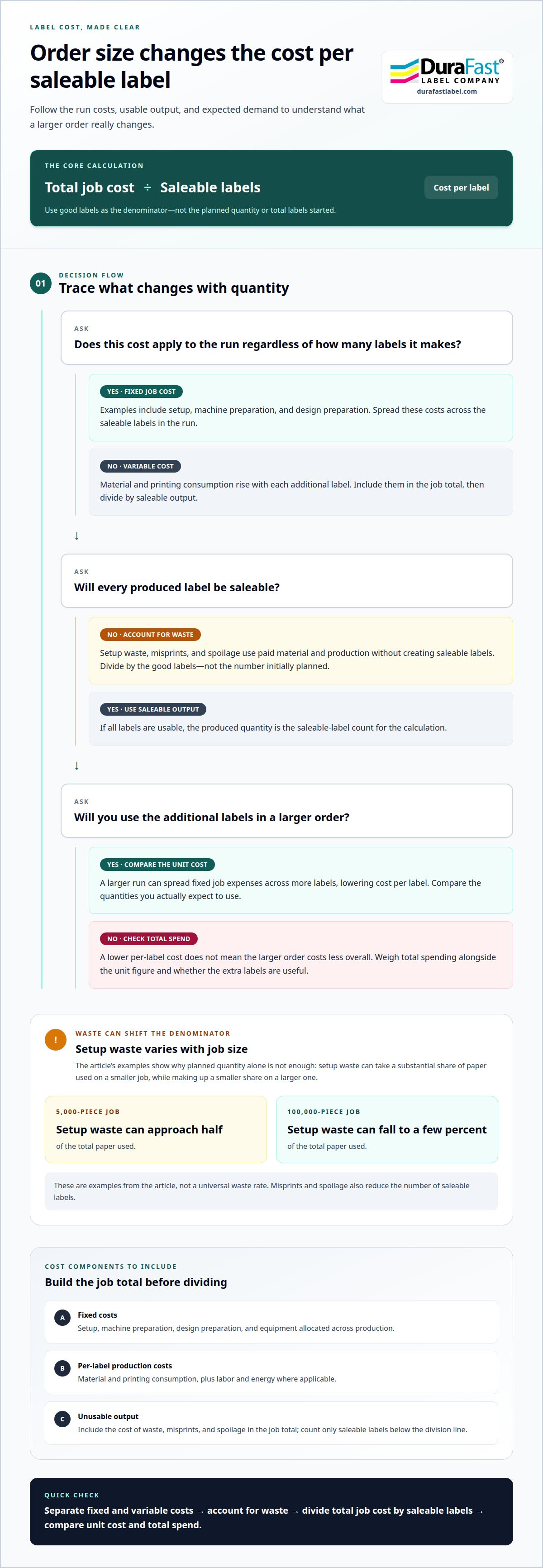
Order quantity affects how fixed production expenses are spread across labels. Setup, machine preparation, and design preparation may apply to a run regardless of its size, while material and printing consumption rise with each additional label. A larger order can therefore lower unit cost, but only if the extra labels will be useful to your business.
Compare cost per label at the quantities you actually expect to use. The unit cost falls when fixed job expenses are spread across more labels. That does not mean the larger order costs less overall, so weigh total spending alongside the per-label figure.
Setup waste also affects the denominator. In a 5,000-piece job, setup waste can approach half of the total paper used; in a 100,000-piece job, it can fall to a few percent. Waste, misprints, and spoilage raise cost per saleable label because you pay for material and production that cannot be sold. Divide total job cost by good labels, not the number initially planned.
Order frequency matters, too. Ordering 1,000 labels ten separate times in a year creates ten setup costs, while ordering 10,000 at once requires one setup. Consolidating orders may reduce repeated setup expenses, though holding a larger quantity means tying up more inventory. The best tier balances production savings with storage needs, label changes, and expected usage.
- Estimate demand. Use expected usage to compare order tiers, rather than choosing solely by the lowest unit cost.
- Separate fixed and variable expenses. Setup is tied to each run; materials and printing are tied to output.
- Count saleable labels. Include setup waste, misprints, and spoilage in the job total.
- Review total spend. A lower unit cost can still require a larger upfront order.
Quantity tiers can affect selling price and margins. Use the cost for each order size as your baseline, then consider packaging, fulfillment, and other business expenses before setting a price. Revisit the estimate when volume, artwork, or production frequency changes, since each can affect how costs are distributed.
If you’re comparing production quantities for a label project, talk through your label requirements as part of planning the right setup.
A single custom label can cost almost the same as 100 or 500 labels, because production preparation is required regardless of order size. That contrast underscores why very small runs may carry a high per-label burden even when the physical label itself uses little material.
Another worked example gives the 50,000-piece label job a unit cost of 0,091 TL, excluding plates. Its machine costs are 982 TL for 10,000 labels and 1.312 TL for 50,000 labels; labor costs are 218 TL for 10,000 labels and 292 TL for 50,000 labels. Packaging costs are 60 TL for 10,000 labels and 150 TL for 50,000 labels. These figures show that some production expenses rise with the run while per-label cost can still fall as fixed preparation is shared. Compare examples on a consistent basis, including exclusions such as plates, before using them to assess a quote.
Monthly and annual label-cost calculations
Monthly usage turns a per-label estimate into a budget figure; annual usage shows the longer-term impact. Calculate each period using the same cost basis, including materials, ink or ribbon, labor, and equipment allocation. Keep the label count and time period aligned so you are comparing like with like.
This example shows why even a small per-label cost can add up when production repeats throughout the year.
Use this simple calculation:
- Monthly label cost: labels used per month multiplied by cost per label.
- Annual label cost: monthly label cost multiplied by 12 months.
- Annual label volume: monthly label quantity multiplied by 12 months.
Keep fixed and variable expenses separate when building a monthly estimate. Ink, label material, and ribbon generally track the number of labels produced. Equipment allocation, setup, and maintenance may be recorded over a different period. Add the costs that apply to the same month, then divide by that month’s saleable label volume.
Usage patterns can change the annual result. A business using 1,000 labels per month consumes 12,000 labels annually, but ordering monthly and ordering that annual quantity together can distribute setup costs differently. Compare the cost of the actual ordering pattern with the expected volume. Include inventory decisions too, since a larger order changes when material is purchased and stored.
Monthly averages are useful when demand varies. Add the label expenses for the full year, then divide by 12 months to find the average monthly spend. For a seasonal product, also examine the months with heavier production. An annual average alone can hide when printing, material, or labor costs are concentrated.
Recalculate when a cost factor changes. A new label design can alter ink consumption, a different material can change stock expenses, and a new production volume can change equipment cost per label. Record each change against the period it affects. This makes monthly estimates easier to compare with prior periods without mixing one-time purchases with recurring label costs.
Use the annual figure for budgeting, then compare it with actual monthly use. If output or label specifications change during the year, calculate the new period separately and add it to the earlier totals. This keeps the annual estimate grounded in actual production instead of assuming every month has the same volume.
How do you calculate label material cost per label?
Material cost per label is the material expense for a job divided by its saleable labels. Start with the amount of stock used, then account for the label layout and production waste. This gives you a material-only figure, separate from ink, labor, machine time, and other manufacturing expenses.
For a roll, estimate material weight from its width, length, and paper weight. One example uses an 80 gsm paper roll that is 500 mm wide and 1,000 m long. Its estimated material weight is 40 kg.
Next, estimate how many labels the roll can produce. The example layout places 50 × 50 mm labels on a 500 mm web across a 1,000 m roll. Its theoretical output is 169,803 labels. That is a layout-based estimate before accounting for material lost during setup or production.
An illustrative 8% production loss reduces the estimated output to 156,218 whole saleable labels. Use saleable output in the denominator, since unusable stock still contributes to the job’s cost.
- Estimate material quantity. Use the roll’s dimensions and stock weight to determine the material consumed.
- Calculate theoretical output. Fit the label dimensions across the web and along the roll.
- Allow for production loss. Reduce theoretical output to the saleable quantity.
- Divide material expense by saleable labels. Keep freight and other charges separate unless they belong in the material figure.
Label size changes how efficiently stock is used. A 50 × 50 mm layout leaves different spacing and edge trim than a smaller format. Gaps between labels, side margins, and the number placed across the web all affect theoretical output. Custom shapes may also require a special cutting die with a one-time cost, which should be tracked separately from recurring material consumption.
Material choice matters, too. Stocks can vary in price and suitability for a label’s intended use, so compare material expense with print and application needs. For a full manufacturing figure, add material, ink and other consumables, setup, labor, die-cutting, and other job expenses, then divide by saleable labels.
For help matching label material to your application, discuss your label requirements.
DuraFast Label Company: Labelview label design and barcoding software
DuraFast Label Company offers Labelview label design and barcoding software to support label creation and barcode workflows. It can be a useful next step when your cost estimate is ready, but your design or barcode process needs attention. A clear, consistent label file helps keep production details organized.
For in-house printing, the Epson ColorWorks C6000A and other leading industrial printing systems are options to consider alongside the label material that suits your application, such as DuraFast Matte Chemical Labels. The right combination depends on your label requirements and printing workflow.
If you’re refining your label setup or choosing printing equipment and supplies, contact DuraFast Label Company to discuss your needs.
Put Your Label-Cost Estimate to Work
Knowing how to calculate cost per label gives you a consistent basis for production and purchasing decisions. Record the assumptions behind your estimate, including label specifications, production method, and expected usage. That context makes future comparisons more useful when a design, material, or workflow changes.
Set a regular time to revisit the estimate, such as during a budget review or when production requirements change. Compare planned costs with actual spending, then investigate meaningful differences before they affect pricing or purchasing plans. A clear cost record also helps teams discuss trade-offs using the same figures and definitions.
If you’re planning a label setup and want to discuss suitable equipment or materials, contact DuraFast Label Company. A well-organized estimate is a practical starting point for making your next label decision with confidence.
Frequently Asked Questions
How Many Labels Can You Make From One Roll?
The usable label count depends on the roll’s usable width and length, label dimensions, spacing, and setup waste. Calculate how many labels fit across the web, then estimate how many rows fit along its length. Multiply those figures and subtract material lost during setup or production. Keep units consistent, and use the repeating label pitch, including gaps, rather than label height alone.
What costs should be included when calculating cost per label?
Include costs directly tied to production, such as label stock, ink or ribbon, setup, labor, and finishing. Add a reasonable share of equipment, energy, and maintenance if you are estimating full manufacturing cost. Include freight, packaging, and applicable taxes when they belong in the cost being analyzed. Count each expense once, and keep one-time purchases separate from recurring job costs.
What is the formula for cost per label?
Divide the production run’s total cost by the number of saleable labels: cost per label = total production cost ÷ saleable label quantity. Use the good labels available for use, not the planned quantity before waste or misprints. This gives you manufacturing cost per label. Selling price is different because it may also account for business expenses and desired profit.
How do order quantity and bulk discounts change cost per label?
A larger order can lower unit cost when fixed preparation expenses are spread across more labels or a supplier discount reduces material costs. But total spending can still rise, and extra stock may tie up cash or require storage. Compare the discounted unit cost with the total order cost, expected use, and any setup charges. Include only discounts that apply to the materials or production in your calculation.