Deep Freeze Label Adhesive for Cold Storage Products
28th Oct 2026
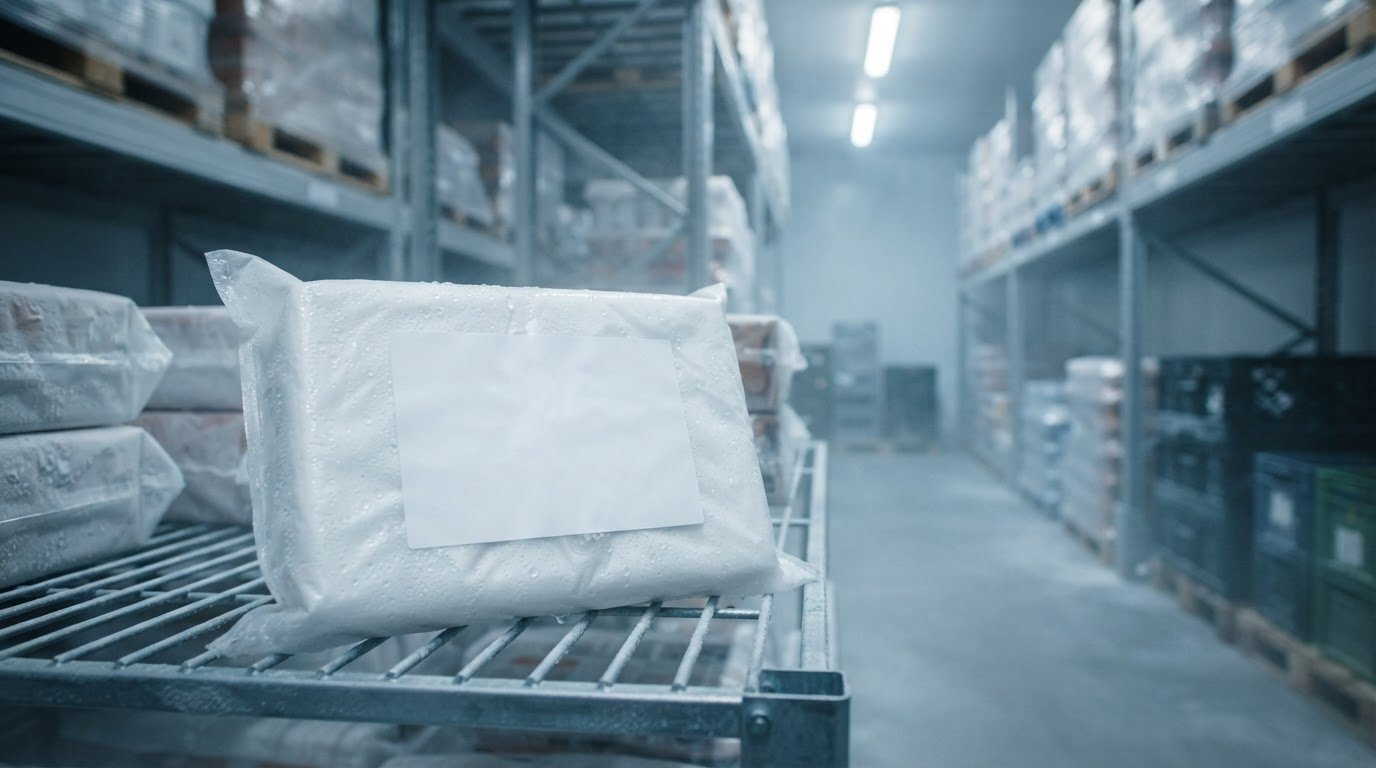
The right adhesive for deep freeze labels must match both the temperature when you apply the label and the conditions it will face in storage. Some freezer-grade adhesives maintain performance at service temperatures as low as -40°F, but their application temperature can be much warmer. Choose for the full cold-storage journey, not just the freezer temperature.
It’s easy to focus on the coldest point in the process. But the surface, moisture, packaging material, freeze-thaw exposure, dry ice, and chemical contact can all affect whether a label stays attached and readable.
This guide explains how to compare adhesives and face materials for cold-storage products, including the difference between application temperature and service temperature. It also covers labeling frozen surfaces, freeze-thaw cycles, and exposure to dry ice or chemicals. Use these factors to narrow your options to a label construction suited to your product and process.
Key Takeaways
- Compare the adhesive’s application temperature with its service-temperature range; a label’s cold-storage rating doesn’t automatically mean it can be applied to a frozen surface.
- Choose an adhesive for the actual surface and conditions, including moisture, packaging material, and how quickly products enter cold storage.
- Plan for freeze-thaw cycles, dry ice, and chemical exposure when selecting label materials, not just the freezer temperature.
- Match the face material to the environment so labels remain suitable for the product and handling conditions.
- Use the article’s selection steps to narrow down label materials and printing options for your cold-storage workflow.
Freezer-grade adhesive application and service temperatures
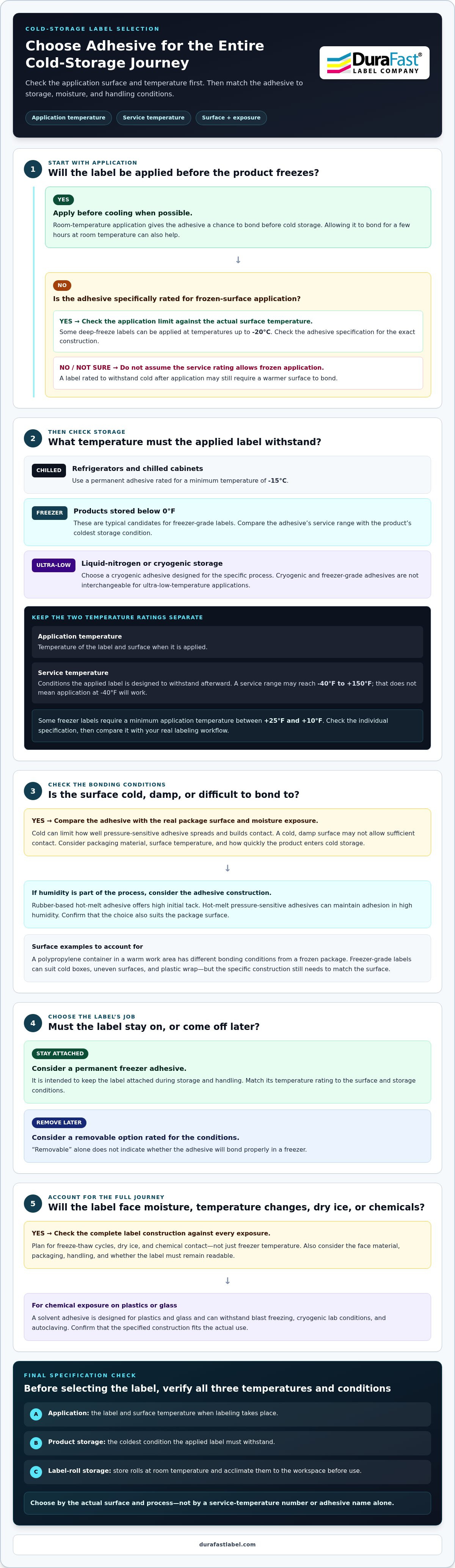
Choose an adhesive by comparing the surface temperature during application with the label’s later storage conditions. An adhesive for deep freeze labels must suit both stages: a service-temperature rating alone doesn’t show whether the label can be applied in a freezer. Check the adhesive specifications before planning the labeling step.
Cold Effects on Pressure-Sensitive Adhesives
Cold can limit how well pressure-sensitive adhesives spread across a surface and build contact. Some general-purpose adhesives become firm or brittle below 40°F, reducing initial tack. Freezer-grade adhesives are formulated to stay flexible and bonded in cold conditions. Consider the package material, moisture, and surface temperature when comparing label constructions.
For example, a label applied to a polypropylene container in a warm work area faces different bonding conditions from one applied to a frozen package. A label placed on a cold, damp surface may not make sufficient contact. Apply most freezer labels before products freeze, unless the adhesive is specifically rated for frozen-surface application.
Application Versus Service Temperatures
Application temperature means the temperature of the label and surface when the label is applied. Service temperature describes conditions the applied label is designed to withstand afterward. A freezer-grade adhesive may have a service range from -40°F to +150°F, while requiring a warmer surface during application. A rating of -40°F in service doesn’t mean application at that temperature will work.
Use the application limit to plan where and when labels are placed. Then compare the service range with the coldest storage condition. Deep-freeze labels can be used for labeling at temperatures up to -20°C, while service ratings can reach -40°C. Some freezer labels require a minimum application temperature between +25°F and +10°F. These are separate specifications, so compare each with the real workflow.
Application, Service, and Storage Temperatures
Account for application, product storage, and label-roll storage. When possible, apply at room temperature before the product cools. Labels should be applied at least at -20°C to allow the adhesive to set; allowing them to bond for a few hours at room temperature before cold storage can also help. Store rolls at room temperature and acclimate them to the workspace before use.
For Jessup TenaciousTac®, compare the applicable service-temperature option with your product’s storage range, then check the application limit against the labeling environment. Select an adhesive for deep freeze labels based on the actual surface and process, not the brand name alone. Consider the roll, package, and work-area conditions when planning a consistent labeling routine.
What Is the Right Adhesive Label for Cold Storage Products?
Choose an adhesive rated for the product’s storage temperature, packaging surface, and moisture exposure. Label cost depends on dimensions, face material, adhesive construction, roll format, and order quantity, all of which affect material use and converting.
Why Standard Adhesives Fail in Cold Storage
Standard adhesives may lose initial tack as they cool, leaving labels prone to lifting from packaging. Some all-temperature ratings around 35°F may not suit a freezer door at -10°F. Compare the adhesive’s temperature rating with the actual surface and storage conditions, especially if moisture or a quick move into frozen storage affects the package.
For chilled cabinets and refrigerators, use a permanent adhesive rated for a minimum temperature of -15°C. Products stored below 0°F are typical candidates for freezer-grade labels. These criteria help distinguish refrigerated use from freezer use without relying on a general-purpose adhesive label.
Freezer-Grade Adhesives for Cold Storage
Freezer-grade adhesives are formulated to stay flexible and bonded in cold conditions. Rubber-based hot-melt adhesive offers high initial tack, helping it grip surfaces in subzero environments. Hot-melt pressure-sensitive adhesives can also maintain adhesion in high humidity, which is useful in cold rooms where moisture may reach packaging.
Match the adhesive to the surface, not just the product inside. Freezer-grade labels can suit cold boxes, uneven surfaces, and plastic wrap. If a frozen product will remain in storage, consider whether the label needs to stay attached through handling and temperature changes.
Liquid-nitrogen storage calls for a different choice from ordinary freezer storage. Cryogenic adhesives are engineered for ultra-low-temperature environments, including laboratory storage. Freezer-grade and cryogenic adhesives aren’t interchangeable for ultra-low-temperature applications. Choose a construction for the specific process, such as a laboratory vial or a food package in a freezer.
Permanent and Removable Adhesive Options
A permanent freezer adhesive is intended to keep the label attached during storage and handling. A removable option suits workflows where staff need to take labels off later. Either way, the adhesive must suit the application surface and cold conditions: “removable” alone doesn’t indicate whether it will bond properly in a freezer.
Decide what the label needs to do: identify a package throughout cold storage, or support a process that requires label removal. Then compare the adhesive rating with the packaging material. For labels exposed to chemicals, a solvent adhesive is designed for plastics and glass and can withstand blast freezing, cryogenic lab conditions, and autoclaving.
Use those criteria to narrow the material choice for your workflow. Discuss cold-storage label and printing options with DuraFast Label Company.
How cold affects pressure-sensitive adhesives
Cold changes how pressure-sensitive adhesives contact surfaces, so match the adhesive to the package and labeling sequence. For U.S. food use, distinguish labels that may touch food directly from those placed only on exterior packaging. Evaluate the face material, adhesive, and ink for the intended contact; a freezer rating alone doesn’t establish food-contact suitability.
Blast-Freezing and Cold-Surface Labeling
Blast-freezing exposes a labeled package to rapid cooling, while a label applied to an already-frozen surface must bond immediately in the cold. Apply most freezer labels before freezing unless their adhesive is specifically rated for frozen-surface application. On a blast-freezing line, label the package before it enters the cold environment, then assess whether the label stays attached after cooling.
Cold-chain workflows may involve corrugated cardboard, plastic wrap, and uneven packaging. Emulsion acrylic adhesive can be an economical option for corrugated boxes, while hot-melt pressure-sensitive adhesives can bond to low- and high-energy surfaces. On rough cardboard, a higher adhesive coat weight can help create a stronger bond. Choose based on the actual outer surface, not just the product temperature.
Frozen Food and Cold-Store Labeling
Frozen food labels must stay attached and readable through storage and handling. Cold-store packaging may collect moisture as products move between environments, so assess adhesion on the actual package surface. A label on a corrugated carton, for example, faces different contact conditions from one on plastic film. Include the barcode and other essential identification in a test print, then inspect readability after the package cools.
For cold-chain cartons, allow adhesive wet-out before the package enters storage. Regular acrylic and standard-grade hot-melt adhesives generally perform well when given 20-30 minutes of wet-out time. That timing is not a substitute for a freezer-grade adhesive when products go below freezing. The adhesive must suit both the carton and the package’s route through the cold chain.
Evaluate a candidate film at 15 minutes and again at 24 hours after application. Those checks reveal early edge lift and later bond changes on the chosen packaging. Include the actual cardboard or plastic, label placement, and handling conditions in the evaluation.
Surface Preparation Before Deep-Freeze Application
Before applying a label, prepare the package surface so the adhesive contacts the material, not frost, moisture, or residue. Wipe away visible contamination and let the surface dry. For a frozen surface, confirm the adhesive is rated for application at that temperature; cleaning alone won’t make a standard adhesive suitable for extreme cold.
Apply firm, even pressure across the label, especially at the edges and corners of curved or uneven surfaces. On a corrugated box, press the label into the board’s texture rather than bridging raised areas. On plastic packaging, make sure the label lies flat without wrinkles. Record the surface, application conditions, and inspection results so you can repeat the same cold-storage process.
Resistance to dry ice, freeze-thaw cycles, and chemicals
Dry ice, moisture, temperature changes, and chemicals challenge different parts of a label. Select the adhesive, face material, coating, and print method as one construction, then assess it under the product’s actual handling conditions.
Dry Ice and Ultra-Low-Temperature Exposure
Don’t assume a freezer adhesive suits every dry-ice workflow. Freezer-grade and cryogenic adhesives aren’t interchangeable for ultra-low-temperature applications. If a shipment or laboratory process uses dry ice, determine whether the label encounters it directly, experiences cold vapor, or stays on outer packaging. These are different exposure conditions to test.
Solvent adhesive is designed for plastics and glass and can withstand blast freezing, cryogenic lab conditions, and autoclaving. That makes it a candidate for demanding applications, not proof that every label construction suits every chemical or dry-ice process. Assess the face material and printed layer alongside the adhesive.
Freeze-Thaw and Chemical Resistance
Repeated movement between frozen storage and warmer handling can stress the bond and label edges. Recreate the sequence using the actual package: apply the label, freeze it, expose it to the expected temperature transition, and inspect for lifting, wrinkles, or print damage. Record whether the surface is metal, glass, plastic, or cardboard, since the adhesive must bond to that specific material.
For chemical exposure, identify the substance and where it contacts the label. A solvent adhesive may suit plastics or glass, but the face stock, coating, and ink also need assessment. A coated label can behave differently from an uncoated one, so inspect printed text and barcode readability after exposure. Don’t infer chemical resistance from the adhesive name alone.
Moisture and Condensation Resistance
Condensation can form when a cold package enters warmer, humid air. Test the complete label on the intended packaging through that transition, checking adhesion, surface appearance, and barcode legibility. Paper and polypropylene are both used for freezer-grade labels, but suitability depends on the package and exposure. Choose a face material appropriate for the label’s handling conditions.
Keep the trial realistic. Use the same surface preparation, label placement, printer, and coated or uncoated material planned for production. For a thermal printer, confirm that the selected label construction prints clearly and stays readable after cold storage and condensation. Inspect the edges and corners, where lifting can appear first.
Compare results under the conditions that matter: dry-ice handling, freeze-thaw transitions, and chemical contact. A simple record of the material, exposure sequence, and visible changes can help identify which part of the label construction needs adjustment.
Choosing label face materials for frozen and wet conditions
The face material is the visible layer that carries printed information and meets the package environment. Freezer-grade labels are available with paper or polypropylene faces. Choose between them by considering moisture, surface shape, handling, and print requirements. A suitable adhesive can’t compensate for a face material that doesn’t fit the product’s conditions.
Match the Face Material to the Package
Start with the surface and route. A paper-faced label may suit a dry carton stored in a cold room, while polypropylene is an option for packaging exposed to moisture. Neither choice guarantees performance on its own. Check how the face material, adhesive, and printed layer work together on the actual package.
For a curved container or flexible plastic wrap, check that the label lies flat and stays attached during handling. Larger labels may peel more easily in cold environments, so consider a smaller format or rounded corners. These choices reduce exposed edges that can catch during packing and movement.
Plan for Moisture and Handling
Condensation can form as cold products move into warmer spaces. Select materials for that transition, then test a complete label on the intended package. Check for edge lift, wrinkles, smudged information, or reduced barcode readability. A label that looks clear when first applied may face different conditions after storage and handling.
Consider what staff need to do with each package. A permanent adhesive suits identification that must stay attached through storage. A removable construction may fit a workflow that requires label removal, but the face and adhesive still need to suit cold conditions. Define the purpose first, then select the material and adhesive combination for that use.
Check Printing and Label Design
Match the face stock to the printer and print method. Inkjet labels and thermal labels use different printing processes, so confirm that the selected material is intended for the printer in use. Text, symbols, and barcodes must remain legible on the actual package, including after cold storage and moisture exposure.
Run a practical trial with the final label size, surface, and temperature range. Include packaging with the same finish and flexibility as production stock. Review the corners and edges, along with printed information after handling. If the construction uses solvent adhesive, use synthetic label material.
Choose face material and label design together, rather than selecting by temperature range alone. Get help choosing materials for cold-storage labels suited to your printing and packaging workflow.
DuraFast Label Company: Epson ColorWorks C6000A
DuraFast Label Company offers the Epson ColorWorks C6000A for businesses printing product labels in-house. Once you’ve selected a face material and adhesive for your cold-storage conditions, match the printing method to the label stock and the information each label must display. The printer is one part of that setup; the label’s adhesive and face material still need to suit the package and storage environment.
Plan a sample label with the intended text, graphics, and barcode, then evaluate its appearance on your actual packaging. This helps align printing needs with material choice without treating printer selection as a substitute for testing label performance.
Contact DuraFast Label Company to discuss label printing options for your workflow.
Put Your Cold-Storage Label Plan Into Practice
Make the label decision a repeatable step in your packaging workflow. Select a representative package and run a small production trial with the intended label design. Record how operators apply, handle, and scan each label, then use those observations to refine the process before wider use.
Choosing an adhesive for deep freeze labels is one part of the plan. Next, align the label construction and printing setup with your products and workflow. Clear requirements make it easier to discuss suitable options and identify what your team needs to evaluate.
For help with label printing choices, contact DuraFast Label Company. Take the next step with a practical plan and move toward a cold-storage labeling process that fits your operation.
Frequently Asked Questions
What’s the best adhesive film for freezers?
For many freezer packages, pair a freezer-grade adhesive with a face material suited to the surface and moisture exposure. Polypropylene is one available face option, but it doesn’t determine adhesive performance by itself. A plastic-wrapped package moving through a humid cold room, for example, needs a different evaluation from a dry carton. Test the complete label on the actual package, including its printed information.
Why do labels peel off in refrigerated cases?
Labels can peel if the adhesive doesn’t bond well to the surface or moisture interferes with contact. Cold can reduce initial tack, while rough cardboard, plastic wrap, and curved containers present different bonding challenges. Check whether labels are applied to a dry surface and given time to bond before refrigeration. Edge lift can indicate a mismatch in adhesive, material, or application conditions.
What adhesive works on labels stored in deep freezers?
A freezer-grade adhesive is generally the starting point for labels stored below 0°F. Rubber-based hot-melt adhesive offers high initial tack for cold-chain applications. For laboratory storage at ultra-low temperatures, cryogenic adhesive is a distinct option, not an interchangeable version of freezer adhesive. Choose according to the actual storage environment and package surface, then evaluate the full label construction under those conditions.
What temperature range can freezer label adhesives withstand?
Freezer-grade adhesive service ranges are often -40°F to +150°F, while some maintain performance down to -40°F. These figures describe service conditions, not necessarily the temperature at application. For instance, an adhesive that withstands -40°F after bonding may require a warmer surface to apply. Read both temperature limits and compare them with the labeling environment and the product’s storage conditions.
Which adhesives stick to frozen or frost-covered surfaces?
Use an adhesive specifically rated for application to frozen surfaces; ordinary freezer-grade labels are usually applied before freezing. Frost can sit between the adhesive and package, preventing direct contact, so remove frost and moisture where the process allows. A high-tack hot-melt freezer adhesive may suit cold applications, but its rating must cover the surface temperature during application, not just later freezer storage.
Which label materials and adhesives resist condensation and thaw cycles?
Consider polypropylene face stock with an adhesive suited to the package and cold conditions. For condensation or thaw cycles, test the complete label on the actual container rather than relying on the face material alone. Check edges, print clarity, and barcode scanning after the package warms and cools. Solvent adhesive is used with synthetic label material, including for applications involving plastics or glass.
What are the best adhesive labels for laboratory, food, and industrial freezers?
Match the label to its setting: freezer-grade labels suit food packaging and cold storage, while cryogenic labels serve laboratory vials and research storage. Industrial containers may need adhesive and face materials selected for their surface and chemical exposure. For food packaging, assess suitability for the intended contact and placement. These uses call for different label constructions, not one universal freezer label.
How can you test label adhesion and legibility in long-term freezer storage?
Apply sample labels to the actual package and print representative text and barcodes. Inspect adhesion and print quality after 15 minutes and again after 24 hours, then continue evaluation through the product’s real storage and handling cycle. Include any moisture or temperature transitions in that trial. Record edge lifting, wrinkles, and scanning results so you can compare materials under consistent conditions.