Epson ColorWorks C6000A vs Afinia L801: 2026 Comparison Guide
8th Aug 2026
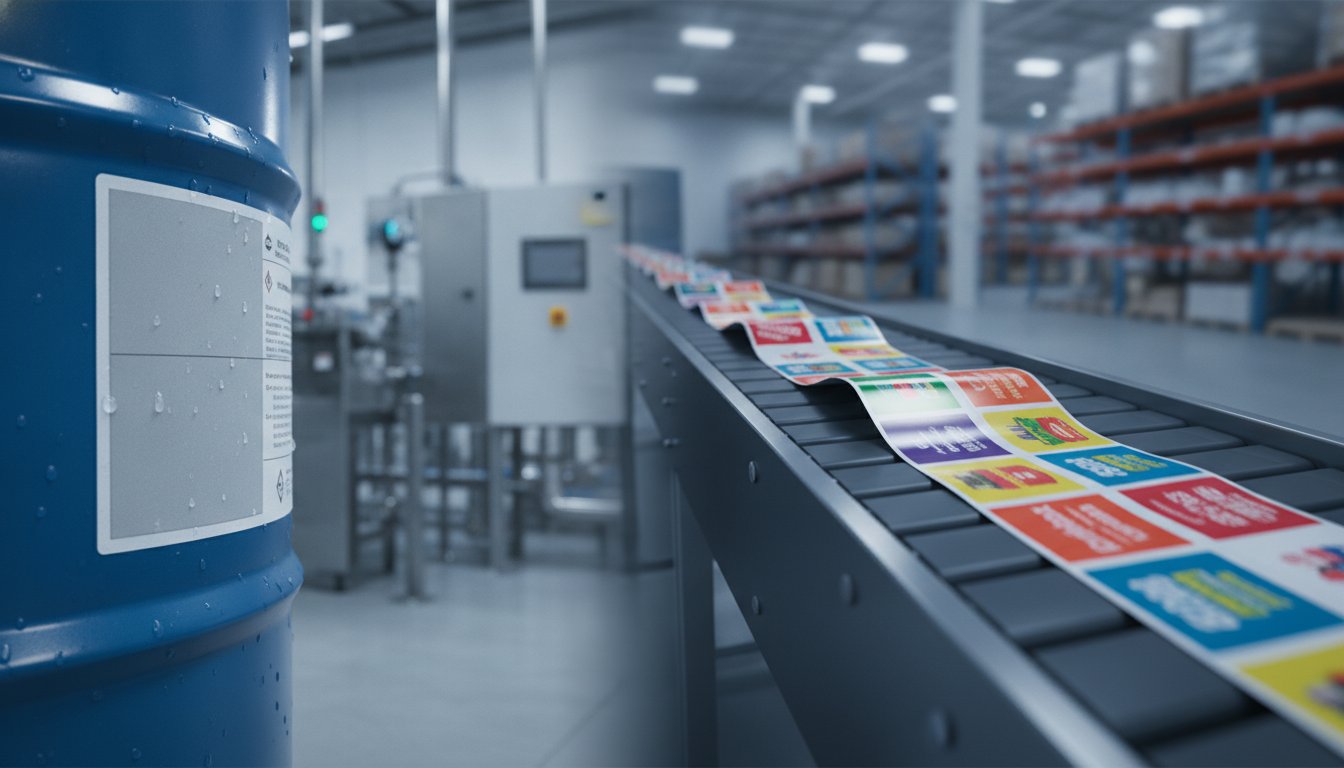
Core Technology: Pigment Ink vs. Memjet Dye Ink
At the heart of the Epson C6000A vs. Afinia L801 debate lies a fundamental difference in ink chemistry. Your choice here will dictate everything from your label's durability to its visual appeal on a retail shelf. This isn't just a technical detail; it's the single most important factor in determining which printer aligns with your business goals.
- Epson ColorWorks C6000A: Utilizes Epson's renowned PrecisionCore TFP printheads with four individual pigment-based ink cartridges (Cyan, Magenta, Yellow, and Black).
- Afinia L801: Employs Memjet technology, which uses a stationary "waterfall" printhead and five large dye-based 'Watershield' ink tanks for incredibly high-speed output.
- Dye Ink (Afinia): Offers a wider color gamut and superior vibrancy, making it perfect for prime product labels where eye-catching graphics are paramount. However, it is inherently less resistant to chemicals and long-term UV exposure.
- Pigment Ink (Epson): Provides industrial-grade resistance to water, oils, chemicals, and UV fading, making it the standard for durable and compliant labeling in harsh environments.
Epson C6000A: The Pigment Advantage for Durability
The Epson C6000A is engineered for applications where label failure is not an option. Its pigment-based ink is the key to this resilience. Pigment ink particles are microscopic, encapsulated solids that sit on top of the label media and bind to its surface, rather than being absorbed like a dye. This physical bond creates a durable layer that can withstand abrasion, moisture, and chemical exposure, making it essential for GHS and BS5609 chemical labeling compliance. If your labels will be exposed to the elements, stored in a warehouse, or applied to chemical drums, the C6000A's pigment ink provides the necessary long-term legibility and safety.
- Ideal for harsh environments where labels face abrasion, moisture, or sunlight.
- Essential for meeting GHS and BS5609 chemical labeling compliance.
- Pigment ink particles bind to the surface of synthetic media, creating a durable, water-resistant image.
Afinia L801: Memjet Speed and Retail Vibrancy
The Afinia L801 is built for one thing above all else: velocity. Its Memjet 'Waterfall' technology features a page-wide printhead with over 70,000 ink nozzles that remains static as the media passes underneath. This design allows for breathtaking print speeds that leave most competitors behind. The L801 uses dye-based inks, which are formulated for maximum color vibrancy and a wide gamut, allowing for precise brand color matching on glossy labels. While its Watershield ink technology offers improved moisture resistance compared to standard dye inks, its primary application is for prime product labels—such as those on food, beverage, or cosmetic products—where shelf appeal and high-volume throughput are the main drivers.
- Memjet 'Waterfall' technology's static printhead design enables faster throughput.
- Watershield ink improvements provide better moisture resistance than standard dye inks.
- Targeted at prime product labels where shelf appeal is the primary driver.
Performance Metrics: Speed, Resolution, and Volume
While ink chemistry defines what a printer can do, performance metrics define how fast and how well it does it. Here, the two printers diverge significantly, catering to completely different production philosophies. One prioritizes raw speed for massive batches, while the other focuses on precision and detail for critical applications.
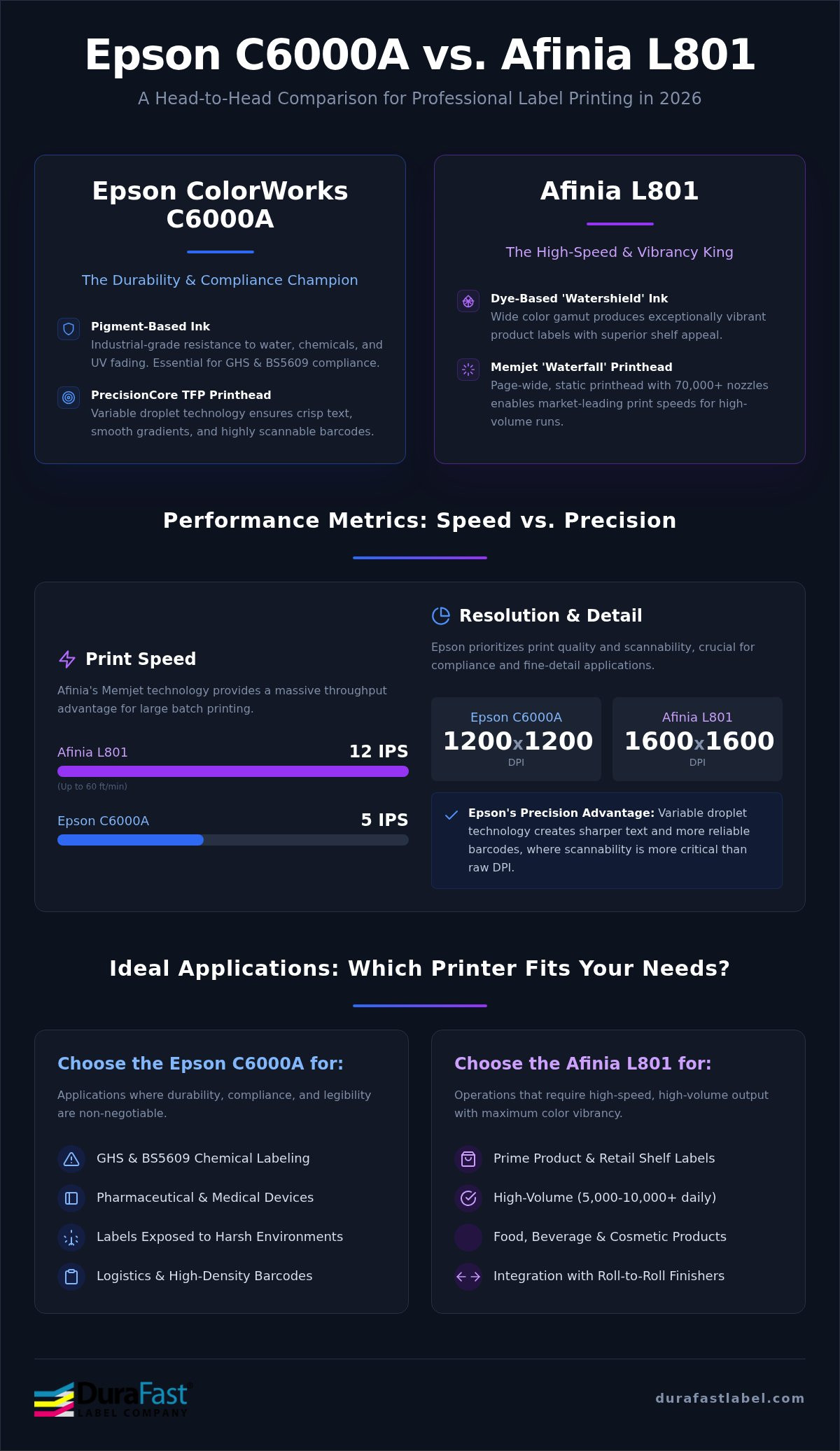
- Afinia L801: Leads the market in velocity, reaching speeds up to 60 feet per minute (12 inches per second) at 1600 x 800 dpi.
- Epson C6000A: Focuses on precision, offering a maximum resolution of 1200 x 1200 dpi and speeds up to 5 inches per second.
- Throughput Calculation: The real question is how many labels you can realistically print per 8-hour shift, factoring in quality settings and image complexity.
- The 2026 Balance: Modern production requires balancing print quality settings with demanding deadlines.
Calculating Throughput for High-Volume Operations
There is no contest when it comes to raw speed: the Afinia L801 is the clear winner. For businesses printing over 5,000 labels daily, especially for seasonal products or large retail orders, the L801's throughput is a game-changer. An 8-inch wide label job that might take hours on another printer can be completed in a fraction of the time. This constant, high speed is also critical when integrating the printer into a larger finishing system with roll-to-roll rewinders and applicators, as it keeps the entire production line moving without bottlenecks. It's important to note, however, that the most complex images printed at the highest 1600x1600 dpi setting will reduce the speed to 6 inches per second—still faster than the Epson, but a factor to consider in your calculations.
- The Afinia L801 is the workhorse for batches exceeding 5,000-10,000 labels daily.
- Constant speed is essential for keeping pace with roll-to-roll finishing equipment.
- While extremely fast, maximum resolution settings will reduce the L801's top speed.
Precision and Fine Detail Printing
While the Afinia L801 wins on speed, the Epson C6000A excels at precision. It's easy to get caught up in comparing DPI numbers, but print quality is more than just dots per inch. The C6000A's PrecisionCore printhead uses variable droplet technology, which produces different-sized ink droplets. This allows for incredibly smooth gradients, crisp text (even at small font sizes), and highly scannable 2D barcodes. For pharmaceutical labels, electronic component labels, or any application where a mis-scan could cause a major supply chain issue, the Epson's focus on detail is paramount. This is a case where resolution becomes more important than raw speed; a perfectly sharp 1200 dpi barcode is infinitely more valuable than a slightly fuzzy 1600 dpi one that fails to scan.
- Epson C6000A excels at small fonts and high-density 2D barcodes critical for logistics and compliance.
- Variable droplet technology in Epson printheads ensures smooth gradients and photographic quality.
- Resolution and scannability become more important than raw speed in regulated industries.
Compliance and Media: GHS vs. Retail Standards
The final printed label is a combination of the printer, the ink, and the media it's printed on. Mismatching these components can lead to smudged labels, poor adhesion, and failed compliance audits. The C6000A and L801 are designed for entirely different media ecosystems, dictated by their ink technology.
- Achieving BS5609 certification for maritime shipping is possible with the Epson C6000A and certified inkjet labels.
- The Afinia L801's dye-based ink means it is generally not recommended for chemical drum labeling or outdoor applications.
- The role of specialized matte chemical labels is crucial for industrial safety and legibility.
- Matching your media to your ink type is non-negotiable for maximum adhesion and legibility.
Chemical and Industrial Labeling Requirements
For any business involved in chemicals, manufacturing, or international shipping, compliance is key. The Globally Harmonized System (GHS) sets the standard for chemical hazard communication, and BS5609 certification is required for labels on goods shipped overseas by sea. These standards require labels to remain legible after prolonged exposure to saltwater immersion, UV light, and abrasion. The Epson C6000A, when paired with certified pigment-receptive media like DuraFast Matte Chemical Labels, is designed specifically to meet these stringent 2026 requirements. Using official Epson inks is the only way to ensure this combination works, as the ink and media are tested together to achieve certification. Pigment ink isn't just a preference for these applications; it's a requirement.
- Understand GHS (Globally Harmonized System) requirements for 2026 to ensure full compliance.
- Pigment ink is the only choice for maritime and outdoor exposure under BS5609.
- Using certified Epson inks and media is essential for guaranteeing long-term label legibility.
Prime Labels and Retail Aesthetics
In the competitive retail space, a product's label is its first impression. The Afinia L801 is built to make that impression a stunning one. Its dye-based inks are absorbed into the top layer of glossy label media, creating vibrant, rich colors that "pop" off the shelf. The L801's wider color gamut allows for more accurate reproduction of brand-specific colors, a critical factor for consumer goods. When using high-gloss synthetic media, the visual difference is clear: dye ink from the L801 produces a seamless, almost laminated look, while pigment ink can appear slightly less vibrant on the same stock. For high-volume product packaging in industries like food, wine, and cosmetics, the L801 and its compatible Afinia inks deliver the speed and aesthetic quality needed to stand out.
- Afinia L801's ability to hit a wider color gamut is ideal for precise brand-matching.
- Using Afinia inks is perfect for high-gloss product packaging that needs to capture customer attention.
- Comparing the visual "pop" of dye vs. pigment on glossy synthetic media clearly shows dye's advantage for retail.
Operational Workflow: Peeler Advantage and Maintenance
A printer's impact extends beyond the print tray. How it integrates into your daily operations, its maintenance demands, and its long-term costs are crucial factors. The C6000A and L801 offer different approaches to workflow automation and long-term reliability.
- The Epson C6000A's "A" model features a built-in auto-peeler for automated peel-and-present workflows.
- The Afinia L801 is optimized for high-speed roll-to-roll production, typically requiring external rewinders and finishers.
- A key difference is maintenance: the L801's Memjet printhead is a user-replaceable consumable, while Epson's PrecisionCore printheads are considered permanent.
- Integrating both with label design software like BarTender is essential for seamless production.
The Peeler Workflow: Speeding Up Manual Application
For businesses that apply labels by hand, the Epson C6000A's built-in peeler is a significant advantage. In a "peel-and-present" operation, the printer automatically separates the label from its backing liner and presents it to the operator for immediate application. This simple feature can dramatically increase efficiency in shipping departments, manufacturing cells, or anywhere labels are applied to individual products or boxes one at a time. It eliminates the tedious and time-consuming task of manually peeling each label, reducing labor costs and speeding up the entire process. This integrated automation is a standout feature that the L801, being a roll-to-roll focused machine, does not offer.
- The Epson C6000A peeler eliminates the need for manual label stripping, saving time and effort.
- Best use cases for peel-and-present include logistics, manufacturing, and individual product labeling.
- Reduces labor costs and improves operator ergonomics with integrated automation features.
Maintenance and Long-Term Reliability
The long-term cost and maintenance schedule for these printers are fundamentally different. The Afinia L801's Memjet printhead is a high-performance component that is also considered a consumable. Depending on usage, it will need to be replaced periodically, representing a significant operational cost. The replacement process is straightforward but must be factored into the Total Cost of Ownership (TCO). In contrast, the Epson C6000A's PrecisionCore printhead is designed to last the life of the printer. The C6000A performs automatic self-cleaning and maintenance routines to ensure nozzle health, maximizing uptime and predictability. When calculating the TCO over a 3-year period, businesses must account for the L801's printhead replacement costs versus the C6000A's potentially lower, more predictable maintenance profile.
- Memjet printhead life expectancy varies, and its replacement is a recurring cost.
- Epson's self-cleaning mechanisms and permanent printhead are designed to maximize uptime.
- Calculating the Total Cost of Ownership (TCO) over a 3-year period is essential for an accurate budget.
Verdict: Which Printer Should You Buy in 2026?
The choice between the Epson ColorWorks C6000A and the Afinia L801 is a strategic business decision, not just a hardware purchase. It comes down to a clear trade-off: do you need industrial durability and compliance, or do you need high-velocity retail throughput? Answering this question will point you directly to the right machine for your operation.
- Choose the Epson ColorWorks C6000A if durability, GHS/BS5609 compliance, and precise barcode scanning are non-negotiable.
- Choose the Afinia L801 if you need maximum speed for printing thousands of vibrant, eye-catching prime retail labels daily.
- The importance of testing your specific media on both platforms cannot be overstated before committing to a hardware purchase.
- Get started with a solution that fits your unique needs to bring your label printing in-house successfully.
Best for Chemicals, Logistics, and Manufacturing
The Epson ColorWorks C6000A is the definitive choice for rugged industrial environments. Its pigment ink provides the durability required to meet strict GHS compliance standards, ensuring labels remain legible despite exposure to chemicals, abrasion, and moisture. For shipping departments and manufacturing lines where labels are applied manually, the "A" model's integrated peeler is a game-changing efficiency booster that reduces labor and accelerates workflow. If your business operates in a regulated industry where label accuracy and longevity are critical, the C6000A is the reliable, purpose-built solution.
- Final summary of the Epson C6000A's strengths in rugged environments.
- The peeler model is a major advantage for shipping and manual application workflows.
- The clear recommendation for any GHS-compliant workflow.
Best for Food, Beverage, and Prime Retail
The Afinia L801 is an unmatched workhorse for high-volume retail labeling. Its incredible Memjet speed allows businesses to handle massive print jobs and seasonal demand spikes with ease. The dye-based Watershield ink delivers the vibrant, brilliant colors necessary to make products stand out on crowded store shelves. For any business where the label's primary job is to attract customers and convey brand quality—such as in the food, beverage, craft beer, or cosmetics industries—the L801's combination of speed and aesthetic excellence is the winning formula. If your priority is getting thousands of beautiful labels printed quickly, the L801 is the printer to beat.
- Final summary of the Afinia L801's speed and color advantages.
- How the L801 is perfectly suited to handle high-volume seasonal demand.
- Final CTA: Contact DuraFast Label Company for a custom ROI analysis.