Fastest Industrial Color Label Printers: The 2026 High-Volume Throughput Guide
9th Sep 2026
Is your production line currently at the mercy of a slow printer? In high-volume manufacturing, a label printer that can't keep up is more than an inconvenience; it's a direct drain on your bottom line. You might have noticed that rated "inches per second" rarely reflect the actual reality of a busy warehouse floor. Finding the fastest industrial color label printers for 2026 isn't just about chasing raw speed. It's about identifying the hardware that maintains peak performance without constant maintenance stops or ink changes.
We understand the frustration of watching orders pile up while you wait for a slow machine or face the high costs of outsourcing your labels. This guide promises to clear the confusion by highlighting the top-performing printers that deliver the highest daily output. We'll preview the latest 2026 technology, from the precision of the Epson ColorWorks C8000 to the rapid Memjet speeds of the Afinia L901. You'll learn how to eliminate production bottlenecks and streamline your workflow with the right combination of high-speed hardware and optimized software like BarTender. Let's find the solution that keeps your production moving at full throttle.
Key Takeaways
- Understand the critical difference between rated inches per second and total daily throughput to ensure your production line never stops.
- Compare the "waterfall" speed of Memjet technology with the industrial durability of Epson PrecisionCore to find the right fit for your facility.
- Identify the fastest industrial color label printers of 2026, such as the Epson C8000 and Afinia L901, and how they balance high resolution with rapid output.
- Learn how to eliminate production bottlenecks by matching your specific peak daily volume to the right hardware and high-speed media.
The Productivity Trap: Why IPS Isn't the Only Speed Metric
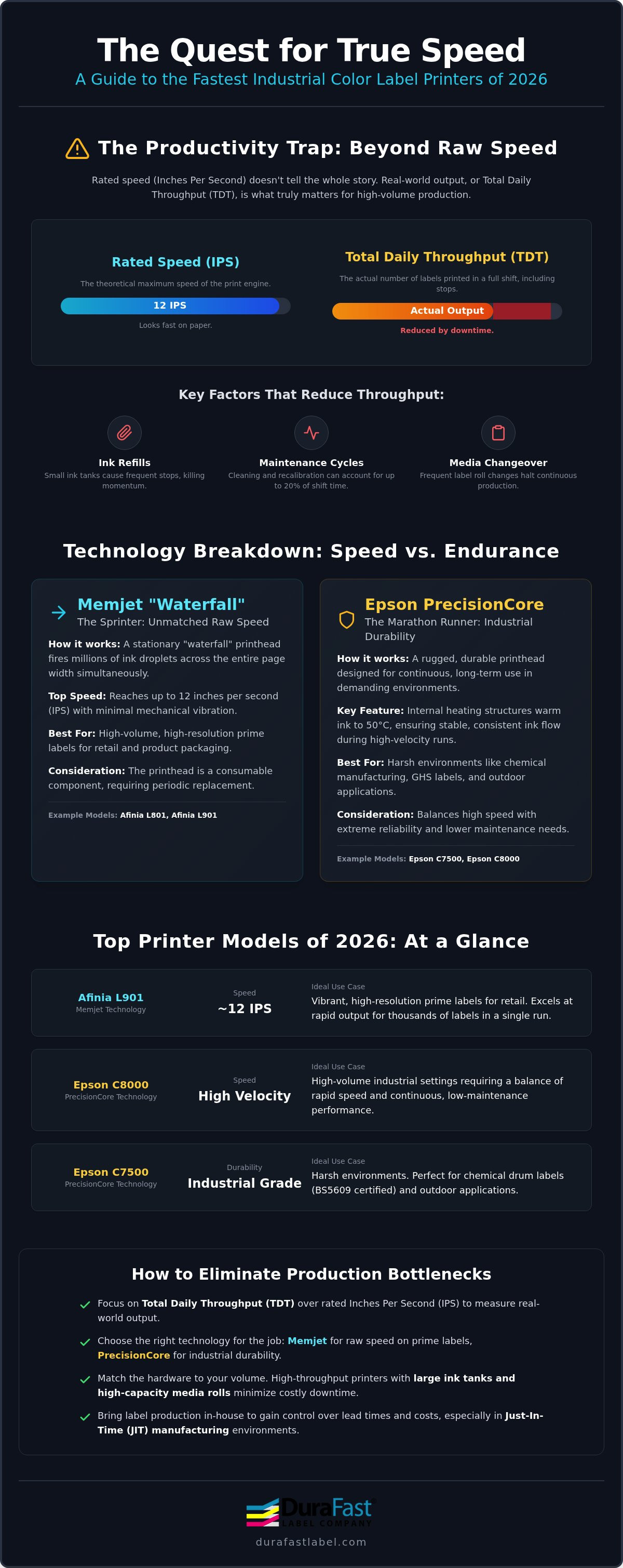
When you search for the fastest industrial color label printers, the first number you see is usually Inches Per Second (IPS). It's a tempting metric to focus on because it feels like a definitive ranking. However, relying solely on IPS is a common productivity trap. IPS measures how fast the paper moves while the ink is hitting the page. Total Daily Throughput (TDT), on the other hand, measures how many finished labels you actually have in your hand at the end of a full shift. It accounts for the stops, starts, and pauses that happen in a real warehouse environment.
Consider a scenario where a 15 IPS printer stops every thirty minutes for a two minute cleaning cycle or an ink refill. Over an eight hour shift, a 12 IPS printer with larger ink tanks and more efficient maintenance cycles will often produce a higher volume of labels. Continuous production is the ultimate goal. If your printer spends 20% of its time cleaning or recalibrating, that high IPS rating is essentially wasted. High-volume industrial label printers must balance raw engine speed with reliability to avoid these hidden bottlenecks.
Ink tank capacity is another silent speed killer. Small cartridges might be fine for short runs, but they aren't built for the fastest industrial color label printers running thousands of units. Every time a machine stops for a refill, you lose money. Printers designed for high throughput use bulk ink systems or high-capacity tanks to keep the lines moving. This ensures that the engine's speed isn't throttled by supply logistics or frequent operator intervention.
Calculating Your Real-World Throughput
To find your true speed, you have to look beyond the print engine. Factors like label roll changeover time can significantly impact your output. If you're running high-volume orders, switching a roll every twenty minutes kills your momentum. Using high-capacity rewinders and larger media rolls helps maintain those top speeds without constant human intervention. Throughput Efficiency is the ratio of active print time to total shift duration.
When Does Raw Speed Become a Necessity?
There's a specific point where outsourcing labels becomes a liability rather than a convenience. This outsourcing threshold is usually reached when your lead times from a print house start causing delays in your own shipping department. Just-in-time (JIT) manufacturing environments require high-velocity printing to keep up with fluctuating order volumes. If you're trying to determine the ROI of bringing production in-house, learning how to print your own product labels is the first step toward reclaiming your schedule and your budget.
Technology Breakdown: Memjet vs. Epson PrecisionCore
Choosing between the fastest industrial color label printers often comes down to two competing philosophies of speed. Memjet technology is the undisputed sprinter of the group. It uses a "waterfall" design where the printhead remains stationary while millions of ink droplets fire simultaneously across the entire width of the page. This allows machines to reach speeds of 12 inches per second without the mechanical vibration of a moving carriage. In 2026, Memjet has pushed this further with the Setanta CMOS nozzle control system, which offers more precise dot placement and faster warm-up times.
Epson PrecisionCore TFP takes a different approach. It's the marathon runner of the industry, designed for rugged, continuous use. While it might not always match the raw top speed of a waterfall head, it offers incredible durability. The 2026 Epson printheads, like the T3200-U3-2, now feature internal heating structures. By warming ink up to 50°C, these engines maintain stability even during high-velocity runs. This thermal management is crucial for preventing jams and ensuring consistent ink flow during long shifts.
Memjet: The King of High-Volume Prime Labels
The Afinia L801 and L901 series are built for speed and vibrant retail aesthetics. These printers excel when you need thousands of high-resolution prime labels in a single afternoon. The trade-off for this velocity is the printhead. Because Memjet heads are a consumable component, you'll need to factor in replacement costs over time. Using genuine Afinia inks ensures your color consistency remains perfect across every run, which is vital for brand integrity on store shelves.
PrecisionCore: Industrial Speed for Harsh Environments
For chemical manufacturing or outdoor applications, the Epson ColorWorks C7500 and C8000 are the gold standards. These machines prioritize pigment-based inks, which are far more resistant to moisture, chemicals, and UV light than dye-based alternatives. Meeting OSHA's Hazard Communication Standard requires labels that won't smudge or fade under duress. Pigment inks handle the heat of high-speed engines exceptionally well, drying almost instantly to prevent smearing. For a deeper dive into these models, our Epson ColorWorks Guide covers every technical detail. If you're unsure which technology fits your volume, talk to our specialists for a tailored ROI analysis.
The Fastest Industrial Color Label Printers of 2026 Compared
Comparing the top models in 2026 requires looking at how they handle raw data as much as how they spray ink. The fastest industrial color label printers are only as quick as their internal processors. If your network or internal RAM lags, the printer will pause to buffer. This "data starvation" bottleneck can ruin your throughput even if the engine is rated for high speeds. Modern industrial units now feature upgraded Ethernet connectivity and high-speed image processing to ensure the "brain" of the machine keeps up with the printhead.
Resolution also plays a major role in your speed settings. While many machines boast 1200 or 1600 dpi, running at maximum resolution often requires a slower IPS setting. Finding the "sweet spot" usually means dropping to 600 x 1200 dpi. At this level, you maintain crisp barcodes and legible fine print while allowing the engine to run at its full rated velocity. Media width is another factor; printing two-up or three-up on an 8-inch wide roll effectively doubles or triples your output compared to a standard 4-inch wide machine.
The Speed Leaders: Afinia L901 and Epson C8000
The Afinia L901 remains the benchmark for Memjet-powered velocity. It delivers a consistent 12 inches per second, making it ideal for massive runs of prime retail labels. Because it uses a stationary head, it avoids the mechanical wear associated with moving parts. This allows for a massive daily volume that few other inkjet systems can match. Ink costs are also lower here due to the use of large 250ml tanks that support long, uninterrupted shifts.
The Epson ColorWorks C8000 is the heavy-duty alternative for those who need industrial-grade durability. It matches the 12 IPS speed of its competitors but utilizes Epson's PrecisionCore printhead technology to deliver permanent, pigment-based results. This machine is built for the "always-on" environment. It handles specialized media with ease, ensuring that even at top speed, the ink bonds perfectly to the surface without smudging or bleeding.
Mid-Range Speed: Epson C6000A and Afinia L502
Sometimes, raw speed isn't the only requirement. For specialized workflows, a mid-range speed of 5 IPS is often "fast enough." The Epson C6000A is a perfect example; it provides the precision needed for GHS and chemical labeling where accuracy is more critical than sheer volume. These industrial color label printers often include built-in auto-cutters. This feature is a massive advantage for high-speed applications where you need individual labels finished and ready for application immediately after they leave the engine. The Afinia L502 offers similar mid-range performance with the added flexibility of switching between dye and pigment inks, making it a versatile workhorse for varying production needs.
Selection Guide: Matching Speed to Your Industry Requirements
Choosing the right engine involves more than just comparing spec sheets. To find the fastest industrial color label printers for your specific needs, you must map the technology to your operational reality. Start by quantifying your peak daily label volume. If your facility pushes 10,000 labels during a single shift, high-velocity hardware is mandatory. However, if those peaks only happen once a month, a mid-range unit might offer better value. Always calculate your Total Cost of Ownership (TCO) by evaluating ink consumption and media costs at your target speeds. High-speed printing is only a win if the cost per label remains sustainable.
Next, determine your environmental durability needs. Retail applications often prioritize the vibrant pop of dye-based inks. In contrast, industrial sectors require the chemical and UV resistance of pigment inks. Software compatibility is equally vital. Using industry-standard tools like BarTender Professional ensures your data reaches the printhead without the lag that causes stuttering. Finally, audit your infrastructure. These high-performance machines require stable power and high-bandwidth network connections to prevent the data starvation bottlenecks discussed in previous sections.
E-commerce and Logistics: Rapid Shipping Labels
For organizations that need to complement their in-house labeling capabilities with larger-scale professional displays, you can learn more about First Stop Signs Print to explore bespoke signage and commercial printing solutions tailored for industrial and retail environments.
Logistics is shifting toward full-color branding on shipping labels to enhance the unboxing experience. It's no longer just about a functional barcode. Integrating high-speed color engines with automated applicators requires hardware that can pause and resume instantly without losing synchronization. For facilities managing hybrid workflows, using industrial thermal printers alongside color inkjet units provides the best balance of speed and branding potential. This allows you to print high-volume monochrome labels while reserving color for premium customer segments.
Chemical and Manufacturing: GHS Compliance at Speed
In the chemical sector, velocity cannot compromise safety. Maintaining BS5609 compliance at 10 or 12 IPS is a technical hurdle that requires precisely matched pigment inks and treated media. If a label smudges or flakes during a high-speed run, you risk non-compliance and significant regulatory fines. Using high-quality media ensures that the ink bonds instantly, even at maximum engine speeds. Our GHS Label Printer Guide provides a deeper look at these 2026 compliance standards. To ensure your specific media performs under pressure, contact our experts for a personalized compatibility test and ROI analysis.
Optimizing Your In-House Production with DuraFast
While high-speed labeling is a critical component of the supply chain, manufacturers in the medical device industry often require broader support; for a look at how a specialist CDMO manages these complex requirements, visit Fong’s Engineering & Manufacturing Private Limited.
DuraFast Label Company positions itself as your specialized partner for high-volume success. We've done the heavy lifting by vetting the fastest industrial color label printers on the market. Our curated selection focuses on hardware that balances raw speed with long-term reliability. By bringing production in-house, you gain total control over your schedule and eliminate the high costs of outsourcing. We support businesses across North America with the hardware and consumables needed to maintain peak performance throughout every shift. Our goal is to simplify your decision-making process by providing solutions that work from day one.
Reducing downtime is our core priority. We provide high-capacity ink tanks and large-diameter label rolls to keep your machines running longer between changeovers. This approach minimizes human intervention during peak production windows. When you combine high-speed hardware with optimized media, your "Total Daily Throughput" finally matches the numbers on the spec sheet. We don't just sell printers; we provide a complete ecosystem for in-house printing success.
High-Speed Consumables: The Secret to Reliable Throughput
Speed is nothing without the right media. Standard inkjet labels often fail when pushed to 10 or 12 IPS. If the topcoat isn't rated for high-speed absorption, the ink will smudge or bleed before it can dry. This creates messy results and can even lead to internal printer contamination over time. Liner quality also impacts the longevity of your equipment. A poor-quality liner can create dust that clogs sensitive printheads during long, high-velocity runs. Our DuraFast Matte Chemical Labels are specifically engineered to handle these high-velocity engines. They ensure that every droplet bonds instantly, providing the durability needed for GHS compliance and harsh industrial environments.
Ready to Eliminate Your Labeling Bottleneck?
Moving from traditional thermal transfer to high-speed color is a significant step for any facility. It's about more than just adding a logo; it's about transforming your entire workflow. DuraFast offers a custom throughput analysis to help you identify the exact ROI for your business. We help you navigate the transition, ensuring your software, network, and media are all aligned for success. Stop letting slow printing dictate your shipping schedule. Contact DuraFast for a High-Volume Printing Consultation to see how the fastest industrial color label printers can revolutionize your production line.
Take Control of Your High-Volume Production
Choosing from the fastest industrial color label printers is a strategic decision that impacts your entire supply chain. You've learned that raw engine speed means little without the right throughput efficiency and specialized media to support it. Whether you need the rapid waterfall output of a Memjet-powered Afinia or the rugged durability of an Epson PrecisionCore engine, the right choice will eliminate your production bottlenecks for good. Don't let slow hardware or poor-quality labels hold your shipping department back in 2026.
As an Authorized Epson Platinum Dealer, DuraFast Label Company offers more than just hardware. We provide specialized high-speed inkjet media and expert North American support to ensure your in-house printing is a success from the first run. We're here to help you calculate your ROI and find the perfect balance of speed, quality, and cost. Shop our full range of high-speed industrial color label printers or speak with a specialist today to get started. It's time to transform your labeling process into a reliable competitive advantage.
Frequently Asked Questions
What is the fastest industrial color label printer available in 2026?
The Afinia L901 and Epson ColorWorks C8000 are the top contenders, both reaching 12 inches per second (IPS). The L901 utilizes Memjet waterfall technology for high-speed prime labels, while the C8000 offers industrial-grade pigment ink performance. Choosing between them depends on whether you value retail-quality dye results or chemical-resistant durability for your specific high-volume production environment. Both models represent the pinnacle of speed for 2026.
Does printing at high speeds reduce the quality of the color labels?
High-speed printing doesn't necessarily sacrifice quality, but it requires finding the right balance between resolution and velocity. Most of the fastest industrial color label printers achieve excellent results at 600 x 1200 dpi while running at full speed. Pushing to maximum dpi often requires slowing the engine down. Using high-quality, treated media ensures that ink sets instantly without smudging or bleeding during these rapid production runs.
How many labels per hour can a high-speed industrial printer produce?
Production volume depends on label size, but a printer running at 12 IPS can process 60 feet of media per minute. For a standard 4x6 shipping label, this translates to roughly 7,200 labels per hour of active print time. It's vital to account for maintenance pauses and roll changes when calculating your total daily throughput. Using high-capacity rewinders helps maintain this momentum by reducing the frequency of operator intervention.
Which technology is faster: Memjet or Epson's PrecisionCore?
Memjet technology typically holds the edge for raw waterfall speed because the printhead remains stationary across the entire page width. However, Epson's PrecisionCore has closed the gap in 2026 with engines like the C8000 matching that 12 IPS benchmark. While Memjet excels at high-speed prime labels, PrecisionCore offers the ruggedness needed for consistent output. It's built for industrial reliability in high-velocity manufacturing environments where durability is a priority.
Do high-speed label printers require special ink or paper?
Yes, running at maximum velocity requires media specifically rated for high-speed ink absorption. Standard labels might not dry fast enough, leading to smearing as the media hits the rewinder. DuraFast Matte Chemical Labels and other high-speed inkjet media are engineered with specialized topcoats that bond with the ink instantly. Using genuine manufacturer inks also ensures the viscosity is perfectly matched to the printhead's firing frequency during these rapid production runs.
Is it more cost-effective to print high-volume labels in-house or outsource them?
In-house printing becomes significantly more cost-effective once your volume reaches a certain threshold, often saving companies 40% or more compared to outsourcing. You eliminate the markup from print houses and the shipping costs of pre-printed rolls. More importantly, you gain the agility to print exactly what you need on-demand. This reduces waste from obsolete designs and prevents production delays caused by waiting for external vendors.
What maintenance is required for printers running at maximum speed?
Maintenance for high-speed units focuses on keeping the printhead and media path clean. You'll need to monitor wiper blades and maintenance boxes more frequently during peak shifts. High-velocity engines generate more heat and paper dust, so regular cleaning prevents debris from affecting dot placement. Most modern industrial models include automated cleaning cycles to handle these tasks, but periodic manual checks ensure long-term reliability and consistent color accuracy.
Can high-speed color label printers be integrated into automated production lines?
Absolutely, these printers are designed for seamless integration with automated applicators and finishing equipment. Using software like BarTender Professional allows the printer to communicate with your ERP system for real-time data accuracy. Connectivity options like high-speed Ethernet and I/O ports ensure the printer stays synchronized with the rest of your line. This setup transforms your fastest industrial color label printers into a fully automated, just-in-time labeling solution for modern warehouses.