Freezer Grade Labels for Commercial Frozen Food Packaging
15th Nov 2026
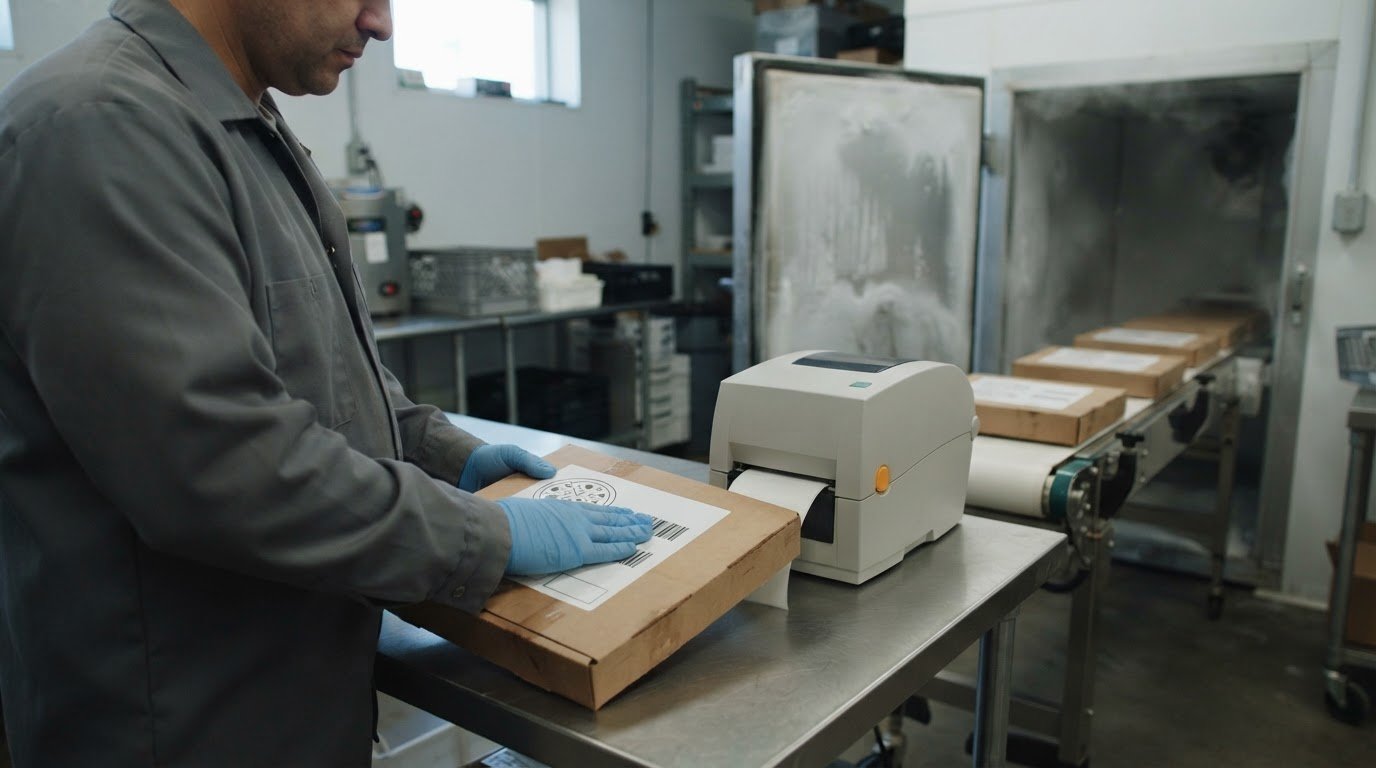
Cold storage doesn’t rule out clear labels, but the label material and adhesive matter more than appearance alone. Freezer grade labels for frozen food need stock and adhesive suited to the conditions they’ll face. For a secure bond, apply labels to a clean, dry package before freezing. If the food is already frozen, use an adhesive rated for cold application.
It’s reasonable to want labels that keep packaging visible while displaying readable product details and changing codes. This guide explains when to apply labels, what affects clear-label and variable-code performance in cold storage, and how to choose options for foods such as ice cream, pizza, popsicles, produce, and frozen dinners. You’ll also learn what to consider for barcode readability, temperature exposure, and materials suited to your packaging and workflow.
Key Takeaways
- Apply labels to clean, dry packaging before freezing when possible; frozen-surface application calls for an adhesive designed for cold use.
- Match label material and adhesive to the freezer environment, packaging surface, and temperature changes the product will experience.
- Keep barcodes and date codes readable by considering moisture, print quality, code placement, and changing batch information.
- Choose label materials and application methods to suit the product and workflow, from individually wrapped popsicles to commercial frozen-food cases.
- Test labels on actual packaging in cold-storage conditions before moving to a full production run.
Can I apply the labels before freezing or wait until after freezing?
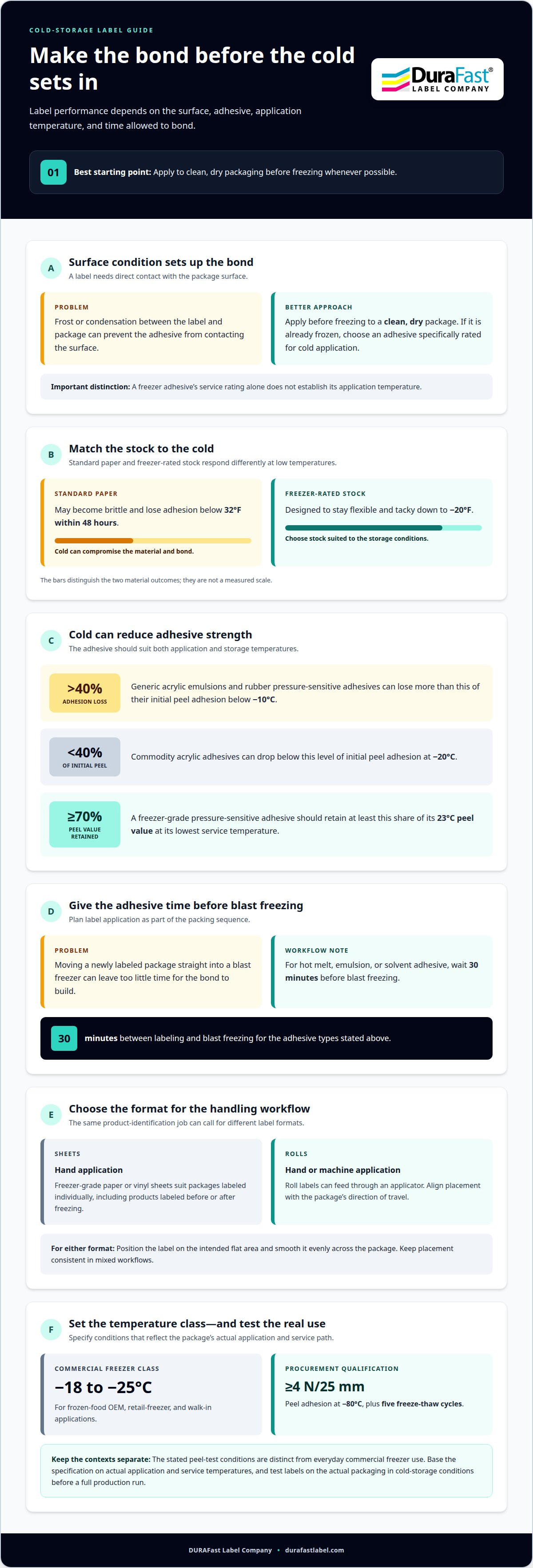
Apply labels before freezing, while the package is clean and dry. If the product is already frozen, use an adhesive specifically rated for cold application.
Freezer-Rated Stock and Adhesives
Freezer-rated stock is designed to stay flexible and tacky down to -20°F, unlike standard paper that may become brittle and lose adhesion below 32°F within 48 hours. Match the label material and adhesive to both the application temperature and the temperature during storage. This distinction matters because a label applied in a warm packing area faces different conditions than one applied to frozen packaging.
Adhesive Performance in Cold Conditions
Cold can reduce the bond from adhesives made for ambient use. Generic acrylic emulsions and rubber pressure-sensitive adhesives can lose more than 40 percent of their initial peel adhesion below −10 °C. Commodity acrylic adhesives can drop below 40 percent of initial peel adhesion at −20 °C. A freezer-grade pressure-sensitive adhesive should retain at least 70 percent of its 23 °C peel value at its lowest service temperature.
For a stronger bond, press the label onto a clean, dry surface before freezing. Frost or condensation between the label and package can prevent the adhesive from contacting the surface. If labeling a frozen package, choose an adhesive specifically rated for cold application. A freezer adhesive’s service rating alone does not establish its application temperature.
Allow time for the adhesive to build bond strength before moving packages into cold storage. For a product heading straight into a blast freezer, hot melt adhesive is recommended. When using hot melt, emulsion, or solvent adhesive, wait 30 minutes before blast freezing. Include that timing in the packing workflow so labels have an opportunity to bond before the temperature drops.
Peel testing can help assess adhesive performance in cold conditions. For a procurement specification, the stated qualification is peel adhesion of at least 4 N/25 mm at −80 °C, plus five freeze-thaw cycles. Those testing conditions are distinct from everyday commercial freezer use, so base a specification on the actual application and service temperatures.
Workplace chemical labels have a separate purpose from food-package labels. According to the Occupational Safety and Health Administration, OSHA 1910.1200 is the Hazard Communication Standard relevant to workplace chemical labels in the United States. Account for that standard when labeling workplace chemicals, rather than treating a freezer adhesive choice as a substitute for chemical-label requirements.
Frozen-food and commercial freezer applications
Commercial freezer labels serve manufacturers, retailers, food-service operations, and distributors handling packaged products. The commercial-freezer temperature class is −18 to −25 °C for frozen-food OEM, retail-freezer, and walk-in applications. Match the label to the package and its handling path, not just the freezer where it waits. A case label for warehouse movement, for example, has a different job from a small label on an individual food pack.
Frozen-food packaging includes cartons, tubs, bags, trays, and wrapped products. Labels can identify products, support inventory handling, and carry changing details such as lot numbers or dates. A label design can reserve fixed space for product information while leaving a clear field for variable data. This keeps the same layout usable across product variations without treating every package as identical.
Material and format affect how labels fit into operations. Sheet labels made from freezer-grade paper or vinyl suit products labeled by hand, whether they are non-frozen or already frozen before freezer storage. Sheets work well when workers label packages individually or use different designs. Rolls can be applied by hand or machine, making them an option for operations that feed labels through an applicator.
- Hand application: Position each label on the intended flat area, then smooth it across the package so it lies evenly.
- Machine application: Feed roll labels through the application setup and align placement with the package’s direction of travel.
- Mixed workflows: Use format and placement consistently so staff can identify the correct label for each product.
Timing matters on the line. Plan label application around packaging, cooling, and freezer entry rather than leaving it as an unplanned final task. Condensation can form as packages move between temperature zones, so account for surface moisture during application. For example, a chilled carton moving into a walk-in freezer may need a different line sequence from a package labeled before cooling. Application conditions matter to the adhesive bond.
For a practical workflow, map each product’s package, label location, application method, and variable numbers before production. A hand-applied sheet and a machine-applied roll solve different handling needs, even when both identify the same frozen food. If you’re planning custom labels or adjusting application operations, discuss your frozen-food label workflow.
How to Keep Barcodes and Date Codes Readable in the Cold
Moisture, temperature changes, and handling can affect printed information in cold storage. Build legibility checks into the label design and production process.
Barcode and Date-Code Legibility
Place barcodes on flat package areas where possible, rather than on curved edges. Keep bars dark against a light background to support scanning if frost is present. Position lot numbers and date fields where they’ll remain visible after packing, stacking, and routine handling.
Direct-thermal labels may develop legibility issues after 60-90 days in some cold-chain conditions. Select a printing method and label construction suited to the product’s storage period. The FDA labeling rules described for frozen foods require lot numbers and use-by dates to remain legible for the life of the product.
Small alignment errors can affect scanning. On a 4-by-6-inch case label, registration off by 1-2 mm can make a barcode unscannable. Print a test batch and inspect code placement, character clarity, and contrast before a full production run. A barcode grade of C or better is the recommended release threshold.
Clear-Label Performance in Cold Environments
Clear labels can show package graphics or product colors through the material, but readable printing still depends on contrast and placement. Consider the background beneath each code: dark bars need a light field, even on transparent material. Check the label’s moisture resistance, then assess whether condensation or frost could obscure the printed information.
Film labels generally resist moisture better than paper labels because film does not absorb moisture. This can matter as packages move between room temperature and cold storage. Clear film does not eliminate the need to check print visibility. Test the actual label on the intended package, accounting for its color, curvature, and surface finish.
Use a practical verification sequence: print representative labels, apply them to actual packaging, and expose them to real operating conditions. Then check that date codes remain readable and that scanners can capture the barcode. A 30-minute freeze-and-thaw cycle provides one legibility check. Record any placement or contrast issue, adjust the template, and repeat the test before production.
Labels for ice cream, pizza, popsicles, produce, and frozen dinners
For plastic containers, glass jars, and freezer bags, choose label stock and adhesive suited to the package surface and application conditions. Flexible, freezer-rated stock is a practical starting point, but the best fit depends on the packaging and how labels will be applied.
Labels for Frozen Food Products
Ice cream tubs, pizza cartons, popsicle wrappers, produce bags, and frozen dinner trays have different shapes and label areas. Match label size and placement to the package, keeping key information visible after sealing or stacking. Freezer-grade paper or vinyl sheet labels can suit hand application, while roll formats can support hand or machine application.
Requirements for Frozen Meat and Egg Labels
Frozen foods regulated by the USDA must include the product name, handling statement, safe handling instructions, inspection legend, net weight, ingredients list with potential allergens, nutrition facts, and company name and address. Products containing meat or eggs may be subject to additional labeling requirements. Plan the label design around these requirements before choosing a size, so the required information remains readable on the package.
Prepackaged frozen foods generally need labels that identify the food and provide key product and company information. Frozen food not monitored by the USDA is monitored by the FDA. Organize information clearly, especially on compact packaging such as a small frozen dinner tray.
Labels for Containers, Jars, and Bags
Plastic containers, glass jars, and flexible freezer bags each present a different application surface. A label that lies flat on a container may wrinkle across a bag’s folds, while a jar’s curved wall can affect placement. Choose a label size and shape that fits the package’s usable area, then apply it consistently to a clean surface.
On production lines, roll-form labels can be applied by hand or machine. Plan the roll’s orientation and label placement around the packaging flow, such as cartons moving past an applicator or bags labeled by hand. This helps make the process repeatable across product numbers and package sizes. Sheet labels, by contrast, are applied by hand.
Test the complete setup on actual packaging before a production run. Apply labels to examples such as a glass jar, plastic tub, and freezer bag, then assess placement, legibility, and whether each label stays attached during cold storage. Include the finished package’s handling and storage conditions in the evaluation. This check can reveal a mismatch between label design, package shape, and application method.
What temperature range can freezer labels withstand?
There isn’t one temperature range for every freezer label. Distinguish the minimum application temperature from the service range, then match both to the package’s actual handling and storage conditions.
For commercial frozen-food packaging, freezer-grade adhesive is listed with a minimum application temperature of -40 °F and a service temperature range of -65 to 120 °F. These figures describe different conditions: application temperature concerns when the label is applied, while service temperature concerns the range it can face afterward. A label applied above its minimum can still encounter colder storage during use.
General-purpose adhesive has a listed service range of -65 to 160 °F, but that broad range alone doesn’t establish suitability for cold application. Its minimum application temperature is 0 °F, with a note that it can be as low as -40 °F. All-temperature adhesive has a 35 °F minimum application temperature and a service range of 0 to 120 °F. Compare these values with the actual application step, not just the freezer setting.
Application conditions can make general-purpose labels suitable in some workflows. If a label is applied in a dry, room-temperature environment and never exposed below 5 °F, general-purpose labels may be sufficient. Frozen food packaging can experience temperature swings from -10 °F to room temperature, so consider every stage, including storage, transport, and handling.
Material matters too. Polypropylene labels become brittle below about −40 °C, making them unsuitable for ultra-low-temperature or cryogenic use. Ultra-low-temperature labels are used from −40 to −80 °C, while cryogenic labels are intended for −80 to −196 °C. Those environments differ sharply from commercial freezers, so don’t select a cryogenic range simply because a product is frozen.
Solvent acrylic adhesive has a listed service range of -320 to 190 °F. That range is far broader than typical frozen-food needs; choose based on the package’s real temperature path and required application conditions. Adhesive range also doesn’t replace practical evaluation of the label stock and package surface together.
To specify a label, write down the coldest application condition, lowest and highest service temperatures, and any room-temperature transitions. Then match those conditions against both adhesive ratings and label material. If your packaging moves through several temperature zones, discuss the temperature requirements for your label application.
DuraFast Label Company
DuraFast Label Company offers label printers and supplies for businesses planning a frozen-food labeling workflow. If you’re choosing how to print product graphics, variable dates, or lot codes, consider the label format and information your packages need. The Epson ColorWorks C6000A is a popular color-label printer option, while the Zebra ZT411 Thermal Transfer Printer supports a thermal-transfer setup. Pair a printer choice with compatible label stock and ribbons for your intended workflow. DuraFast Matte Chemical Labels are another label option, but they shouldn’t be treated as freezer-rated based on their name alone. Share your application details when you contact DuraFast Label Company to discuss available printing and labeling products.
Turn Your Label Requirements Into a Practical Plan
Turn your packaging needs into a clear label specification. Note the package types, how labels will be applied, what information changes between batches, and how the finished product moves through your operation. These details help narrow the options for freezer-grade labels for frozen food without treating every product or production line alike.
Bring those requirements together before changing a label design or printing workflow. A focused discussion can help connect your label needs with suitable printing and labeling products from DuraFast Label Company. Contact DuraFast Label Company to discuss your frozen-food labeling setup and decide on a practical next step.
Frequently Asked Questions
Are there clear label options that still work well in cold?
Yes, a clear label can work in cold storage if its material and adhesive suit the package and conditions. For example, transparent stock can leave a printed carton design visible while adding a separate product or batch field. Plan the printed area so changing codes remain easy to read against the package graphics. Evaluate the label and packaging together rather than choosing by appearance alone.
Can they survive refreezing cycles?
Freezer labels can be designed to withstand repeated freeze-thaw exposure, but construction and handling conditions matter. A package that thaws during distribution and later returns to a freezer may face more moisture and surface changes than one kept in steady cold storage. Test labels on the finished package through the expected handling sequence. Check for lifting edges, faded print, or codes that become difficult to read after each transition.
How do I choose between direct thermal, inkjet, or laser freezer labels?
Choose a printing method that matches the label stock, variable-data workflow, and required storage period. Direct thermal printing avoids a ribbon, while inkjet and laser require compatible label materials. The listed lifespan ranges vary by print method: direct thermal is 6-12 months, thermal transfer with wax ribbon is 2-5 years, and resin-ribbon thermal transfer is 10-35 years per vendor specifications. Treat these as general lifespan figures, not a guarantee for every frozen-food application.
What makes a label freezer-grade for frozen food?
A freezer-grade label combines stock and adhesive selected for cold application or storage, depending on the use case. Its rating should cover the temperature at application as well as the temperatures it faces afterward. The printed surface must also suit the chosen printing process. For freezer grade labels for frozen food, consider the package material, application environment, and expected handling before choosing a construction.
Which label materials and adhesives work best on frozen food packaging?
Choose material and adhesive as a matched pair for the package surface and cold-chain conditions. Film generally resists moisture better than paper because it doesn’t absorb moisture; freezer-grade paper and vinyl are also used for frozen-food labels. For packaging involving indirect food contact, FDA 21 CFR 175.105 addresses adhesives for that use. The right choice depends on the package and where the adhesive sits.
Can freezer labels be applied to packaging before or after freezing?
Both are possible, but the adhesive must suit the application conditions. Applying labels before freezing works for a line that labels clean, dry packages before cold storage. For already-frozen packaging, use adhesive rated for cold application. Also plan for bonding time: products going straight into a blast freezer need a process suited to the rapid temperature drop, not an ordinary packing sequence.
Are freezer labels waterproof, oil-resistant, and condensation-resistant?
Cold suitability doesn’t automatically mean a label is waterproof, oil-resistant, or unaffected by condensation. These are separate exposure conditions. For example, a package handled with oily gloves may need a different surface-performance check from a carton exposed mainly to cold air. Choose label stock and print materials for the actual contact and moisture risks, then assess legibility and adhesion on the finished package.
Can you use regular labels or masking tape to label frozen food?
Regular paper labels may be unsuitable for extended cold exposure: standard paper labels may become brittle and lose adhesion below 32°F within 48 hours. Masking tape also shouldn’t be assumed to perform like freezer-rated label stock. For commercial identification, use a label construction matched to storage conditions and the package surface. This helps keep product details attached and readable during handling.