Label Material Selection for Frozen Food Packaging
16th Nov 2026
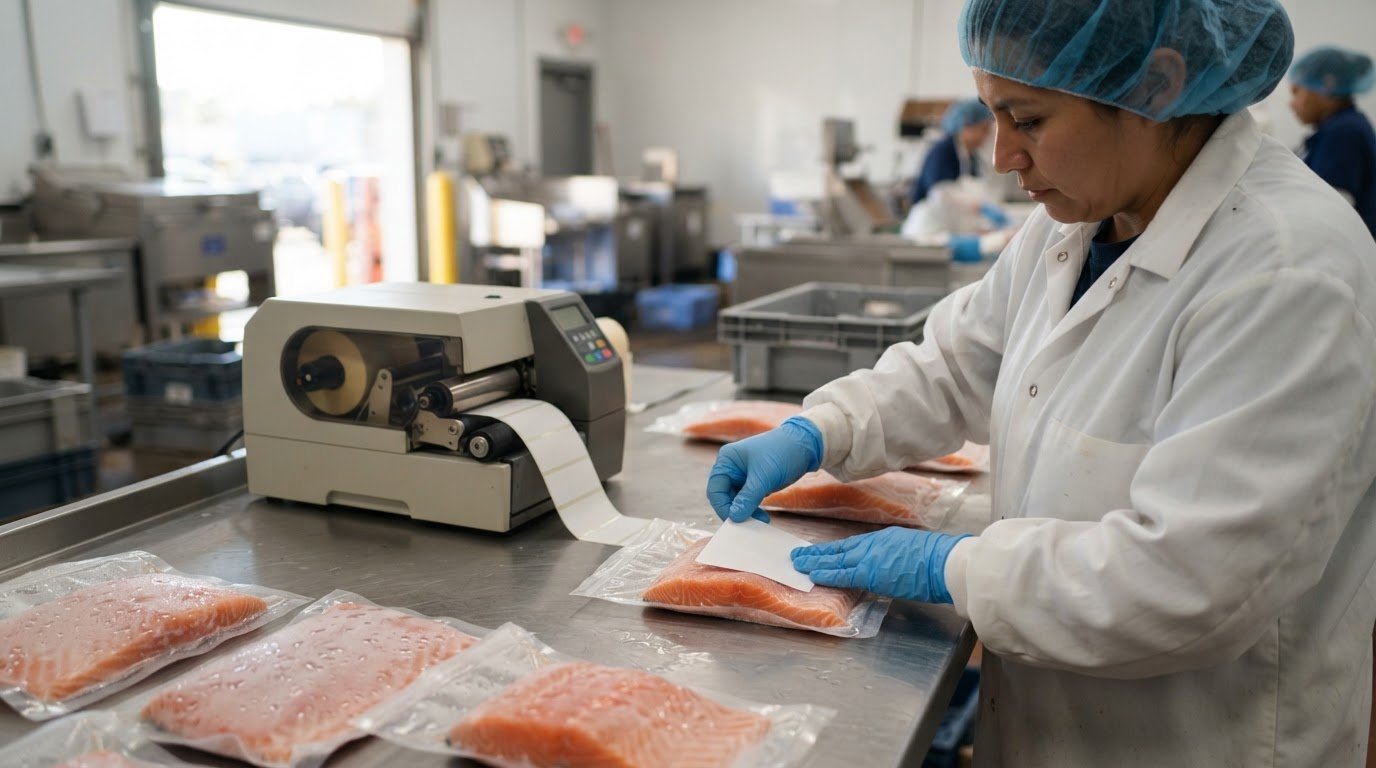
A label that stays put in the freezer isn’t automatically suitable for direct food contact. Choosing label materials for frozen food packaging means considering both performance and how each component may contact the food. In the United States, FDA 21 CFR 175.105 covers adhesive properties for indirect food contact, according to the Electronic Code of Federal Regulations.
It’s understandable to focus first on whether a label will stay attached through freezing and condensation. But the facestock, adhesive, and package surface all affect performance. Food-contact considerations also depend on the label’s intended use and construction.
This guide explains how freezer-grade adhesives, paper and film facestocks, and package surfaces influence label performance. It also covers food-contact considerations, including the difference between direct and indirect contact. You’ll learn how to assess labels on the actual frozen-food package and match materials to moisture exposure, temperature, printing, and application needs.
Key Takeaways
- Choose an adhesive for both the temperature during application and the coldest conditions the label will face in storage.
- Test adhesion on the actual package through chilling, freezing, handling, and thawing, not just on a dry sample.
- Match paper, synthetic paper, or film facestock to moisture exposure, package shape, and the durability the printed information needs.
- In cold, moist packaging areas, condensation, frost, oil, and food residue can interfere with initial adhesion.
- Consider how label design, barcoding, and printing equipment fit the information and application needs of your packaging line.
Are recyclable or wash-off food labels required by law?
For U.S. frozen-food packaging, the cited federal adhesive rule addresses indirect food contact, not wash-off or recyclability performance. In the United States, FDA 21 CFR 175.105 covers adhesive properties for indirect food contact, according to the Electronic Code of Federal Regulations. This makes the adhesive’s intended use important. A label designed to remain attached in a freezer still needs suitable materials and performance, while recyclability depends on how the label interacts with the full package. The cited rule alone does not establish that every food label must wash off or be recyclable.
Food-label content is a separate question from adhesive compliance. FDA 21 CFR 101 sets U.S. food-label content requirements, according to the Electronic Code of Federal Regulations. The Nutrition Facts panel is governed by 21 CFR 101.9. The U.S. Food and Drug Administration recognizes nine major food allergens for labeling. Frozen food labels can also carry cooking instructions, batch numbers, dates, barcodes, and QR codes. These examples show why artwork and adhesive performance need separate review.
Indirect food contact does not mean every adhesive suits every package. With greasy foods, fat-soluble adhesive components can migrate into food, so this migration must be prevented. Low-migration adhesive choices matter when food composition or package construction raises a migration concern. Wash-off adhesives serve a different purpose: they help labels separate during package washing or recycling. A permanent freezer adhesive is designed to stay attached through cold storage and handling. These functions are not interchangeable.
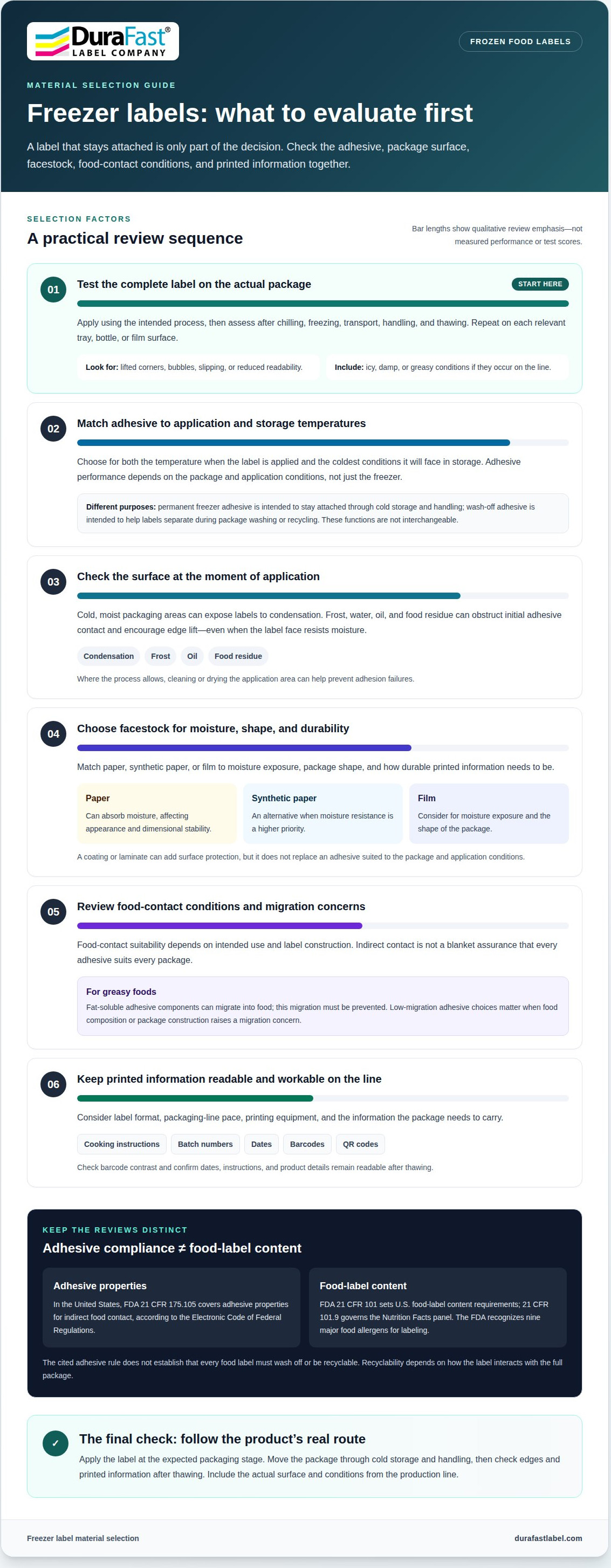
Test adhesion on the actual tray, bottle, or film, not just a dry sample. Apply the label using the intended process, then assess it after chilling, freezing, transport, and thawing. Look for lifted corners, bubbles, slipping, or reduced readability. Include icy, damp, and greasy surfaces if they occur on the production line. Frost, condensation, oil, and food residue can reduce initial adhesive contact. Where the process allows, cleaning or drying the application area can help prevent these failures.
A practical test follows the product’s real path. Apply a sample at the expected packaging stage, then move it through cold storage and handling before checking the edges and printed information. Repeat the test on each package surface, since film, trays, and bottles can behave differently. Check barcode contrast and whether dates or cooking instructions remain readable after thawing. This process can reveal failures a room-temperature adhesion check misses.
Recyclability also involves the label and its package together. A wash-off adhesive may support a process that removes labels, while a durable freezer adhesive may be necessary for reliable cold-chain attachment. Those goals can conflict, so the intended package recovery process matters. Separate product categories have separate labeling needs: pillow law labels are an example of a different application, not a substitute for food-packaging decisions.
Need Help Choosing Labels for Refrigerated and Frozen Food Packaging?
Match the label to the food, package, and packaging-line conditions. A label for a dry carton faces different demands from one applied to damp film.
Applying Labels in Cold, Moist Conditions
Cold rooms can expose labels to condensation before application, especially when packaging moves between temperatures. Labels may be applied to uneven film immediately after shrink-wrapping in a cold, moist area. That makes the surface condition and adhesive contact central selection factors. Consider the application point, package movement, and whether the label must adhere to a damp surface. The label format should also suit the quantity and pace of the packaging process.
Suitability for Dry, Moist, and Fatty Foods
Start with the product and package, not just the label face. Dry food in a carton may need less moisture resistance than frozen vegetables in a flexible bag. Moist foods can create condensation or residue near the label area. Fatty foods raise another concern: fat-soluble adhesive components can migrate into food, so migration must be prevented. Choose an adhesive for the package construction and intended contact conditions. A label suited to a dry outer carton may not work on a greasy surface.
Resistance to Condensation, Frost, and Moisture
Waterproof or moisture-resistant materials help protect printed information from damp handling and condensation. However, a moisture-resistant face does not mean the adhesive will bond to a wet surface. Frost, water, oil, and food residue can obstruct initial contact and encourage edge lift. Consider where moisture forms: a refrigerated tray may collect condensation during handling, while a frozen bag may develop frost. Choose materials for that exposure, then check that instructions and product details remain readable.
Paper facestock can absorb moisture, affecting its appearance and dimensional stability. For a paper label on a refrigerated container, consider whether condensation reaches it during storage or handling. A coating or laminate can add surface protection, but it does not replace an adhesive suited to the package and application conditions. Synthetic paper and film are alternatives when moisture resistance is a higher priority.
Build the choice around the full route from application to use. Record the package surface, whether it is dry or damp at labeling, food residue risks, and expected moisture exposure. Then test the chosen construction on the actual packaging, including the label edges and printed details. A brief review of the label format, material, and application environment can help narrow suitable options. Discuss label requirements for your packaging conditions.
Freezer-grade label materials
Choose a freezer label by separating application conditions from storage conditions. A label applied before freezing faces a different bonding challenge from one applied to an already-frozen package. The facestock must tolerate the cold, while the adhesive must grip the package during application and stay attached through storage and handling.
Flexible materials can help prevent labels from cracking or tearing in freezer conditions. Freezer-grade paper and vinyl sheet labels are available for products that are non-frozen or already frozen and stored in a freezer. Polypropylene and polyester are also common choices for frozen-food labels because they resist moisture and freezing conditions. The right option depends on the package surface, moisture exposure, and required print durability.
Temperature ratings describe a material’s resistance, not every condition it will encounter. Some product listings show 14 products with low-temperature resistance rated to -80°C, and 20 with ultra-low-temperature resistance rated to -196°C. Treat those ratings as selection points, then consider the entire label construction. The adhesive, facestock, ink, and package surface all affect real-world performance.
Application temperature and service temperature are separate requirements. A label placed on a cold package needs an adhesive able to bond at that moment. It must also withstand the lowest storage temperature afterward. General-purpose acrylic adhesive can lose tack below about +5°C in freezer or cold-chain conditions. Select adhesive for both stages, rather than relying only on its cold-storage rating.
For labels applied before freezing, focus on the surface at application. A dry package gives the adhesive more direct contact than a damp or frosted one. Then assess the label after chilling, freezing, transport, and thawing. For labels applied after freezing, confirm that the package surface and adhesive can form a bond in those cold conditions. In either workflow, look for edge lift, cracking, and unreadable print.
The printing method also affects material choice. Ink and thermal printing interact differently with label surfaces, so match the printable facestock to the process. Test printed details after cold exposure, including dates, instructions, and barcodes. A durable face material cannot compensate for poor print adhesion or unsuitable ink. Review the label’s full journey, from printing and application through freezer storage and handling.
How much do freezer-grade labels cost by material and printing method? Cost depends on facestock, adhesive, printing method, label format, and order quantity. Compare the complete label construction against the conditions it must withstand, rather than choosing by material name alone.
Packaging surface and material compatibility
A label bonds to the package surface, not to an abstract material category. A smooth, rigid tray, a curved bottle, and flexible film each create different contact conditions. Identify the exact surface that will receive the label. Include coatings, seams, curves, and areas that flex during packing. These details help determine whether the facestock can conform and the adhesive edges can stay in contact.
Surface condition matters as much as surface type. Condensation on a tray, food residue on film, or a textured area on a bottle can interfere with adhesive contact. Map where labels go on each package, then note the surface condition at that point. For example, labels applied to film immediately after shrink-wrapping may encounter a cold, moist area. Evaluate this process on the finished package, not on a separate dry sample.
Match the label construction to the packaging material and how it moves. Flexible film can bend or wrinkle as packages are filled, handled, and stacked. A stiff facestock may not follow a tight curve as closely as a flexible one. Bottles and trays can also have recessed areas or molded edges that limit the usable label zone. Check that the label lies flat across these features without bridging gaps or lifting at the corners.
Moisture protection depends on both the face and the adhesive bond. Laminated surfaces and special coatings can help protect labels from water and condensation. However, a protective face does not ensure the adhesive will bond well to every package surface. Consider the full construction alongside the package finish and exposure. Close adhesion can help limit air and moisture infiltration, while poor edge contact can leave areas vulnerable.
Include printing and application equipment in the compatibility review. Label specifications should account for the surface, application temperature, moisture exposure, printing process, and labeling equipment. A roll label’s liner strength, orientation, winding direction, roll diameter, and core size should suit the printer and applicator. A mismatch can disrupt feeding or placement, even if the facestock and adhesive suit the package. Include these details when selecting the format.
Finish with a test on the complete package. Apply labels to each actual surface, such as the tray, bottle, or film used in production. Then inspect edge adhesion, print durability, and barcode contrast on the finished frozen-food package. A barcode that looks clear on a label sheet may be harder for a scanner to read on a curved or reflective surface. Confirm that product information remains readable after normal handling, and assess the package as a whole.
Paper, synthetic paper, and film facestocks
Paper, synthetic paper, and film each offer different advantages for frozen-food labels. Compare moisture resistance, conformability, and print durability against the package and storage conditions. A label on a rigid carton, for example, faces different demands from one on flexible packaging. The material must also suit the printing process so product information stays legible through handling and storage.
Paper facestock can work when moisture exposure is limited and the package provides a stable surface. However, paper can absorb moisture, so condensation may affect its appearance and performance. A coating or laminate adds a protective layer but does not determine adhesive suitability. For a paper label on a frozen carton, assess the printed face and edges after exposure to the package’s actual conditions.
Synthetic paper is another facestock option for refrigerated or frozen products. Its performance depends on the specific construction, including its surface and any coating. Compare it with paper by considering moisture exposure, package shape, and the durability printed details require. A label on a flexible bag may need to bend with the package, while a label on a flat tray may have different conformability needs.
Polypropylene and polyester film facestocks are commonly used for frozen-food labels because they resist moisture and freezing conditions. They can suit packages exposed to condensation or damp handling. Still, “film” covers different materials and constructions, so compare the chosen facestock’s print durability and flexibility. Check how it sits on a curved bottle, tray edge, or flexible film package.
Printing requirements narrow the choice further. Inkjet and thermal printing require label surfaces suited to their respective processes. Consider whether the label carries small cooking instructions, nutritional details, dates, or barcodes. A face material that resists moisture may still need testing for print clarity and durability. Assess the printed label after cold storage and normal package handling, rather than judging an unprinted sample.
Use a simple comparison before choosing a label construction. List each package type, its surface, moisture exposure, and the information consumers need to read. Then compare paper, synthetic paper, and film against those needs. For a frozen bag exposed to damp handling, moisture resistance may matter most. For a dry outer carton, print clarity and surface fit may be more important. The right fit depends on the complete packaging use.
Test each candidate on the finished package. Apply printed samples to the actual tray, carton, or film, then inspect face condition, edges, and readability after cold storage. Include thermal or inkjet printing in the test when that is the planned process. This helps reveal whether the facestock, adhesive, and printed image work together. Discuss facestock and printing options for frozen packaging.
DuraFast Label Company: Labelview label design and barcoding software
DuraFast Label Company offers Labelview label design and barcoding software for creating label layouts and barcodes. It can support workflows that need consistent product information, batch details, or scannable codes on frozen-food labels.
For in-house printing, the Epson ColorWorks C6000A Color Label Printer is an available option. Pairing label design software with a printer helps bring artwork and label production into one workflow. DuraFast Matte Chemical Labels are another listed label option, though freezer suitability depends on the application and conditions described earlier.
Consider Labelview when you need to prepare label designs and barcodes, or explore printing hardware when bringing label production in-house. Contact DuraFast Label Company to discuss your label design and printing needs.
Plan Your Next Labeling Step
Turn your material decision into a repeatable labeling workflow. Define the package, printing process, and information each label must carry, then choose a construction that fits. The right label materials for frozen food packaging depend on how the finished label performs in your actual process, not just how it looks before application.
For in-house printing, DuraFast Label Company offers the Epson ColorWorks C6000A and Afinia L801 Color Label Printer. It also offers DuraFast Matte Chemical Labels. Each serves a different labeling need, so consider the label format and intended use alongside the printer and design workflow.
Ready to discuss label printing options for your packaging? Contact DuraFast Label Company to talk through your next step. A thoughtful material choice can help you move forward with a clearer, more practical labeling plan.
Frequently Asked Questions
Are food packaging labels safe for direct food contact?
Only labels designed and suitable for the specific direct-contact use should touch food. In the United States, FDA 21 CFR 175.105 covers adhesive properties for indirect food contact, according to the Electronic Code of Federal Regulations. That rule does not by itself establish suitability for direct contact. For a label placed on exposed food, assess the complete construction and intended use, including the facestock, ink, and adhesive.
What does “food-grade adhesive” mean, and does my label need it?
“Food-grade adhesive” is a broad description, not proof that an adhesive suits every food package or contact condition. The key distinction is whether the adhesive could contact food directly or indirectly through the packaging. A label on the outside of a sealed carton has a different use from one touching unpackaged food. Consider the food, package design, and possibility of migration, especially with fatty products.
What label materials are best for frozen food packaging?
Polypropylene and polyester film are common options because they resist moisture and freezing conditions. Paper may suit a drier outer carton, while flexible film can suit packaging that bends during handling. Choose based on the package surface, moisture exposure, required print durability, and printing method. A label on a flexible frozen-food bag, for example, needs a different fit from one on a rigid carton.
What temperature range can frozen food labels withstand?
There isn’t one temperature range for every frozen-food label. Product ratings vary by facestock and adhesive; some listed materials are rated to -80°C, while others are rated to -196°C. Those figures describe specific products, not every label construction. Also separate the temperature at application from the lowest temperature during storage. A material’s storage rating alone does not show whether it can bond to a cold package.
Which label adhesives stick to frozen or frost-covered packaging?
Freezer-grade permanent adhesives are intended for labels that must stay attached in cold storage. Frost can block direct adhesive contact, so a freezer-storage rating does not automatically mean the label will apply successfully over frost. Applying the label before freezing, while the package surface is dry, can avoid that obstacle. For labels applied to already-frozen products, assess adhesion on the actual surface and through the product’s handling conditions.
What label materials work on plastic bags, cartons, and glass containers in frozen food packaging?
Film facestocks such as polypropylene or polyester can suit moisture-exposed plastic bags, while paper may work on a drier carton. Glass is rigid, but the label still needs to suit its finish and exposure to condensation. Don’t choose by package name alone. Compare the actual surface, label flexibility, moisture conditions, and printing needs, then test samples on each package format.
How should frozen food labels be stored, applied, and tested for adhesion?
Protect label stock from dust, moisture, and damage before use, and follow the material’s handling instructions. Apply a sample using the intended production method and package surface. Record whether application happens before or after freezing, then inspect the label after chilling, freezing, transport, and thawing. Look for lifted edges, shifting, surface damage, and print that becomes difficult to read.