LTX 2.3 License Guide: Commercial Terms and BarTender Integration in 2026
18th Jul 2026

What if the $10 million revenue threshold you're tracking doesn't actually apply to your labeling software at all? Many growing brands find themselves stuck in a loop of confusion, trying to align the LTX 2.3 Community License terms with their daily production needs. It's a common frustration in 2026. You want to use cutting-edge AI for your branding without accidentally triggering a compliance audit or overpaying for features you don't use. This BarTender software license guide is here to simplify that process and help you distinguish between your digital AI tools and your physical printing requirements.
You likely already know that keeping your brand assets consistent from the design screen to the physical label is a major challenge. We promise to help you secure those assets by choosing the right BarTender tier, whether you need a workstation-based Professional license or a scalable Automation setup. We'll preview the specific revenue limits for Lightricks, explain how printer-based licensing works for BarTender, and show you how to integrate these tools to produce professional results on systems like the Epson ColorWorks C6000A.
Key Takeaways
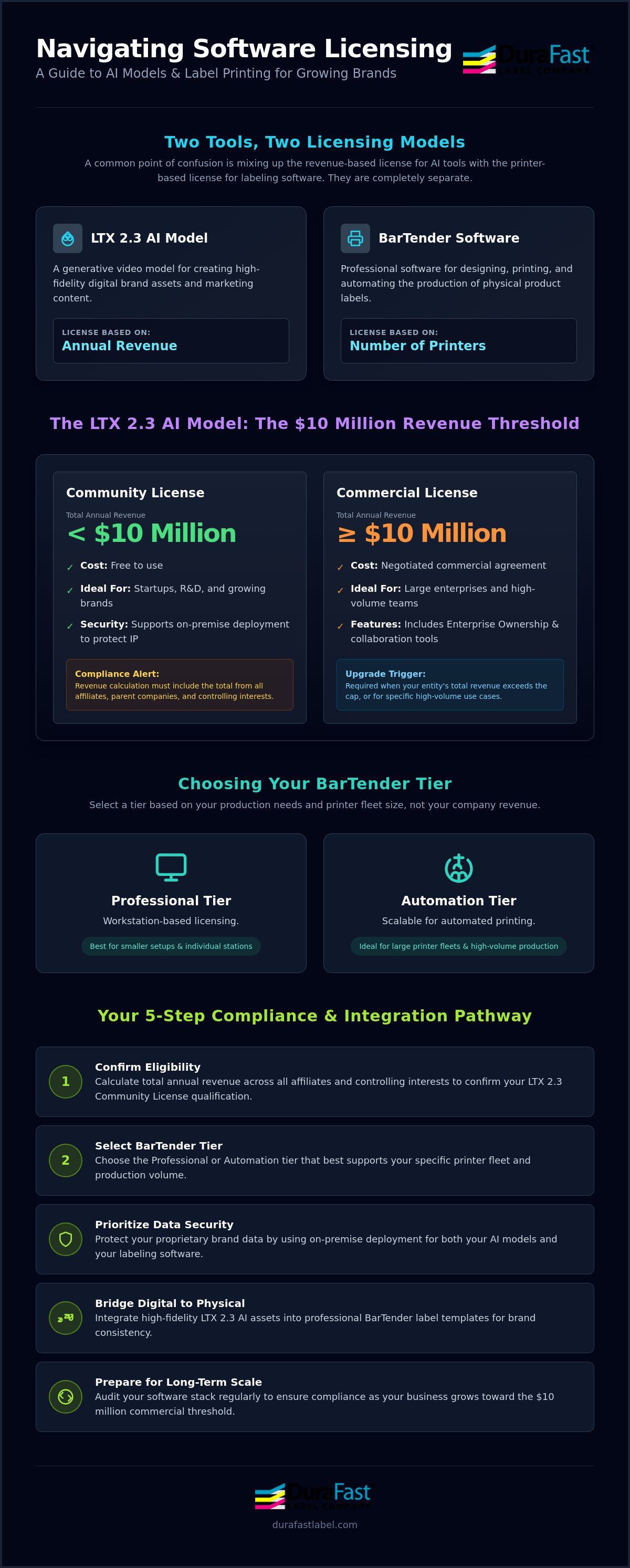
- Confirm if your business qualifies for the free LTX 2.3 Community License by calculating total annual revenue across all affiliates and controlling interests.
- Follow this BarTender software license guide to select the Professional or Automation tier that best supports your specific printer fleet and production volume.
- Protect your proprietary brand data and intellectual property by prioritizing on-premise deployment for both your AI models and your labeling software.
- Bridge the gap between digital AI visualizations and physical products by integrating high-fidelity LTX 2.3 assets into professional BarTender label templates.
- Prepare for long-term scalability by auditing your software stack regularly to ensure compliance as your business grows toward the $10 million commercial threshold.
What is the LTX 2.3 Community License?
The LTX-2 Community License is a legal framework that governs how businesses use Lightricks' 2.3 generative video model. It specifically outlines the rules for reproducing, distributing, and utilizing the model's weights and assets for commercial purposes. While this might sound like a technical hurdle, it's actually a foundational tool for modern brand management. Understanding these terms is just as vital as following a BarTender software license guide to ensure your inkjet labels and physical production match your digital vision.
The 2026 update to this license focuses on high-fidelity brand visualization. It gives companies the right to run AI generation on their own private servers. This provides a massive boost for security. By keeping the model weights local, you avoid the risk of public APIs training on your proprietary brand assets. You keep your trade secrets safe while using cutting-edge tech. This private infrastructure ensures that your unique product designs don't end up in a competitor's generated content.
When you look at different software licensing models, the Community License stands out because it balances accessibility with clear commercial boundaries. It allows smaller entities to innovate without massive upfront costs, provided they stay within specific revenue limits. It’s a supportive model for businesses that are scaling fast but still need to protect their intellectual property during the growth phase.
LTX 2.3 vs. Legacy Versions
The transition from legacy versions to LTX 2.3 represents a massive leap in capability. Older models often relied on video-to-video workflows, which could be unpredictable for product consistency. The 2.3 version introduces full image-to-video capabilities. You can take a high-resolution photo of a product and generate consistent, lifelike motion around it. These weights offer much better fidelity for branding. Because the technology changes so fast, you should conduct regular audits of your model versions. This ensures you're still compliant with the specific license tied to those weights. It also helps you maintain a consistent look across all your marketing channels.
Ownership and IP for AI-Generated Assets
The $10 Million Threshold: Community vs. Commercial Licensing
The LTX 2.3 Community License offers a powerful entry point for businesses, but it comes with a strict financial boundary. To remain compliant, your entity must stay under the $10 million annual revenue cap. This limit isn't just a suggestion. It's a legal requirement that dictates whether you can use the model weights for free or if you need to negotiate a commercial agreement. For many growing brands, this threshold arrives faster than expected. This BarTender software license guide helps you align your physical production costs with these digital compliance requirements, ensuring your entire software stack scales legally.
Calculating your Annual Recurring Revenue (ARR) requires a deep dive into your corporate structure. You must include all affiliates, parent companies, and controlling interests in your total. If a larger parent company owns your brand, their total revenue counts toward the $10 million limit. Misreporting this data creates significant compliance risks. Using model weights while exceeding the revenue cap can lead to legal disputes or the loss of your right to use generated assets. It's much safer to audit your finances early and transition to the correct tier before an issue arises.
Moving to a commercial license isn't always about hitting a specific dollar amount. Sometimes, your production volume or specific use cases trigger the need for an upgrade. If you find the licensing terms for your AI tools or your color label printer software are becoming unclear, it’s a good idea to reach out for an expert consultation to avoid any gaps in coverage.
When to Contact Lightricks for Enterprise Terms
- High Volume Production: If your brand generates thousands of high-fidelity visualizations per month, you likely exceed standard community use.
- Model Fine-Tuning: Enterprise tiers often include dedicated engineering support to help you tune the 2.3 weights specifically for your product line.
- Custom Indemnity: Larger organizations often require specific legal protections and indemnity clauses that are only available in custom commercial-tier agreements.
License Enforcement in 2026
Usage monitoring has become more sophisticated in the decentralized AI environment of 2026. While you might run the model on private hardware, the weights themselves often have digital signatures that can be tracked if assets are distributed publicly. For LTX 2.3 compliance, the $10 million ARR threshold serves as the definitive line between community and commercial use. Brands scaling their AI marketing should conduct quarterly legal audits. This ensures that as your revenue grows, your software permissions grow with it. This proactive approach mirrors the best practices found in any professional BarTender software license guide, where matching your license to your printer count prevents production downtime.
On-Premise Deployment and Brand Data Security
Why are brands suddenly pulling their creative assets back from the cloud? The shift toward on-premise deployment for LTX 2.3 is driven by a need for absolute privacy. Public AI APIs often incorporate user data into their training sets. This means your proprietary product designs or unreleased logo variations could inadvertently help train a model that your competitors eventually use. Running LTX 2.3 on your private servers eliminates this risk. It allows you to maintain a unified brand voice without the interference of third-party cloud filters that might subtly shift your brand colors. This level of control mirrors the security benefits discussed in our BarTender software license guide, where on-premise deployment ensures your sensitive label data remains within your company firewall.
Local inference also offers a significant financial advantage. Once you have the hardware in place, you can run unlimited iterations at a fixed cost. There are no "per-render" fees or API credit limits to worry about. This is especially useful for marketing teams that need to test hundreds of variations before finding the perfect shot. By hosting the model weights locally, you ensure that every iteration remains your exclusive property. You aren't just renting a service; you are building a private asset pipeline that grows in value as you refine your workflows.
Securing the Digital Asset Pipeline
The "No API Meter" advantage is a game-changer for high-volume marketing teams. When you remove the cost-per-generation, your team is free to innovate without budget anxiety. Keeping your proprietary designs on-premise is the only way to guarantee they won't leak during the training phase of a public model. This security model is very similar to how professional label management works. Just as you would use a color label printer to keep production in-house, running LTX 2.3 locally keeps your digital trade secrets under your own lock and key.
Technical Success Factors
Success in 2026 requires the right infrastructure. To run LTX 2.3 weights efficiently, your servers typically need at least 48GB of VRAM and high-end enterprise GPUs. This hardware ensures model stability and prevents the "version drift" that can happen when cloud providers update their underlying software without notice. Engineering support is also vital. Having a team that understands model weights ensures your generations stay consistent over long-term campaigns. Following a BarTender software license guide helps you manage the software side of this equation, while your hardware handles the heavy lifting of AI generation.
Integrating AI Video with Physical Product Branding
How do you bring a digital AI masterpiece into the real world? It starts by bridging the gap between LTX 2.3 visualizations and your physical production line. You can now turn high-fidelity AI renders into professional inkjet labels in record time. This workflow moves your brand from an AI-generated concept directly into BarTender Professional Software templates. The result is a seamless transition that maintains the visual impact of your digital assets throughout the entire supply chain.
Color accuracy is non-negotiable for high-end branding. Printers like the Epson ColorWorks C6000A are specifically designed to handle the complex gradients and vibrant tones produced by modern AI models. By keeping this process in-house, you reduce your time-to-market significantly. You don't have to wait for external print shops. You can generate a new product visualization in the morning and have finished, high-resolution labels on your packaging by the afternoon. It's a level of agility that traditional design cycles simply can't match.
BarTender Software License Guide for AI Assets
Choosing the right tier is vital for a smooth workflow. This BarTender software license guide highlights the functional split between workstation and printer-based models. For teams using AI assets, the Professional Edition is usually the best fit. It allows for dynamic data integration. This means you can pull AI-generated variables or high-resolution frames directly into your label designs without manual imports. Software licenses for labels protect brand integrity by ensuring every print job matches the approved digital master. It's about maintaining control over every pixel from the screen to the shelf.
Hardware for AI-Designed Labels
Your hardware must keep up with your creative software. High-resolution color label printers are essential for reproducing the intricate details found in AI graphics. You want to match the "Zolt" and energy of an AI-generated video with the punchy, vibrant output of Afinia or Epson systems. Using certified media is just as important as the printer itself. It ensures the ink bonds correctly and the colors don't bleed. This preserves the high-fidelity look of your AI-designed product packaging, even in harsh environments.
Ready to synchronize your digital designs with your physical labels? Contact our team for a custom hardware and software audit to find the perfect fit for your production needs.
Building a Compliant Business Software Stack
Creating a reliable production environment requires more than just buying the latest tools. It's about building a synchronized ecosystem where your AI models, design software, and industrial label printers work as a single unit. In 2026, this means ensuring your LTX 2.3 assets flow perfectly into your BarTender templates without technical friction. A professional BarTender software license guide serves as your roadmap here. It helps you select the right edition to handle high-fidelity graphics while maintaining the data integrity your brand deserves. When your software and hardware are in sync, you spend less time troubleshooting and more time growing your business.
Scalability is a primary focus for any brand on the move. As your business nears or exceeds the $10 million revenue mark, your licensing needs change instantly. You don't want to find out you're out of compliance during a busy production run. Regular audits of your current stack are essential. These checks ensure that your revenue growth doesn't outpace your software permissions. Working with an authorized partner provides a massive advantage. You get access to expert troubleshooting and compliance advice that keeps your operations running smoothly. It's about future-proofing your workflow for the next generation of AI integrations and labeling requirements.
Professional Solutions vs. Freemium Risks
Relying on free community tools carries significant long-term risks. While they might work for initial testing, they often lack the stability and legal protections required for commercial scaling. Professional licenses offer a much better ROI because they include integrated support for both your software and your printing hardware. You get a single source of truth for all your brand asset licensing. This reduces the risk of conflicting terms or data leaks that can happen with unverified tools. It's a supportive approach that values your peace of mind much more than a temporary cost saving. Professional tools are built to handle the pressure of a real-world production floor.
Next Steps with DuraFast
DuraFast provides the physical pipeline your brand needs to thrive. We combine high-end hardware with the software expertise required for 2026 compliance. We can help you audit your current printer fleet and software setup to ensure every piece is optimized for your revenue tier. This BarTender software license guide is just the beginning of your journey toward a more efficient production floor. Don't let licensing complexity slow down your innovation or put your brand assets at risk. Contact DuraFast for a consultation on your labeling infrastructure and secure your brand's future today.
Secure Your Brand Pipeline for 2026
Scaling your business past the $10 million revenue threshold requires more than just financial growth. It demands a software stack that keeps pace with your ambition. By aligning your LTX 2.3 assets with the right tools, you protect your intellectual property and ensure production never stops. This BarTender software license guide has shown you how to bridge the gap between digital AI innovation and physical label production. You don't have to navigate these technical waters alone. Success in 2026 is about having the right partners in your corner.
DuraFast is here to simplify your transition. We are a North American leader in labeling compliance and an authorized Epson and Afinia partner. Our team provides expert technical support for in-house printing to ensure your hardware and software work in perfect harmony. We help you move from AI concepts to finished labels with total confidence in your security. It's time to stop worrying about revenue caps and start focusing on your brand's next big leap.
Upgrade your labeling workflow with BarTender Professional Software today. Reach out to our experts to audit your infrastructure and build a future-proof production line that grows with you.
Frequently Asked Questions
Is the LTX 2.3 license free for commercial use?
Yes, the LTX 2.3 Community License is free for commercial use by companies with less than $10 million in annual revenue. This allows you to reproduce and distribute model weights and assets without upfront fees. If your business exceeds this revenue threshold, you must contact Lightricks to negotiate specific commercial terms. This structure helps smaller brands leverage advanced AI for their marketing and production needs.
What happens if my company makes more than $10 million?
You must transition to a custom commercial license once your annual revenue hits the $10 million mark. This total includes all affiliates and controlling interests, so a deep financial audit is necessary. Continuing to use the community model weights after crossing this threshold creates significant compliance risks. Proactive negotiation with Lightricks ensures you maintain the legal right to use your AI-generated assets as you scale.
Can I use LTX 2.3 for social media marketing and product labels?
You can use LTX 2.3 assets for both digital marketing campaigns and physical product labeling. The high-fidelity output is ideal for creating consistent brand visualizations across different platforms. To ensure your AI-generated graphics look professional on physical packaging, follow a BarTender software license guide to select an edition that supports high-resolution image integration and dynamic data for your production line.
Do I need to attribute Lightricks when using LTX 2.3 for my brand?
Attribution requirements depend on the specific terms of the license version you are using. In the 2026 Community License Agreement, commercial users typically have more flexibility, but some distributions may still require a "Powered by LTX" credit. You should always verify the latest requirements in your specific agreement. This ensures your marketing materials remain fully compliant while showcasing your AI-powered branding.
How does an LTX 2.3 license differ from a BarTender software license?
An LTX 2.3 license governs the right to use AI model weights for content generation, while a BarTender software license guide focuses on the rights to design and print physical labels. LTX is about the creative digital asset. BarTender is about the execution of that asset on a printer. You need both to build a secure, in-house pipeline that moves from AI concept to finished product.
Can I run LTX 2.3 on my own company servers for security?
You can run LTX 2.3 on your private infrastructure to ensure maximum brand data security. This on-premise deployment prevents public AI APIs from training on your proprietary designs or unreleased products. It gives your team total control over the generation process. This setup is a perfect match for on-premise labeling solutions, as both keep your sensitive data and trade secrets behind your own corporate firewall.
Does the LTX 2.3 license expire or require renewal?
The Community License generally remains valid as long as you adhere to the revenue limits and usage terms. However, model weights often receive technical updates that might come with updated licensing language. It's a good idea to perform a compliance audit every quarter. This ensures your brand is always using the most recent model version and remains protected under the current legal framework.
What are the restrictions on using LTX 2.3 for physical merchandise?
There are very few restrictions on using LTX 2.3 for physical merchandise, provided your company stays under the $10 million revenue cap. You can print AI-generated graphics on labels, packaging, or promotional items. The main challenge is ensuring high-fidelity reproduction. Using professional design software and high-end industrial printers ensures that the intricate details of your AI assets translate perfectly to your physical products.