NeuraLabel Callisto: Durable BS5609 Chemical Drum Labeling
9th Aug 2026
What if your labeling process was the fastest part of your production line instead of the biggest bottleneck? For many chemical manufacturers, the struggle to balance high-speed output with the rigid durability requirements of marine shipping feels like a losing battle. You know the frustration of labels peeling off in harsh conditions or shipping schedules slipping because your hardware just can't keep up. It's a stressful cycle that often leads to wasted inventory and unnecessary overhead costs.
It's time for a more efficient, reliable approach. The NeuraLabel Callisto GHS BS5609 Chemical Drum Label Printer changes the game by bringing industrial-grade reliability and 2400 x 1200 dpi resolution directly to your facility. This guide explores how the Callisto uses advanced HP PageWide technology to hit speeds of 90 feet per minute while maintaining 100% GHS compliance. We'll dive into the benefits of in-house printing, the latest BS 5609:2024 standard updates, and how you can meet the upcoming 2026 OSHA deadlines without breaking a sweat. Discover how to streamline your workflow and ensure your drums are ready for any journey.
Key Takeaways
- Learn how HP PageWide technology enables industrial print speeds of 90 feet per minute to eliminate shipping delays.
- Discover the specific hardware and media combinations required to achieve full certification with the NeuraLabel Callisto GHS BS5609 Chemical Drum Label Printer.
- Reduce label waste and inventory costs by bringing production in-house and ending your reliance on third-party print vendors.
- Automate your GHS compliance workflow using BarTender Professional software to manage complex chemical formulations and variable data.
- Master the setup process, including environmental controls and media path selection, to ensure long-term reliability and print consistency.
What is the NeuraLabel Callisto GHS Label Printer?
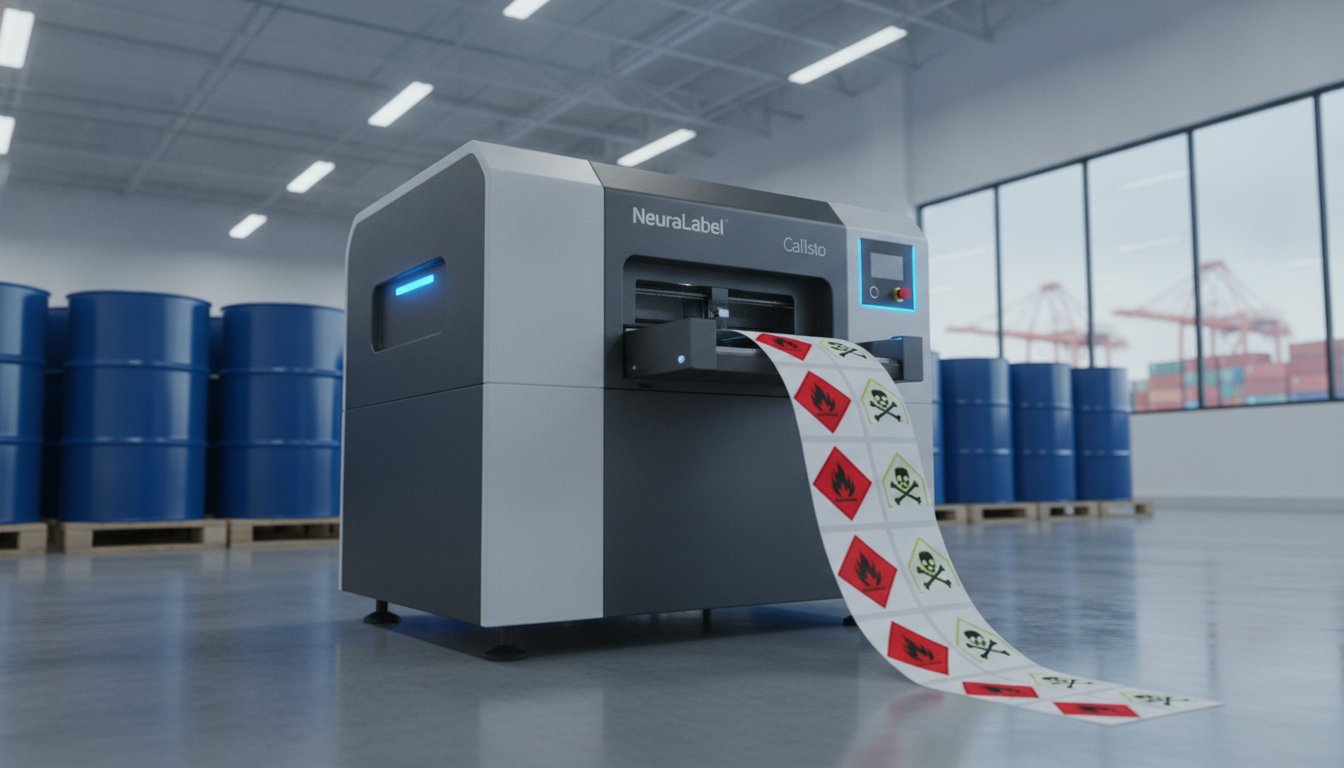
The NeuraLabel Callisto GHS BS5609 Chemical Drum Label Printer is a commercial-grade inkjet solution built for speed and regulatory compliance. It handles the intense demands of chemical manufacturing without breaking a sweat. Unlike standard office equipment, this machine is engineered to survive the dust and vibration of a factory floor. You can manage every job through a responsive 7-inch touchscreen, which provides real-time updates on ink levels and active print status. It's a specialized tool designed to solve the common headache of producing durable labels in a high-pressure environment.
The Power of HP PageWide Technology
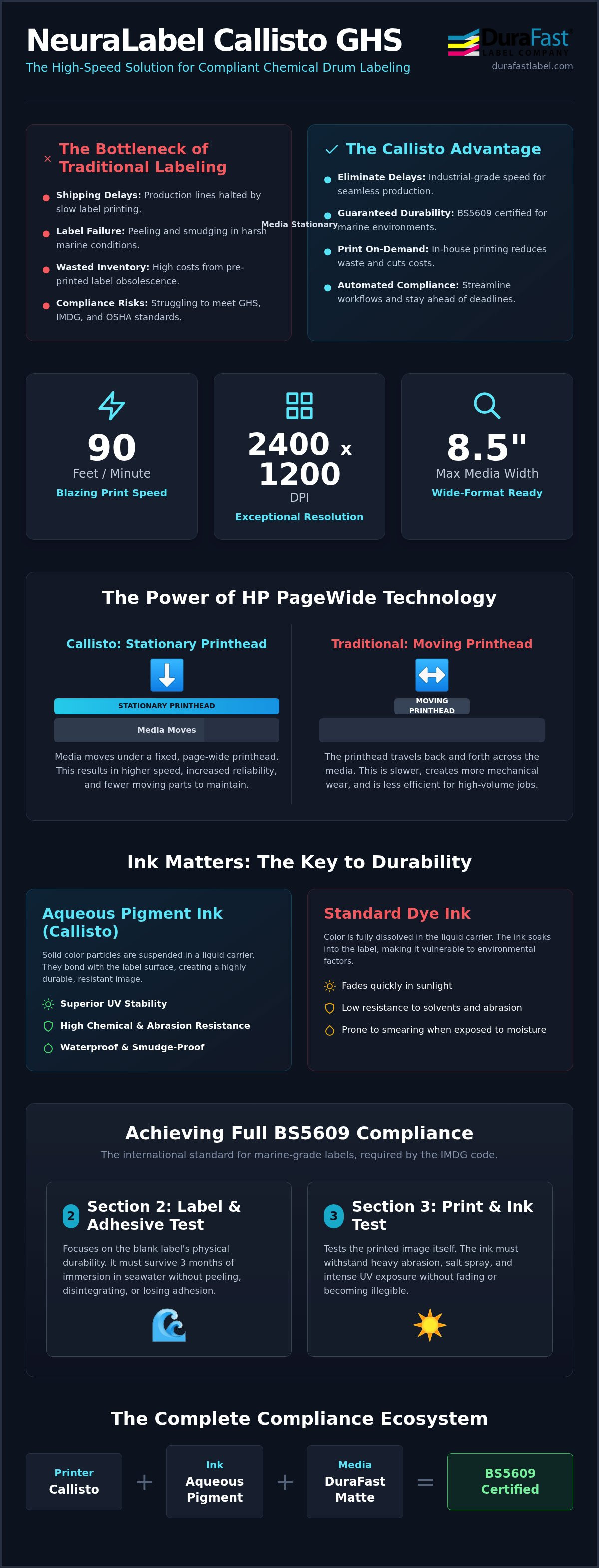
Speed usually comes at the cost of quality, but the Callisto manages to deliver both. It uses stationary HP PageWide technology to achieve print speeds up to 90 feet per minute. Traditional printers move the printhead back and forth across the page, which creates mechanical wear and slows down the entire process. Because the Callisto's printheads remain fixed while the media moves underneath, you get incredible reliability with fewer moving parts to maintain. This setup is ideal for wide-format drum labels up to 8.5 inches across. It ensures that every hazard symbol and barcode is perfectly aligned with consistent color registration from the first label to the last.
Aqueous Pigment Ink vs. Dye Ink
When you are dealing with the Globally Harmonized System (GHS), the type of ink you use determines whether your shipment is legal or a liability. The Callisto utilizes aqueous pigment ink, which is fundamentally different from the dye-based inks found in standard color label printers. Pigment particles are solid, suspended bits of color that bond with specialized media coatings to provide superior UV stability and chemical resistance.
Aqueous carriers allow the printer to reach a stunning 2400 dpi resolution, delivering sharp text and vibrant warnings that don't smudge. While dye inks might look bright initially, they often fail when exposed to the moisture and abrasion typical of marine transport. Pigment ink ensures your labels remain legible even after months of sun exposure or contact with harsh solvents. This industrial-grade durability is what makes the NeuraLabel Callisto GHS BS5609 Chemical Drum Label Printer the preferred choice for modern compliance workflows.
Achieving BS5609 Compliance for Chemical Drum Labeling
Shipping hazardous materials across international waters requires more than just a clear warning. It demands a labeling system that can survive the most punishing environments on Earth. BS5609 is the international benchmark for pressure-sensitive, adhesive-coated labels used in marine environments. If your drums are traveling via cargo ship, they must meet this standard to comply with the International Maritime Dangerous Goods (IMDG) code. Achieving this level of durability isn't about one single component; it's about the synergy between your hardware, your ink, and your media. The NeuraLabel Callisto GHS BS5609 Chemical Drum Label Printer provides the foundation for this ecosystem, ensuring that every signal word and pictogram remains legible even after months at sea.
Section 2 vs. Section 3: What You Need to Know
Understanding the distinction between the two parts of the BS5609 standard is vital for any compliance officer. Section 2 focuses on the "blank" label itself. It tests the base material and the adhesive to ensure they can withstand three months of seawater immersion without peeling or degrading. However, having a label that sticks doesn't matter if the information on it disappears. That is where Section 3 comes in. This part of the standard tests the printed image, specifically how the ink interacts with the label surface. It measures resistance to heavy abrasion and intense UV fading. The NeuraLabel Callisto GHS BS5609 Chemical Drum Label Printer is a market leader for Section 3 compliance because its pigment inks bond deeply with certified substrates to create a nearly indestructible image.
The Importance of Certified Media
You can't achieve marine-grade durability using standard paper or low-quality synthetics. To guarantee your labels won't fail an inspection, you must pair your printer with DuraFast Matte Chemical Labels. These specialized materials feature a microporous topcoat specifically engineered to "lock in" the aqueous pigment inks used by the Callisto. This chemical bond is what prevents the ink from smearing or washing away when exposed to salt spray or harsh solvents. You can explore our full range of inkjet labels that have been rigorously tested to meet these industrial requirements.
Beyond the physical durability, your labels must also satisfy the informational requirements of OSHA's Hazard Communication Standard. This includes the correct use of red-bordered pictograms, specific signal words like "Danger" or "Warning," and detailed hazard statements. By bringing this process in-house, you gain total control over these variables, allowing you to update your designs instantly as regulations change. If you aren't sure which media combination is right for your specific chemical formulations, feel free to reach out to our compliance team for a personalized recommendation.
Speed and Performance: Why the Callisto Leads in 2026
Speed is often the deciding factor for chemical manufacturers who need to keep their shipping docks moving. The NeuraLabel Callisto GHS BS5609 Chemical Drum Label Printer delivers an impressive 90 feet per minute, which is a significant leap over entry-level industrial systems. This throughput is especially vital when you consider that OSHA's Hazard Communication Standard requires precise, up-to-date information on every container. While other printers might slow down or pause to process complex variable data like batch numbers or unique weights, the Callisto maintains its top speed. It processes data on the fly, eliminating the frustrating buffering delays that can stall a busy production line.
Durability isn't just about the labels; it's about the machine itself. The Callisto features a rugged aluminum construction designed to handle the vibration and temperature fluctuations of a 24/7 factory floor. Despite this industrial strength, it maintains a relatively small footprint. It fits easily into existing production environments without requiring a massive facility overhaul. This balance of power and size makes it an efficient problem-solver for facilities where space is at a premium but volume is high.
High-Speed Roll-to-Roll Integration
For manufacturers with high-volume needs, the Callisto offers optional 8-inch and 13-inch roll-to-roll systems. These units allow for continuous, unattended printing, which frees up your staff for other tasks. A key feature here is the synchronized tension control. It prevents the media from drifting or misaligning during high-speed runs, ensuring every label is perfectly centered. Moving from a fan-fold setup to a roll-to-roll workflow often results in massive efficiency gains, as it reduces the frequency of media changes and allows for easier integration with automatic label applicators.
Comparing the Callisto to Desktop Alternatives
Is it time to upgrade your current setup? Many businesses start with a desktop unit like the Epson ColorWorks C6000A. While that printer is a reliable workhorse, it tops out at approximately 5 inches per second. In contrast, the NeuraLabel Callisto GHS BS5609 Chemical Drum Label Printer is nearly four times faster. If your daily label volume has grown to the point where your desktop printers are running all day just to keep up, moving to a PageWide system is the logical next step. You can see how this machine stacks up against other high-volume options in our Industrial Label Printer Roundup. This comparison helps you determine exactly when the operational ROI justifies the move to a faster, more robust system.
Operational ROI: The Financial Case for In-House GHS Printing
Outsourcing chemical labels often forces you into the "minimum order quantity" trap. You pay for thousands of labels when you only need hundreds, which ties up capital in sitting inventory. This becomes a major financial drain when GHS regulations shift or your chemical formulations change, rendering your existing stock obsolete. By investing in the NeuraLabel Callisto GHS BS5609 Chemical Drum Label Printer, you print exactly what you need on demand. This flexibility eliminates wasted stock and ensures your labels are always up to date with the latest safety requirements.
Efficiency also shows up in your consumables. The Callisto uses high-capacity 240ml ink cartridges, which significantly lower your cost-per-label compared to smaller desktop systems. High-volume production becomes much more affordable when you aren't constantly swapping out tiny ink tanks. Using specialized inkjet labels designed for this system further optimizes ink absorption and durability, reducing the number of rejected labels and reprints.
BarTender Professional Integration
Managing compliance data manually is a recipe for expensive errors and potential fines. The Callisto integrates seamlessly with BarTender Professional software, allowing you to pull GHS data directly from your existing ERP or SDS database. This automation ensures that the correct red-diamond pictograms and signal words appear based on the specific hazard levels of each chemical. It removes the human error factor from the equation and streamlines your entire labeling workflow, making it easy to manage hundreds of different product SKUs with a single template.
Minimizing Downtime and Maintenance
Industrial reliability means keeping the printer running during peak shifts without constant intervention. The Callisto features an on-board service tray and specialized cleaning kits that help extend the life of your printhead and maintain crisp image quality. If you need to replace ink, the easy-access design lets you swap cartridges quickly. This continuous operation is essential for maintaining high-speed production schedules and meeting tight shipping deadlines. If you want to see how these savings apply to your specific facility, contact our experts today for a custom ROI analysis.
Implementation Guide: Setting Up Your Callisto for Success
Setting up your new hardware involves more than just finding a clear spot on the factory floor. To get the best performance from the NeuraLabel Callisto GHS BS5609 Chemical Drum Label Printer, you must start with a stable environment. Aqueous pigment inks are precision-engineered fluids that perform best in climate-controlled spaces. High humidity can slow down drying times, while excessive dryness might affect how the ink settles on the media. Maintaining a consistent environment ensures that your production runs stay predictable and your labels remain professional.
Your next decision involves the media path. If you are handling high-volume production, the roll-to-roll configuration is the most efficient choice for 2026. This setup allows for unattended operation and integrates perfectly with automatic label applicators. For smaller, more frequent job changes, the fan-fold path offers a quicker transition between different label sizes. Regardless of the path you choose, initial color calibration is a mandatory step. GHS regulations are strict about the specific shades of red used in pictograms. You can't leave this to chance. Use the on-board tools to calibrate your colors so they meet every regulatory requirement from day one.
Don't overlook the importance of a regular maintenance schedule. High-speed industrial printing generates minor amounts of dust and debris that can eventually affect print quality. Establishing a daily and weekly cleaning routine using NeuraLabel-approved cleaning kits will protect your investment. This simple habit prevents clogged nozzles and extends the life of your printhead assembly, keeping your costs low and your output high.
Sourcing the Right Supplies
Consistency in your supply chain is just as important as the printer itself. Stocking up on NeuraLabel Callisto ink cartridges ensures you won't face unexpected production stops during a busy shift. You also need to choose the right media for your specific drum types. Matte chemical-resistant media is the standard for industrial drums, but some specialized applications might require a gloss finish for better visibility. While you are optimizing your inkjet workflow, don't forget to check your other labeling needs. You can shop our full selection of thermal ribbons and inkjet supplies to keep your entire facility running smoothly.
Training and Support
The transition to high-speed in-house printing is easier when you have the right partners. You can leverage DuraFast's technical knowledge for your initial setup and calibration to avoid common pitfalls. We recommend a "train the trainer" approach, where your lead operators become experts in the system's nuances. This internal expertise is essential for maintaining high-speed industrial printing success and troubleshooting minor issues without calling for outside help. Ready to transform your chemical labeling? Request a NeuraLabel Callisto quote and take control of your compliance workflow today.
Take Control of Your Industrial Labeling Today
Implementing the NeuraLabel Callisto GHS BS5609 Chemical Drum Label Printer is more than a simple hardware upgrade; it's a strategic move to eliminate shipping bottlenecks and inventory waste. By bringing production in-house, you gain the ability to print durable, marine-grade labels at 90 feet per minute while ensuring 100% GHS compliance. You don't have to wait for third-party converters or worry about labels failing during harsh seawater immersion. This system gives you total control over your workflow and your budget.
As an authorized NeuraLabel dealer, DuraFast Label Company is here to simplify your transition. We provide the specialized BS5609 media and expert North American technical guidance you need to succeed from your very first print run. Our team can help you navigate the 2026 OSHA deadlines and optimize your operational ROI with the right software and ink combinations. It's time to transform your labeling from a compliance hurdle into a competitive advantage.
Request a NeuraLabel Callisto Quote & Compliance Consultation
Frequently Asked Questions
Is the NeuraLabel Callisto BS5609 Section 3 certified?
Yes, the NeuraLabel Callisto GHS BS5609 Chemical Drum Label Printer is Section 3 certified when you use it with approved media like DuraFast Matte Chemical Labels. Section 3 testing specifically measures the durability of the printed image against abrasion and saltwater. The printer's pigment inks bond deeply with specialized coatings. This ensures your hazard symbols and text remain legible even after months of exposure to harsh marine conditions.
What is the maximum print width of the NeuraLabel Callisto?
The Callisto handles label media from 1 inch up to 12 inches wide. This wide range makes it suitable for everything from small containers to massive 55-gallon drums. The stationary printhead provides a maximum print width of up to 8.5 inches. This gives you ample room to include all required GHS pictograms, signal words, and safety instructions without sacrificing clarity or regulatory compliance.
Can I use the Callisto for labels other than GHS chemical drums?
You can certainly use the Callisto for a wide variety of industrial and prime labels. While it excels at chemical durability, its 2400 dpi resolution is perfect for high-quality product branding and shipping labels. The ability to handle variable data at 90 feet per minute means you can switch between different label types without slowing down your production schedule or changing hardware.
How does HP PageWide technology differ from standard inkjet?
HP PageWide technology uses a stationary printhead that spans the entire width of the media. Standard inkjet printers move a smaller printhead back and forth, which limits speed and increases mechanical wear. By keeping the printhead fixed and moving the paper underneath, the Callisto achieves much higher speeds and greater reliability. This design reduces the number of moving parts, making it a robust choice for factory floors.
What software is compatible with the NeuraLabel Callisto for GHS labeling?
The Callisto is fully compatible with BarTender Professional, which is the industry standard for GHS compliance. This software allows you to automate your labeling by pulling data directly from your SDS database or ERP system. It ensures that the correct red-bordered pictograms and safety instructions are applied to every label automatically. This integration significantly reduces the risk of human error during the compliance process.
How often do the NeuraLabel Callisto printheads need to be replaced?
The lifespan of a printhead depends on your daily volume and maintenance habits. These assemblies are designed to last for millions of inches of printed media under normal industrial use. Using NeuraLabel-approved cleaning kits and maintaining a stable environment with controlled humidity will extend the life of the hardware. The printer's on-board service tray also automates much of the routine maintenance needed to keep the nozzles clear.
Does the Callisto support roll-to-roll printing for high-volume jobs?
Yes, the Callisto supports optional 8-inch and 13-inch roll-to-roll systems for high-volume jobs. These systems are designed for continuous, unattended printing, which is much more efficient than fan-folding for large production runs. Using a roll-to-roll setup minimizes media changes and allows you to integrate the printer with automatic label applicators. This is the ideal configuration for facilities that need to move thousands of containers daily.
What is the cost-per-label difference between the Callisto and a thermal transfer printer?
The Callisto is often more cost-effective for color GHS labels than thermal transfer systems. Thermal transfer requires multiple ribbons to produce the red pictograms needed for compliance, which increases complexity and waste. The Callisto uses high-capacity pigment ink cartridges that lower the cost-per-print. You also eliminate the need to stock expensive pre-printed labels with red diamonds, as the printer handles all colors in a single high-speed pass.