Outsourced Label Printing Cost Compared With In-House Printing
6th Nov 2026
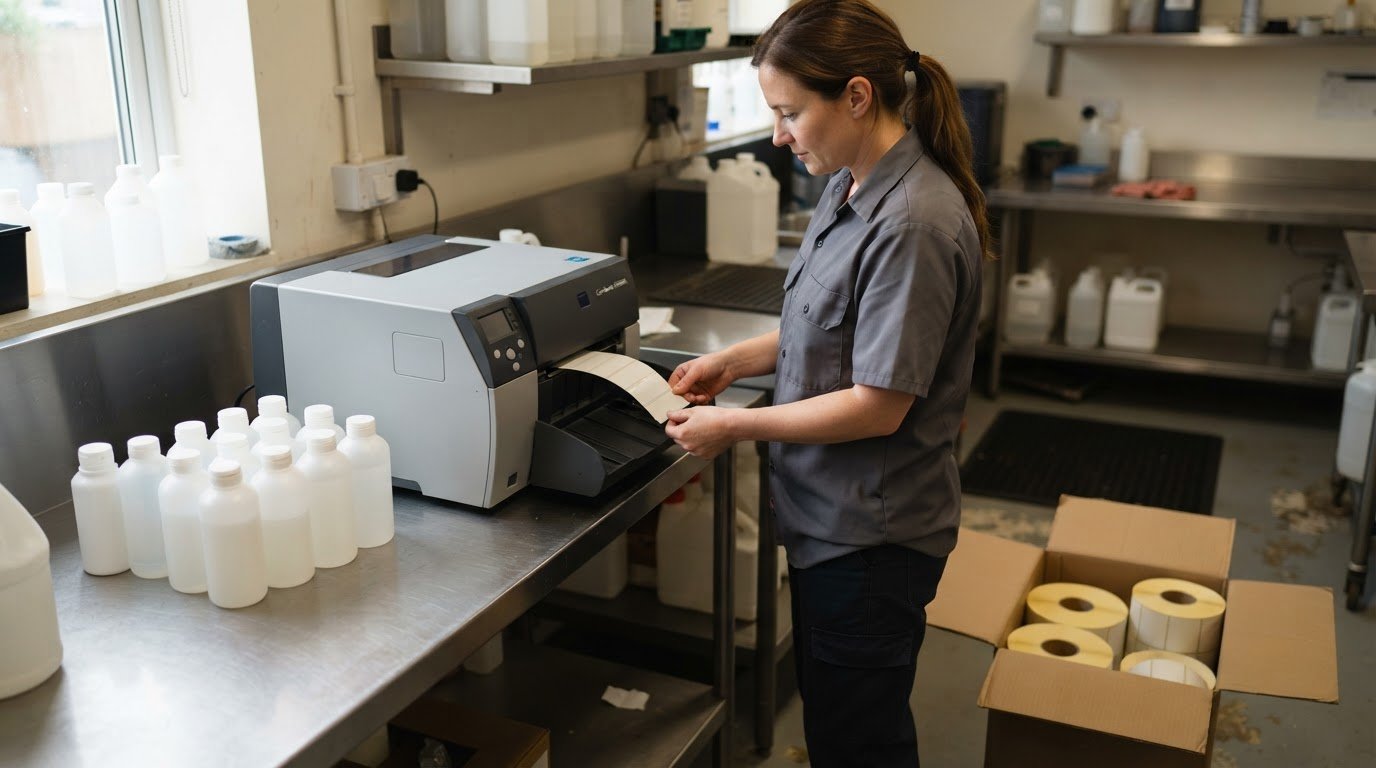
In-house label printing isn’t always cheaper than outsourcing. If you need 500 labels this month, an outsourced order may mean paying for more labels than you need or facing a short-run premium. An outsourced label printing cost analysis should compare the full cost of each option, not just the price per label.
Outsourcing avoids the need to buy and manage printing equipment, while in-house printing can make more sense for smaller batches or on-demand production. Which option costs less depends on your print volume, label materials, equipment and supplies, maintenance, minimum order quantities, and setup fees.
This guide shows how to compare those costs against your actual label needs. You’ll learn when outsourcing may be practical, when in-house printing may offer better value, and which expenses to include before deciding.
Key Takeaways
- Compare the full cost of each option, including label stock, shipping, setup, storage, and waste, rather than focusing only on the per-label price.
- In-house printing offers more direct control over print quality and timing, but requires equipment, supplies, maintenance, and staff time.
- Minimum order quantities can leave you with excess labels, especially when demand or designs change frequently.
- Include setup fees and the cost of design changes when comparing outsourced quotes with in-house production.
- Use your print volume, label needs, and order frequency to decide whether owning a printer or outsourcing is the better fit.
Is in-house label printing always cheaper than outsourcing?
There’s no single best option. The right choice depends on print volume, label requirements, and how much control you need over production. Compare the full costs as well as turnaround and flexibility.
Deciding When to Print In-House
In-house printing means producing labels on equipment your business owns and operates. Outsourcing means a print shop handles production and delivers finished labels. To evaluate the house vs. outsourced choice, track order sizes, repeat frequency, design changes, and how quickly labels are needed. A business that uses 500 labels this month may face a short-run premium or end up storing extra stock after a larger outsourced order.
In-house printing requires an initial equipment investment, supplies, maintenance, and staff time. In return, your team can print from approved artwork as needed, set production schedules, and manage print quality directly. Outsourcing avoids equipment management, but gives you less direct oversight and may mean waiting days or weeks for an order.
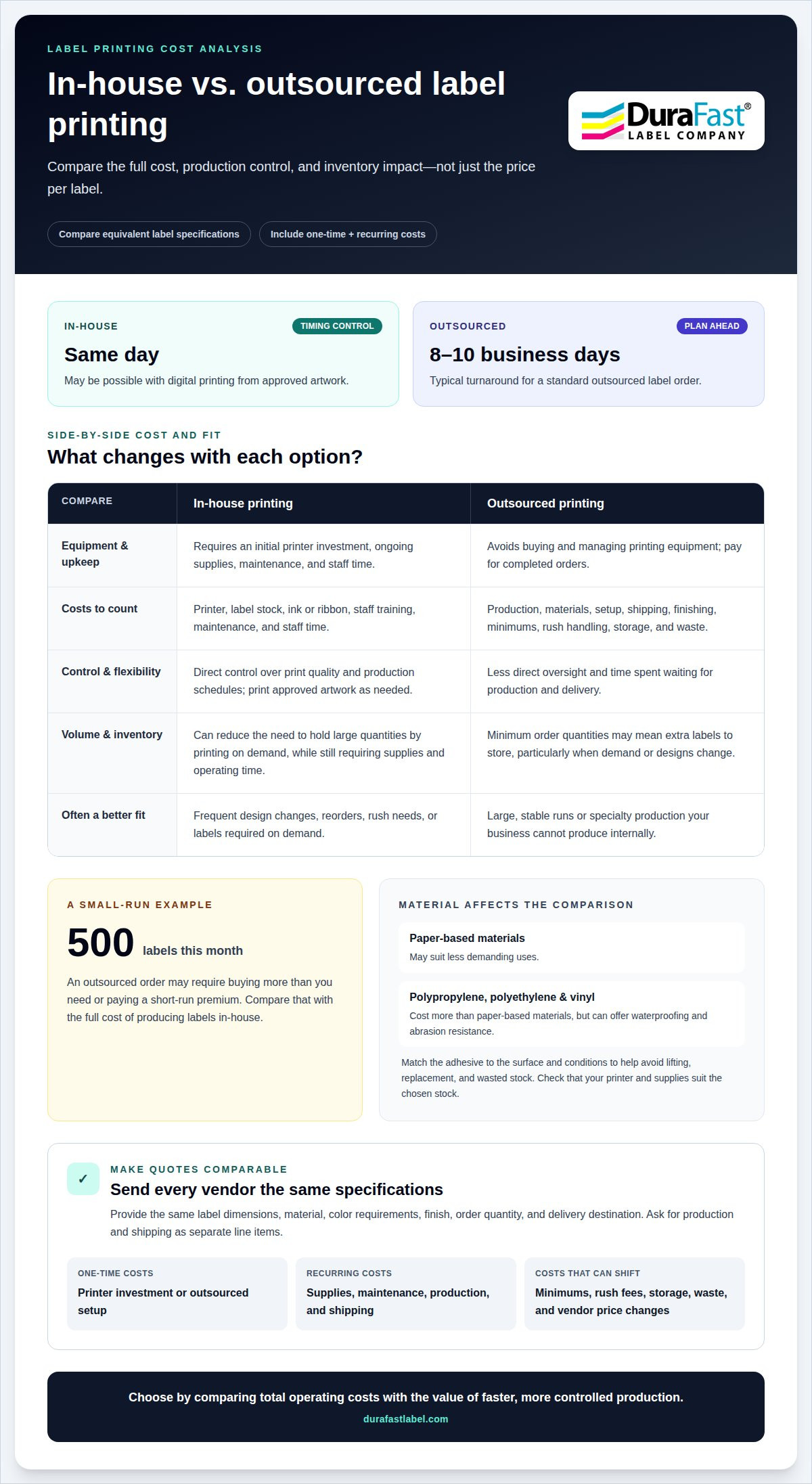
Turnaround can shape the decision as much as unit cost. In-house digital printing can produce labels the same day from approved artwork. A standard outsourced label order typically takes 8-10 business days. Consider in-house production when frequent reorders, rush fees, or excess stock make outsourced workflows difficult to manage. Very large, stable runs may still suit outsourcing.
| Option | Cost considerations | Quality and timeline control | Best fit |
|---|---|---|---|
| In-house | Equipment, supplies, maintenance, and staff time | Direct control; same-day printing may be possible | Frequent changes or labels needed on demand |
| Outsourced | Order pricing, shipping, minimums, and storage | Less direct oversight; allow for production and delivery | Large, stable runs or specialty production |
Choose by comparing total operating costs with the value of faster, more controlled production.
Material and Adhesive Cost Effects
Label material affects both cost and performance. Synthetic polypropylene, polyethylene, and vinyl cost more than paper-based materials, but can offer waterproofing and abrasion resistance. That durability may suit labels exposed to moisture or frequent handling, while paper may work for less demanding uses.
Adhesive choice also affects whether a label stays attached to its intended surface. A mismatch can lead to lifting, label replacement, or wasted stock, so compare the application surface and conditions with the required performance. For a specific label-use example, pillow law labels show how the label’s purpose shapes material decisions.
Include material and adhesive requirements before choosing a printing method. In-house printing lets your team schedule approved jobs, but the printer and supplies must suit the label stock. Outsourcing may be a better fit for specialty materials or finishing your business cannot produce internally. Factor these requirements into production planning alongside turnaround, equipment investment, and storage.
Outsourcing equipment, supply, and maintenance costs
Outsourcing shifts equipment and supply management to the print shop. In-house production requires an upfront investment and ongoing attention. Compare all relevant costs, including shipping, stock, maintenance, and staff time.
Outsourced Printing Charges
An outsourced quote may include production, materials, and finishing, with shipping charged separately. The same structure can apply to signage, where stock and finishing choices affect the total. With in-house digital printing, the business buys equipment and supplies, then manages production itself.
For in-house printing, include the printer, label stock, ink or ribbon, staff training, and maintenance. A permanent printhead can wear over time and may need attention at a service center. Outsourcing avoids equipment upkeep for each job, but you pay for completed orders and may have less direct control over production details.
Separate one-time charges from recurring expenses for each option. Outsourced jobs may include setup, materials, delivery, or finishing costs. In-house printing involves the printer and its ongoing use. Compare quotes for the same label specifications to make the figures meaningful.
Hidden and Changing Vendor Costs
The production charge may not include every cost. Shipping, minimum order quantities, rush fees, storage, and unused inventory can increase the total. Vendor price changes can also affect repeat orders, especially when your business uses the same label specification throughout the year.
Seasonal demand adds another planning challenge. A business may order extra stock before a busy period, then have to store unused labels afterward. In-house printing can reduce the need to hold large quantities because teams can print as needed, but it still requires supplies and operating time.
When reviewing an outsourced order, list each possible charge separately: production, setup, shipping, rush handling, storage, and waste. Compare those costs with in-house equipment, supplies, and maintenance. For thermal applications, include the required thermal transfer labels and printing method when comparing supply costs.
Quote Comparisons and Price Factors
To compare U.S. vendor quotes, send each vendor the same label dimensions, material, color requirements, finish, order quantity, and delivery destination. Request production and shipping as separate line items so you can compare equivalent orders.
Label size affects material use, while material choice determines the stock required. Color coverage and finishes also affect production, so specify them consistently in each request. For example, a matte label and one requiring a specialty finish aren’t directly comparable if the quoted specifications differ.
Compare turnaround and minimum quantities alongside the quote. A lower production charge may not mean a lower total if shipping, excess stock, or a rush order adds expense. Keep each quote with its specifications and delivery assumptions for a clear comparison.
Total Cost of Ownership
A useful total cost of ownership calculation for in-house printing includes the printer, label stock, ink or ribbon, maintenance, staff training, and operating time. For outsourcing, include order charges, setup, shipping, minimum quantities, storage, rush fees, and waste.
Use the same production period and expected label demand for both options. Separate recurring expenses from upfront equipment costs, then account for seasonal changes and design revisions. This helps show whether stable, high-volume demand offsets equipment ownership or outsourced production better fits changing needs.
Build a simple comparison sheet with one column for each method and rows for every cost category. If you want help matching label supplies to an in-house setup, discuss your label printing requirements through the contact page.
Minimum order quantities
Outsourced label orders often come with minimum order quantities (MOQs). Commercial suppliers typically require 1,000 to 10,000 units, depending on the supplier and substrate. That threshold can make the per-label price look attractive while increasing the total order cost and the inventory you need to store.
Consider a business that needs 300 labels. A supplier might require an order of 2,000 or 5,000 instead. The business must then account for the unused labels, including storage space and the chance that they become obsolete. A predictable reorder schedule helps only when demand and label designs stay stable.
Design changes create another risk. If a business orders 5,000 labels and later changes its branding or product details, it may have to discard the unused stock. The order’s original unit price won’t show the full impact of that waste. Changes at the last minute can also make stored inventory less useful, especially for products with frequently updated information.
In-house printing changes how much you need to order. A business can print a single label without meeting a supplier’s order minimum, then produce more as demand becomes clear. This can help with short runs, product tests, or variable label needs. The trade-off is managing the printer, supplies, and production process instead of relying on a supplier to deliver finished labels.
Compare order quantities with actual use, not just a forecast. If demand shifts between products, a large batch of one design can leave surplus labels while another design runs short. In-house production can make smaller batches practical, while outsourcing may suit a stable design used consistently. Neither option eliminates planning: one concentrates inventory in finished labels, while the other requires supplies and printer capacity.
- Estimate usage: Review how many labels each product needs and how demand changes.
- Check the MOQ: Compare the required order with the quantity you expect to use before a design change.
- Account for leftovers: Include storage and potential waste when an order exceeds immediate needs.
- Compare production: Weigh outsourced batch sizes against the flexibility of printing one label or a short run in-house.
If minimum-order quantities repeatedly lead to excess stock, frequent reorders, or waste after design updates, consider evaluating in-house production. If demand is steady and thousands of labels use the same design, outsourcing can simplify ordering. The key is how closely the order quantity matches usable demand.
Outsourced label pricing and setup fees
An outsourced label quote can include more than the production charge. A useful outsourced label printing cost analysis separates setup, shipping, delivery timing, and possible rush fees. Line-item quotes make it easier to compare vendors and spot charges a single total can hide.
Setup fees may cover work before production, such as preparing supplied artwork, creating a proof, or configuring a job for a specific label format. The details depend on the order. A repeat order using approved artwork may require different preparation from a first run with revised dimensions or a new layout. Check which tasks are included and which are charged separately.
Artwork changes can affect cost and turnaround. Changes after proof approval may require revised files, another proof, or schedule adjustments. Outsourced design revisions can add fees or delay production, while in-house printing lets your team update a label file directly. Allow time for approval, especially when packaging or product information must be finalized before labels are used.
Treat shipping and delivery as separate parts of the comparison. A quote’s production total may exclude transport, and delivery costs can vary with order size and destination. Compare the delivered total for the same label quantity, format, and destination rather than treating the production charge as the final cost. Include these details in your outsourced label printing cost analysis, and check whether delivery timing fits your production schedule.
Delays can add costs if you need labels before a standard order arrives. Rush handling may incur an extra fee, and late delivery can disrupt packaging or fulfillment schedules. Production time, proof approval, artwork corrections, and shipping all affect when labels arrive. Include each stage in the schedule rather than counting only printing time.
- Production: Record the quoted cost for the same label quantity, dimensions, material, colors, and finish.
- Setup: Identify artwork preparation, proofs, or other job-specific setup work and whether each is included.
- Delivery: Add shipping and compare the delivered total for the same destination.
- Timing: Include approval stages and ask how rush handling affects the order schedule and charges.
For example, compare two vendor quotes for an identical label format. One may show a lower production charge but list setup and delivery separately, while another bundles those items. Reconcile the line items, then compare the total with in-house costs, including equipment, supplies, and staff time. This makes your outsourced label printing cost analysis reflect the complete order, not just the headline price.
Print volume and printer selection
Print volume helps determine whether owning a label printer makes financial sense. Compare equipment and operating costs with outsourced costs across your actual jobs, not just one order. Include label counts, job frequency, artwork changes, and required turnaround. A printer suited to a steady production schedule may be costly for occasional work.
Review volume and job mix together. Count labels by design and note which jobs need color, different materials, or wider formats. The research describes occasional color-label printing as fewer than 500 labels per day. For runs in the tens of thousands or more per month, outsourcing may be cost-effective. These are comparison points, not automatic switch thresholds.
Printer selection should match daily output and quality expectations. Entry-class color-label printers may print at less than 1 inch per second at their best quality, or up to 4 inches per second in draft mode. A 4-inch-wide label is a prompt to consider a large-format color printer. Compare these capacities with the longest daily run and the time available for production.
Digital, flexographic, and offset printing have different cost structures. Digital printing suits on-demand jobs and changing designs, while flexographic and offset production involve setup costs that can be spread across larger runs. The right comparison depends on run size, artwork changes, material, and finishing needs. No method is least expensive for every label order.
Calculate break-even by comparing the printer investment and ongoing in-house costs against the savings per label. An illustrative printer-investment example reached break-even at around 18,700 labels when per-label savings offset the investment. Use your own expected volume and costs in the same calculation. Keep the estimate separate from assumptions about future growth.
Industrial equipment may be a better fit for sustained production than entry-class models. The research describes industrial printers as providing reliable performance over five years for large-volume printing. Match the printer class to your job mix, then include supplies, maintenance, staff time, and downtime in the comparison. A high-speed model adds little value if demand remains low.
- Track: Record monthly labels by design, size, and print type.
- Estimate: Calculate in-house cost per label, including equipment and operating expenses.
- Compare: Set that estimate beside outsourced costs for the same jobs and volumes.
- Review: Revisit the decision when volume or job mix changes.
Use the calculation to identify a practical switch point, not a universal rule. Discuss printer options for your label volume when matching equipment to production needs.
DuraFast Label Company: Labelview label design and barcoding software
DuraFast Label Company offers Labelview label design and barcoding software for businesses evaluating in-house label production. It also sells color label printers, including the Epson ColorWorks C6000A, along with DuraFast Matte Chemical Labels.
These options are relevant if your outsourced label printing cost analysis points toward managing label production internally. Consider software, printer, and label stock together to ensure your selection suits the labels you need to produce. For example, a chemical-label workflow may require a suitable printer paired with the right label material, while barcode projects can include label design and barcoding software.
Contact DuraFast Label Company to discuss label printing equipment, software, and supplies for your needs.
Turn your cost comparison into a practical next step
Before changing your label workflow, apply your outsourced label printing cost analysis to a representative product run. Choose a job that reflects your usual material, artwork, and production schedule. Track what the workflow requires, from artwork approval to labels ready for use. This gives your team a practical basis for judging whether the process fits daily operations, not just a spreadsheet.
Use that experience to decide the next step: keep production external, bring a specific label job in-house, or review equipment and software options. A focused decision can help you avoid a workflow that doesn’t suit your actual needs. DuraFast Label Company offers label printing equipment, supplies, and software for in-house production.
Contact DuraFast Label Company to discuss your label printing needs, and take the next step with a clearer plan.
Frequently Asked Questions
Is It Time to Bring Label Production In-House?
Consider in-house production when label demand is recurring, designs change frequently, or production timing needs close control. To assess the fit, choose a representative label job and compare repeat-order requirements with the work involved in printing it internally. Include artwork changes, staff time, supplies, and equipment use. If the process would add more work than it removes, outsourcing may remain the better fit.
What is the average cost of outsourced label printing in the United States?
There’s no single average that reliably represents every outsourced label order. A quote depends on label dimensions, material, color coverage, finish, quantity, setup needs, and delivery destination. For a useful budget, define a specific label job and request an itemized quote. A food jar label and a durable industrial label, for example, may need different stock and production choices.
How much do custom labels cost per unit at different order quantities?
Per-unit pricing depends on the production method and job specifications, so quantity alone can’t provide a reliable rate. Larger runs may spread setup work across more labels, while smaller jobs may have a higher per-unit share of preparation and handling costs. Compare quotes for the same dimensions, material, color, finish, and delivery terms at each quantity. This shows how the price changes as the order grows.
What are typical setup, plate, die, shipping, and artwork fees for label printing?
Charges vary by job and vendor, so request them as separate quote lines instead of assuming they’re included in production. Setup and artwork costs can depend on file preparation or revisions; plate and die charges depend on the production process. Shipping depends on delivery requirements. Ask which charges apply to your label specifications and whether repeat orders can use existing artwork or need new preparation.
How do outsourced label printing costs compare with in-house printing?
Outsourcing makes label production an order expense. In-house printing combines equipment investment with ongoing supplies and operating time. For a useful comparison, use the same label specifications and expected demand for both methods. Include costs tied to actual production, not only a printer’s purchase price or a vendor’s quote. Also consider whether staff can manage printing without interrupting other work.
What hidden costs and risks should buyers check when outsourcing label printing?
Look beyond the production charge to shipping, minimum quantities, storage, rush handling, and waste from unused or outdated labels. Artwork revisions can also affect timing and add preparation costs. Before production starts, match the approved proof against the intended label dimensions, material, and final artwork. This helps reduce the risk of receiving a batch that doesn’t fit the product or application.