Polyester PET Labels for Cold Chain: Compare Water and Wear Resistance
17th Nov 2026
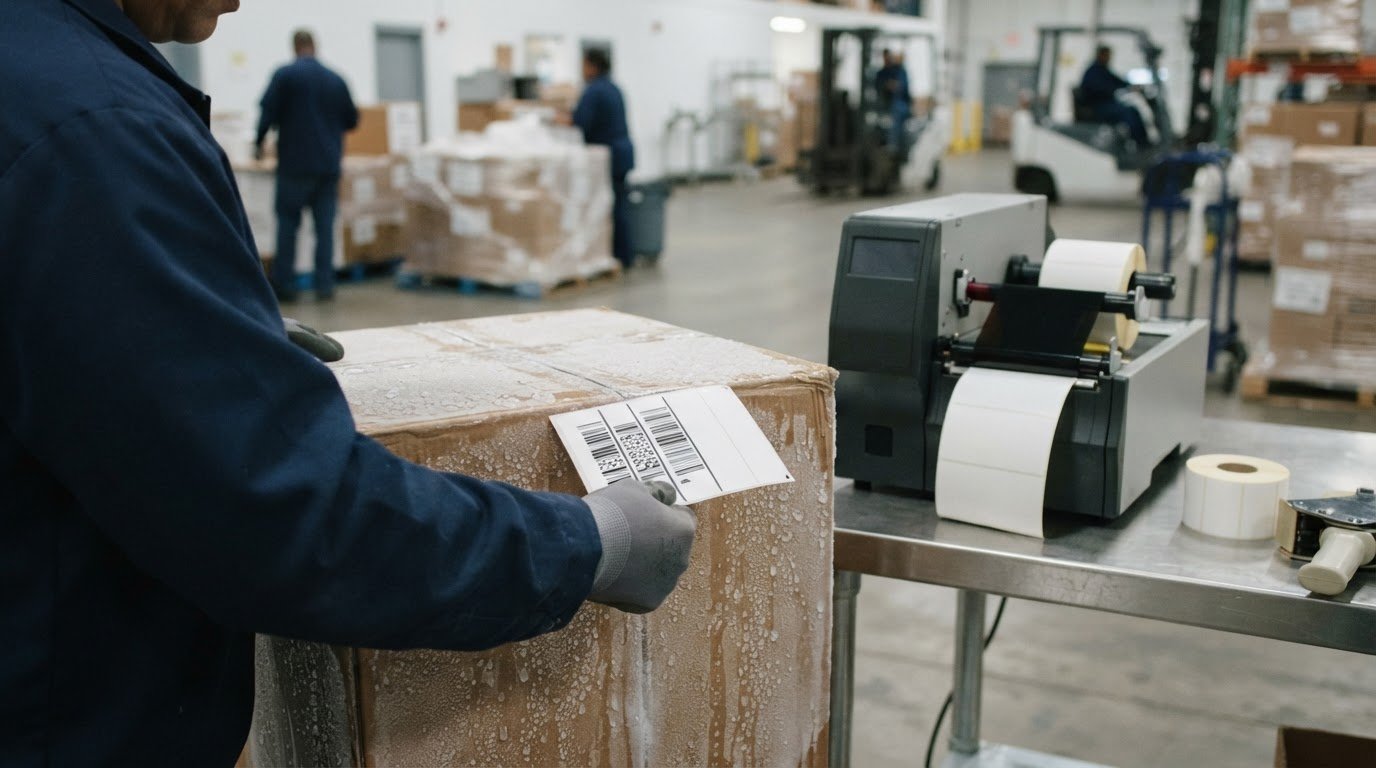
A PET label can resist water without being the right choice for every cold-chain application. Polyester PET labels for cold chain use absorb around 0.5% water, but the finished label’s performance also depends on its adhesive, print, and exposure conditions. A durable facestock alone doesn’t guarantee that a label will stay attached or readable.
If you’re asking whether PET is waterproof, the practical answer is that it offers strong resistance to water and wear, but the entire label construction matters. Temperature changes, chemicals, condensation, and the labeled surface can all affect adhesion and print legibility. To assess polyester PET labels for cold chain use, consider these conditions together.
This guide compares PET with other label materials and explains how water, temperature, chemicals, printing, and adhesion affect performance. It covers key considerations for industrial identification, pharmaceutical products, and shipping, and shows how sample testing can uncover problems before labels enter use. Use these criteria to decide whether polyester PET labels for cold chain suit your application.
Key Takeaways
- Compare polyester with other label materials against the temperatures and exposure your application actually involves.
- Choose a label construction suited to the surface, chemicals, and handling conditions in industrial, pharmaceutical, or shipping settings.
- Understand why water resistance alone doesn’t tell you whether a label will stay readable and securely attached.
- Match the label’s temperature range to cold storage, transitions, and use conditions.
- Use sample testing to assess print clarity and adhesion before selecting a label for routine use.
Chemical and heat resistance of polyester
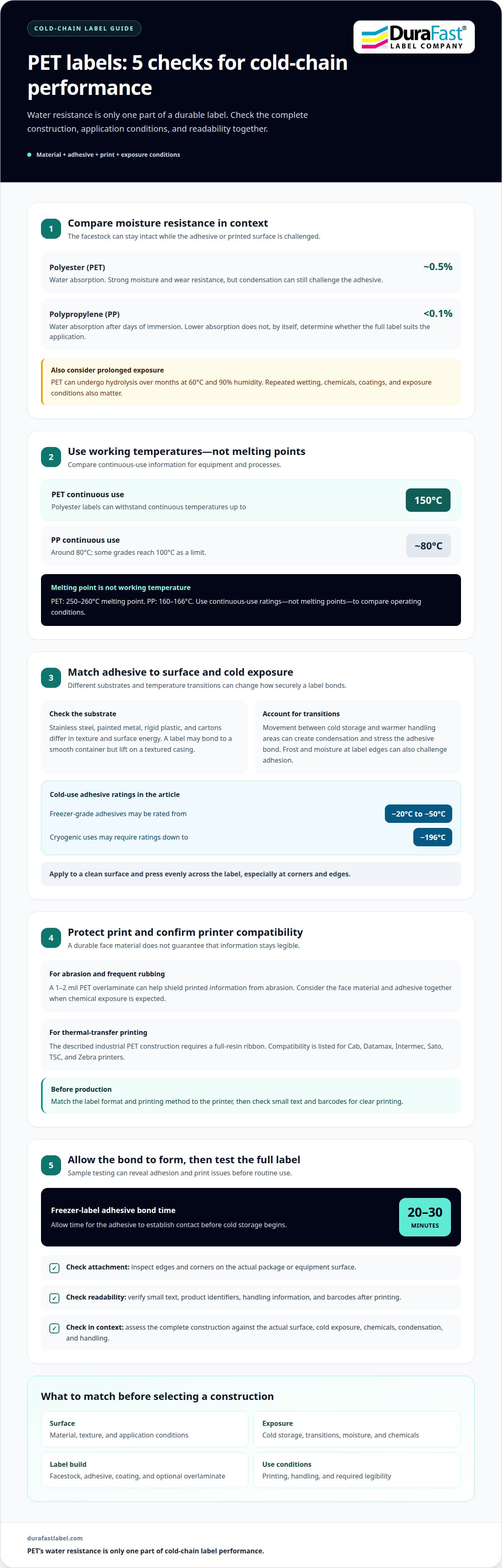
Yes. PET labels resist moisture, many chemicals, and surface wear, but performance depends on the complete label construction. Condensation can challenge the adhesive even when the polyester face remains intact, so material resistance alone does not guarantee a secure bond.
PET absorbs around 0.5% water, while polypropylene absorbs less than 0.1% after days of immersion. That difference doesn’t make PET unsuitable for damp conditions, but it shows why “waterproof” needs context. Repeated wetting, chemical contact, and the label’s surface coating can affect print and durability. PET can also undergo hydrolysis over months at 60°C and 90% humidity, a reminder that prolonged heat and moisture exposure matters.
For heat, polyester labels can withstand continuous temperatures up to 150°C. Polypropylene labels are reliable around 80°C in continuous use, while some grades reach 100°C as a limit. PET’s listed melting point is 250-260°C, compared with 160-166°C for polypropylene. A material’s melting point isn’t its working temperature, so use the continuous-use rating when comparing labels for equipment or processes.
| Option | Water and moisture | Heat information | Wear considerations |
|---|---|---|---|
| Polyester (PET) | Around 0.5% water absorption | Up to 150°C continuous use | Can be paired with a 1-2 mil PET overlaminate |
| Polypropylene (PP) | Less than 0.1% absorption after days of immersion | Around 80°C continuous use; some grades reach 100°C as a limit | Construction and surface conditions affect label performance |
| PET with overlaminate | Added film protects the printed surface | Match the complete construction to operating conditions | Overlaminate can help shield print from abrasion |
Choose a label for the conditions it will face, not just its facestock. For frequent rubbing, a PET overlaminate can protect printed information. With chemical exposure, consider both the face material and adhesive. Condensation and frost also challenge adhesion: moisture can collect at the label edge, and cold surfaces can make bonding more difficult. The PET film may remain intact even if a poorly matched adhesive lifts.
Recycling can also influence material choices. According to the European Union, the EU Packaging and Packaging Waste Regulation requires packaging sold in EU markets to be designed for recycling at scale by 2030, with grades based on recyclability thresholds of 95%, 80%, and 70%. For PET labels on PET bottles, clean recycling depends on adhesive designed to separate during the wash step. For other uses, compare the label’s exposure, service conditions, and end-of-life requirements before choosing.
Durable label applications in industrial, pharmaceutical, and shipping settings
Durability depends on the surface, adhesive, printing method, and handling conditions. Industrial equipment, pharmaceutical containers, and shipping cartons each present different demands.
Application Surfaces and Freeze-Thaw Cycles
Stainless steel, painted metal, rigid plastic, and cartons differ in texture and surface energy. A label that bonds well to a smooth container may lift at the edges on a textured casing. In cold-chain applications, repeated movement between cold storage and warmer handling areas can create condensation and stress the adhesive bond. Apply labels firmly across the full surface, especially at corners and edges.
On pharmaceutical packaging, product identifiers and handling information must stay readable and attached through storage and distribution. A synthetic PET face can suit applications involving frequent handling, but the adhesive must also match the package surface and application temperature. Shipping labels face additional rubbing and contact during sorting. Pharmaceutical vials, cartons, and industrial components therefore require different label sizes, adhesives, and print layouts, even when all need a durable material. When shipping sensitive or fragile components, companies often pair durable exterior labeling with protective inserts from Foam Packaging Direct to stabilize packages and minimize transit abrasion.
Printer Compatibility and Application Practices
Printer compatibility depends on the label construction, not just its PET face. Thermal-transfer printing uses a ribbon; the described industrial PET construction requires a full-resin ribbon. It is compatible with Cab, Datamax, Intermec, Sato, TSC, and Zebra printers. Match the label format and printing method to the printer before production, then check that small text and barcodes print clearly.
Application conditions matter just as much as printer fit. Freezer-grade adhesives may be rated from -20°C to -50°C, while cryogenic uses may require ratings down to -196°C. Apply the label to a clean surface and press it evenly so adhesive contacts the substrate. Allow freezer-label adhesive 20-30 minutes to form a permanent bond before freezing. This gives the adhesive time to establish contact before cold storage begins.
Material Cost and Application Conditions
Material cost reflects more than PET film alone. Adhesive type, facestock thickness, topcoat, liner, and printing requirements all shape the finished construction. A 2-mil white PET label with permanent acrylic adhesive is described as standard for industrial labels. Its matte topcoat supports print quality and long-term use on steel, plastic, and painted metal. For pharmaceutical or shipping use, select features according to the actual surface and handling conditions.
Separate the application requirements before choosing: identify the package surface, coldest exposure, chemical contact, and expected handling. That helps avoid paying for features the task doesn’t need, or selecting a construction that can’t hold. For a practical discussion of label and printer requirements, share your application details.
Q: Is PET label material waterproof?
PET resists water, but “waterproof” describes the complete label and its exposure, not just the facestock. For packaging exposed to condensation, outdoor weather, or repeated handling, consider the adhesive, print protection, and surface together.
Durable Label Materials Including PET
Polyester PET is a synthetic film used for labels that need tear, chemical, and UV resistance. Polypropylene is another film option, with very low water absorption during immersion. Neither material alone determines whether a label will stay attached or readable. Adhesive, topcoat, and print method also affect durability during storage, transport, and use.
Choose material according to the label’s job. A PET asset label intended for outdoor use differs from a short-term shipping label on corrugated packaging. The brief lists typical outdoor or asset-tag service life for PET labels as 5-10 years, depending on application. For a label that faces frequent abrasion, a protective overlaminate can shield printed information. For chemical contact, the adhesive and face material both matter.
Condensation and Barcode Print Durability
Condensation can form when a cold package moves into warmer air. Moisture may affect adhesion at edges or seams, while handling can rub the barcode surface. A PET face can resist wear, but barcode readability also depends on print quality and protection. Test the complete label on the actual package, including after exposure to moisture and routine abrasion.
For example, a barcode on a chilled pharmaceutical carton must remain scannable after storage and handling. Check that the bars stay distinct and the label edges remain flat. A PET overlaminate can add a protective layer, but the finished construction still needs to suit the packaging and exposure.
Outdoor Durability and Water Protection
Outdoor labels face water alongside UV exposure, chemicals, and abrasion. Polyester labels are described as capable of outdoor durability lasting upwards of 5 years. Actual service life depends on the label construction and conditions, including sunlight and contact with cleaning agents. Polypropylene can also offer water resistance, but its suitability depends on the exposure and handling demands.
Durable labeling can also involve standards and identification requirements. BS 5609 sets criteria for labels applied to dangerous goods in marine environments, including saltwater exposure. GHS was adopted and revised by OSHA in 2012; label material must preserve required hazard information through its intended handling. Underwriters Laboratories has operated since 1894, but UL recognition should not be assumed for every label. Match any required certification to the specific label construction and application.
PET label temperature range and glass transition
At refrigerated and frozen temperatures, PET labels can remain flexible down to -40°C. General-use PET film has a short-term service range of -70°C to 150°C, but the adhesive and full label construction also determine performance.
Temperature Cycling and Dimensional Stability
Temperature cycling moves a label between cold storage and warmer operating conditions. PET labels can remain stable through shifts from -10°C at night to 60°C during operation. This makes dimensional stability relevant for containers moving between refrigerated transport and indoor handling. The film may stay intact, but repeated expansion and contraction can stress edges or affect the bond to the package.
Glass transition helps explain how PET responds to heat, but it isn’t the same as a recommended operating limit. PET’s glass transition temperature is approximately 67°C to 81°C, depending on grade. Above this transition, material behavior changes. General-use PET film’s short-term service range extends from -70°C to 150°C, so choose a construction based on actual exposure, not one temperature figure alone.
Cold-Temperature Flexibility and Brittleness
PET labels remain flexible at temperatures as low as -40°C, which can help them conform to packages in cold environments. Standard freezer-grade labels are typically suitable down to around -20°C to -30°C. These ranges describe different label applications, so don’t assume a general-purpose construction will perform like a freezer-grade one in an extreme environment.
At very low temperatures, consider both the facestock and how the package will be handled. A label on a curved container may flex differently from one on a flat carton. Temperature cycling can also reveal weak edges as packaging moves between storage and transfer. Match the label’s intended range to the coldest point in the process, then assess the complete construction under those conditions.
Low-Temperature Adhesive Performance
Low-temperature performance depends on whether the adhesive can make contact with the package and maintain its bond. A PET face may remain flexible while the adhesive struggles to stick to a cold, damp, or frosted container. Application conditions matter: applying a label before chilling differs from applying it directly to a cold package.
Choose an adhesive suited to the application temperature and substrate, then account for moisture, surface texture, and handling. A smooth vial and a corrugated shipping carton, for example, present different bonding surfaces. A label that must stay attached during refrigerated storage also needs to tolerate transfers and temperature changes. Evaluate the complete label construction, including the adhesive, on the actual package.
Sample testing, print legibility, and adhesion
A sample run helps show whether the PET label, printer, adhesive, and package work together. Assess print clarity and adhesion under the conditions the finished label will face.
Sample Testing and Print Legibility
Print the actual identification layout on sample stock using the intended printer and settings. Review small text, symbols, and barcode edges before applying labels to packages. Scan the barcode, then inspect it again after handling. Use a sample with the real label size and content: a clear test graphic may not reveal problems with dense data or narrow bars.
Allow the applied sample to bond, then assess adhesion after 48 hours. Look for lifting edges, wrinkles, smudged print, or loss of barcode readability. If the label will encounter moisture, abrasion, or cold storage, include those exposures in the evaluation. Testing the finished label on its intended surface gives a more useful result than testing PET film alone.
Adhesive Compatibility and Thermal Cycling
Adhesives behave differently across substrates and temperature changes. PET label constructions may use hot-melt, water-based acrylic, or UV-curable adhesives. A sample on a smooth bottle may bond differently from one on a textured carton, so test it on the same packaging material used in production.
After application, expose the sample to the expected temperature changes and check whether the edges stay flat. Thermal cycling can reveal bonding weaknesses that a room-temperature inspection misses. Record visible changes in adhesion and print, especially where labels curve around containers or cross a package seam. Compare results on the intended surfaces, not just across adhesive types.
PET Adhesive and Liner Construction
The label’s construction includes its PET face, adhesive, and release liner. Described PET constructions use release liners in the 1.5-2.4 mil range. Liner thickness and release behavior affect how labels feed and dispense during application. The facestock also varies: PET film used as backing in two of six ASTM D3330 peel adhesion tests is 0.025 mm thick.
This illustrates why construction matters when interpreting adhesion results. A peel measurement applies to the materials and method tested; it does not automatically predict performance on every package. Compare the complete construction on the actual substrate, using the intended application process. Include printed samples, since ink or protective layers can change the surface exposed to handling.
Use the test results to narrow the construction before routine printing. Discuss your PET label application and testing needs.
DuraFast Label Company
DuraFast Label Company offers label printers and supplies that can support durable identification workflows. For color printing, the Epson ColorWorks C6000A is an option to consider. For thermal-transfer workflows, the Zebra ZT411 Thermal Transfer Printer and DuraFast Thermal Transfer Ribbons fit the equipment-and-ribbon pairing. DuraFast Matte Chemical Labels provide another label option where chemical resistance is a priority.
Match the printer and label to the information you need to print, the package surface, and expected exposure. If you’re narrowing down a setup for cold-chain labeling, contact DuraFast Label Company to discuss your requirements.
Put Your Label Choice Into Practice
Turn the label decision into a clear specification for your workflow. Start with the information that must remain readable, the package it will go on, and the conditions it will encounter from application through delivery. This helps teams compare label constructions against the actual task instead of choosing by material name alone.
For polyester PET labels for cold chain applications, test the label, print method, and package together in a representative trial. Record what happens during storage, transfer, and handling. A focused evaluation can reveal whether the construction suits the process before it becomes routine. Use the results to set a practical specification for polyester PET labels for cold chain use.
If you’re ready to discuss label printers or supplies for your workflow, contact DuraFast Label Company. Share the application and the outcome you need, and take the next step with a clearer plan.
Frequently Asked Questions
What Does a Freezer Labels Manufacturer Actually Do?
A freezer-label manufacturer develops or supplies label constructions for cold storage, including a facestock, adhesive, and liner suited to the intended application. DuraFast Label Company is a supplier of label printing equipment and supplies, supporting businesses that print labels in-house. For example, a buyer may pair a compatible printer with suitable label media and ribbons, then evaluate the finished label on its packaging.
What are polyester PET labels used for in cold-chain logistics?
PET labels identify products, packages, and assets that need durable printed information during refrigerated storage and transport. Examples include product identification on a pharmaceutical carton, tracking details on a reusable container, or handling information on a shipping package. Choose the label construction for the specific substrate and journey: a small container, corrugated carton, and reusable bin face different handling and moisture conditions.
Which adhesives work best for PET labels on cold, damp, or frosty surfaces?
Choose an adhesive rated for the application temperature and the package surface. Freezer-grade adhesives may be rated from -20°C to -50°C, while cryogenic applications may require ratings down to -196°C. Remove frost and surface moisture before applying a label, since they can interfere with contact. For freezer labels, allow the adhesive 20-30 minutes to form a permanent bond before freezing.
What are the temperature limits of common PET label facestocks and adhesives?
General-use PET film is described with a short-term service range of -70°C to 150°C. That range doesn’t set the limit for the whole label: adhesive performance and the package surface matter too. Freezer-grade adhesive ratings vary with the construction and intended use. For a label moving from application into cold storage, consider both the temperature at application and the coldest exposure afterward.
How do PET labels compare with polypropylene labels for cold-chain use?
PET and polypropylene each suit different label demands; neither is automatically best for every cold-chain application. PET can remain flexible at low temperatures, while polypropylene has low water absorption and can also be made for cold-chain use. Compare temperature exposure, expected wear, and container surface. A label on a smooth package, for example, may need different features from one on a handled shipping carton.
How should surfaces be prepared and PET labels applied in cold environments?
Apply PET labels to a clean, dry surface, avoiding frost, condensation, seams, and loose residue. Press the label firmly across its full area, paying attention to corners and edges. On a chilled container, cold and moisture can affect adhesive contact, so applying the label before chilling may differ from labeling a package already in cold storage. Allow freezer adhesive to bond before freezing.
Which printing methods and ribbons are compatible with PET cold-chain labels?
Thermal-transfer printing uses a ribbon, and the described industrial PET construction requires a full-resin ribbon. Compatibility still depends on the specific label construction and printer. A thermal-transfer setup, for example, needs suitable media dimensions and a printer that accepts the label roll. Check that text and barcodes remain clear on the finished label, especially when identification must be scanned during receiving or inventory handling.
What label standards and regulations apply to cold-chain products in the United States?
Requirements depend on the product and its intended use; PET material alone doesn’t establish regulatory compliance. The Globally Harmonized System was adopted and revised by OSHA in 2012, but that fact doesn’t mean every cold-chain label has identical requirements. Dangerous-goods labels for marine environments may involve BS 5609 criteria. Separate product-specific rules can also affect the information and presentation needed on packaging.