The 2026 Professional Guide to Wash Care Labels: In-House Printing & Compliance
20th Aug 2026
Did you know that a single non-compliant garment could cost your business up to $51,744 in FTC penalties as of August 2026? It's a staggering figure that highlights just how critical accurate labeling has become. You likely already know the frustration of outsourcing small batches of wash care labels only to wait weeks for delivery. Even worse, those expensive labels often fade or become illegible after just a few industrial laundry cycles, leaving your customers frustrated and your brand looking unprofessional.
We're here to help you simplify this technical process. This guide promises to show you how to produce durable, compliant labels in-house to reduce costs and gain total control over your garment branding. You don't need to be a manufacturing expert to get started. We will provide a clear roadmap for setting up your own printing station, choosing the right resin ribbons for nylon or polyester, and navigating the complex 2026 global symbol requirements. From understanding the ISO 3758:2023 standards to preparing for upcoming Digital Product Passports, you'll gain everything needed to keep your apparel business running efficiently and legally.
Key Takeaways
- Stay compliant with the latest FTC and ISO regulations to protect your brand from significant financial penalties.
- Reduce overhead and eliminate long lead times by transitioning from outsourced orders to an on-demand, in-house printing system.
- Identify the best textile substrates like nylon and polyester to ensure your labels remain legible after repeated industrial washes.
- Learn how to pair thermal transfer printers with specialized resin ribbons to create permanent wash care labels that won't fade.
- Follow a step-by-step workflow to configure BarTender software and optimize your printer settings for professional results.
Understanding Wash Care Labels: Compliance and Legal Requirements
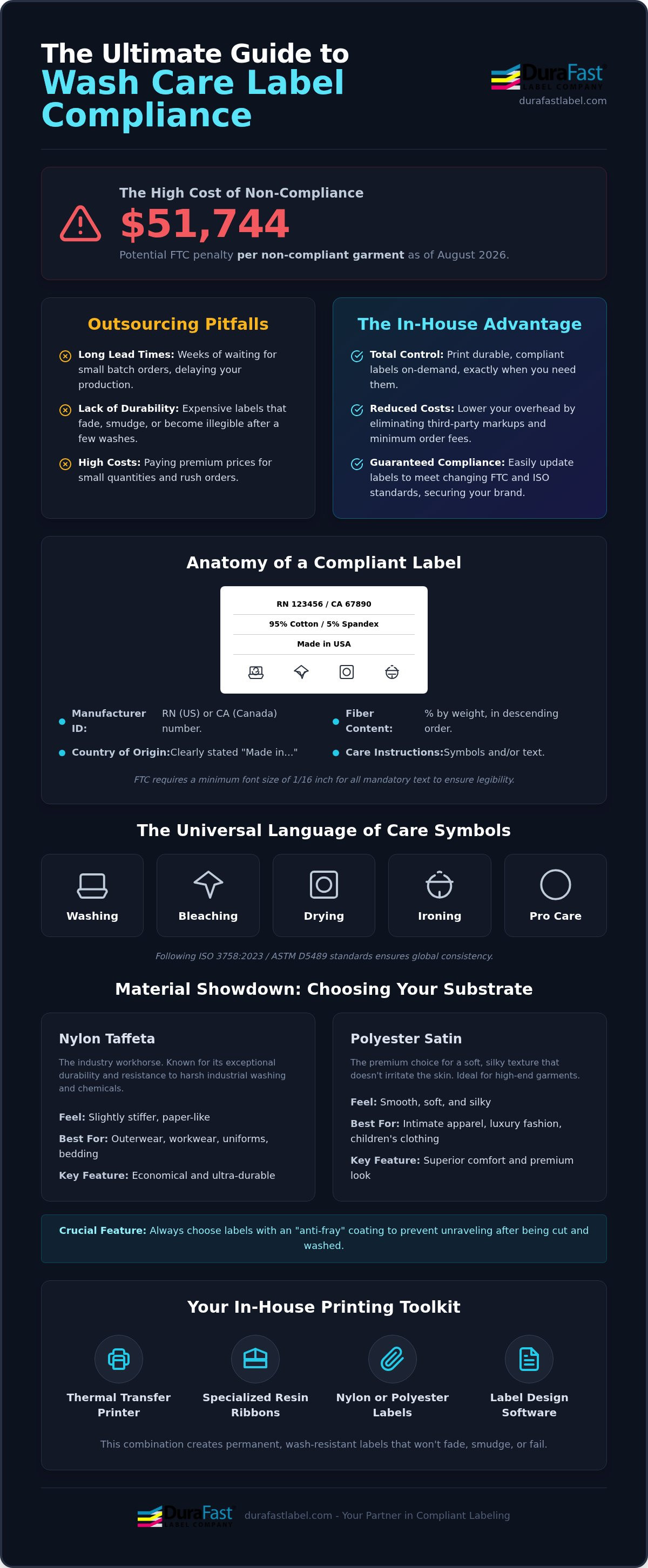
Think of wash care labels as the legal passport for your apparel. They aren't just tags; they're essential textile information carriers that protect both the consumer and the manufacturer. In the United States, the Federal Trade Commission (FTC) oversees these requirements through the Care Labeling Rule. In Canada, the Competition Bureau handles similar enforcement. These regulations aren't suggestions. They're strict mandates. You must ensure that every garment includes a permanent label providing instructions for washing, drying, and general care. Legibility is the most important factor here. A label that becomes a blank white strip after three trips through the laundry is a liability. As of August 10, 2026, violations of the FTC's Care Labeling Rule can result in penalties of up to $51,744 per item.
Mandatory Information for North American Apparel
Compliance starts with three specific data points: fiber content, country of origin, and manufacturer identification. You need to list fiber percentages by weight in descending order. For example, "95% Cotton, 5% Spandex" is the standard format. You also must identify your business using a Registered Identification Number (RN) in the US or a CA number in Canada. This allows regulators to trace the product back to your company. Placement matters, too. Labels must be easy to find and attached securely. The FTC requires a minimum font size of 1/16 inch for all mandatory text. Small font sizes might save space, but they often lead to compliance fines if a consumer can't read the instructions clearly.
The Universal Language of Care Symbols
Adopting international laundry care symbols is the smartest way to communicate with a global audience. Most manufacturers follow the ISO 3758:2023 or ASTM D5489 standards to ensure consistency. These standards utilize five core pictograms:
- Washing: Represented by a washtub icon.
- Bleaching: Represented by a triangle.
- Drying: Represented by a square.
- Ironing: Represented by an iron icon.
- Professional Care: Represented by a circle.
The ISO 3758:2023 update introduced specific symbols that align more closely with GINETEX symbols, making international trade much simpler. While symbols are highly efficient for small wash care labels, we recommend pairing them with brief text. This dual-labeling approach reduces the risk of customer errors and helps your brand meet the highest standards of transparency in both the US and Canadian markets.
Materials and Durability: Choosing the Right Textile Substrate
Selecting the right material for your wash care labels is about more than just aesthetics. You need a substrate that can survive the specific life cycle of your garment. If you produce high-performance workwear, the label faces industrial detergents and high-heat drying. If you're in the luxury fashion space, a scratchy label ruins the customer experience. Most textile labels consist of nylon, polyester, or satin. Each has unique strengths. One critical feature to look for is "anti-fray" coating. This treatment ensures that when the label is cut, the edges don't unravel during washing. Without this protection, your compliant information could literally fall apart. It's also vital to consider how these materials react to heat. Polyester, for instance, handles high-heat drying and ironing better than many cheaper synthetics, which might shrink or distort.
Nylon Taffeta vs. Polyester Satin
Nylon Taffeta is the workhorse of the industry. It's incredibly durable, economical, and stands up well to chemical stone-washing and heavy-duty laundering. It has a slightly stiffer, paper-like feel. This makes it perfect for outerwear, bedding, or uniforms where "skin-feel" isn't the primary concern. In contrast, Polyester Satin offers a premium, silky texture. It's the standard for intimate apparel and high-end fashion because it doesn't irritate the skin. Both materials are highly compatible with thermal transfer printing. This technology ensures that your text remains crisp and won't smudge; it stays legible even when exposed to constant moisture or friction against the skin.
Specialized Labels for Extreme Conditions
Some garments require more than standard durability. For example, safety equipment and children's sleepwear must use flame-retardant label options to meet strict safety standards. If your products are destined for dry-cleaning environments, you'll need specialized thermal transfer labels that can resist harsh chemical solvents. Following the ASTM D5489 care symbols is essential here to ensure your instructions are accurate for these specific conditions. These symbols provide a clear, standardized way to communicate complex care needs to professional cleaners. You don't want a label that melts or fades when a customer takes their coat to the cleaners. If you aren't sure which material fits your specific production run, reach out to our team for a recommendation tailored to your brand.
The Business Case for In-House Wash Care Label Printing
Many apparel brands start by outsourcing their wash care labels. It seems easy at first. However, as production scales or diversifies, the hidden costs of third-party printing become a burden. When you outsource, you're often forced into high minimum order quantities. This leads to drawers full of unused labels every time you update a fiber blend or change a logo. Printing in-house flips this dynamic. You gain the ability to print exactly what you need, when you need it. This on-demand approach eliminates lead times entirely. If a shipment arrives with a different fabric composition than expected, you can update your label design in seconds. There's no waiting for a vendor to re-ship a corrected batch. This flexibility is a massive competitive advantage in the fast-paced 2026 apparel market.
Calculating ROI on Label Printing Hardware
Is the investment worth it? To find out, look at your total cost per label. When you factor in the printer, wash care resin ribbons, and textile rolls, the unit cost is usually a fraction of what a service bureau charges. Most mid-sized businesses find that their hardware pays for itself within the first few months of high-volume production. Owning thermal transfer label printers means you aren't just buying tags; you're buying operational agility. You can scale your printing speed to match your production runs, ensuring your labeling station never becomes a bottleneck in your shipping department. Reducing inventory waste alone often covers the monthly cost of consumables.
Controlling Quality and Compliance
Communication gaps with external vendors are a leading cause of labeling errors. A simple typo in a fiber percentage can lead to a shipment being rejected or flagged for non-compliance. By bringing production in-house, you remove the middleman. You can verify every batch against the FTC's Care Labeling Rule before the first garment leaves your facility. You also ensure consistency. By sourcing your own high-quality supplies, like specialized resin ribbons, you guarantee that every label meets the same industrial durability standards. This level of control also protects your proprietary branding. You don't have to share your manufacturing techniques or upcoming designs with external parties, keeping your intellectual property secure within your own four walls.
Essential Equipment: Printers, Ribbons, and Software
Your equipment choice determines whether your wash care labels survive the first wash or fade into a blank strip. For permanent textile marking, thermal transfer technology is the only viable option. Unlike direct thermal printing, which reacts to heat and friction, thermal transfer uses a heated printhead to melt ink from a ribbon onto the fabric. This process creates a chemical bond that withstands the rigors of industrial laundering. To get the best results, you'll need a combination of high-resolution hardware and specialized consumables designed specifically for the apparel industry.
Selecting an Industrial Thermal Transfer Printer
High-volume textile production requires a rugged machine that can run all day without overheating. The Zebra ZT411 is a proven workhorse for this environment. It offers the durability needed for large production runs and supports 300 DPI (dots per inch) resolution. This high resolution is critical. Care symbols are often tiny, and lower resolution printers will produce blurry icons that fail compliance checks. If you are a boutique manufacturer with limited space, the Seiko SLP850 provides a compact desktop alternative without sacrificing print quality. It's an excellent choice for small-batch labels or custom branding projects.
The Role of Textile-Grade Resin Ribbons
The ribbon is just as important as the printer. Many businesses make the mistake of using standard wax or wax-resin ribbons. These will wash away almost immediately in a standard laundry cycle. You must use "Wash Care Resin Ribbons" specifically formulated for nylon and polyester substrates. These thermal transfer ribbons are engineered to resist detergents, high-heat drying, and the intense friction of a washing machine. Always ensure your ribbon width slightly exceeds the width of your label material. This small adjustment protects the printhead from direct contact with the abrasive textile edges, extending the life of your hardware.
Label Design with BarTender Professional
Software is the final piece of the puzzle. BarTender Professional allows you to automate the placement of complex care symbols, ensuring they always meet international standards. You can manage multiple SKUs and varied fiber contents from a single database, which reduces the risk of manual entry errors. The software also supports serialization. This is a powerful tool for tracking production batches or adding anti-counterfeiting features to your branding. If you need help choosing the right hardware bundle for your facility, contact our experts today for a personalized equipment audit.
Best Practices for Designing and Printing Compliant Care Tags
Setting up a dedicated textile printing station is the final step in taking control of your production. You should place your printer in a clean, low-dust area, though we know this is challenging in a garment factory. Textile materials naturally shed fibers that can clog sensitive components. To ensure your wash care labels remain professional, you must balance technical settings with smart design choices. High-contrast layouts, specifically black resin on white nylon or polyester, provide the best legibility for consumers and regulators alike.
Design Layout for Maximum Legibility
Legibility isn't just about font size. You must leave adequate white space between care symbols to prevent ink bleed. During high-heat industrial washes, tightly packed symbols can blur together. We recommend a minimum of 2mm of spacing between each pictogram. Always place mandatory legal text in a clear, sans-serif font. This ensures that even after the label has been through the laundry, the 1/16 inch minimum font size remains readable. If you're using satin, remember that the weave is looser than nylon. Avoid ultra-fine lines that might disappear into the fabric texture during the printing process.
Maintenance and Printhead Care
Resin ribbons require higher heat settings than standard wax options to achieve a permanent bond. However, running your printer at maximum darkness and high speed will wear out the printhead prematurely. Find a "sweet spot" where the print is crisp but the heat is as low as possible. Textile dust is highly abrasive; it acts like sandpaper on your Zebra or Epson printhead. Clean the printhead with 99% isopropyl alcohol every time you change a ribbon roll to prevent "dead pixels" in your barcodes or symbols. If you notice diagonal lines or ribbon wrinkle on your wash care labels, it's usually a sign of uneven tension. Adjust the ribbon supply spindle or the printhead pressure toggles to smooth out the feed.
Before committing to a full production run, perform a 50-wash durability test. This is the industry standard for high-quality apparel. If the text remains sharp after 50 cycles of washing and drying, your resin-to-substrate bond is successful. Finally, organize your printed batches using a take-up rewinder. This keeps your labels in a neat roll. It makes it much easier for your sewing team to cut and insert them into seams without damaging the printed surface or creating unnecessary waste on the factory floor.
Master Your Garment Branding with In-House Production
Taking control of your wash care labels is one of the most effective ways to streamline your apparel business in 2026. By moving production in-house, you eliminate the risks of third-party delays and ensure every garment meets strict FTC and international standards. You've learned that pairing the right industrial hardware with specialized resin ribbons is the secret to labels that survive the toughest industrial laundry cycles. This shift doesn't just save money; it gives you the flexibility to launch new products and update fiber content information instantly.
As an authorized Zebra and Epson partner, we have specialized wash care resin ribbons in stock and ready to ship. We also provide expert technical support to help you configure your in-house setup for long-term success. Ready to upgrade your workflow? Shop Industrial Printers and Wash Care Supplies today to get started. Your brand deserves the reliability and professional finish that only high-quality, on-demand printing can provide.
Frequently Asked Questions
Do wash care labels have to be sewn in?
Yes, the FTC requires care labels to be attached permanently and remain legible for the entire life of the garment. While "tagless" heat transfers are popular for branding, mandatory care instructions must be securely fastened to the product. Sewing them into a seam is the industry standard because it ensures the label won't peel off like an adhesive sticker might during heavy agitation or high-heat drying cycles.
What is the best material for labels that touch the skin?
Polyester satin is the superior choice for garments that have direct skin contact. It features a soft, silky weave that prevents the "itchy label" complaint common with cheaper materials. While nylon taffeta is more durable for heavy-duty workwear, satin provides the luxury feel required for intimate apparel, baby clothes, and high-end fashion. It remains comfortable even after multiple industrial wash cycles and chemical treatments.
Can I use an inkjet printer for wash care labels?
No, standard inkjet printers aren't suitable for printing wash care labels. Inkjet ink is water-based and will bleed or wash away during the first laundry cycle. You must use thermal transfer technology paired with a specialized resin ribbon. This process creates a permanent chemical bond with the textile substrate, ensuring your compliance information and branding remain crisp and legible for years of regular use by the consumer.
Are care symbols mandatory in the United States?
No, care symbols aren't strictly mandatory in the US, but written instructions are required. However, the FTC allows you to use symbols instead of words as long as they comply with ASTM D5489 standards. Most modern brands use a combination of both symbols and text. This approach ensures your garments are ready for international trade while providing clear, easy-to-read instructions for your domestic North American customers.
How do I prevent my care labels from fraying?
You should use "anti-fray" coated textile materials to prevent the edges from unravelling. These substrates are chemically treated during manufacturing to hold the weave together when the label is cut. If you're using satin, ensure you use a "slit-edge" or "hot-cut" method to seal the fibers. Choosing high-quality, treated rolls of nylon or polyester is the easiest way to maintain a professional look throughout the garment's lifespan.
What is the difference between a wax ribbon and a resin ribbon for textiles?
Wax ribbons are designed for paper shipping labels and will wash off immediately if used on fabric. Resin ribbons are engineered specifically for synthetic textiles like nylon and polyester. The resin melts at a higher temperature, creating a smudge-proof bond that resists detergents, bleach, and high-heat drying. For any garment application, a full-resin "wash-care" ribbon is the only way to guarantee permanent legibility and regulatory compliance.
How do I get an RN number for my garment labels?
You can apply for a Registered Identification Number (RN) through the FTC's website. This number identifies your business as the manufacturer or importer of the textile product. It's a free service for US-based businesses and serves as a legal alternative to printing your full company name on every label. Having an RN number simplifies your label design and helps you maintain a clean, professional aesthetic on small tags.
What font size is required for care instructions?
The FTC requires a minimum font size of 1/16 inch for all mandatory care information. This ensures that the text is legible to the average consumer. When designing your wash care labels, it's best to use a clear, sans-serif font like Helvetica or Arial. Avoid condensed or decorative styles that might become difficult to read if the ink spreads slightly during the high-heat thermal transfer process.