Ultramax DT Direct Thermal Labels: High-Performance Guide
7th Sep 2026
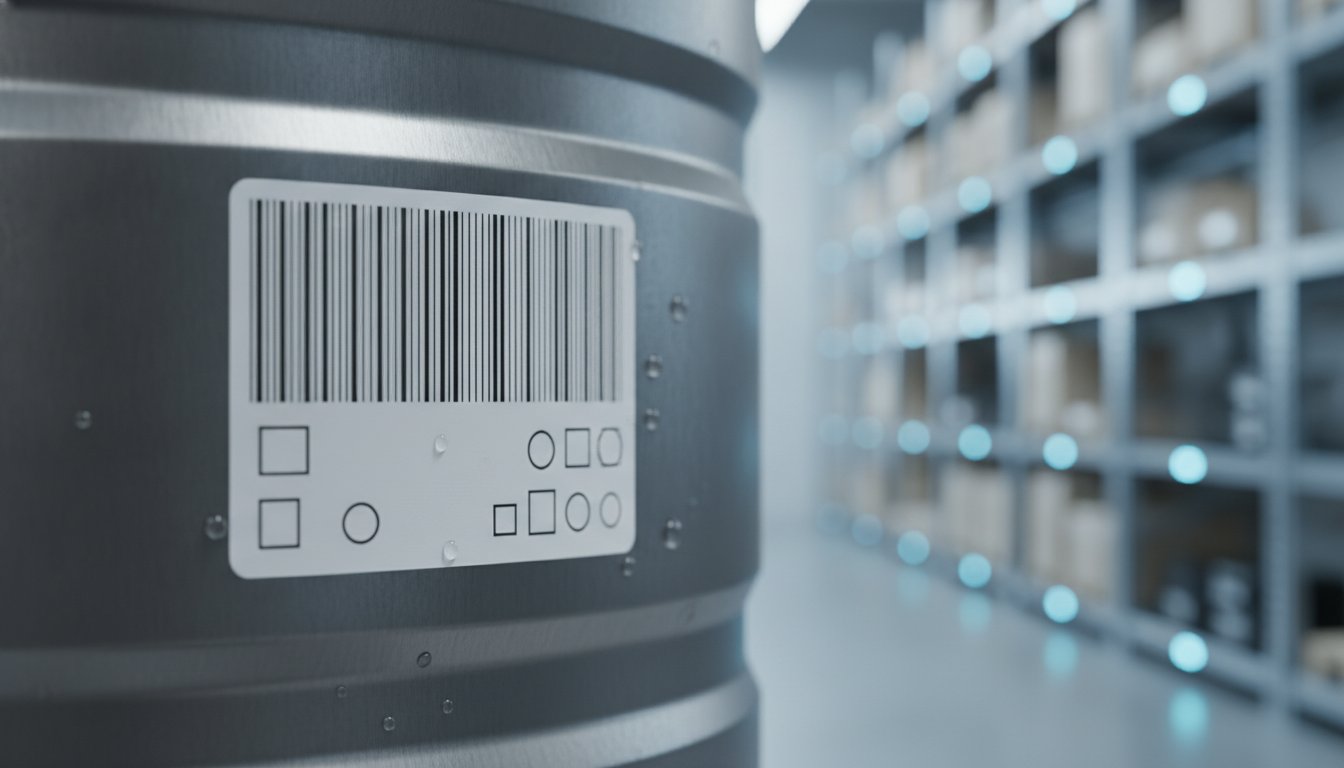
What if you could get the rugged durability of thermal transfer printing without ever touching another ribbon? It sounds like a dream for any busy warehouse manager or mobile fleet operator. You're likely tired of labels that fade in the sun or fail the moment they touch cleaning chemicals. By switching to Ultramax DT Direct Thermal Labels, you can eliminate the hassle of ribbon changes while keeping your operations running smoothly. We know you need solutions that work as hard as you do, especially in demanding industrial environments.
In this guide, you'll discover how this technology provides thermal transfer durability without the extra hardware. We'll show you how these labels stay scannable for up to two years and withstand temperatures up to 70°C. You'll also learn about their resistance to harsh substances like alcohol, bleach, and acetone. We'll break down how these BPA-free labels lower your consumable costs and enable high-durability printing on your mobile units. It's time to simplify your labeling process without sacrificing quality and peace of mind.
Key Takeaways
- Learn how synthetic construction and a specialized topcoat provide thermal transfer durability without the need for ribbons.
- Discover how Ultramax DT Direct Thermal Labels reduce operational downtime and eliminate ribbon waste for a better ROI.
- See how these labels remain scannable for up to two years and resist exposure to harsh chemicals like bleach and acetone.
- Find out why this media is the ideal choice for mobile printers like the Seiko SLP850 in rugged field environments.
- Identify the best adhesive and roll configurations to ensure high-performance labeling on plastic, metal, or cardboard surfaces.
What are Ultramax DT Labels? The Science of Rugged Direct Thermal
Ultramax DT is a high-performance synthetic media designed to bridge the gap between convenience and durability. Most people think direct thermal is only for short-term receipts, but this technology changes that. It uses a robust synthetic base instead of fragile paper, making it a reliable choice for industrial environments. You can find these specialized Ultramax DT Direct Thermal Labels at DuraFast Label Company. They're built to survive where standard products fail.
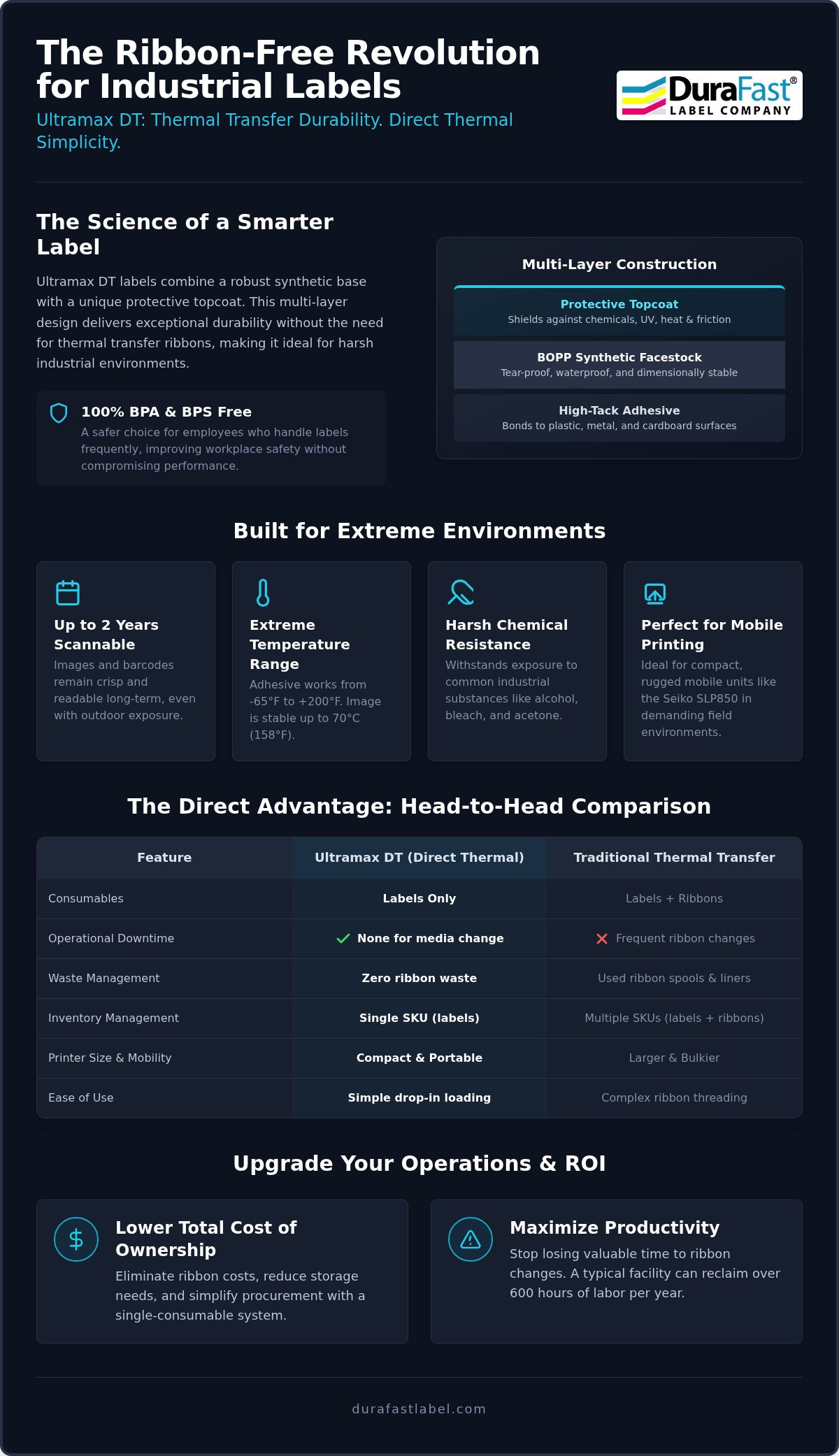
The secret lies in the multi-layered construction. It starts with a high-tack all-temperature adhesive that grips surfaces from -65°F to +200°F. Above that is the Biaxially Oriented Polypropylene (BOPP) facestock, followed by a patent-pending protective topcoat. This coating is the final line of defense against the elements. It ensures your data remains intact throughout the label's lifecycle.
The Technology Behind the Topcoat
Standard labels often fail because the direct thermal printing process leaves the chemical layer exposed to the environment. Ultramax DT is a ribbon-free alternative to thermal transfer that provides the same level of durability. The specialized topcoat acts as a barrier that prevents heat, friction, and UV rays from triggering the leuco dyes prematurely. This means your barcodes stay crisp and scannable even after prolonged exposure to direct sunlight or high-heat warehouse conditions up to 70°C.
Synthetic vs. Paper: Why BOPP Matters
Choosing a synthetic facestock over traditional paper is a game-changer for moisture resistance. Paper labels absorb water and humidity, which causes them to swell, wrinkle, or peel away. BOPP is dimensionally stable, so it keeps its shape even in fluctuating humidity. It also offers superior tear strength. This ensures that labels don't get destroyed during rough handling or shipping.
Beyond physical toughness, there's a significant safety advantage. Many standard direct thermal labels contain Bisphenol A (BPA) or Bisphenol S (BPS), which can be absorbed through the skin. Ultramax DT Direct Thermal Labels are completely BPA-free and BPS-free. This makes them a safer choice for your employees who handle labels all day. It's a simple way to improve workplace safety while upgrading your labeling performance.
Ultramax DT vs. Thermal Transfer: A 2026 ROI Comparison
Switching to a ribbon-free system isn't just about convenience; it's a strategic financial move. When you use Ultramax DT Direct Thermal Labels, you're simplifying your entire procurement process. Traditional thermal transfer setups require you to manage two separate inventory streams: labels and ribbons. This doubles your ordering overhead and storage requirements. By removing the ribbon from the equation, you immediately lower your Total Cost of Ownership (TCO) through reduced administrative labor and storage footprint.
Downtime is the silent killer of warehouse productivity. Every time a printer runs out of ribbon, the line stops. A typical ribbon change can take three to five minutes, depending on the printer model and operator skill. If your team manages ten printers and each requires three ribbon changes per shift, you're losing up to 150 minutes of active work time every single day. Over a standard 250-day work year, that's 625 hours of lost labor. Eliminating this step allows your team to focus on moving products rather than troubleshooting hardware.
Hardware flexibility also improves with a direct thermal approach. Thermal transfer printers are inherently larger because they must house two internal spindles. Direct thermal technology allows for more compact, rugged designs. This makes it easier to deploy mobile printing solutions across your facility. You can empower your team with wearable or cart-mounted units that don't require the extra bulk of ribbon-carrying mechanisms. If you're unsure which system fits your budget, you can request a custom ROI analysis from our team.
Operational Efficiency and Time Savings
Managing ribbons creates hidden costs in your supply chain. You have to match ribbon widths to label sizes and ensure chemical compatibility between the two. Implementing Ultramax DT Direct Thermal Labels reduces the complexity of your inventory to a single SKU. This simplification makes staff training much faster. New employees only need to learn one media loading process for all their rugged labeling needs, which reduces errors and prevents ruined print heads from improper ribbon installation.
Sustainability and Waste Management
Eliminating ribbons has a massive impact on corporate green initiatives in 2026. Used thermal transfer ribbons are typically non-recyclable because of the residual ink and plastic film construction. This creates tons of landfill waste for high-volume operations. By choosing a ribbon-free path, you're directly reducing the carbon footprint of your label production. For more details on traditional setups, see our Thermal Transfer Ribbon Guide. Moving to Ultramax DT ensures your facility remains compliant with modern environmental standards while cutting down on daily waste.
Built for Extremes: Chemical and Environmental Resistance
Industrial environments don't play fair. Labels often face a gauntlet of solvents, extreme heat, and constant sunlight that would destroy standard paper media. Ultramax DT Direct Thermal Labels are engineered to survive this pressure. They maintain barcode integrity even when drenched in industrial cleaning agents or exposed to the elements for months at a time. This durability ensures that your tracking remains accurate from the factory floor to the final destination.
The synthetic construction provides a robust barrier against liquids. Whether it's saltwater spray on a maritime shipping dock or ammonia-based cleaners in a food processing plant, the printed data remains crisp. These labels are rated to stay scannable for up to 12 months in outdoor conditions. This is a significant upgrade over traditional direct thermal products that often fade after just a few weeks of UV exposure. They stay stuck. They stay readable. They don't fail.
Chemical Resistance Breakdown
Lab environments and heavy manufacturing require resistance to aggressive solvents. Ultramax DT handles exposure to alcohol, bleach, and even harsh chemicals like acetone and xylene without the text smearing or the background turning black. This makes them ideal for healthcare settings where equipment is frequently sanitized with isopropyl alcohol. Researchers who explore Sale of Research Peptides and Compounds often rely on these durable labels to ensure that sensitive samples remain clearly identified throughout rigorous testing. If your application involves heavy outdoor exposure or chemical contact, you can find the right sizes by exploring Ultramax DT Labels for Outdoor. They provide the chemical defense you need without the complexity of a ribbon-based system.
Thermal stability is a core feature of this media. These labels can withstand temperatures up to 158°F (70°C), which is critical for labels used in automotive or manufacturing settings where temperatures frequently climb. They also perform exceptionally well in cold storage. The all-temperature acrylic adhesive ensures the label stays bonded to the substrate as it moves from a deep-freeze environment to a humid loading dock. This prevents the common issue of label curling or "winging" in tropical or high-humidity climates.
In 2026 infrastructure projects, durability is a non-negotiable requirement for asset tracking. Field teams use these labels to tag outdoor equipment and raw materials that sit in open-air yards for months. The patent-pending topcoat prevents the direct thermal chemistry from reacting to ambient heat or direct sunlight. This ensures that when a technician scans a piece of equipment a year later, the barcode is just as legible as the day it was printed. You get the speed of direct thermal printing with the environmental resilience of a much more complex system.
Mobile Direct Thermal Printing: Ultramax DT in the Field
Field service teams need gear that's lightweight and reliable. Carrying extra boxes of thermal ribbons into the field adds unnecessary weight and complexity to a mobile technician's kit. By using Ultramax DT Direct Thermal Labels, you eliminate the need for ribbons entirely. This simplifies the printing process for your workforce. They can focus on the job at hand instead of fumbling with delicate ribbon rolls in the wind or rain.
Compatibility is a major advantage for fleet managers. These labels work seamlessly with industry-standard hardware from brands like Zebra and Seiko. Whether your team uses rugged handheld units or cart-mounted industrial printers, the transition is straightforward. Scan accuracy is vital for last-mile delivery and logistics. The high-contrast print quality ensures that barcodes are readable the first time, every time. This prevents delivery delays and keeps your data tracking accurate across the supply chain.
Optimizing Mobile Hardware for Synthetic Media
Printing on synthetic BOPP facestock requires slightly different settings than standard paper. You should adjust your printer's darkness and heat settings to ensure the best bond between the thermal coating and the material. Lowering the print speed slightly can also improve clarity on rugged surfaces. Battery life is another key consideration. Direct thermal printing is generally more energy-efficient than thermal transfer because the motor doesn't have to pull both a label and a ribbon. For more tips on setting up your mobile hardware, check out our Seiko SLP850 Bluetooth Guide.
Industry Applications: From Warehousing to Parking
In logistics, labels face rough handling and constant friction. Standard paper labels often scuff or tear, making them unreadable. Ultramax DT provides the tear-strength of a synthetic material with the ease of direct thermal technology. This makes it perfect for Mobile Direct Thermal Labels used in shipping and receiving. Parking enforcement is another area where this media shines. Citations printed on this material resist rain, sunlight, and humidity. They stay legible for the recipient and the court, even if they sit on a windshield for hours.
Selecting the right media for your mobile fleet doesn't have to be complicated. Our team can help you match the correct roll size and core configuration to your specific printer models. If you're ready to upgrade your field operations, contact our experts for a hardware compatibility check.
Implementing Ultramax DT: Selection and Setup at DuraFast
Selecting the right roll for your specific hardware is the final step in optimizing your labeling workflow. You need to ensure the physical dimensions match your printer's internal capacity. Ultramax DT Direct Thermal Labels come in various configurations to fit everything from small mobile units to large industrial presses. Beyond the roll size, you must identify the correct adhesive for your specific substrate. While the standard all-temperature acrylic adhesive works well on most surfaces, testing is essential for low-energy plastics or recycled cardboard. It's about finding the perfect bond for your environment.
Integrating this media into your existing software environment is a seamless process. If you use BarTender Professional, you simply need to update your media type settings to "Direct Thermal" and adjust the stock dimensions. You don't need to redesign your templates or change your barcode logic. We recommend ordering samples for environmental testing before committing to a large volume. This allows you to verify performance in your specific real-world conditions, whether that's a high-heat manufacturing floor or a refrigerated warehouse. It gives you the confidence that your labels will stay put.
Roll and Core Compatibility Guide
Printers have strict limits on the outer diameter (OD) of the label roll they can hold. Most desktop printers require a 1-inch or 1.5-inch core, while mobile units often use a 0.75-inch core. Industrial printers typically use a 3-inch core to accommodate larger rolls. Check your Zebra or Seiko manual to confirm these specs before ordering. Typical limits include:
- Mobile Printers: Usually limited to a 2.25-inch OD.
- Desktop Printers: Often support up to a 5-inch OD.
- Industrial Printers: Can handle 8-inch OD rolls or larger.
Transitioning Your Workflow
Moving from paper-based labels to synthetic Ultramax DT Direct Thermal Labels is straightforward. Start by cleaning your print head to remove any residue from previous ribbons or paper dust. Load the new media and perform a calibration. Once printed, verify the scan accuracy using your Datalogic barcode scanners. This ensures the contrast and edge definition meet your internal requirements. For a deeper look at hardware options, see The 2026 Professional Guide to Thermal Label Printers. This transition reduces your maintenance needs and ensures long-term scannability for your assets without the hassle of extra consumables.
Upgrade Your Workforce with Ribbon-Free Durability
You now have the tools to eliminate the complexity and waste of thermal transfer ribbons without losing the rugged performance your environment demands. By switching to Ultramax DT Direct Thermal Labels, you're choosing a path that simplifies your inventory and boosts your team's productivity. These labels offer up to two years of indoor warehouse life and are completely BPA and BPS free for worker safety. They provide the chemical resistance you need for tough industrial applications while maintaining perfect compatibility with your existing Zebra, Seiko, and Godex printers.
It's time to stop worrying about fading barcodes or constant downtime from ribbon changes. Whether you're managing a high-volume warehouse or a mobile fleet in the field, this technology ensures your operations stay efficient and reliable. Our team is ready to help you find the exact roll size and adhesive for your specific needs. Shop high-performance Ultramax DT labels at DuraFast to see the difference for yourself. We look forward to helping you simplify your labeling process and improve your bottom line.
Frequently Asked Questions
How long do Ultramax DT labels last in a warehouse environment?
Ultramax DT Direct Thermal Labels are designed to remain scannable for up to two years when stored in standard indoor warehouse conditions. This lifespan is significantly longer than traditional paper products, which often fade within months. The specialized construction ensures that your barcode data remains crisp and readable for long-term inventory management. It's a reliable choice for businesses that need to track assets over a multi-year period without the hassle of frequent re-labeling.
Are Ultramax DT labels truly chemical resistant without a ribbon?
Are Ultramax DT labels truly chemical resistant without a ribbon?
Yes, these labels provide high durability and chemical resistance without the need for a thermal transfer ribbon. The patent-pending topcoat protects the thermal layer from aggressive substances like alcohol, bleach, ammonia, and acetone. This makes them perfect for healthcare and industrial settings where frequent cleaning is required. Organizations like Biomod Peptides rely on this level of protection for laboratory supplies that must remain clearly identified despite exposure to harsh sanitizing agents. You get the convenience of direct thermal printing with the rugged resilience typically associated with complex ribbon-based systems. It's a simpler way to manage tough environments.
Ultramax DT media is a drop-in solution compatible with most major direct thermal printer brands, including Zebra, Seiko, and Godex. Whether you are using a portable unit for field work or an industrial press, these labels will work without requiring hardware modifications. You only need to ensure the roll size and core diameter match your specific printer's specifications. This flexibility allows you to upgrade your labeling performance across your entire fleet using your existing hardware.
What is the difference between Ultramax DT and standard BOPP labels?
Ultramax DT Direct Thermal Labels feature a specialized topcoat that standard direct thermal BOPP labels lack. This coating is specifically engineered to prevent premature fading from UV exposure and industrial chemicals. Standard BOPP labels often turn black or lose clarity when exposed to heat or solvents. Ultramax DT maintains its integrity in these harsh environments, providing a much higher level of reliability for outdoor or industrial use. It bridges the gap between convenience and durability.
Is Ultramax DT media safe for food contact or healthcare use?
This media is both BPA-free and BPS-free, making it a safer option for employees in healthcare and food service. The adhesive also complies with FDA 21 CFR 175.105 for indirect food contact. This ensures that the labels meet modern safety standards while providing the durability needed for medical equipment or food packaging. It's a responsible choice for businesses that prioritize both worker safety and regulatory compliance in their labeling workflows.
Do I need special software to print on Ultramax DT labels?
No special software is required to use this media. It integrates easily with industry-standard design tools like BarTender Professional Software. You can continue using your existing templates and barcode logic without any changes. Simply select the direct thermal print method in your printer driver settings and adjust the darkness to suit the synthetic material. This ease of integration helps your team transition to a more durable labeling system with minimal technical friction and no training delays.
What happens if Ultramax DT labels are exposed to temperatures above 70°C?
These labels are rated to withstand temperatures up to 70°C without losing clarity. If they are exposed to temperatures significantly above this threshold, the direct thermal chemistry may begin to react, causing the label to darken. For most industrial and outdoor applications, this range provides a generous safety margin. If your environment regularly exceeds this limit, we recommend testing samples in your specific conditions to ensure the barcodes remain scannable for your scanners.
How does the cost of Ultramax DT compare to thermal transfer labels?
While the per-label cost may be higher than standard paper, the total cost of ownership is often lower because you eliminate ribbons and reduce downtime. You save money on ribbon inventory, storage, and the labor required for frequent changes. Additionally, the extended lifespan of up to two years reduces the need for expensive re-labeling. It is an efficient way to improve your hardware ROI while simplifying your overall supply chain management and reducing daily waste.