Zebra ZT411 vs SATO CL4NX Plus: 2026 Industrial Printer Comparison
15th Aug 2026
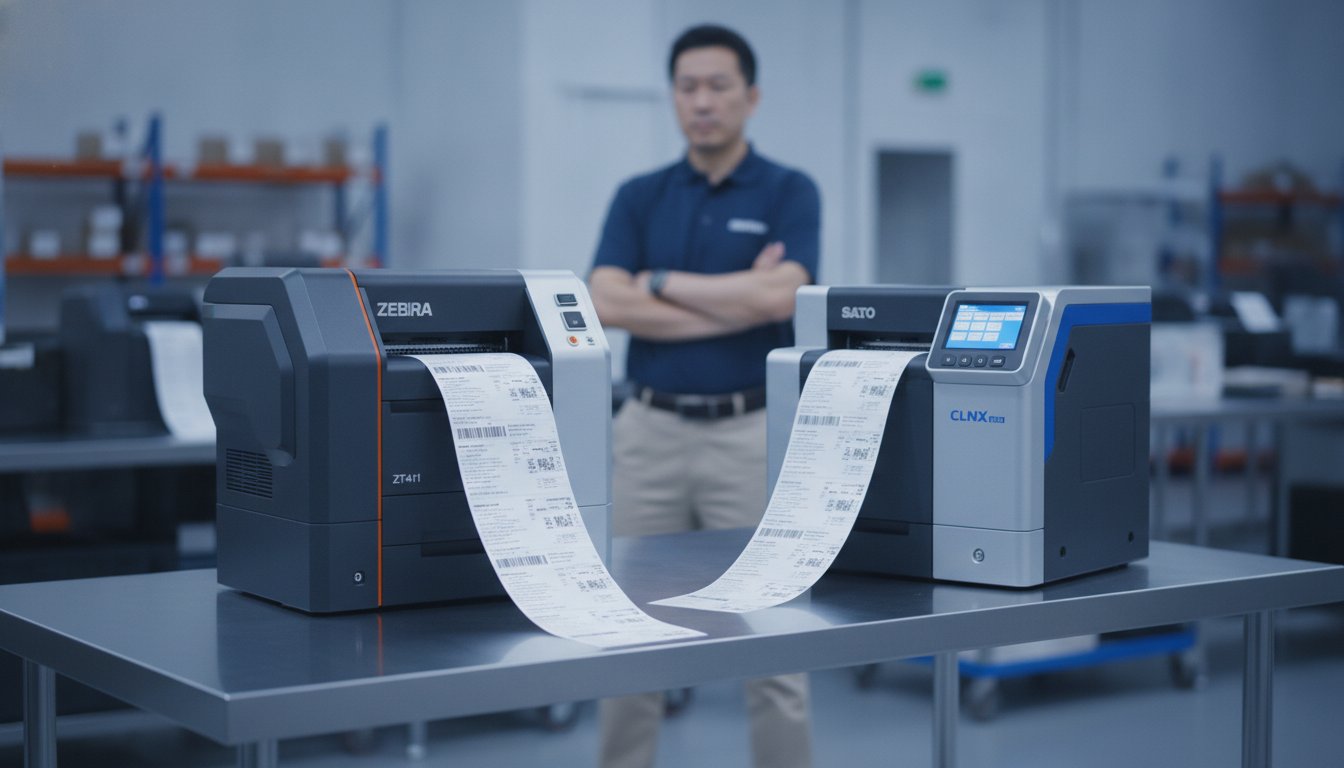
The industry standard printer you've relied on for years might actually be the bottleneck in your production line. You probably agree that nothing stalls a warehouse faster than a label jam or a complex calibration process that feels like it requires an engineering degree. It's frustrating to deal with proprietary parts that eat into your budget while your team waits for a fix. This detailed comparison of the Zebra ZT411 vs SATO CL4NX Plus helps you decide which 2026 model offers the best reliability and ROI for your facility.
Are you looking for a machine that handles various label types without constant recalibration? We promise to show you which printer delivers the best media flexibility and lowest long-term maintenance costs. We'll preview how each model integrates with your existing enterprise software and compare their performance in high-volume environments. Whether you need the rugged familiarity of Zebra or the user-friendly innovations of SATO, this guide simplifies your decision-making process. You'll discover which industrial workhorse keeps your operations running smoothly around the clock.
Key Takeaways
- Compare raw performance specs including print speeds of up to 14 ips and resolution options reaching 609 dpi for high-precision labeling.
- Understand the Zebra ZT411 vs SATO CL4NX Plus trade-offs regarding media flexibility, including SATO's ability to handle both wound-in and wound-out labels.
- Discover how the latest 2026 firmware updates improve cloud connectivity and security for modern enterprise environments.
- Learn how to achieve seamless software integration using BarTender Professional to manage ZPL and SBPL printer languages without downtime.
- Identify which industrial workhorse fits your specific ROI goals, whether you prioritize logistics volume or specialty manufacturing versatility.
Industrial Printing in 2026: The Zebra vs. SATO Rivalry
The industrial printing market in North America has reached a point of high stability, yet the competition for floor space remains fierce. Most facilities rely on industrial barcode printers to keep supply chains moving around the clock. While some claim R&D has slowed, the choice between the Zebra ZT411 vs SATO CL4NX Plus is more critical than ever. It's not just about printing a label; it's about how much downtime your facility is willing to tolerate.
The Zebra ZT411: The Legacy of Reliability
Zebra has spent decades building a reputation for consistency. The ZT411 is the direct descendant of the ZM400 and ZT410 series, making it a familiar face for many warehouse managers. IT departments often insist on Zebra because of the Link-OS environment. This operating system makes managing a fleet of printers across multiple locations much easier. If your primary needs involve high-volume shipping labels, asset tracking, or standard retail tags, the ZT411 is often the default choice. It's a rugged workhorse designed for the grit of the loading dock and integrates seamlessly with industrial barcode printer networks.
The SATO CL4NX Plus: A New Standard for Versatility
SATO has disrupted the market by addressing the pain points Zebra users sometimes overlook. Their "universal" design is a game changer for facilities that deal with diverse suppliers. Unlike many competitors, the CL4NX Plus handles both wound-in and wound-out media without extra kits or complex adjustments. The "NX" architecture focuses on a global appeal, offering multi-language support and on-board help videos that guide users through media loading. We've seen this model become a favorite in automotive and high-precision manufacturing where accuracy is non-negotiable. Features like tool-less printhead replacement mean your operators spend less time troubleshooting and more time producing.
Choosing the right machine requires looking at your specific label volume and media types. A printer that's overkill for a small workshop might be a lifesaver in a 24-hour distribution hub. The Zebra ZT411 vs SATO CL4NX Plus debate often comes down to your specific media needs. If you're using non-standard materials or need extreme precision, SATO's versatility stands out. If you don't want to change your existing ZPL workflows, Zebra remains the benchmark. We focus on helping you find the hardware that matches your workflow perfectly while providing the high-quality consumables needed for 24/7 operation.
Performance Breakdown: Speed, Resolution, and Durability
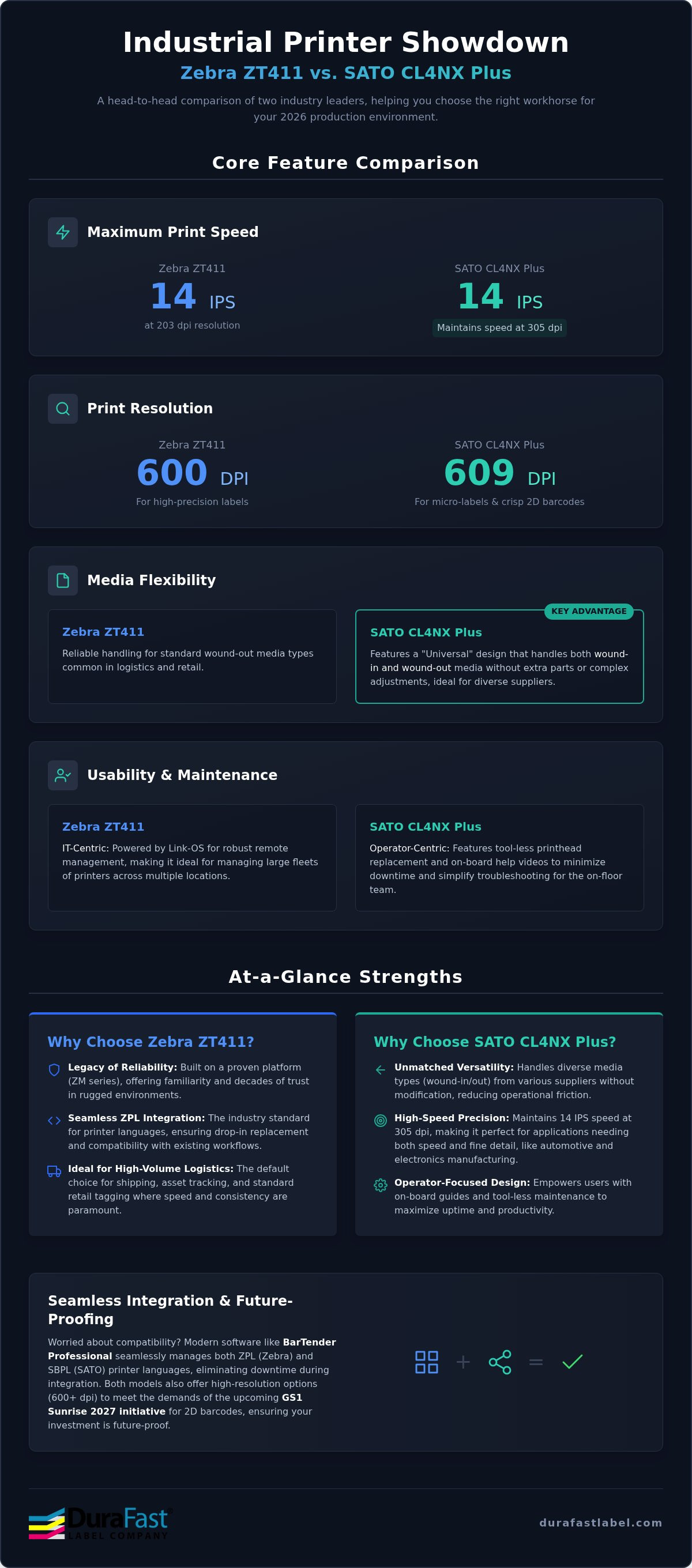
When your production line moves fast, your printer needs to keep pace. Both the Zebra ZT411 and the SATO CL4NX Plus are designed for high-speed industrial environments, but they distribute their power differently. The Zebra ZT411 reaches a top speed of 14 inches per second (ips) at 203 dpi. The SATO CL4NX Plus matches that 14 ips speed, but it maintains that velocity even at 305 dpi resolution. This gives the SATO a slight edge for facilities that require both high throughput and finer detail for complex labels.
Print Quality and Resolution Options
Resolution needs vary depending on your specific application. A standard 203 dpi setting works perfectly for shipping labels, while 600 dpi (or SATO's 609 dpi) is essential for micro-labels on circuit boards. Both brands manage thermal transfer ribbon tension effectively to ensure barcodes remain crisp and smudge-free. As the industry moves toward the GS1 US-led Sunrise 2027 initiative, the demand for high-resolution 2D barcodes is increasing. Higher DPI ensures crisp edges on complex barcodes, preventing scan failures during high-speed automated sorting. If your facility is preparing for this shift, the Zebra ZT411 vs SATO CL4NX Plus comparison becomes a question of long-term compliance and scanning accuracy.
Ruggedness in Industrial Environments
Durability is the backbone of any industrial facility. SATO features a cast aluminum frame that provides excellent stability for the internal components. Zebra counters with an all-metal construction that's been the industry standard for years. Both models offer significant resistance to the dust and moisture found in typical warehouse settings. If you operate in extreme conditions, you need industrial barcode printers for harsh environments that won't quit when the air gets thick with debris. The duty cycle for both machines supports 24/7 operation, but maintenance differences exist. SATO offers tool-less printhead replacement, which can save valuable minutes during a mid-shift swap. Zebra's parts are often more accessible through a wider network of distributors, though they might require a bit more effort to install.
Choosing between these two powerhouses often comes down to how much you value those small maintenance windows. If you're still weighing the specs of the Zebra ZT411 vs SATO CL4NX Plus for your specific workflow, you can reach out to our experts for a detailed performance analysis. We'll help you find the model that maximizes your uptime and print quality.
Usability and Media Handling: Where SATO Challenges the Status Quo
SATO really pushes the boundaries of media versatility with its "Universal" design. Most industrial printers require specific winding directions for labels, but the CL4NX Plus doesn't care if your labels are wound-in or wound-out. This flexibility saves you from ordering errors and inventory headaches. Zebra’s ZT411 takes a different approach to usability. It uses bright, gold-colored touchpoints to guide operators through the loading process. These physical cues help staff identify exactly where to move levers and rollers without second-guessing. It's a simple system that prevents a lot of frustration during mid-shift media changes.
Ribbon capacity is another area where these machines work to keep you running. The SATO CL4NX Plus accommodates ribbons up to 600 meters in length, which is significantly longer than many entry-level industrial models. Using high-quality thermal ribbons ensures that both machines maintain consistent print darkness and avoid premature printhead wear. While Zebra’s system is a legacy favorite, SATO’s design makes it easier to use a wider variety of third-party supplies without the printer getting "picky" about tension.
Media Flexibility and Sensor Intelligence
Sensor placement can make or break your workflow. SATO’s sensors are highly adjustable, making them ideal for circular labels or unique die-cut shapes. Zebra is optimized for standard thermal transfer labels used in shipping and retail. While Zebra's auto-calibration is reliable for standard stock, SATO's sensor intelligence often handles transparent or heavy-stock media with less manual tweaking. To avoid common "Media Out" errors, always ensure your sensors are clean and positioned correctly over the label web.
User Interface and On-Board Video Guidance
The Zebra ZT411 vs SATO CL4NX Plus comparison shows two very different philosophies for user interfaces. SATO includes a library of 31 on-board tutorial videos. If a ribbon breaks or a jam occurs, the screen shows a video on how to fix it. This feature is a lifesaver for reducing training time for new warehouse staff. Zebra relies on a crisp 4.3-inch touch interface that uses intuitive icons and clear text. Both interfaces are designed to be used while wearing gloves, which is a must in cold storage or heavy manufacturing environments. SATO’s video-first approach simply provides a more supportive experience for operators who aren't printer experts.
Integration and Software: BarTender and Enterprise Compatibility
Hardware specs don't matter if the printer won't talk to your ERP system. The Zebra ZT411 vs SATO CL4NX Plus competition often boils down to how easily they slide into your existing IT stack. Zebra's ZPL language is the industry standard, but SATO has made significant strides in ensuring its SBPL language doesn't create silos. In 2026, cloud printing and IoT integration are standard requirements for any modern facility.
Software Emulations: Can You Switch Brands?
SATO's AEP (Application Enabled Printing) and native ZPL emulation mean you can often swap a Zebra for a SATO without rewriting a single line of code. This "plug-and-play" capability is a major selling point for mixed-fleet environments. However, be careful with complex SAP or Oracle environments where custom scripts might rely on specific Zebra firmware behaviors. For a broader look at how these stack up against other brands, check out our Industrial Label Printer Roundup: Best Solutions for 2026.
Remote management tools have also evolved. Zebra DNA provides a comprehensive suite for mass configuration and security updates. SATO Online Services (SOS) takes a more proactive approach with predictive maintenance. It monitors the life of the printhead and notifies you before it fails. This IoT integration is vital for 24/7 operations where even an hour of downtime is too expensive. Both models offer seamless compatibility with BarTender Professional software. This software acts as the universal translator, allowing you to design labels once and print them to either machine without formatting errors.
Barcode Verification and Compliance
Compliance is non-negotiable in 2026. Both the ZT411 and CL4NX Plus offer RFID encoding options for high-accuracy asset tracking. If you need 100% barcode accuracy, on-board scanners can verify every label as it's printed. This prevents "bad" labels from ever leaving your facility, saving you from costly chargebacks in the automotive and retail sectors. When evaluating the Zebra ZT411 vs SATO CL4NX Plus for enterprise use, consider how each brand handles these real-time verification tasks.
Need help configuring your network for a new install? Contact our integration experts to ensure your new hardware works perfectly from day one.
Choosing the Right Workhorse for Your Workflow
Deciding between the Zebra ZT411 vs SATO CL4NX Plus comes down to your daily operational reality. If you're running a massive logistics hub where every second counts, the Zebra ZT411 remains the industry standard. Its deep integration with existing warehouse management systems and the massive network of available spare parts mean you're never far from a solution. It's built for high-volume, standardized labeling that keeps global supply chains moving without a hitch. You can trust its legacy of reliability in the most demanding shipping environments.
On the other hand, the SATO CL4NX Plus is the clear winner for specialty manufacturing and high-mix environments. Its ability to handle diverse media types without constant sensor tweaking makes it invaluable when your label sizes or materials change frequently throughout a shift. While the initial investment for SATO might be higher, the reduction in downtime for calibration and maintenance often leads to a better long-term ROI for complex facilities. It's a versatile tool that adapts to your needs rather than forcing you to adapt to its limitations.
For North American businesses looking to scale in 2026, the choice should reflect your technical support capacity. Zebra is often easier for IT teams to manage at scale due to its widespread adoption and familiar Link-OS environment. However, SATO’s user-centric design empowers warehouse operators to handle more maintenance tasks locally without calling for technical help. Balancing these factors helps you choose a printer that won't become a bottleneck as your order volume grows.
The ROI of Premium Supplies
Total cost of ownership isn't just about the hardware price; it's about the consumables you feed the machine. Using high-quality Zebra ribbons and compatible labels significantly extends the life of your printhead. Low-quality adhesives can ooze or leave residues that cause premature wear, forcing expensive replacements and unnecessary downtime. For a deeper dive into these technical nuances, read The 2026 Professional Guide to Thermal Label Printers. Investing in specialized supplies ensures your 24/7 operation stays online without unexpected hardware failures.
Next Steps: Consultation and Setup
Every facility has unique challenges that a spec sheet can't always address. We recommend trialing these units in your specific environment to see how they handle your unique media and software integration. Getting the initial configuration right is the most important step for long-term success. Our team helps you vet these products so you can focus on scaling your business with confidence. Contact DuraFast Label Company today for a personalized industrial printer consultation and let us help you find your perfect match.
Future-Proof Your Production with the Right Industrial Printer
Choosing between the Zebra ZT411 vs SATO CL4NX Plus defines your operational efficiency for years to come. You've seen how Zebra offers unmatched reliability for high-volume shipping while SATO dominates in specialty manufacturing with its universal media handling. Both machines represent the peak of 2026 industrial technology. Your final decision should align with your team's technical comfort and your specific label variety.
We're here to make this selection process simple and stress-free. As an Authorized Zebra Partner and a specialized thermal ribbon manufacturer, we provide more than just the hardware. Our team offers expert enterprise software support for BarTender Professional to ensure your new printer integrates perfectly with your existing workflows. We've done the heavy lifting of vetting these models so you can focus on scaling your business with total confidence.
Request a Quote for Your Industrial Printing Solution today. We're ready to help you secure the long-term reliability and ROI your facility deserves.
Frequently Asked Questions
Can the SATO CL4NX Plus use Zebra ZPL label formats?
Yes, the SATO CL4NX Plus supports Zebra ZPL natively through its built-in competitive emulation. This feature allows you to replace an existing Zebra unit without changing your label designs or backend code. It's a "plug and play" solution for facilities looking to switch brands without an IT overhaul. The printer automatically detects the command language and prints without manual configuration.
Which printer is easier to maintain without a technician?
The SATO CL4NX Plus is generally easier for operators to maintain because of its tool-less printhead and platen roller replacement. It also features 31 on-board help videos that show staff exactly how to clear jams or change ribbons. While Zebra's gold-coded touchpoints are helpful for loading, SATO’s video guidance significantly reduces the need for an on-site technician for routine fixes.
Does the Zebra ZT411 support RFID encoding?
Yes, the Zebra ZT411 supports factory-installed or field-installable RFID encoding modules. It's designed to handle both standard and on-metal RFID tags for complex asset tracking. This makes the Zebra ZT411 vs SATO CL4NX Plus comparison very close for enterprise users. Both models offer robust RFID capabilities that meet the latest retail and automotive compliance standards.
What is the main advantage of the SATO CL4NX Plus over the Zebra ZT411?
The main advantage of the SATO CL4NX Plus is its "Universal" media handling. It accepts both wound-in and wound-out labels and ribbons without requiring any hardware adjustments or optional kits. This eliminates inventory errors and allows you to source media from a wider variety of suppliers. It also maintains a 14 ips print speed at a higher 305 dpi resolution compared to Zebra.
How often should I replace the printhead on these industrial models?
You should typically replace the printhead after 1 to 2 million linear inches of printing, though this varies based on your settings. Using high-quality thermal transfer ribbons and cleaning the head with every ribbon change will extend this lifespan. If you notice consistent white lines or faded spots on your labels, it’s a clear sign that the printhead needs a replacement.
Are the ribbons for Zebra and SATO printers interchangeable?
Ribbons are often interchangeable if they share the same width and 1-inch core size, but you must check the winding direction. Zebra printers typically use coated-side-out (CSO) ribbons. SATO’s universal design handles both CSO and coated-side-in (CSI) ribbons, but you should always verify that the ribbon formulation matches your specific label material for the best print quality and durability.
Which printer has better connectivity for cloud-based labeling?
Both printers are updated for 2026 cloud-based workflows, but the Zebra ZT411 offers an edge with optional Wi-Fi 6 and 6E connectivity. Zebra’s Link-OS environment also provides robust remote management via Zebra DNA. SATO counters with SATO Online Services (SOS), which offers proactive IoT monitoring to prevent downtime by tracking printhead health and part wear in real time.
Can I use BarTender software with both Zebra and SATO printers?
Yes, you can use BarTender Professional software with both Zebra and SATO printers. BarTender provides native drivers for both brands, ensuring that your label designs print accurately with full access to internal fonts and barcode generators. This makes it easy to manage a mixed fleet of industrial printers from a single software interface without worrying about compatibility issues.