What Is a Color Thermal Transfer Ribbon and Its Uses?
29th Jul 2026
Key Highlights
-
A color thermal transfer ribbon prints colored text, graphics, and barcodes using thermal transfer technology, helping businesses improve visual identification in labeling systems.
-
Common thermal transfer ribbon colors include black, red, blue, green, and white, each used for safety warnings, product categorization, inventory identification, or brand differentiation.
-
Industries such as manufacturing, healthcare, logistics, and retail rely on color ribbons to improve workflow efficiency, highlight critical information, and reduce labeling errors in busy production environments.
-
Choosing the right thermal transfer ribbon depends on printer compatibility, label material, ribbon formulation, and durability requirements.
-
White resin ribbons are especially popular for printing on dark or transparent synthetic labels due to their high opacity and durability. White resin ribbons require a resin formulation for adequate opacity on dark or transparent labels. Wax and wax-resin white ribbons do not provide sufficient coverage.
-
Color ribbons typically cost slightly more than black ribbons due to specialized pigment formulations and smaller production batch sizes.
Many businesses rely on black ribbons for barcode labels, but certain applications require color for clearer identification. Color-coded labels help teams quickly distinguish products, warnings, or inventory categories without scanning each label.
In warehouses, manufacturing plants, and healthcare facilities, visual labeling improves speed and reduces operational errors. Using different ribbon colors also helps companies align labels with safety standards, compliance markings, or brand requirements.
This guide explains what a color thermal transfer ribbon is, how different thermal transfer ribbon colors are used, and how businesses can choose the right option based on application, printer compatibility, and labeling needs.
What Is a Color Thermal Transfer Ribbon?
A color thermal transfer ribbon in the US is designed to print labels in colors other than standard black. Instead of carbon-based black pigment, these ribbons contain colored ink formulations that transfer onto labels when heat is applied by the printer.
During the printing process, the thermal printhead melts the ribbon coating and transfers colored ink onto the label surface, producing clear text, graphics, or barcodes.
Below are the key characteristics of a color thermal transfer ribbon:
-
Available in wax, wax resin, and resin formulations
-
Compatible with thermal transfer printers
-
Used for colored text, graphics, and barcode labels
-
Supports labeling applications that require visual differentiation
Because they enable color-coded labeling systems, these ribbons help businesses improve organization, speed up identification processes, and reduce operational errors.
Color ribbons typically cost slightly more than black ribbons because they use synthetic organic pigments rather than carbon black. These pigments require more precise formulation and are usually manufactured in smaller batch sizes for each color, which increases production costs.
Want to understand how thermal label printing works? Learning the basics of thermal transfer technology can help you choose the right ribbon type, color, and label material for better print durability and barcode clarity.
What Are the Most Common Thermal Transfer Ribbon Colors and Their Uses?
Different ribbon colors serve different labeling purposes across industries. Color selection often depends on operational needs, safety standards, or product categorization.
Below are common thermal transfer ribbon colors and their typical uses:
|
Ribbon Color |
Typical Applications |
Best Formulation |
|---|---|---|
|
Black |
Standard shipping labels, product identification |
Wax, Wax Resin |
|
Red |
Hazard warnings, urgent instructions |
Wax Resin |
|
Blue |
Medical labeling, document classification |
Wax Resin |
|
Green |
Environmental labels, inventory categories |
Wax Resin |
|
Yellow |
Safety labels, caution markings, and warehouse identification |
Resin |
|
White |
Printing on dark or transparent synthetic labels |
Resin |
|
Silver / Metallic |
Asset tags, premium product labels, and electronics identification |
Resin |
Color ribbons make labels easier to identify at a glance, reducing the need for manual verification and helping teams quickly recognize product categories, warnings, or operational instructions.
What Are Color Thermal Transfer Ribbon Uses Across Industries?
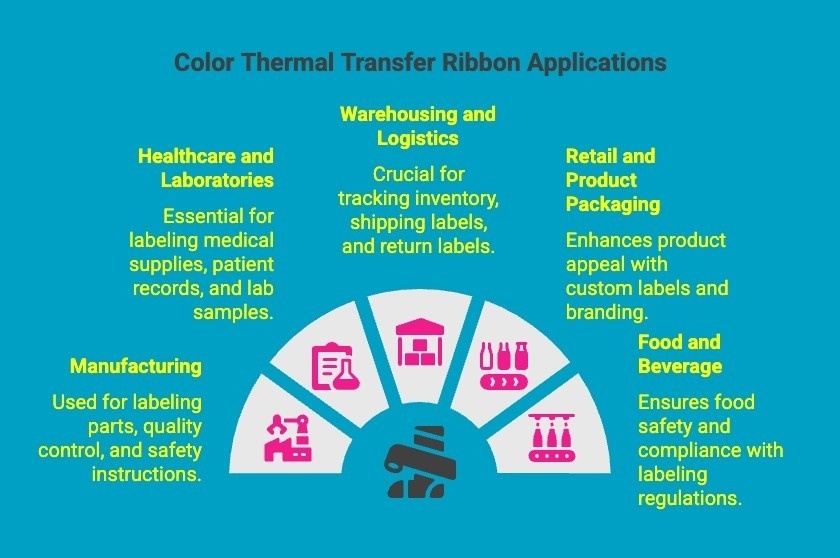
Color ribbons are used across many industries where labeling clarity and differentiation are important. From manufacturing to healthcare, color labels support faster identification, better organization, and improved operational accuracy.
Below are industries that commonly use color thermal transfer ribbons:
1) Manufacturing
Manufacturing environments use color ribbons for component identification, work-in-progress tracking, and production stage labeling. For example, colored labels may identify inspection status, batch categories, or assembly lines. Wax resin ribbons are typically recommended because they provide durability against handling, light abrasion, and industrial environments.
2) Healthcare and Laboratories
Healthcare and laboratories use color ribbons to differentiate specimen tubes, medication trays, and sample categories at a glance. Labels must often withstand chemical disinfectants and, in cryogenic storage applications, extreme cold. Resin formulation on polyester or polypropylene label stock is typically recommended in these environments.
3) Warehousing and Logistics
Warehouses and logistics operations rely on color-coded labels to identify shipping priorities, routing zones, and storage categories. For example, different colors may indicate express shipments, temperature-sensitive goods, or warehouse locations. Wax or wax resin ribbons are commonly used because they provide clear barcodes and durable labels for cartons and packaging.
4) Retail and Product Packaging
Retailers and product manufacturers often use colored ribbons to highlight pricing categories, promotional products, or brand-related labeling elements. Colored labels may also be used for shelf tags, packaging identifiers, or seasonal product differentiation. Wax ribbons are usually sufficient for paper labels used in retail environments.
5) Food and Beverage
Food and beverage producers use color labels for batch identification, allergen warnings, date coding categories, and packaging differentiation. In refrigerated or moisture-prone environments, labels must resist condensation and light abrasion. Wax resin ribbons are commonly recommended for paper labels, while resin ribbons are preferred for synthetic packaging materials.
Because color labeling simplifies visual recognition, it is widely used in operations that handle large volumes of labeled products and require quick identification across workflows.
How to Choose the Right Color Thermal Transfer Ribbon?
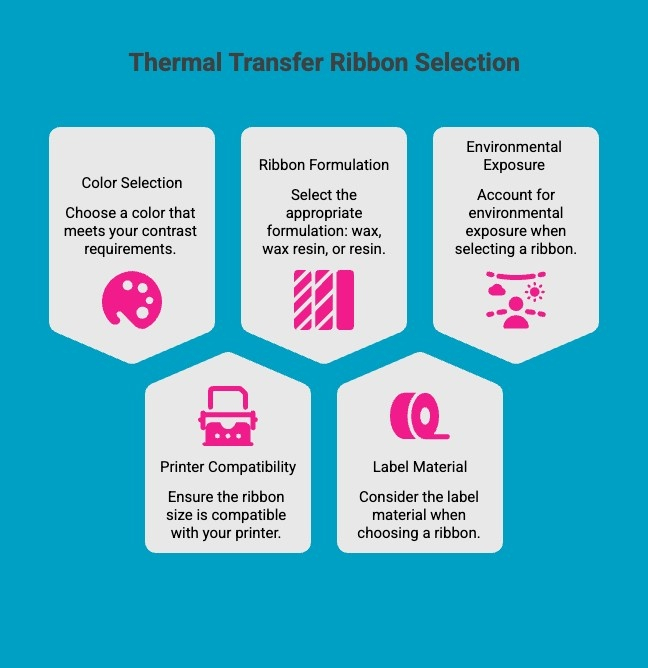
Choosing the correct ribbon ensures consistent print quality, reliable barcode scanning, and clear visual identification within your labeling system. Because colored ribbons use different pigments and opacity levels than black ribbons, selection requires a few additional considerations.
Several factors should be evaluated before choosing a color ribbon for your application.
1. Color Selection and Contrast Requirements
The first step is selecting a ribbon color that provides a strong contrast with the label material. Labels must remain readable for both human operators and barcode scanners.
For example, white ribbons are required when printing on dark or transparent synthetic labels, while colors such as red, blue, or green work best on white or light-colored label stock. Poor contrast can reduce barcode readability and make labels harder to identify.
2. Printer Compatibility and Ribbon Size
Not all ribbons fit every printer. Thermal transfer printers require ribbons that match the printer’s width, core size, and maximum ribbon length.
Common configurations include desktop printer ribbons (typically 74 m to 300 m) and industrial printer ribbons (450 m to 900 m). Always confirm compatibility with your printer model before selecting a ribbon.
3. Ribbon Formulation: Wax, Wax Resin, or Resin
Color ribbons are available in different ink formulations depending on durability requirements.
Wax ribbons work well for standard paper labels used in retail or shipping. Wax resin ribbons provide improved resistance to smudging and light abrasion. Resin ribbons offer the highest durability and are recommended for synthetic labels exposed to chemicals, moisture, or outdoor environments.
4. Label Material
Label material plays a major role in determining the correct ribbon type.
Paper labels typically print well with wax or wax resin ribbons. Synthetic materials such as polyester, polypropylene, or vinyl require resin ribbons to ensure the ink bonds properly and resists scratching or environmental exposure.
5. Environmental Exposure
Consider the conditions the label will face after printing. Exposure to heat, moisture, cleaning chemicals, or abrasion can affect print durability.
For example, warehouse labels may only require wax or wax resin ribbons, while laboratory, electronics, or industrial labels often require resin ribbons to ensure long-lasting performance.
Selecting the right color ribbon based on these factors helps ensure labels remain clear, durable, and easy to identify throughout the product lifecycle.
Considering in house label printing to reduce costs? Printing labels internally can improve operational control, lower long-term labeling expenses, and help businesses scale packaging and shipping processes more efficiently.
How Much Does a Color Thermal Transfer Ribbon Cost?
Color thermal transfer ribbon pricing varies depending on formulation, ribbon length, and durability requirements. In general, color ribbons cost slightly more than standard black ribbons because they use specialized pigments rather than carbon black.
Below are example ribbon types and typical price ranges based on products available from DuraFast Label Company:
|
Ribbon Type |
Example Product |
Size |
Price |
Durability |
Best For |
|---|---|---|---|---|---|
|
Wax Resin Color Ribbon |
4.33" × 984 ft |
$29.70 |
Moderate to High |
Product identification, warehouse labeling |
|
|
Wax Resin Color Ribbon |
4.33" × 984 ft |
$29.70 |
Moderate to High |
Inventory categorization, logistics labels |
|
|
Wax Resin Ribbon |
4.33" × 243 ft |
$6.00 |
Moderate to High |
Synthetic labels, packaging labels |
|
|
Wax Ribbon |
4.33" × 243 ft |
$4.00 |
Moderate |
Paper labels, retail labels |
|
|
Premium Wax Ribbon |
4.33" × 243 ft |
$12.00 |
Moderate |
Shipping labels, warehouse labels |
These examples illustrate how color ribbon pricing depends on ribbon width, length, and formulation. Shorter desktop ribbons typically cost less, while long industrial ribbons may cost more due to higher material volume.
Businesses that use color-coded labeling systems often choose wax-resin color ribbons because they provide a balance between durability, print clarity, and cost efficiency for most labeling environments.
To explore available sizes, colors, and compatible models, businesses can browse thermal transfer color ribbons from DuraFast Label Company, including options designed for Zebra desktop and industrial printers.
Why Is White Resin Ribbon a Popular Color Choice?
One of the most requested color ribbons is white resin ribbon, especially for printing on dark or transparent synthetic labels. White ribbons provide strong contrast and high opacity, making them ideal for industrial asset labels, compliance tags, and product identification.
DuraFast offers several white resin ribbon options compatible with both desktop and industrial printers:
DuraFast also offers colored wax resin ribbons, including red, blue, and green options, for Zebra-compatible printers.
Conclusion
Color thermal transfer ribbons provide a practical way to improve label visibility, organization, and operational efficiency across many industries. By using different ribbon colors, businesses can quickly identify products, highlight safety warnings, and simplify inventory management without relying only on barcode scanning.
From manufacturing and logistics to healthcare and retail, color-coded labels help reduce errors and streamline workflows. Choosing the right ribbon formulation, printer compatibility, and label material ensures consistent print quality and durability.
As ribbon technology continues to evolve, businesses can benefit from a wider color selection, improved durability, and cost-effective solutions that support reliable labeling performance in modern packaging and supply chain environments.
Frequently Asked Questions
What is a color thermal transfer ribbon used for?
A color thermal transfer ribbon is used in thermal transfer printing to create colored text, graphics, and barcodes on labels. With thermal transfer technology, ribbons like red wax ribbons, blue wax ribbons, and green wax ribbons play a crucial role in product identification and safety labeling.
Are color thermal transfer ribbons compatible with all printers?
Most color ribbons work with printers that support thermal transfer printing, but compatibility depends on ribbon size, base film, and formulation. Many ribbons are designed for major printer manufacturers and models like RL Zebra or RL Genius, ensuring reliable performance.
Which thermal transfer ribbon colors are most common?
Common colors include black, red, blue, green, and white color ribbons. Options such as red wax ribbons, blue wax ribbons, and green wax ribbons are widely used because they provide clear visual differentiation in labeling and industrial workflows.
Is colored thermal transfer ribbon more expensive than black?
Yes, colored ribbons may cost slightly more than standard wax or wax ribbon options because they require specialized pigments and different compositions. However, businesses can still find low price color thermal transfer ribbon options depending on ribbon formulation and application.
Can I buy color thermal transfer ribbon near me in the US?
Yes. Many suppliers offer the newest color thermal transfer ribbon options online with a wide color selection and immediate shipment across the US. Retailers like DuraFast Label Company provide ribbons compatible with printers from major printer manufacturers for various labeling applications.