
What Is High Voltage Electric Cable and How Is It Used?
14th Jul 2026
Key Highlights
-
High-voltage electric cables are designed to transmit large amounts of power above 1,000 volts AC or 1,500 volts DC for industrial, utility, and infrastructure use.
-
Different cable types, including XLPE, PVC, PILC, oil-filled, and gas-insulated cables, are selected based on voltage level, environment, installation method, and safety needs.
-
These cables are widely used in power transmission networks, industrial machinery, renewable energy systems, substations, and large-scale construction projects.
-
Proper high-voltage cable labeling is critical to prevent electrical hazards, reduce accidents, and protect workers during installation, maintenance, and emergency situations.
-
Clear, compliant labels improve maintenance efficiency, speed up troubleshooting, and reduce downtime by allowing quick circuit identification without manual tracing.
-
Correct labelling requires durable materials, visible voltage and hazard information, standardized color coding, and consistent placement along cable runs.
-
MAX Letatwin labelling tools streamline high voltage cable identification by delivering durable, automated, and highly readable cable markers for demanding environments.
High voltage transmission cables are essential for efficiently moving large amounts of electricity over long distances. As the demand for power increases, particularly with the rise of offshore wind farms and other renewable energy sources, the need for reliable and effective cable solutions has never been greater.
These cables are specifically engineered to handle the high energy loads required for power transmission, whether through submarine cables, underground systems, or overhead lines. They are designed to manage intense electric fields and minimize energy loss during transmission, ensuring that power reaches consumers safely and efficiently.
In this blog, we will explore what high voltage electric cables are, the main types available, and where they are used, as well as the importance of proper labeling in maintaining safety and operational efficiency across electrical systems.
What Does ‘High Voltage Electric Cable’ Mean?
A high-voltage electric cable refers to a power cable designed to carry electricity at significantly higher voltage levels than standard household or low-voltage wiring. These cables are typically used to transmit large amounts of electrical power over long distances or to supply energy to heavy-duty equipment and infrastructure.
In most applications, high-voltage cables operate above 1,000 volts for alternating current or above 1,500 volts for direct current. They are engineered with advanced insulation, shielding, and protective layers to manage electrical stress, reduce energy loss, and prevent leakage or breakdown.
You will commonly find high-voltage electric cables in power transmission networks, substations, renewable energy systems, industrial plants, and large commercial facilities where reliable and efficient power delivery is essential.
What Are the Main Types of High Voltage Electric Cables?
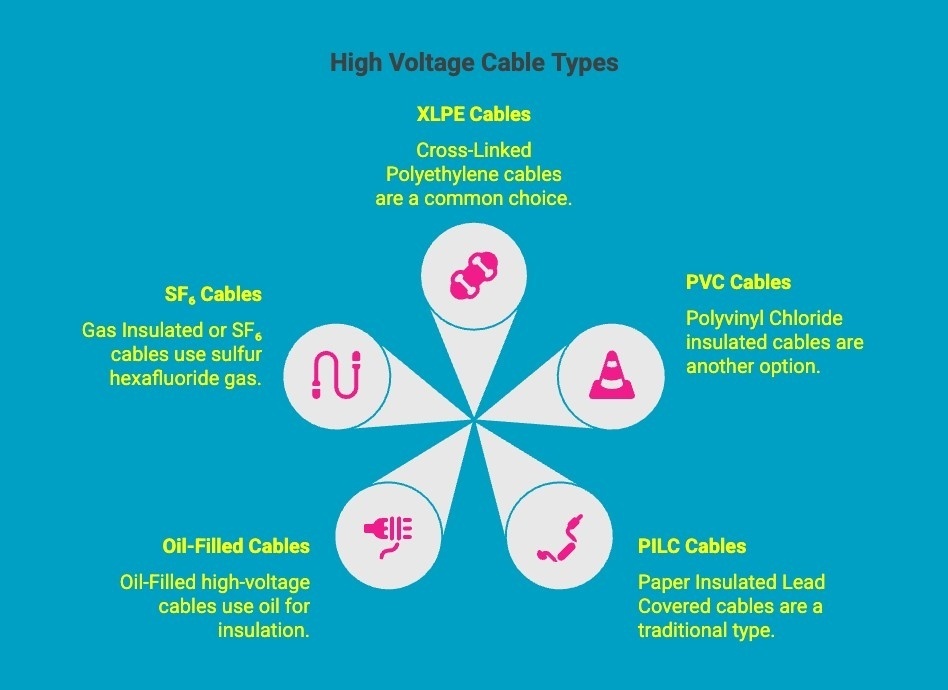
High-voltage electric cables are designed for reliable power transmission across demanding environments, with each type suited to specific voltage levels, installation conditions, and safety requirements.
Below are the main types of high-voltage electric cables commonly used today:
1) XLPE (Cross-Linked Polyethylene) Cables
XLPE cables are widely used in modern power networks due to their excellent thermal resistance, electrical strength, and long service life. Cross-linked polyethylene insulation allows these cables to handle high temperatures and voltages with minimal energy loss. They are lightweight, moisture resistant, and suitable for underground, industrial, and utility-scale transmission applications.
2) PVC (Polyvinyl Chloride) Insulated Cables
PVC insulated cables are valued for their flexibility, durability, and cost-effectiveness. While typically used for lower voltage ranges, specially engineered PVC cables can support certain high voltage applications. They offer good resistance to chemicals, abrasion, and environmental stress, making them suitable for controlled industrial settings where extreme voltage and temperature demands are limited.
3) Paper Insulated Lead Covered (PILC) Cables
PILC cables use layers of oil-impregnated paper for insulation, protected by a lead sheath. They were widely used in older power distribution systems due to their reliable insulation performance. Although durable, these cables are heavier and require more maintenance. Today, they are mostly found in legacy underground networks rather than new installations.
4) Oil-Filled High-Voltage Cables
Oil-filled high voltage cables use pressurized insulating oil to enhance electrical performance and heat dissipation. The oil reduces voids within insulation, lowering the risk of electrical breakdown. These cables are suitable for very high-voltage transmission over long distances but require complex monitoring systems to manage oil pressure and prevent leaks.
5) Gas Insulated or SF₆ Cables
Gas-insulated cables use sulfur hexafluoride gas to provide excellent electrical insulation within a sealed system. They allow compact designs and high power capacity in limited spaces, such as urban substations or tunnels. While highly efficient, these systems are expensive and require strict handling due to environmental concerns associated with SF₆ gas.
Understanding the main types of high-voltage electric cables helps ensure safer installations, better performance, and long-term reliability across power transmission and industrial applications.
Where Are High Voltage Cables Commonly Used?
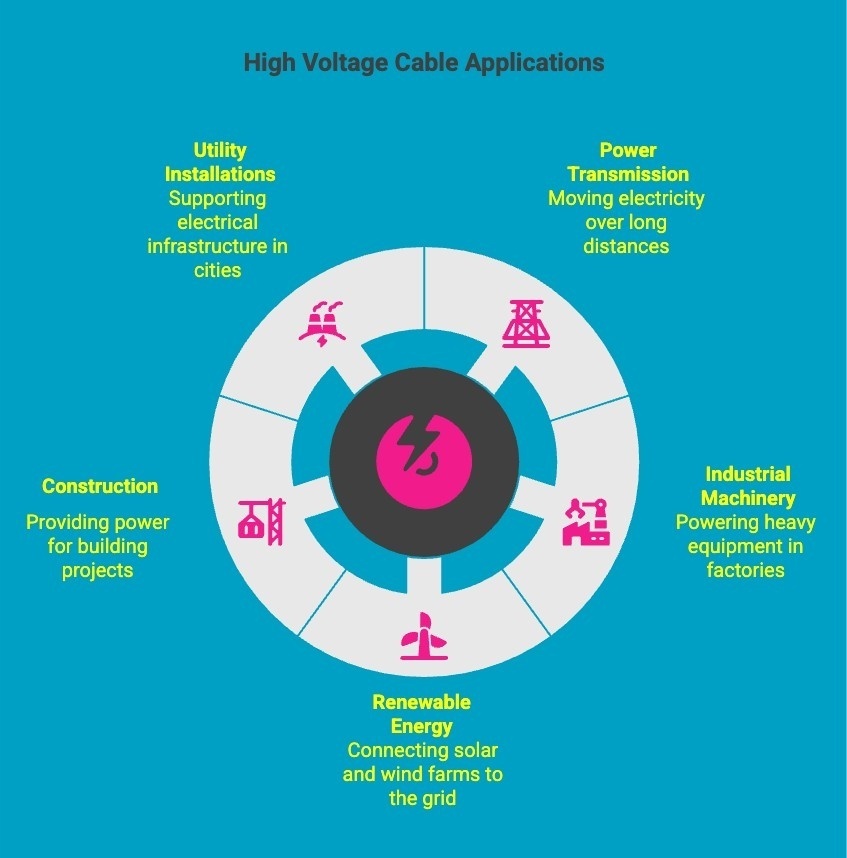
High-voltage cables are essential for delivering large amounts of electrical power safely and efficiently across different sectors. Their design supports demanding loads and long distances.
Below are the most common areas where high-voltage cables are used:
-
Power Transmission and Distribution: Used to move electricity from power plants to substations and end users, supporting long-distance transmission with minimal energy loss and stable voltage control.
-
Industrial Machinery and Equipment: Supply power to heavy-duty machines, production lines, and large motors that require high voltage for reliable and continuous industrial operation.
-
Renewable Energy Installations: Connect wind farms, solar plants, and energy storage systems to grids, enabling efficient transfer of high-capacity renewable power.
-
Construction and Infrastructure: Support large-scale projects such as tunnels, rail systems, and commercial developments that demand high voltage for equipment and permanent installations.
-
Utility and Substation Installations: Enable safe switching, control, and distribution of electricity within substations and utility networks.
Understanding where high-voltage cables are used highlights their critical role in modern power and infrastructure systems.
Why is it Important to Label High Voltage Cables Correctly?
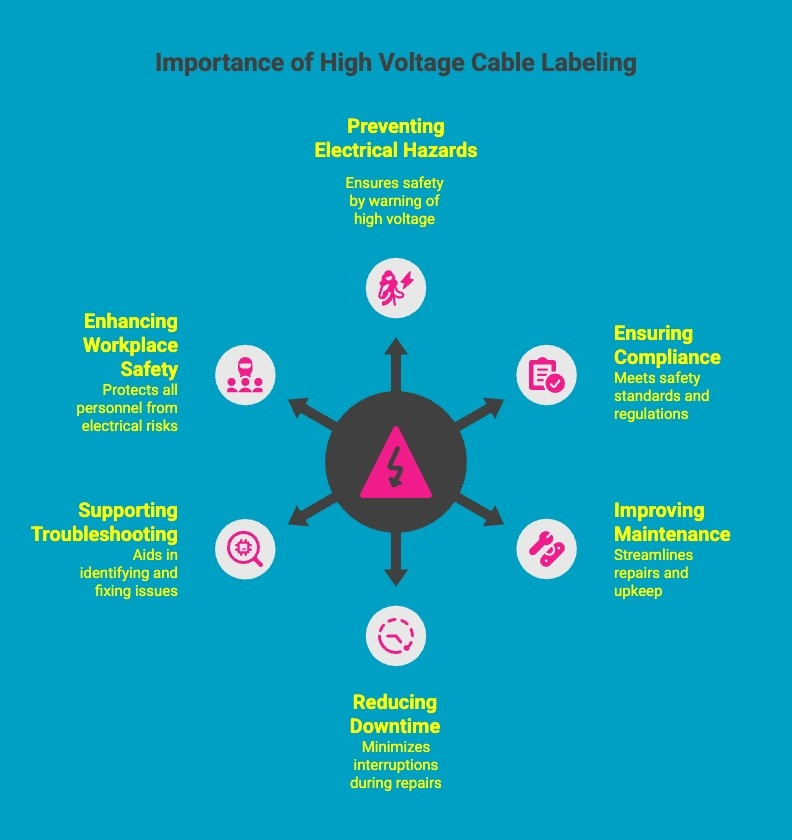
Correctly labeling high voltage electric cables is essential for maintaining safety, compliance, and efficiency in electrical systems. Clear identification reduces risk and confusion when working around high-energy circuits, ensuring both workers and equipment are protected.
Below are the key reasons why proper labeling of high voltage electrical cabling matters:
1) Preventing Electrical Hazards and Accidents
Clear, accurate labels alert workers to the presence of high voltage electrical cabling, reducing the risk of accidental contact, incorrect handling, or unsafe connections. Proper identification helps prevent electric shock, arc flash incidents, and serious injuries, especially during installation, inspection, or emergency situations where quick decisions are required.
2) Ensuring Compliance With Safety Regulations
Many electrical codes and workplace safety standards require high voltage electric cables to be clearly identified. Proper labeling supports regulatory compliance, simplifies inspections, and reduces the risk of penalties or failed audits. It also demonstrates that safety procedures are being followed consistently across electrical installations.
3) Improving Maintenance Efficiency
Well-labeled high voltage electrical cabling allows maintenance teams to identify circuits quickly without tracing lines manually. This reduces time spent locating cables, minimizes disruption, and helps technicians complete routine inspections or upgrades more efficiently while avoiding unnecessary interference with live systems.
4) Reducing Downtime During Repairs
During faults or outages, clear high voltage electrical cabling labels help teams isolate the correct circuit immediately. Faster identification shortens repair times, limits service interruptions, and helps restore operations quickly, which is especially important in industrial, commercial, and critical infrastructure environments.
5) Supporting Accurate Troubleshooting
Accurate labeling ensures technicians work on the intended high voltage electric cable when diagnosing issues. This reduces missteps, prevents secondary faults, and improves the accuracy of testing, leading to faster and more reliable problem resolution.
6) Enhancing Workplace Safety for All Personnel
Consistent labeling of high voltage electrical cabling protects not only electricians but also contractors and facility staff. Clear warnings and identification reduce accidental exposure to high-voltage areas, creating a safer work environment for everyone on-site.
Proper labeling of custom high voltage electric cable strengthens safety, compliance, and operational reliability across all electrical systems, ensuring that each part of the network functions as intended without unnecessary risk or delay.
How Should You Label High Voltage Cables Correctly?
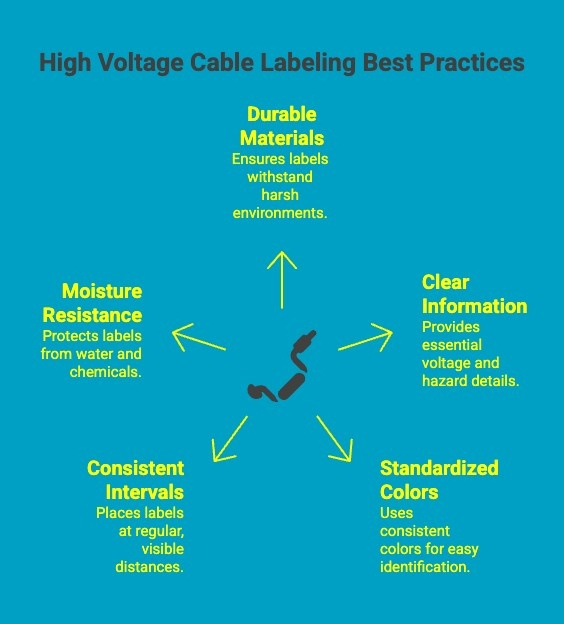
Correct labeling of high-voltage cables ensures safety, clarity, and long-term reliability in electrical systems. Labels must remain readable under harsh conditions and communicate risk instantly, especially when dealing with various high voltage electrical cable types.
Below are the essential practices to follow when labeling high-voltage cables correctly:
-
Use Durable, Heat-Resistant Label Materials: Select labels designed to withstand high temperatures, electrical stress, and prolonged exposure without fading, peeling, or cracking. This is especially crucial for high voltage electrical cable types that operate under extreme conditions.
-
Clearly Display Voltage and Hazard Information: Labels should prominently show voltage ratings, warning symbols, and hazard notices to alert anyone working near the cable. This helps ensure safety for workers handling different high voltage electrical cabling.
-
Follow Standardized Color Codes: Use recognized color standards to help workers identify voltage levels and cable functions quickly and consistently. Standardized colors are particularly useful when managing multiple high voltage electrical cable types.
-
Position Labels at Consistent, Visible Intervals: Place labels at both ends and along long runs so identification is always visible without the need to trace cables. This ensures that no matter what high voltage electrical cabling is used, it can be easily identified.
-
Ensure Labels Are Moisture and Chemical Resistant: Labels must resist water, oils, and chemicals to remain legible in industrial and outdoor environments, especially for high voltage electrical cables exposed to harsh environmental conditions.
Applying these labeling practices helps protect personnel, reduce errors, and maintain safe, efficient electrical operations across all high voltage electrical cable types.
How Do MAX Letatwin Labeling Tools Simplify High Voltage Cable Identification?
MAX Letatwin labeling tools simplify high-voltage cable identification by delivering fast, consistent, and highly durable cable markers designed for demanding electrical environments. Using dedicated cable and wire printers, MAX Letatwin systems produce clear text, symbols, and voltage warnings that remain legible under heat, abrasion, and electrical stress. Heat shrink tubes and wrap-around labels ensure secure attachment on large-diameter, high-voltage cables without slipping or fading.
What makes the MAX Letatwin especially effective is its automation. Features like auto sizing, serialization, and repeat printing reduce manual errors and ensure every cable is labeled accurately and consistently. This improves safety, speeds up installation, and makes maintenance and troubleshooting far more efficient.
When paired with DuraFast Label Company, businesses gain access to high-quality MAX Letatwin supplies, expert guidance, and reliable support for industrial labeling needs.
For professional high-voltage cable labeling solutions, contact DuraFast Label Company today to get expert advice and the right MAX Letatwin system for your application.
Conclusion
Proper high-voltage cable labeling is essential for safety, efficiency, and reliability across the electrical grid, especially for HV cables, transmission cables, and underground cables exposed to harsh environmental conditions. Clear identification reduces accidents, supports compliance, and helps technicians work confidently.
Professional labeling tools keep information legible despite heat, moisture, and mechanical stress common in outdoor use and electric power transmission. Consistent labeling speeds up maintenance, improves fault identification across different types of transmission lines, and reduces downtime in demanding electrical environments.
Frequently Asked Questions
Which label materials work best for high-voltage cable environments?
High-voltage cable labels perform best when made from durable materials such as industrial-grade PVC, polyethylene, or heat shrink tubing. These materials resist heat, moisture, chemicals, and UV exposure, ensuring labels remain readable and securely attached over long service periods.
How often should high-voltage cable labels be inspected or replaced?
Labels should be inspected during every routine maintenance cycle. Any label that is faded, damaged, peeling, or unreadable should be replaced immediately. Inspection frequency depends on environmental exposure, such as heat, moisture, chemicals, or outdoor conditions that accelerate wear.
Where should labels be positioned on high-voltage cables for maximum visibility?
Labels should be placed at both ends of the cable, near joints or terminations, and at regular intervals along long runs. In substations or complex routes, labels should also be positioned where cable direction or function changes.
How do I choose the right high-voltage electric cable for my project?
Choosing the right cable depends on voltage rating, current capacity, installation environment, and regulatory requirements. Factors such as insulation type, temperature resistance, mechanical protection, and whether the cable is installed underground, overhead, or indoors should guide selection.
What safety precautions should be taken when working with high-voltage electric cables?
Always de-energize and lock out circuits before work, wear appropriate personal protective equipment, and verify voltage absence using approved testing tools. Follow approved procedures, maintain safe distances, and ensure clear labeling is in place before handling or servicing cables.
What is the difference between high-, medium-, and low-voltage electric cables?
The difference lies in voltage range and application. Low-voltage cables serve homes and small systems, medium-voltage cables support regional distribution, and high-voltage cables transmit large amounts of power over long distances with specialized insulation and safety requirements.
How are high-voltage electric cables installed underground?
Underground installation typically involves trenches or ducts, bedding layers, and protective conduits. Cables are carefully laid, spaced, and backfilled to manage heat dissipation and prevent damage. Proper jointing, sealing, and testing are critical before commissioning.
Can high-voltage electric cables be customized for specific requirements?
Yes, high-voltage cables can be customized for conductor size, insulation material, shielding, armoring, and environmental resistance. Custom designs are common for industrial plants, renewable energy projects, and unique installation conditions requiring specific performance characteristics.
How does the technology behind high-voltage electric cables ensure performance and safety?
Advanced insulation materials, shielding layers, and precise manufacturing control electrical stress and prevent leakage. These technologies reduce energy loss, manage heat, and protect against faults, ensuring safe, stable, and long-term performance under high electrical loads.
What are common applications for single-conductor high-voltage electric wire?
Single-conductor high-voltage wire is commonly used in substations, power plants, switchgear, and industrial equipment. It is ideal for controlled environments where individual phase routing, high current capacity, and flexibility in installation are required.