How Does HVAC Wiring Impact System Performance?
21st Jul 2026
Key Highlights
-
Poor HVAC wiring organization directly slows troubleshooting and increases service errors
-
Clear labeling reduces miswiring, short circuits, and expensive system downtime
-
HVAC control and power wiring must be identified differently for safety and accuracy
-
HVAC wiring colors guide function, but printed labels confirm exact connections
-
Organized panels improve maintenance speed, technician safety, and system reliability
-
Heat-shrink tube markers and industrial labels provide long-term clarity in harsh HVAC environments
You have seen it before. You open an HVAC unit, look inside the panel, and instantly feel the pressure. Wires are overlapping, old tape flags are peeling, and nothing is clearly marked. Now you are the one expected to figure out what connects where, often while the system is down and someone is waiting for answers.
That is the real impact of poorly managed HVAC wiring. The issue is not just appearance. Disorganized wiring slows troubleshooting, increases the chance of miswiring, and turns routine service into time-consuming diagnostics that drive up labor and risk.
Whether you are a field technician, contractor, or facility team member, understanding HVAC wiring and labeling it correctly helps you work more safely and faster. This guide covers HVAC system wiring types, HVAC wiring colors, and how durable labeling, especially tube-based wire markers, improves clarity from thermostats to control panels.
What Does HVAC Wiring Mean?
HVAC wiring is the network of electrical and control connections that power and manage heating, ventilation, and air conditioning systems. It links thermostats, control boards, sensors, motors, compressors, and safety devices into one coordinated system. A qualified electrician or HVAC professional ensures both control and power circuits are installed correctly and safely.
To make it easier to understand, think of HVAC wiring as two working layers that must function together:
Control and signal layer
-
Includes HVAC low-voltage wiring
-
Connects thermostats, relays, and control boards
-
Sends commands for heating, cooling, fan speed, and mode changes
Power delivery layer
-
Includes higher load HVAC electrical wiring
-
Feeds motors, compressors, and heating elements
-
Provides the energy equipment needed to operate
When either layer of basic electrical wiringthat HVAC systems rely on is disorganized, poorly routed, or unlabeled, troubleshooting becomes slower, mistakes become more likely, and system reliability suffers.
Why Is Labeling Important for HVAC Wiring?
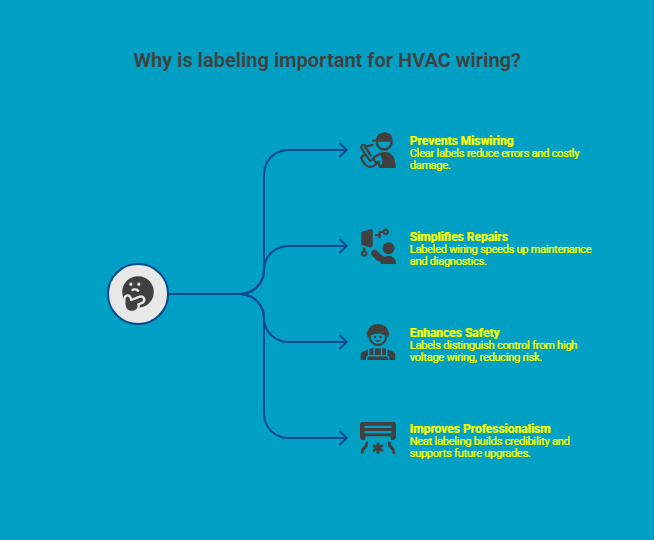
When you are working inside a panel, clarity is everything. Labeling is not just for looks. It directly affects troubleshooting speed, system safety, and long-term reliability. Clear HVAC wiring identification helps every technician who touches the system after installation.
1. Prevents Miswiring and Short Circuits
Unlabeled HVAC control wiring forces technicians to rely on tracing and assumptions. That is where cross connections happen. A wire landed on the wrong terminal can blow fuses, damage control boards, or shut systems down. Clear labels remove guesswork and reduce costly errors.
2. Makes Repairs and Maintenance Easier
Service work depends on speed and accuracy. When HVAC panel wiring is labeled, technicians spend less time identifying circuits and more time fixing issues. Testing, part replacement, and diagnostics become faster and more predictable during maintenance.
3. Improves Safety and Compliance
Proper circuit identification helps distinguish control from high voltage wiring. When technicians can quickly recognize circuit types, they work more confidently and reduce the risk of accidental contact with energized conductors.
4. Keeps Installations Neat and Professional
Clean routing and consistent labeling show craftsmanship. For contractors, it builds credibility. For facility teams, it sets a clear standard that supports future modifications, upgrades, and organized system expansion.
Labeling turns complex HVAC wiring into a system that is easier to understand, safer to handle, and faster to service.
It protects equipment, technicians, and your time on every future job.
What Are the Main Types of HVAC Wiring?
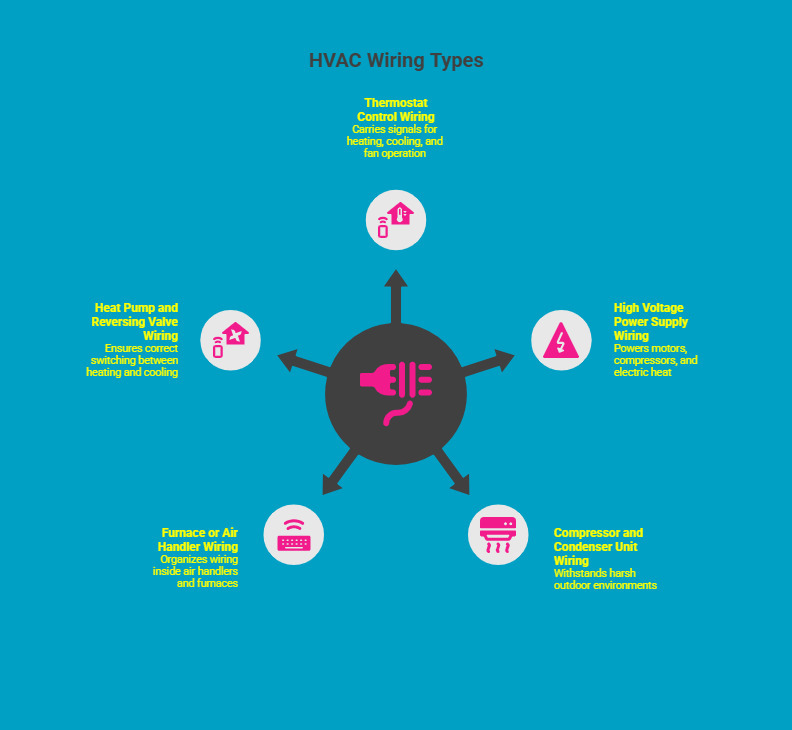
Every system you work on combines multiple wiring types, and each one serves a different purpose. Knowing the role of each category helps you label correctly, follow diagrams faster, and avoid costly mistakes during service or upgrades.
Below is a practical breakdown of where most HVAC wiring falls and why it matters in the field.
1. Thermostat Control Wiring Low Voltage
This is standard HVAC low-voltage wiring, usually 24 volts, running between the thermostat and equipment. A transformer stethe ps voltage down to a safe control level. These conductors carry signals for heating, cooling, and fan operation. Because many small wires land on tight terminals, clear, compact labels are essential.
2. High Voltage Power Supply Wiring
This section of HVAC electrical wiring powers motors, compressors, and electric heat. These circuits carry a higher risk and must be clearly separated and identified to prevent confusion between control and power conductors during maintenance.
3. Compressor and Condenser Unit Wiring
Outdoor units expose HVAC system wiring to heat, moisture, UV, and vibration. Labeling here must withstand harsh environments, making industrial tapes and heat-shrink tube markers far more reliable than handwritten tags.
4. Furnace or Air Handler Wiring
Inside air handlers and furnaces, wiring links blowers, control boards, safeties, and sensors. Organized wiring in this area speeds up diagnostics when dealing with airflow or heating complaints.
5. Heat Pump and Reversing Valve Wiring
Heat pumps add reversing valves and defrost controls, increasing circuit complexity. Accurate identification is critical to ensure the system switches correctly between heating and cooling modes.
Clear HVAC wiring and professional labeling turn complex systems into manageable ones. When every wire is identified, maintenance gets faster, safer, and far less stressful.
Need labels that hold up to heat, moisture, and daily wear? Brother P-Touch tapes deliver sharp, durable identification for panels, equipment, and surfaces.
How Do HVAC Wiring Colors Help You Identify Connections?
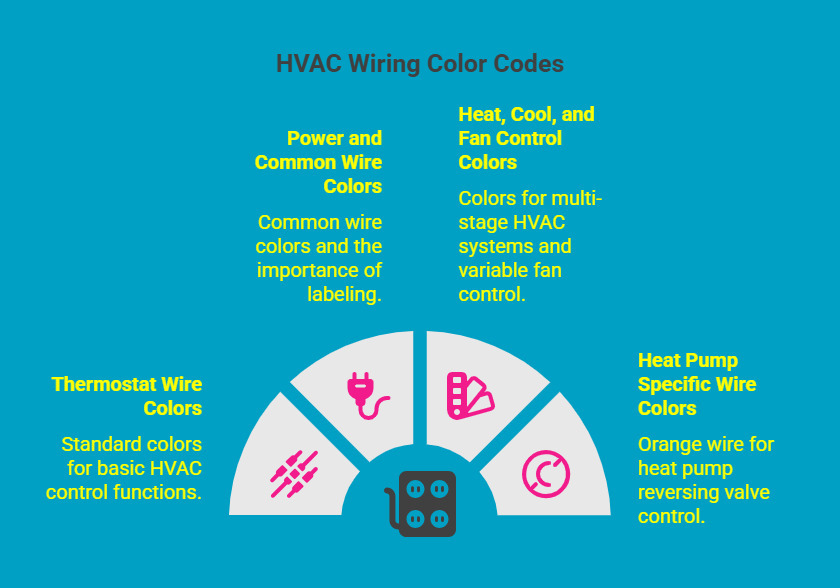
When you open a panel, wire color is often your first reference point. It helps you quickly estimate a function before tracing circuits. But while HVAC wiring colors are helpful, they are only part of the picture and should always be supported by clear labeling.
1. Standard Color Codes for Thermostat Wires
Most systems follow general conventions. Red typically carries power, white signals heat, yellow controls cooling, and green operates the fan. These standards make basic HVAC control wiring easier to recognize during installation, service, or quick visual inspections.
2. Power and Common Wire Color Identification
Common wires may appear blue or black depending on system design or installer preference. Because color usage can vary, relying on color alone can be confusing. Pairing color coding with printed identification ensures each conductor’s role is clear.
3. Heat, Cool, and Fan Control Colors
As systems move to multi-stage operation, more conductors are added. Colors alone cannot show stage numbers or specific control logic. Labels clarify which wire handles first-stage cooling, second-stage heat, or variable fan control.
4. Heat Pump Specific Wire Colors
Heat pumps often use orange for the reversing valve circuit. Misidentifying this wire can cause the system to operate in the wrong mode. Clear labeling prevents performance issues and unnecessary service calls.
In short, color helps you narrow down possibilities, but labeling confirms the exact function. Together, they create safer, easier-to-service HVAC wiring systems.
Want a fast, reliable way to label panels, equipment, and components beyond just wires? Explore how a Brother P Touch label maker helps HVAC pros create durable, easy-to-read labels for enclosures, breakers, and system parts, keeping every installation organized and service-ready.
What Are the Best Practices for Organizing HVAC Wiring?
Well-organized HVAC wiring is not about appearance. It directly affects troubleshooting speed, service safety, and system reliability. When wires are clearly identified and consistently managed, technicians spend less time tracing circuits and more time fixing actual issues, reducing downtime and risk.
-
Label both ends of every wire
Marking only one side leads to confusion after panel changes or rerouting. Dual-end labeling ensures every circuit remains traceable from source to termination, even years later. -
Follow color codes and standards
Color helps with quick visual recognition, but it should support printed identification. Labels confirm function when colors fade, vary, or become unclear in complex HVAC control wiring. -
Use durable, heat-resistant labels
HVAC environments expose wiring to heat, moisture, and vibration. Systems like the MAX Letatwin LM550A3BH PC Tube and Tape Printer produce heat-shrink tube markers that stay legible and secure under demanding conditions. -
Inspect and replace labels regularly
During maintenance visits, check for faded, loose, or damaged markers. Replacing them early keeps the HVAC system wiring easy to service and prevents confusion during future repairs.
Applying these practices turns HVAC wiring into a structured, service-friendly system that supports faster diagnostics, safer work, and long-term reliability.
How MAX Letatwin Printers Simplify HVAC Labeling?
In real HVAC environments, labeling must survive heat, vibration, moisture, and constant handling. Handwritten tags and basic tape rarely last. That is why tube-based wire marking systems are becoming standard for technicians who need durable identification that stays readable throughout the system’s service life.
-
Prints directly on heat-shrink tubes
Instead of wrapping labels around conductors, Letatwin printers produce markings on tubes that shrink tightly onto the wire. This creates secure, permanent IDs for HVAC wiring that will not slide, curl, or peel over time. -
Delivers long-lasting, readable labels
Mechanical rooms, rooftops, and control panels expose wiring to temperature swings, humidity, and dust. Tube markers maintain clear text in conditions where ordinary adhesive labels often fade or loosen. -
Ideal for panels, thermostats, and controls
From terminal blocks to control boards, tube markers keep HVAC panel wiring organized without adding bulk. For additional industrial labeling options on equipment surfaces and panels, Epson LabelWorks PX tapes can also be used: -
Saves time during field installation
Printing labels in advance or on site reduces mix-ups and rework. Clear identification speeds termination, testing, and future service, making labeling part of an efficient workflow rather than an afterthought.
This keeps Letatwin as the main wire-marking solution and positions Epson tapes as a complementary option for surface labeling, which is exactly how they should be framed.
Why HVAC Professionals Choose DuraFast Label
DuraFast Label Company supports HVAC professionals who need labeling that holds up in real mechanical environments. Their industrial systems are designed for heat, moisture, abrasion, and constant service handling around HVAC wiring and control panels.
-
Durable systems for HVAC conditions
Heat-shrink tube printers and industrial tapes are built for electrical and control identification in demanding spaces. -
Proven industrial labeling tools
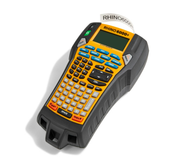
Many teams rely on Dymo Rhino label makers for tough job sites, paired with Dymo Rhino industrial tapes for long-lasting surface labels. -
Complete labeling coverage
Solutions for wires, panels, enclosures, and equipment, keeping identification consistent across the entire system.
Better labels mean safer work, faster troubleshooting, and fewer wiring mistakes.
Ready to make your HVAC labeling more durable and easier to manage? Our team will help you choose the right printers, tapes, and wire marking solutions for your application.
Contact Us to get expert guidance and the best-fit labeling system for your job.
Final Thoughts
Clear, organized HVAC wiring is not just about neatness. It directly affects safety, troubleshooting speed, and long-term system reliability, ensuring each component has a specific function. When you combine proper routing, consistent color use, and durable printed labels, you create systems that are easier to service and less prone to costly errors.
Treat labeling as part of the installation standard, not an afterthought. The time you invest now pays back every time someone opens that panel in the future.
Frequently Asked Questions
How can I tell if my HVAC wiring needs replacement?
Look for brittle insulation, heat discoloration, corrosion, or repeated control faults in your cooling system or heating system. Unstable thermostat wiring, loose connections, or signal issues affecting your air conditioner are strong signs that sections should be replaced and clearly relabeled.
Can labeling HVAC wiring improve energy efficiency?
Yes. Clear thermostat wiring labels help the heating system and cooling system run as designed. When main parts like the compressor relay receive proper signals, the air conditioner operates correctly, reducing wasted runtime and helping maintain indoor air quality and the home’s comfort.
What’s the best way to keep HVAC labels from fading or peeling?
Use heat-shrink markers and laminated industrial tapes designed for moisture, abrasion, and temperature shifts around the air conditioner. These labeling methods are an effective way to protect thermostat wiring identifiers and maintain readability across various HVAC system configurations.
How often should HVAC wiring be checked or relabeled?
HVAC wiring should be inspected as a first step during routine service, usually once or twice yearly. Faded or loose labels on thermostat wiring, line voltage conductors, or control wires should be replaced immediately to ensure safe operation and homeowner peace of mind.
What do the different thermostat wire colors mean in HVAC wiring?
Common colors include the white wire for heating system control, yellow wire for cooling system signals, green wire for the fan, blue wire or b wire for constant power, and rc wire or rh wire for power distribution, though configurations may vary.
How do I read an HVAC wiring diagram step-by-step?
Start with the power source, then follow control paths in the ladder diagram from the old thermostat to relays and the compressor relay. Trace one function at a time, like cooling, matching labels and terminal names, rather than relying only on wire colors.
Are there standard diagrams for AC wiring in HVAC systems?
Yes, manufacturers use similar ladder diagram styles showing line voltage, control circuits, and main parts. However, layouts differ by model. Always reference the specific air conditioner diagram and confirm thermostat wiring labels to match each conductor correctly.
What safety tips should I follow when working with HVAC wiring?
Always shut off and verify line voltage before touching conductors. Use insulated tools and protective gear. Clearly labeled thermostat wiring, including the rh wire and orange wire, helps separate control circuits from high-voltage areas and provides extra peace of mind.
Can you walk me through troubleshooting common HVAC wiring issues?
Begin with a visual check of thermostat wiring for loose or burnt connections. Test voltage, then continuity, step by step. Follow labeled wires through the ladder diagram to isolate faults in the heating system or cooling system without moving conductors randomly.
How do I identify and connect wires when installing a new thermostat?
Match each conductor from the old thermostat to terminals on the new smart thermostat, such as rc wire, rh wire, yellow wire, and green wire. Labels ensure constant power and correct control signals for advanced features and set temperature accuracy.
Where can I find helpful resources for learning more about HVAC wiring?
Homeowners can review manufacturer manuals, technical training guides, and professional forums for guidance. Studying ladder diagram examples, thermostat wiring layouts, and system configurations helps build understanding of main parts, smart thermostat connections, and overall system control for better home comfort.