What is Low-Voltage Cabling and Why Does It Matter in 2026?
17th Jul 2026
Key Highlights
-
Low-voltage cabling is essential for powering modern systems like data networks, security setups, and AV equipment.
-
Common low-voltage cables include Twisted Pair, Coaxial, Fiber Optic, Multi-Core Control, and Power Cables, each designed for specific applications.
-
Clear, durable labeling is vital for safety, efficiency, compliance, and ensuring long-term system reliability.
-
Effective cable management, such as separating power and data lines, helps maintain optimal performance and organization.
-
Avoid common mistakes like mixing power and data cables, poor labeling, over-tightening cable ties, and skipping cable testing to ensure a smooth installation.
-
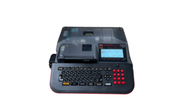
The MAX Letatwin LM-550A3BH printer provides fast, high-quality, durable labels for heat-shrink tubes and vinyl sleeves, enhancing cable organization and long-lasting identification.
Low-voltage cabling is the cornerstone of modern electrical infrastructure, powering everything from network systems to security setups and AV equipment. For contractors, IT professionals, and systems integrators, getting the cabling right is crucial. However, the real challenge lies in ensuring the installation is efficient, organized, and properly labeled, issues that, if overlooked, can lead to costly mistakes and downtime.
As an expert in the field, it's important to not only understand the types of low-voltage cables but also the best practices for installation, management, and labeling. This guide will provide you with the knowledge you need to execute low-voltage cabling projects seamlessly.
We’ll also discuss how professional-grade tools like the MAX Letatwin printer can help you streamline cable labeling, ensuring your installations are clear, durable, and easy to manage. By the end of this blog, you'll have actionable insights to enhance your low-voltage cabling work and boost system reliability.
How Does Low-Voltage Cabling Differ From Regular Electrical Wiring?
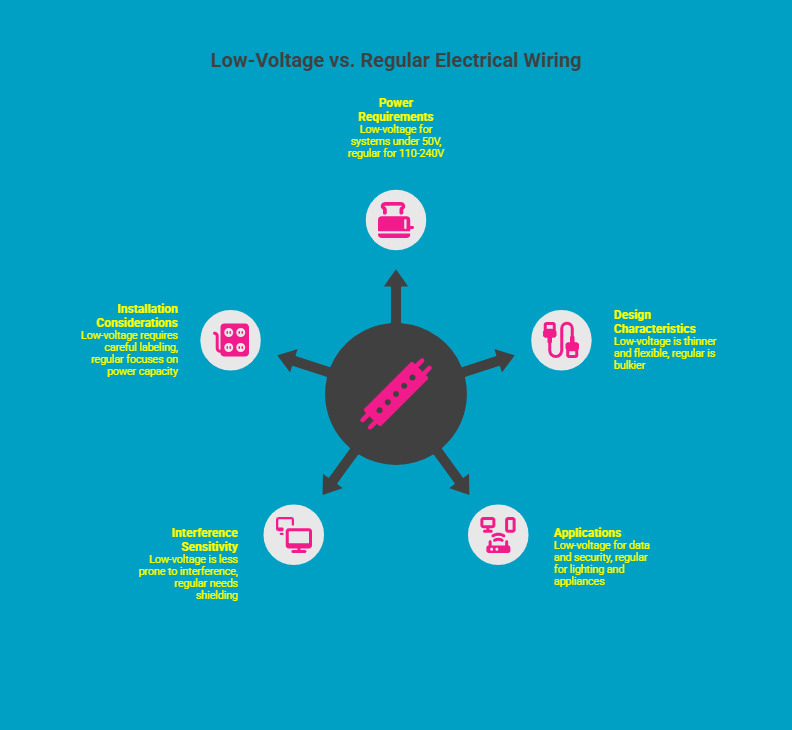
Low-voltage cabling and regular electrical wiring are designed for different purposes, each with distinct characteristics. Understanding these differences is key to using the right wiring for the job.
-
Power Requirements: Low-voltage cabling is used for systems that require under 50 volts, such as data networks, security systems, and telecommunications. In contrast, regular electrical wiring powers high-energy systems that require 110-240 volts, like lighting and appliances.
-
Design and Physical Characteristics: Low-voltage cables are thinner and more flexible, needing less insulation due to their lower power demand. Regular electrical wiring is bulkier, with thicker insulation to handle higher current loads and prevent overheating.
-
Applications: Low-voltage cabling is used in networking, AV systems, telecom lines, and security cameras, while regular electrical wiring powers lighting, HVAC systems, and machinery.
-
Sensitivity to Interference and Overheating: Low-voltage cables are less likely to overheat or cause interference, making them ideal for sensitive applications like data transmission. Regular electrical wiring, however, needs more shielding to prevent overheating and interference due to its higher current.
-
Installation Considerations: Low-voltage cabling requires careful management and labeling for efficient identification and troubleshooting, whereas regular electrical wiring focuses on ensuring sufficient power capacity for larger systems.
Understanding the key differences between low-voltage cabling and regular electrical wiring ensures that you choose the right solution for your project. Proper installation, labeling, and cable management are essential for maximizing performance and reliability in any system.
What Types of Low-Voltage Cables Are Commonly Used?
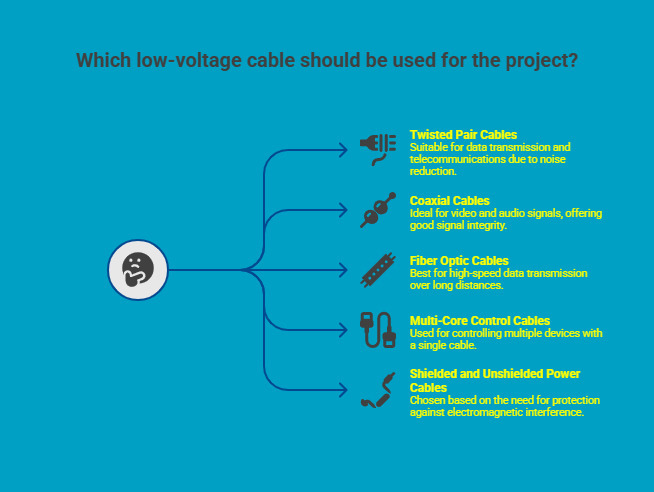
Low-voltage cabling is essential for systems like data transmission and security. Operating under 50 volts, these cables are tailored for specific applications. Understanding the various types ensures optimal performance, whether for home networks or large-scale industrial setups.
1. Twisted Pair Cables
Twisted pair cables are among the most common types of low-voltage cables used in both telecommunications and data networks. Composed of pairs of copper wires twisted together, these cables help reduce electromagnetic interference, making them ideal for environments with varying electrical noise. Twisted pair cables are widely used for Ethernet connections, phone lines, and other data transmission applications.
These cables come in two primary varieties:
-
Unshielded Twisted Pair (UTP): Most commonly used in residential and commercial installations, UTP cables are cost-effective and easy to install. They are ideal for most everyday networking needs.
-
Shielded Twisted Pair (STP): These cables have an additional shield layer that provides extra protection against interference. They are typically used in environments where electrical noise is more prevalent, such as industrial settings or data centers.
Twisted pair cables, especially UTP, are popular for their flexibility and affordability, making them a reliable choice for many low-voltage applications.
2. Coaxial Cables
Coaxial cables are widely used for video transmission and data services. Their robust design, which includes a central conductor, an insulating layer, a metallic shield, and an outer protective layer, minimizes signal interference, ensuring stable and clear transmission over long distances.
Coaxial cables are commonly found in:
-
Cable television systems: To deliver clear video signals to homes and businesses.
-
Broadband internet connections: For data transmission in high-speed internet services.
-
Video surveillance setups: To connect cameras with monitoring equipment in security systems.
These cables are especially effective at maintaining signal integrity, making them an excellent choice for video and data transmission systems that require minimal disruption.
3. Fiber Optic Cables
For high-speed data transmission, fiber optic cables are unmatched. Unlike copper cables, which transmit electrical signals, fiber optic cables use light signals to transmit data, offering significantly higher bandwidth and lower latency. This makes them ideal for long-distance communication and high-demand applications like data centers, backbone internet connections, and telecommunication networks.
Fiber optic cables are available in two types:
-
Single-mode fiber: Designed for long-distance communication, this type of cable transmits data through a single beam of light, making it suitable for applications that require data to travel over several miles.
-
Multi-mode fiber: Often used for shorter distances, multi-mode fiber transmits multiple light beams through the cable, which allows for efficient communication within buildings or campuses.
The key benefits of fiber optic cables include faster data transfer speeds and immunity to electromagnetic interference, making them a top choice for high-performance network systems.
4. Multi-Core Control Cables
Multi-core control cables are designed for industrial and power control systems, where they carry multiple signals simultaneously. These cables are engineered for environments that demand robust and reliable connections, such as factories, power plants, and large-scale industrial systems.
Typically, multi-core cables are made up of several individual wires, each encased in a single outer jacket. They are used to:
-
Control electrical power distribution.
-
Connect sensors and actuators in automation systems.
-
Transmit data between control units and machinery.
These cables are built to withstand harsh conditions and ensure safe, reliable communication across industrial setups.
5. Shielded and Unshielded Power Cables
Low-voltage power cables are designed to transmit electrical power in systems where high-voltage cables are unnecessary. These cables are commonly used in security systems, telecommunication networks, and various other low-voltage applications.
There are two main types:
-
Shielded power cables: These cables include a protective shield to prevent interference from external electromagnetic fields. They are ideal for sensitive environments like data centers, medical equipment, and industrial automation systems, where clear and reliable power transmission is essential.
-
Unshielded power cables: These cables lack the protective shield but are still commonly used in less demanding environments. They offer a cost-effective solution for general low-voltage power transmission.
Choosing between shielded and unshielded cables depends on the level of interference in the environment and the need for reliable power delivery.
By understanding the different types of low-voltage cables and their applications, you can make informed decisions for your installation projects. Ensure reliability, safety, and performance with the right cabling and professional-grade labeling solutions.
Why Clear, Durable Identification Matters in Low Voltage Cabling?
Clear and durable cable identification is essential for maintaining safety, efficiency, and compliance in any low-voltage cabling system. Here’s why it matters:
1. Safety
Proper labeling helps prevent dangerous mistakes, such as accidentally disconnecting vital cables during maintenance. With clear labels, technicians can quickly identify the purpose of each cable, ensuring the right one is worked on.
2. Efficiency
Clear labeling allows technicians to quickly trace cables, reducing downtime. This is especially critical in systems like network cabling, where maintaining performance relies on fast and accurate connections.
3. Compliance
Industries like data centers and communication networks often require adherence to standards such as TIA-568 or ISO 9001. These standards include specific labeling guidelines to ensure safety and proper system organization.
4. Future-Proofing
Well-labeled cables make it easier to modify, upgrade, or troubleshoot systems in the future. Proper labeling ensures technicians can quickly identify cables for reconfigurations or repairs, saving time and reducing errors.
5. Long-Term Durability
Using durable materials like polyester tapes or heat-shrink tubes ensures labels stay intact and legible over time, even in harsh environments.
Clear and durable cable identification enhances safety, improves efficiency, ensures compliance, and protects the long-term reliability of your low-voltage cabling system.
What Label Materials Ensure Long-Lasting, Professional Cable Identification?
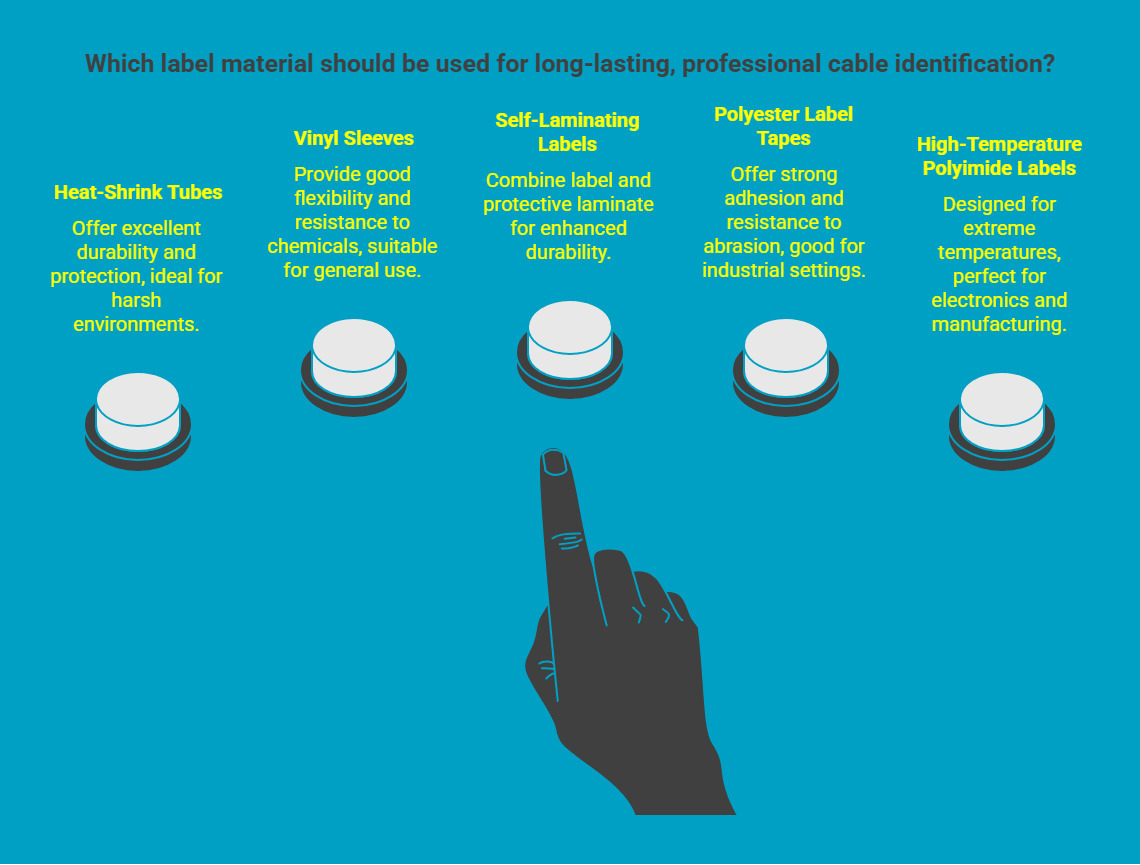
Selecting the right labeling material for low-voltage cables is essential to ensuring clarity, durability, and long-term reliability. Below are the top materials used for labeling low-voltage cables, each offering specific benefits for different environmental conditions.
1. Heat-Shrink Tubes
Heat-shrink tubes offer a secure and waterproof fit around cables. When heated, the tube shrinks tightly, providing a protective seal that keeps labels intact in harsh environments.
-
Advantages:
-
Waterproof and durable
-
Ideal for outdoor and high-stress environments
-
Provides a tight, long-lasting seal around cables
-
The MAX Letatwin printers print easily on heat-shrink tubes, ensuring clear, smudge-proof labels.
Explore our Heat Shrink Tube Printers for fast, durable cable labeling that ensures clarity and reliability.
2. Vinyl Sleeves
Vinyl sleeves are flexible and durable, providing resistance against wear, tear, and moisture. These are a versatile option for network and security cables.
-
Advantages:
-
Flexible, fits various cable sizes
-
Resistant to moisture and chemicals
-
Offers longevity in moderate conditions
-
Vinyl sleeves are best for indoor systems where flexibility and easy cable management are key.
3. Self-Laminating Labels
Self-laminating labels offer clear protection against dirt, moisture, and fading. The laminate shields the text, ensuring readability over time.
-
Advantages:
-
Protects against smudging and fading
-
Cost-effective for indoor use
-
Easy to apply, with long-lasting results
-
These labels are ideal for systems in controlled environments where easy identification is needed.
4. Polyester Label Tapes
Polyester label tapes are designed for high-temperature, UV-resistant, and chemical-resistant applications, making them suitable for outdoor and industrial settings.
-
Advantages:
-
Withstands high temperatures, UV rays, and chemicals
-
Ideal for industrial and outdoor environments
-
Provides clear, visible labels
-
Polyester tapes are perfect for installations exposed to harsh conditions or outdoor use.
5. High-Temperature Polyimide Labels
For environments with extreme heat, polyimide labels can endure temperatures up to 500°F, making them ideal for electrical rooms and automotive systems.
-
Advantages:
-
Withstands extreme heat up to 500°F
-
Perfect for high-heat applications like automotive or aerospace
-
Ensures durability under extreme conditions
-
These labels are critical for high-heat applications, where durability is a must.
By choosing the right material for labeling your low-voltage cables, you ensure clarity, durability, and long-term efficiency.
How Can You Manage and Organize Low-Voltage Cables Effectively?
Effective cable management is essential for maintaining the efficiency, safety, and longevity of low-voltage systems. Whether you’re installing network cables, security systems, or AV equipment, proper organization ensures smooth operation and simplifies troubleshooting.
1. Plan Cable Routes Before Installation
Planning is key to avoiding future complications. Mapping out cable paths allows you to minimize bends that can degrade signal quality and ensures easy access for future expansions.
-
Outline cable trays and conduit locations before installation to avoid interference.
-
Consider future system upgrades while designing cable routes.
2. Separate Power and Data Lines
Separating power and data cables is critical for preventing interference. Power lines can introduce noise that disrupts the signals carried by data cables, leading to unreliable connections.
-
Keep cables for power and data separate to improve performance.
-
Use shielded cables for additional protection against interference.
3. Use Cable Trays or Conduits
Cable trays and conduits help organize and protect cables, ensuring they stay secure and accessible. These systems reduce clutter, making the setup cleaner and more manageable.
-
Protect cables from physical damage by running them through trays or conduits.
-
Ensure easy access for maintenance or upgrades.
4. Label Both Ends Clearly
Proper labeling allows for quick identification of cables, reducing troubleshooting time and simplifying future modifications. Clear labels ensure that both ends of the cables are traceable.
-
Label both ends of every cable to improve tracing and modifications.
-
Use durable, high-quality labels to maintain legibility.
5. Avoid Sharp Bends and Extra Slack
Sharp bends and excessive slack can damage cables over time, affecting performance. Keeping cables straight and minimizing slack ensures longevity and optimal performance.
-
Avoid sharp bends to maintain signal quality and prevent physical damage.
-
Limit slack to keep the installation neat and prevent tangling.
By following these straightforward cable management practices, you can enhance the performance and reliability of your low-voltage systems while simplifying future maintenance and upgrades.
What Are the Common Mistakes in Low-Voltage Cabling?
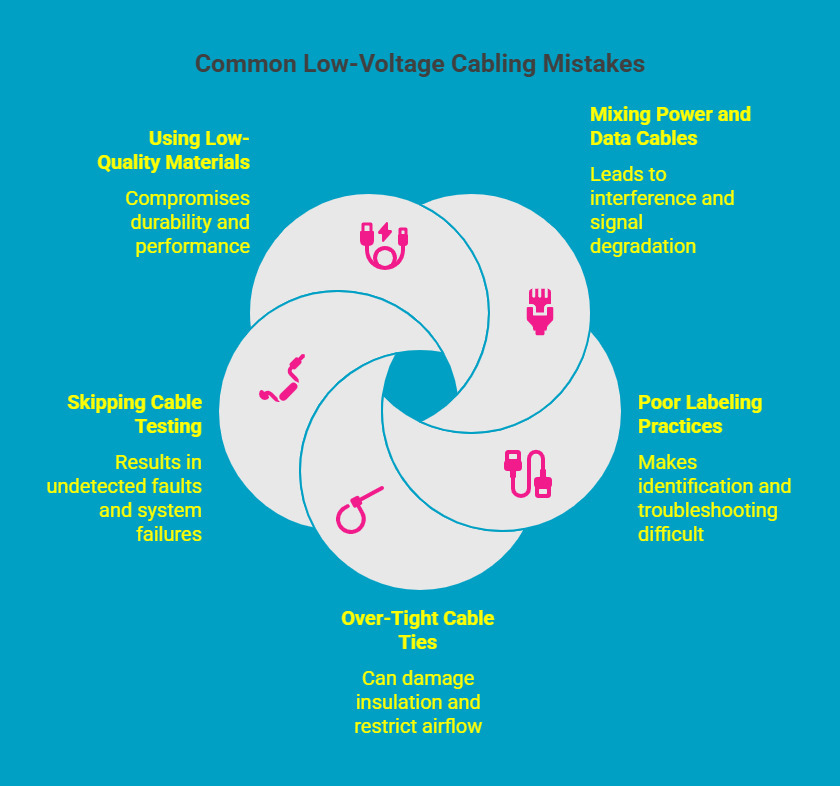
Avoiding common mistakes in low-voltage cabling can significantly improve the efficiency and reliability of your installations. Here are the key mistakes to watch out for and how to prevent them.
1. Mixing Power and Data Cables
Mixing power cables with data cables can cause electromagnetic interference (EMI), resulting in signal degradation or connectivity issues.
How to Avoid:
-
Separate Cables: Always route power and data cables separately.
-
Use Shielded Cables: Opt for shielded cables where necessary to reduce interference.
Ensuring proper separation of power and data cables helps maintain signal quality and prevents costly disruptions.
2. Poor Labeling Practices
Inadequate labeling leads to confusion during installation and maintenance, wasting time and increasing the risk of mistakes.
How to Avoid:
-
Durable Labels: Use heat-shrink tubes or vinyl sleeves for lasting identification.
-
Label Both Ends: Labeling both ends of cables ensures easy traceability.
Investing in clear, durable labels simplifies future troubleshooting and maintenance tasks.
3. Over-Tight Cable Ties
Tight cable ties can damage cables, leading to signal loss or physical damage to the wiring.
How to Avoid:
-
Use Snug Ties: Ensure ties are snug but not too tight to avoid pinching the cables.
-
Right Size Ties: Select cable ties that fit the cable bundle appropriately.
Properly tightened cable ties prevent unnecessary damage and ensure cable longevity.
4. Skipping Cable Testing
Skipping cable testing can lead to undetected faults, potentially causing system failure later on.
How to Avoid:
-
Test Before and After Installation: Use cable testers to ensure proper functionality both before and after installation.
-
Document Results: Keep records of test results for future reference.
Testing cables ensures all connections are functioning correctly and avoids costly delays.
5. Using Low-Quality Materials
Cheap, low-quality materials can result in premature failure, increased maintenance costs, and performance issues.
How to Avoid:
-
Choose High-Quality Cables: Opt for cables that meet industry standards for durability and performance.
-
Invest in Quality Labels: Use professional-grade labeling materials, like those from Durafastlabel Company
High-quality materials lead to better system reliability and fewer replacements down the line.
By avoiding these mistakes, you can enhance the overall success of your low-voltage cabling projects, ensuring long-lasting performance and reduced maintenance costs.
How Does the MAX LETATWIN LM-550A3BH Deliver Superior Labeling Performance?
The MAX Letatwin LM-550A3BH is designed to offer efficient, durable, and precise labeling solutions for low-voltage cables. It combines speed, versatility, and long-lasting performance to ensure your installations are well-marked and organized.
Key Features:
-
Fast, Efficient Printing: Prints high-quality labels quickly with up to 360 dpi resolution, saving time on large installations.
-
Versatile Labeling Options: Compatible with heat-shrink tubes and vinyl sleeves, ideal for various cable types.
-
Durable, Smudge-Proof Labels: Labels are waterproof, fade-resistant, and smudge-proof, ensuring longevity in harsh environments.
-
Reliable and Long-Lasting: Built to withstand demanding conditions, reducing the need for re-labeling.
-
Compact and User-Friendly: Ergonomically designed for easy portability and straightforward operation.
-
Cost-Effective: High-quality materials that ensure durability without the need for frequent replacements.
The MAX Letatwin LM-550A3BH is a reliable, high-performance labeling solution that enhances efficiency and accuracy in low-voltage cable installations.
Why Choose Durafast for Your Low-Voltage Cabling Labeling Needs?
At Durafast Label, we understand that clear and durable labeling is essential for the success of your low-voltage cabling and standard wiring projects. That's why we offer the MAX Letatwin LM-550A3BH printer engineered for precise, efficient, and long-lasting labeling for networking, security, and AV systems.
-
High Durability: Waterproof, fade-resistant, and smudge-proof labels that stand up to harsh environments.
-
Fast Printing: Achieve high-quality labels quickly, saving valuable time on large installations.
-
Versatility: Compatible with heat-shrink tubes, vinyl sleeves, and self-laminating labels for a variety of cable types.
-
Cost-Effective: Reliable labels that reduce the need for frequent re-labeling, minimizing long-term costs.
-
Compact and User-Friendly: Ergonomically designed for easy operation and portability, perfect for on-site labeling.
-
High-Resolution: Print up to 360 dpi for clear and readable labels, ensuring precise cable identification.
-
Long-Term Reliability: Built for demanding environments, ensuring your labels remain intact and legible for the life of the system.
Choose Durafastlabel for efficient, durable, and cost-effective labeling that keeps your low-voltage cabling organized and easy to manage.
Ensure your low-voltage cabling projects are organized, efficient, and reliable. Ready to enhance your labeling?
Order your labeling solution now and take your installations to the next level!
Final Thoughts
Low-voltage cabling is a critical component in modern electrical infrastructure, from network systems to security setups. Proper installation, management, and labeling are essential for ensuring performance, safety, and future scalability.
By understanding cable types, adhering to best practices, and using professional-grade labeling tools like the MAX Letatwin LM-550A3BH, you can enhance the efficiency and reliability of your systems. With the right approach, your low-voltage cabling projects will be well-organized, durable, and easy to maintain for years to come.
Frequently Asked Questions
Are there industry standards for low-voltage cabling in the United States?
Yes, standards like ANSI/TIA-568 and the National Electrical Code (NEC) outline the correct installation and management of low-voltage cables, ensuring safety, consistency, and performance across installations.
How does proper low-voltage cable management improve safety and reliability?
Effective cable management reduces the risk of errors by ensuring cables are organized and clearly labeled, making troubleshooting and maintenance easier in all areas, including the conference room. This boosts system reliability, enhances energy efficiency, and helps avoid costly disruptions in operation.
What is the difference between low-voltage and high-voltage cabling?
Low-voltage cables operate under 50 volts, used for a variety of applications like data transmission, power outlets, and security systems. In contrast, high-voltage cables are designed to carry higher power levels for lighting, appliances, and heavy-duty systems.
Do low-voltage cables need to be run in conduit?
Conduit requirements depend on local codes and environmental exposure factors. In some areas, conduit is mandatory to protect cables, while in others, low-voltage cables can be run without it, as long as they meet safety standards and guidelines.
How do I choose the right label type for different low-voltage cables?
For network and security cables, heat-shrink tubes and vinyl sleeves provide flexibility and durability. Polyester labels are ideal for high-temperature environments, offering excellent resistance to extreme conditions.
What safety precautions should be followed when installing low-voltage cables?
Ensure cables are correctly rated for their specific application, avoid overloading circuits, and use proper insulation and grounding to prevent interference and minimize risks of electrical faults or accidents.
How can I identify if a cable is low-voltage or not?
Low-voltage cables are typically labeled with voltage specifications on their outer casing, indicating they operate at 50 volts or less. Check for this marking to distinguish them from higher-voltage cables.