What Is Near Edge Thermal Printing for High-Speed Lines?
24th Jul 2026
Key Highlights
-
Near edge thermal printing is a thermal transfer method built for high-speed packaging lines, maintaining clear codes even when materials move above 400 mm/s.
-
It uses an angled printhead near the platen edge, which causes the ribbon to peel away quickly and release ink almost instantly.
-
The technology is widely used in food, pharmaceutical, cosmetics, and consumer goods packaging, especially on flow-wrap, pouch, sachet, and form-fill-seal lines.
-
Near-edge printers typically work with Thermal Transfer Overprinters (TTO) to print real-time data such as expiry dates, batch numbers, barcodes, and QR codes.
-
Compared with flat-head printing, near-edge systems support faster speeds, longer ribbons (600–900 m), and flexible packaging films instead of paper labels.
-
Specialized near-edge ribbons are required; using standard wax or resin ribbons can cause smearing or incomplete ink transfer.
-
Although near-edge ribbons cost more per roll, longer ribbon lengths and fewer changeovers often reduce the total cost per print in high-volume packaging lines.
In high-speed manufacturing environments, printing must keep pace with production. Whether it's expiry dates on snack packs, batch numbers on pharmaceutical cartons, or barcodes on shipping labels, downtime is not an option. That’s where near-edge thermal printing stands out.
Unlike conventional thermal transfer systems, near-edge technology is designed specifically for fast-moving packaging lines, flexible films, and real-time coding applications.
In this guide, we’ll break down how it works, how it differs from flat head printing, and why it plays a critical role in industrial packaging operations.
What Is Near Edge Thermal Printing?
Near-edge printing is a thermal transfer printing method designed for high-speed packaging and coding applications. It uses a specialized printhead positioned close to the edge of the platen roller, allowing heat to transfer quickly to the ribbon during printing. Because the printhead sits near the edge of the platen roller, the ribbon peels away at a much sharper angle, releasing ink almost instantly rather than over a longer dwell time.
This rapid ink release helps maintain clear, consistent print quality even on fast-moving packaging materials. Near-edge is the dominant thermal transfer technology used in food and pharmaceutical packaging lines because it can maintain reliable print quality at speeds above 400 mm/s.
Want to understand printing methods better? Read our guide on Thermal Transfer vs Direct Thermal Printing: What’s the Difference?
Where Is Near Edge Thermal Printing Used?
Near-edge thermal printing is primarily used in high-speed packaging environments where products move quickly through automated machines and variable information must be printed clearly and reliably. Because the technology releases ink very quickly, it performs well on flexible packaging materials and continuous production lines.
It is commonly used in the following industrial applications:
-
Flexible food packaging films.
Snack foods, frozen foods, confectionery, and bakery products are often packaged in flexible films. Near-edge printers apply expiry dates, batch numbers, and barcodes directly onto these films during packaging. -
Flow-wrap packaging machines.
Flow wrappers used for products such as chocolate bars, snack bars, biscuits, and medical products require fast, continuous printing. Near-edge technology keeps codes clear even as packaging materials move rapidly through the machine. -
Pouches and sachets.
Products like sauces, coffee, spices, cosmetics, and pharmaceuticals packaged in stand-up pouches or small sachets require date codes and lot numbers printed directly on the packaging material. -
Form-fill-seal packaging lines.
Vertical and horizontal form-fill-seal machines produce thousands of packages per hour. Near-edge printing ensures batch codes, QR codes, and regulatory information remain readable at these high speeds. -
Thermal Transfer Overprinters (TTO).
Near-edge ribbons are commonly used in TTO printers integrated into packaging lines, where they print real-time information such as expiry dates, production timestamps, and serial numbers directly on flexible packaging materials.
Because of its ability to maintain consistent code quality at high speeds, near-edge printing is widely used in food, pharmaceutical, cosmetics, and consumer goods manufacturing environments.
How Near Edge Thermal Transfer Ribbons Work?
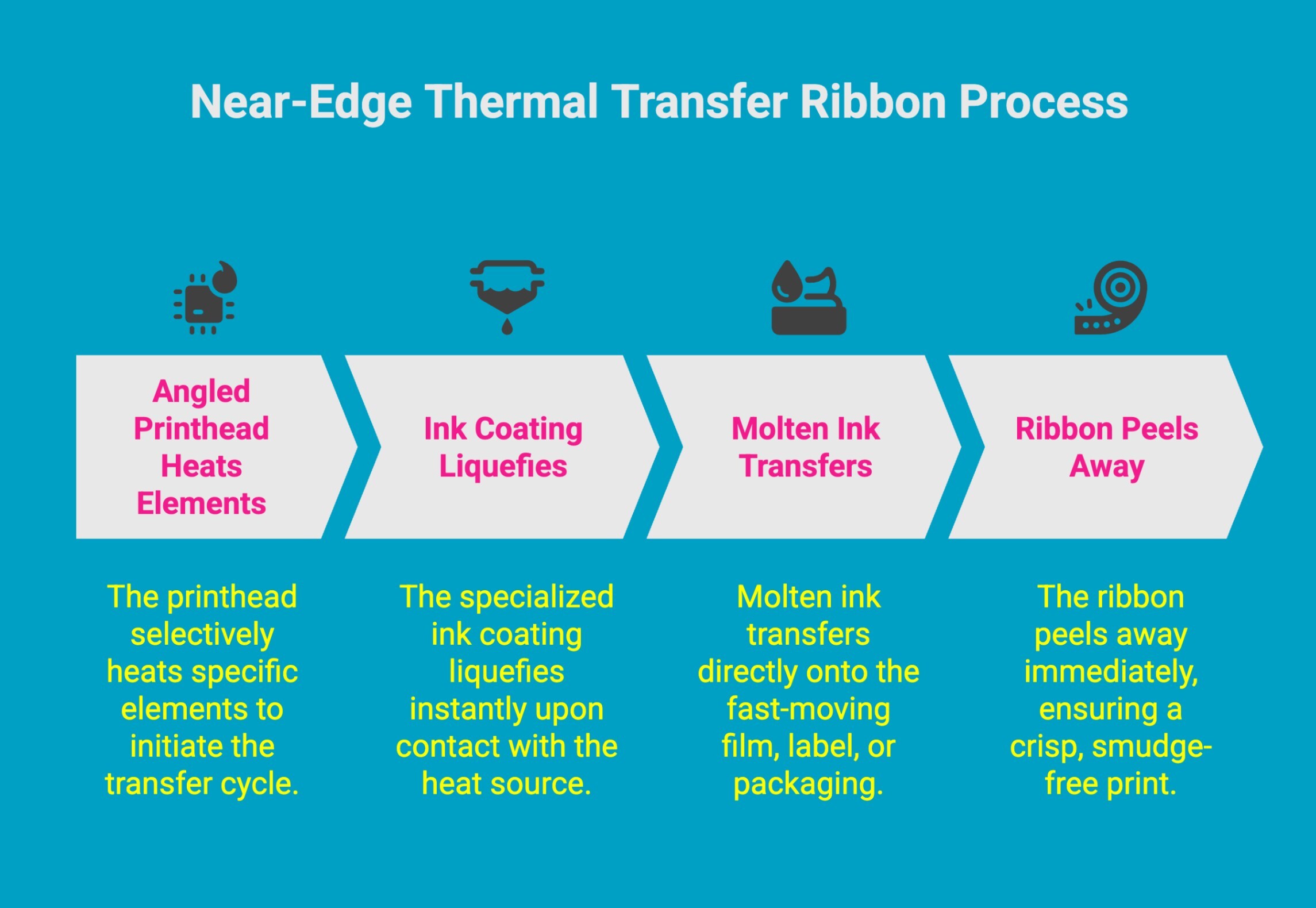
Near-edge thermal ribbons are a special breed of printing supplies. Because the printhead is angled right near the edge, the ink must be extra reactive. It has to melt and transfer in a fraction of a second to keep up with fast, continuous industrial packaging lines.
Here is the step-by-step mechanical process that makes these fast ribbons work:
-
The angled printhead selectively heats specific elements to begin the transfer cycle.
-
Specialized ink coating liquefies instantly upon contact with the heat source.
-
Molten ink transfers directly onto the fast-moving film, label, or packaging.
-
Ribbon peels away immediately, ensuring a crisp, smudge-free print at high speeds.
Using the wrong ribbon type can affect print quality. A standard wax or resin ribbon used in a near-edge printer will often produce smearing or incomplete ink transfer, because the ribbon’s release layer is not designed for the faster peel angle and rapid separation used in near-edge printing systems.
Most near-edge systems can complete this full transfer cycle 8-15 times per second at full production speed.
Curious how thermal label printing works? Explore our Deep Dive into Thermal Label Printing to learn the full process.
What Are the Key Differences Between Near-Edge and Flat-Head Thermal Printing?
When you’re deciding between near-edge and flat-head printing, it really comes down to the speed of your production line and the type of material you’re printing on. Think of it like choosing between a high-speed printer for a bustling packaging floor and a reliable workhorse for standard shipping labels. Each has a specific job they do best.
The table below breaks down the key performance differences between these two systems:
|
Feature |
Near-Edge |
Flat-Head |
|---|---|---|
|
Printhead Position |
Angled and positioned near the edge of the ribbon path |
Flat and parallel to the label surface |
|
Speed Capability |
Designed for high-speed packaging lines |
Best suited for moderate, standard printing speeds |
|
Printhead Resolution |
Typically 300 dpi or higher for precise coding |
Commonly 203 dpi or 300 dpi for label printing |
|
Ribbon Type |
Requires specialized near-edge ribbons |
Uses standard wax, wax-resin, or resin ribbons |
|
Typical Ribbon Length |
Often 600 m to 900 m for long production runs |
Typically 74 m to 450 m depending on printer type |
|
Ideal Substrates |
Flexible films and thin packaging materials |
Paper labels, tags, and cardboard |
|
Typical Industrial Use |
Fast-paced packaging and TTO applications |
Shipping labels, warehouse inventory, and general labeling |
Which one is right for you?
-
Choose Flat-Head if you are printing standard paper labels, tags, or inventory barcodes. It’s the cost-effective, reliable standard for most warehouse environments.
-
Choose Near-Edge if you need to print directly onto fast-moving, flexible packaging films. It’s built to keep up with the rapid pace of continuous production lines.
Near-edge ribbons may cost more per roll, but longer ribbon lengths and fewer changeovers often reduce the total cost per print in high-volume production.
What Are the Key Operational Benefits of Thermal Near-Edge Printing?
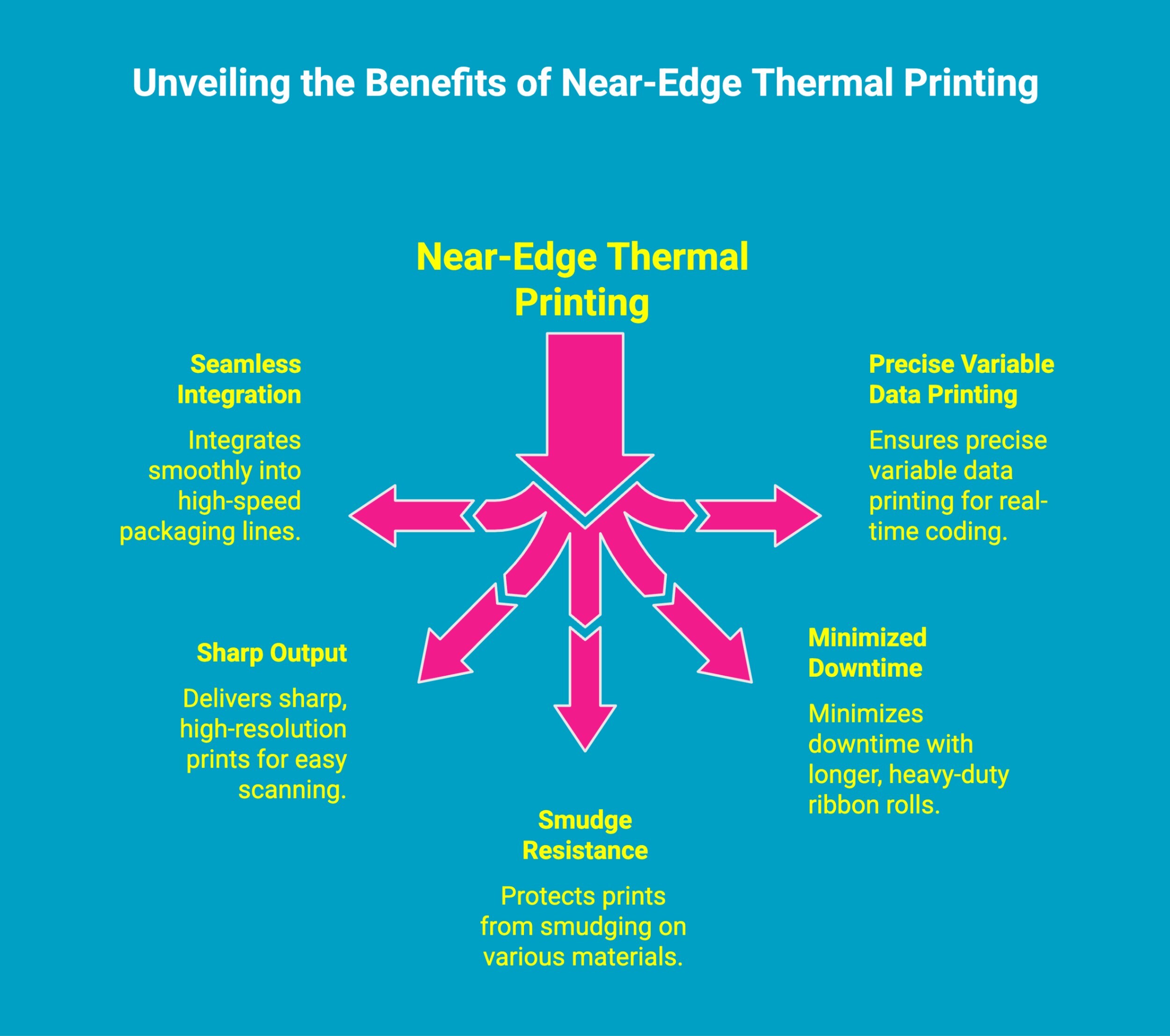
Near-edge printing is built for fast production lines where everything moves quickly. While standard printers can struggle to keep codes clear at high speeds, near-edge systems transfer ink faster, helping ensure barcodes, batch numbers, and expiry dates stay sharp and easy to read.
This technology provides several distinct advantages for busy, high-output environments:
-
Seamlessly integrates into high-speed packaging lines to keep your overall throughput at maximum capacity.
-
Delivers exceptionally sharp, high-resolution output, making small text and barcodes easy for scanners to read.
-
Protects your prints from smudging, even on tricky flexible films and glossy plastic materials.
-
Minimizes production downtime by utilizing longer ribbon rolls that can handle massive, heavy-duty production shifts.
-
Ensures precise variable data printing, which is vital for real-time date, batch, or QR coding.
Because the ribbon peels away from the film the moment the ink is transferred, the print sets instantly, avoiding the common blurriness you might see in slower, traditional printing methods.
Not sure which printing method fits your setup? Learn When to Use Thermal vs Inkjet Printing in this practical comparison.
Where Is Near-Edge Thermal Printing Most Commonly Used?
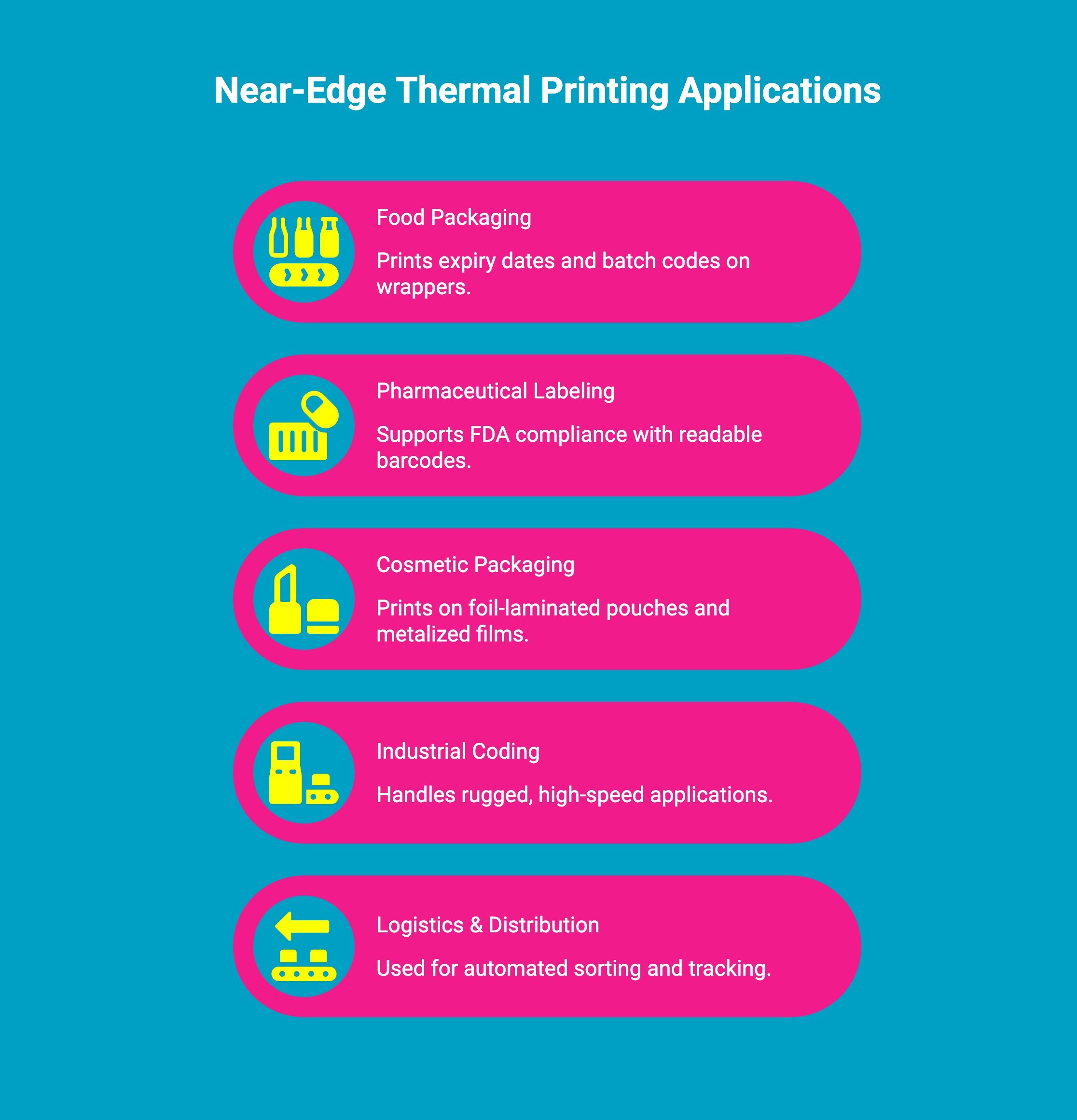
Near-edge printing isn't just for heavy-duty industrial settings; it’s the quiet hero behind the dates and barcodes on the products you use every day. Because it handles high-speed, flexible materials so well, you'll find this technology integrated directly into the packaging machinery of major consumer goods and pharmaceutical lines.
This technology is the go-to solution for industries that require speed and high precision:
-
Food Packaging: Essential for printing expiry dates and batch codes directly onto wrappers as they zip down the line.
-
Pharmaceutical Labeling. Near-edge printing supports compliance with FDA 21 CFR Part 11 serialization requirements by producing high-contrast, consistently readable barcodes used for pharmaceutical track-and-trace systems.
-
Cosmetic Packaging: Cosmetic packaging lines use near-edge to print batch codes and ingredient information on foil-laminated pouches and metalized films that standard printheads cannot reliably adhere to.
-
Industrial Coding: Handles rugged, high-speed applications where reliability and speed are non-negotiable.
-
Logistics & Distribution: Often used for advanced automated sorting and tracking on diverse packaging materials.
These printers are particularly common on specialized packaging equipment, including:
-
Flow-wrap packaging: Where items are sealed in a continuous "tube" of film.
-
Form-fill-seal lines: Used extensively for snack foods, powders, and liquids.
-
Shrink wrap films: Where precise printing must remain stable despite heat-shrinking processes.
-
Flexible pouches: The ideal substrate for the instant, crisp release of near-edge ink.
Important Note: Near-edge printing is not the right choice for paper shipping labels, cardboard cartons, or standard inventory tags, flat-head systems handle these more cost-effectively.
Which Near-Edge Ribbon Systems Are Best for Industrial TTO Printers?
In high-volume industrial environments, the right ribbon isn't just about printing; it's about keeping the production line moving without interruption. Brands like Toshiba, Markem-Imaje, and Videojet have engineered specialized near-edge ribbon systems designed to handle everything from continuous film wrapping to delicate pharmaceutical pouch coding.
Understanding Thermal Transfer Overprinters (TTO)
A TTO is the "specialist" in the packaging world. Unlike standard desktop printers, TTO units are integrated directly into your packaging line to print real-time data, like expiration dates or QR codes, directly onto flexible films, sachets, and flow-wraps.
TTO systems offer several advantages for fast-paced packaging:
-
Precision: High-resolution output for logos, barcodes, and regulatory data.
-
Speed: Designed for both continuous and intermittent packaging machines.
-
Versatility: Works perfectly on flexible pouches, shrink wrap, and form-fill-seal lines.
-
Efficiency: Utilizes long ribbon rolls (up to 900m) to drastically reduce line downtime.
-
Durability: Produces rub-resistant codes that survive the rigors of supply chain handling.
Toshiba Near-Edge Solutions
Toshiba systems are built for long, reliable production runs. Their ribbons are categorized primarily by length to match the scale of your industrial operations:
-
600m Ribbons (Industrial Class): Compatible with B-472, B-572, B-SX4T, B-SX5T, B-EX4T1/6T1, and BX410T/610T. These are ideal for manufacturing floors where minimizing roll changeovers is key.
-
300m Ribbons (Wide-Format Class): Compatible with B-872, B-882, B-SX6T, and B-SX8T, specifically for wide-format packaging and heavy-duty industrial needs.
-
High-Performance Coding: The B-EX4T1 and BX410 ribbons are specifically optimized for synthetic labels and films, offering superior ink density and quick-release properties for high-speed throughput.
Leading TTO Ribbon Brands
-
Markem-Imaje: Known for reliability across global food and pharma packaging lines, their systems prioritize consistent image density and low maintenance.
-
Videojet Ribbons: Their near-edge ribbons are engineered specifically for superior adhesion on difficult surfaces like glossy films, ensuring that codes remain moisture and abrasion-resistant.
|
Brand |
Model Series |
Ribbon Width |
Ribbon Length |
Ink Type |
|---|---|---|---|---|
|
Toshiba |
B-472, B-572, B-SX4T, B-SX5T, B-EX4T1, BX410T |
55 mm to 110 mm |
600 m |
Wax-Resin, Resin |
|
Toshiba |
B-872, B-882, B-SX6T, B-SX8T |
110 mm to 160 mm |
300 m |
Wax-Resin, Resin |
|
Markem-Imaje |
SmartDate Series |
22 mm to 128 mm |
600 m to 900 m |
Wax-Resin, Resin |
|
Videojet |
DataFlex Series |
22 mm to 128 mm |
650 m to 900 m |
Wax-Resin, Resin |
Contact our team for a full compatibility list by brand and model. Our ribbon range supports major TTO platforms, including Markem-Imaje, Videojet systems, and Toshiba, with multiple ribbon widths and lengths designed for high-speed packaging operations.
When Should You Switch to Near-Edge Thermal Printing?
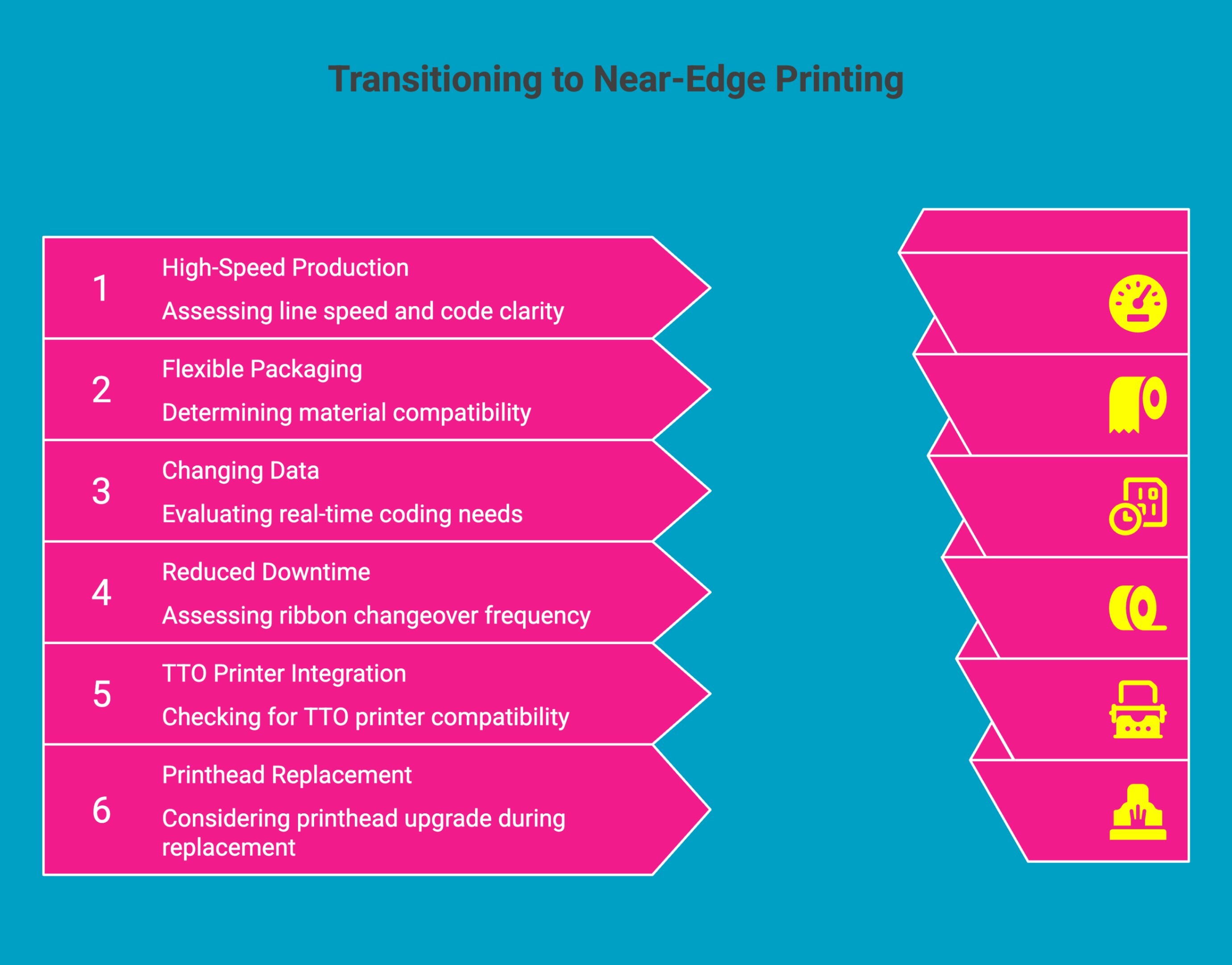
Choosing between flat-head and near-edge printing usually comes down to how fast your line runs, what materials you print on, and how often your codes change. Near-edge systems are built for fast packaging environments where printers must keep up with production without sacrificing code quality.
If two or more of the following sound like your operation, near-edge printing will likely improve efficiency on your line.
-
Your production line runs at high speeds.
If your packaging line moves quickly and still needs sharp, readable codes, near-edge printing is designed to keep up without losing print clarity. -
You print on flexible packaging materials.
If your products use films, flow-wrap packaging, pouches, or laminated packaging materials, near-edge systems handle these surfaces much better than standard flat-head printers. -
You print changing data during production.
Many packaging lines need to print timestamps, batch numbers, serial numbers, or QR codes that change throughout the shift. Near-edge printers are built to handle this kind of real-time coding. -
You want to reduce ribbon changeovers and downtime.
Longer ribbons, such as 600m near-edge ribbons, mean fewer stops to replace ribbons. For example, on a line running 200 packs per minute, a 5-minute ribbon change can cost around 1,000 units of production. Longer ribbons can eliminate several of those changeovers during a shift. -
You already use or plan to install TTO printers.
Near-edge ribbons are commonly used with Thermal Transfer Overprinters (TTO) integrated into flow wrappers and form-fill-seal packaging machines. -
Your current printhead is nearing replacement.
If your flat-head printhead is close to its recommended service interval, it may be a good time to evaluate a near-edge upgrade. Making the switch during a normal replacement cycle can help avoid overlapping equipment costs.
Flat-head printers are still an excellent and cost-effective option for shipping labels, warehouse barcodes, and paper-based labels. However, when production involves high-speed lines and flexible packaging materials, near-edge printing is often the better fit.
How Can DuraFast Label Company Support Your Near-Edge Printing Needs?
At DuraFast Label Company, we understand that in high-speed manufacturing, your printing solution is only as good as the ribbon feeding it. We specialize in supplying near-edge thermal ribbons engineered for consistent performance on packaging lines. Whether you operate a high-volume snack packaging system or a pharmaceutical coding line, our team helps ensure your ribbon matches the material, printer, and production speed used in your facility.
For example, our 600m near-edge ribbon is verified compatible with printers such as the Toshiba B-EX4T1 and B-572, and is available in both wax-resin and full resin formulations depending on the durability and adhesion required for your packaging material.
We work closely with production teams to support reliable coding on packaging equipment using ribbons compatible with leading industrial printing systems.
What we provide:
-
Extensive Compatibility.
We supply ribbons designed for major industrial printing platforms including Toshiba, Markem-Imaje, and Videojet TTO systems, commonly used on form-fill-seal machines and flow wrappers. -
Flexible Capacity Options.
Our ribbon inventory includes 300m, 600m, and extended-length TTO ribbons, helping packaging lines reduce changeovers and maintain consistent uptime during long production runs. -
Material-Matched Ribbon Formulations.
We match ribbon ink chemistry to your film type. Whether you are running BOPP, PET, OPP, or metallized polyester films, we recommend and supply the formulation that adheres correctly and produces clear, durable codes. -
Operational Efficiency.
Using the right ribbon improves print clarity, reduces printhead wear, and minimizes line stoppages caused by ribbon breakage or poor ink transfer.
Need expert guidance on selecting the right ribbon for your specific printer and material? Contact our team today to discuss your printing goals and receive a custom solution.
Frequently Asked Questions
What is the difference between near-edge and flat head thermal printing?
Near-edge printing positions the edge of the printhead at an angle so heating elements transfer ink instantly. This precision allows users to print very small fonts clearly while ensuring the text remains legible at high velocities.
Do near-edge printers require special ribbons?
Yes, near-edge ribbons incorporate a specialized release layer to facilitate instant ink detachment. This specific coating ensures that ink transfers cleanly onto packaging surfaces, even when the printer operates at incredibly high production line speeds today.
Are near-edge ribbons compatible with standard thermal printers?
No, near-edge ribbons are not compatible with standard tabletop printers. These ribbons require specific engineering matched to angled printhead mechanics, unlike thermal transfer formulations designed for flat-head devices that generally perform much better at slower print speeds.
Are Toshiba near-edge printers used in packaging lines?
Yes, Toshiba industrial models are widely used on packaging lines. They excel at printing on synthetic material used in label printing, ensuring durable coding for products while maintaining the extreme precision required for manufacturing environments in modern industrial factories.
How do you maintain or clean a near-edge thermal printhead?
Regular cleaning is absolutely essential for near-edge printheads. Always use a lint-free swab dipped in isopropyl alcohol to gently wipe the surface after every ribbon roll change. This prevents dust accumulation, which ruins clarity and device longevity forever.
What are common issues or troubleshooting tips for near-edge thermal printers?
Common issues include light printing, wrinkled ribbons, or vertical white lines. Ensure correct heat and pressure settings are applied for your specific material. If problems persist, check for misaligned printheads or worn-out rollers causing uneven contact during operation.