Near Edge vs Flat Head: Which Printing Method Is Better?
21st Jul 2026
Key Highlights
-
Near edge vs. flat head printing refers to two different thermal transfer technologies that differ in printhead position, printing speed, and typical applications.
-
Flat head printing is the most common method used for barcode labels, shipping labels, and product identification across retail, logistics, and manufacturing industries.
-
Near-edge printing uses an angled printhead design and supports faster printing speeds, making it ideal for flexible packaging and automated production lines.
-
The main technical difference lies in the printhead position, ribbon release timing, and compatibility with specific ribbon formulations.
-
Flat head printers work well with paper and synthetic labels, while near-edge printers are often used for printing on packaging films and continuous materials.
-
Near-edge printers require near-edge-specific ribbons; using a flat-head ribbon in a near-edge printer causes wrinkling, poor ink transfer, and accelerated printhead wear.
-
Near-edge systems cost 3–5x more than flat-head printers but support print speeds up to 3x faster, making them cost-effective only for high-speed packaging lines above 200 mm/s.
Thermal printing is widely used for labels, packaging, and barcode applications. However, many businesses are unsure whether they should use near-edge printing technology or flathead printing technology, especially when choosing printers, ribbons, or replacement printheads.
Both printing methods use thermal printheads to transfer images onto labels or packaging materials, but they operate differently. The position of the printhead, printing speed, and ribbon compatibility all influence which technology performs best for a specific application.
This guide explains the differences between near-edge vs. flat-head thermal printing, how each technology works, and how to choose the right option based on your printing environment and production needs.
What Is Flat Head Thermal Printing?
Flat head thermal printing is a widely used thermal transfer printing method designed for producing barcode labels, product labels, and shipping labels. In this system, the thermal printhead sits flat against the ribbon and label material during the printing process.
As the label and ribbon pass under the printhead, heat is applied to transfer ink from the ribbon onto the label surface. This process typically occurs at print speeds between 2 and 12 inches per second (ips), creating clear text, graphics, and barcodes suitable for many labeling applications.
Flathead printers are commonly used in desktop and industrial label printers because they provide consistent print quality and reliable performance. They work well with paper and synthetic label materials and support various ribbon types such as wax, wax resin, and resin for different durability requirements.
Examples of widely used flathead printers include the Zebra ZT410, SATO CL4NX Plus, and Honeywell PX940, all of which are designed for high-volume industrial labeling and consistent barcode printing.
New to thermal printing? Understanding how thermal printing works can help you choose the right printer, ribbon, and label material for better durability and barcode clarity.
What Is Near Edge Thermal Printing?
Near-edge thermal printing is a thermal transfer printing method commonly used in high-speed packaging and production environments. In this system, the thermal printhead is positioned at an angle near the edge of the platen roller rather than sitting flat against the material.
During the printing process, the ribbon and material move together while heat from the angled printhead transfers ink onto the surface. Because printing occurs just before the ribbon separates from the material, near-edge printers support faster printing speeds.
This technology is often used for printing on flexible packaging films, labels, and product packaging materials in automated production lines. Near-edge printing is commonly found in industrial packaging equipment and continuous manufacturing processes.
Examples of near-edge printing systems include the Toshiba TEC EC-3 and Videojet 6330, both designed for high-speed packaging lines that print variable data such as barcodes, batch numbers, and expiration dates directly onto packaging materials.
What Are the Key Technical Differences Between Near Edge and Flat Head Printing?
Understanding the technical differences between near-edge and flat-head thermal printing helps businesses choose the right printing technology for their labeling or packaging operations. While both systems rely on thermal transfer technology, they differ in printhead position, printing speed, and material compatibility.
Below is a comparison table outlining the main technical differences between near edge and flat head printing technologies:
|
Feature |
Near Edge Printing |
Flat Head Printing |
|---|---|---|
|
Printhead Position |
Positioned at an angle near the platen roller |
Sits flat against the label and ribbon |
|
Printing Speed |
Typically 10–40 inches per second (ips) in high speed packaging lines |
Typically 2–12 inches per second (ips) in label printers |
|
Material Compatibility |
Often used for flexible packaging films |
Commonly used for paper and synthetic labels |
|
Printer Integration |
Often integrated into packaging machines |
Typically used in standalone label printers |
|
Ribbon Type |
Requires near edge ribbons |
Uses standard flat head ribbons |
|
Printhead Lifespan |
Generally shorter due to high speed operation, often 20–40 km of printed ribbon depending on conditions |
Typically longer lifespan, often 40–80 km of printed ribbon with proper maintenance |
|
Typical System Cost |
Higher system cost, often $3,000 to $10,000+ due to integration with packaging equipment |
Lower cost, typically $500 to $3,000 for desktop and industrial label printers |
These differences influence not only printing performance but also ribbon compatibility, printer selection, and the types of materials that can be printed efficiently in different production environments.
Are Near Edge Print Heads Flat?
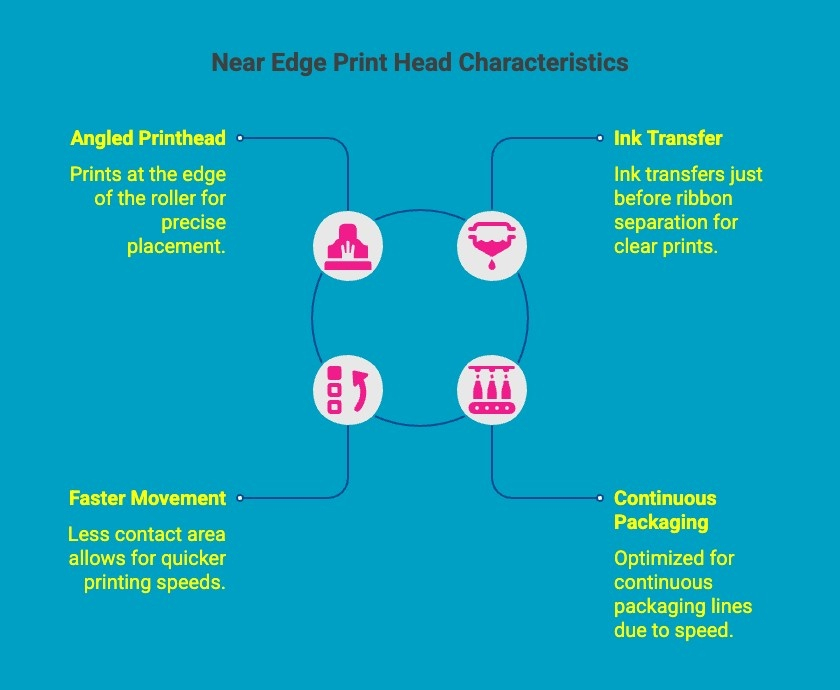
No, near-edge printheads are not flat. Unlike flathead printheads that sit directly against the label surface, near-edge printheads are positioned at a slight angle near the platen roller.
This angled position allows printing to occur just before the ribbon separates from the material, supporting faster printing during heat transfer and improving efficiency in high-speed packaging systems used across the printing industry.
Here is how the physical shape of a near-edge printhead directly affects how it performs:
-
The Angled Printhead Prints at the Edge of the Roller: A near-edge printhead is mounted at a slight angle rather than lying flat on the label. This means printing happens at the point where the ribbon and material begin to separate from the roller, not across the entire contact surface.
-
Ink Transfers Just Before Ribbon Separation: Because the ribbon separates almost immediately after heat is applied, the melted ink transfers quickly onto the packaging material. This short contact time reduces friction and allows the printer to operate at much higher speeds.
-
Less Contact Area Allows Faster Movement: Flat head printers press the ribbon and label together across a larger surface area, which limits speed. The near-edge design reduces this contact area, allowing the ribbon and material to move faster through the print zone.
-
Optimized for Continuous Packaging Lines: This geometry works well in automated packaging equipment where films or labels move continuously. The angled design supports consistent printing of barcodes, dates, and batch codes even when packaging lines run at very high speeds.
Because of this angled structure, near-edge printheads behave differently from flathead systems and are specifically engineered for fast, continuous production environments.
How Do You Choose Between a Near Edge or Flat Head Printer?
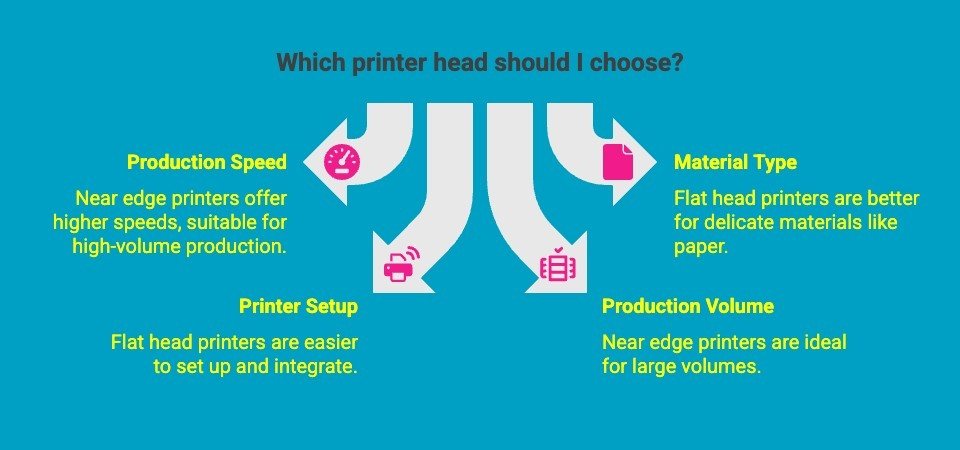
Choosing the right thermal printing technology depends on your production speed, material type, and equipment setup. Instead of comparing general features, it is often easier to decide by looking at practical thresholds in real production environments.
Use the following decision framework to determine whether flathead or near-edge printing is the better fit.
1) Production Speed Requirements
If your operation prints labels at 2 to 12 inches per second (ips), a flat head printer is typically the right choice. These printers prioritize stable print quality for barcode labels and product identification.
If your packaging line runs faster than 12 ips and can reach 20 to 40 ips, a near-edge system is usually required to maintain print clarity at higher speeds.
2) Material Type Being Printed
If you are printing on paper labels, polypropylene labels, polyester labels, or other synthetic barcode labels, flathead printers generally provide the best performance and ribbon compatibility.
If you are printing on flexible packaging films, foil packaging, or laminated packaging materials, near-edge printing systems are typically better suited for these substrates.
3) Printer Setup and Equipment Integration
If printing is done on standalone desktop or industrial label printers used in warehouse, manufacturing, or logistics environments, flathead printing is the industry standard.
If printing must occur directly inside automated packaging machines or continuous production lines, near-edge printers are often integrated into packaging equipment to print variable data during production.
4) Production Volume
For operations producing thousands of barcode labels per day, flathead printers provide reliable, cost-efficient printing.
For high-speed packaging lines producing thousands of packaged products per hour, near-edge systems are designed to keep up with continuous production.
By evaluating speed requirements, materials, and production setup, businesses can select the thermal printing technology that best fits their labeling or packaging workflow.
Choosing the right thermal label printer for industrial barcodes? The right printer can improve barcode clarity, printing durability, and labeling efficiency across manufacturing, logistics, and packaging operations.
What Applications Are Best Suited for Flat Head Printing?
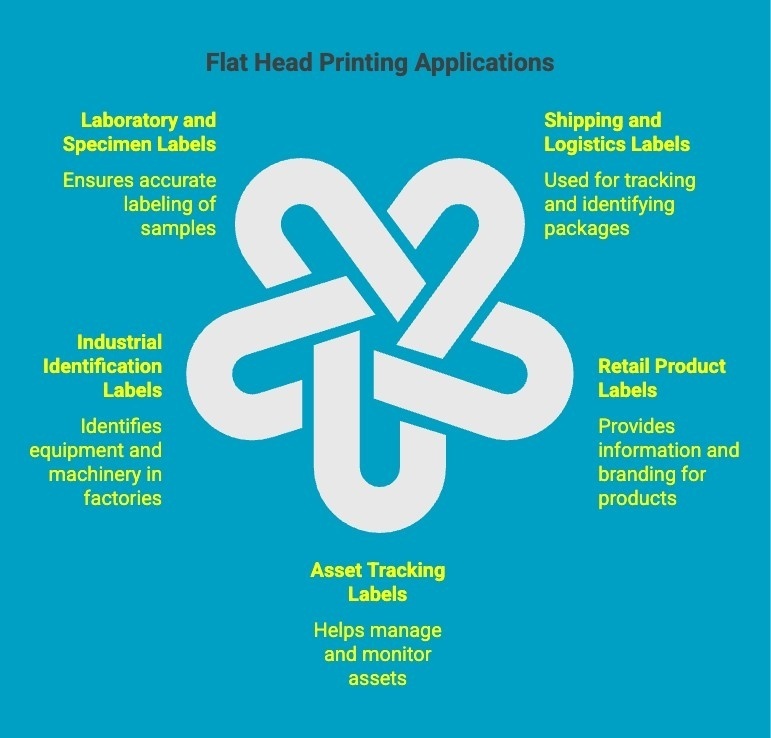
Flat head thermal printing is widely used in industries that rely on durable labels and consistent barcode readability. It works well with many label materials and printer models used in labeling environments.
Below are common applications where flat head printing performs best:
1) Shipping and Logistics Labels
Flat head printers are widely used for printing shipping labels, barcode labels, and carton labels in warehouses and distribution centers. These labels must remain readable throughout transport and scanning. Printers such as the Zebra ZT410 are commonly used in logistics operations where reliable barcode printing is essential for inventory tracking and shipping accuracy.
2) Retail Product Labels
Retail environments often rely on flat head printing for product identification labels, shelf tags, and price labels. Clear barcodes ensure products scan quickly at checkout and remain readable on store shelves. Desktop printers such as the Honeywell PC42E-T are frequently used in retail stores for daily label printing.
3) Asset Tracking Labels
Asset tracking labels help organizations monitor equipment, IT devices, tools, and company property across facilities. These labels are typically printed on durable synthetic materials such as polyester or polypropylene so they remain attached to equipment for years. Industrial printers like the SATO CL4NX Plus are commonly used for producing long-lasting asset tracking labels.
4) Industrial Identification Labels
Industrial identification labels are used on machinery, electrical components, manufacturing equipment, and compliance plates. These labels often require higher durability and resistance to chemicals, abrasion, or heat. Flathead printers paired with resin ribbons are commonly used to produce these long-lasting industrial ID labels.
5) Laboratory and Specimen Labels
Healthcare and laboratory environments use flathead printers to produce specimen labels, patient identification labels, and laboratory sample barcodes. These labels must remain readable in cold storage, refrigeration, or chemical exposure. Desktop and mid-range printers are often used to ensure accurate tracking of samples and patient records.
Flat head printing is well suited for everyday labeling applications that require reliable barcode printing, durable labels, and compatibility with a wide range of label materials.
Want to improve label visibility and organization? Color-coded thermal transfer labels help businesses quickly identify products, improve workflow efficiency, and reduce labeling errors across packaging and logistics operations.
What Applications Are Best Suited for Near Edge Printing?
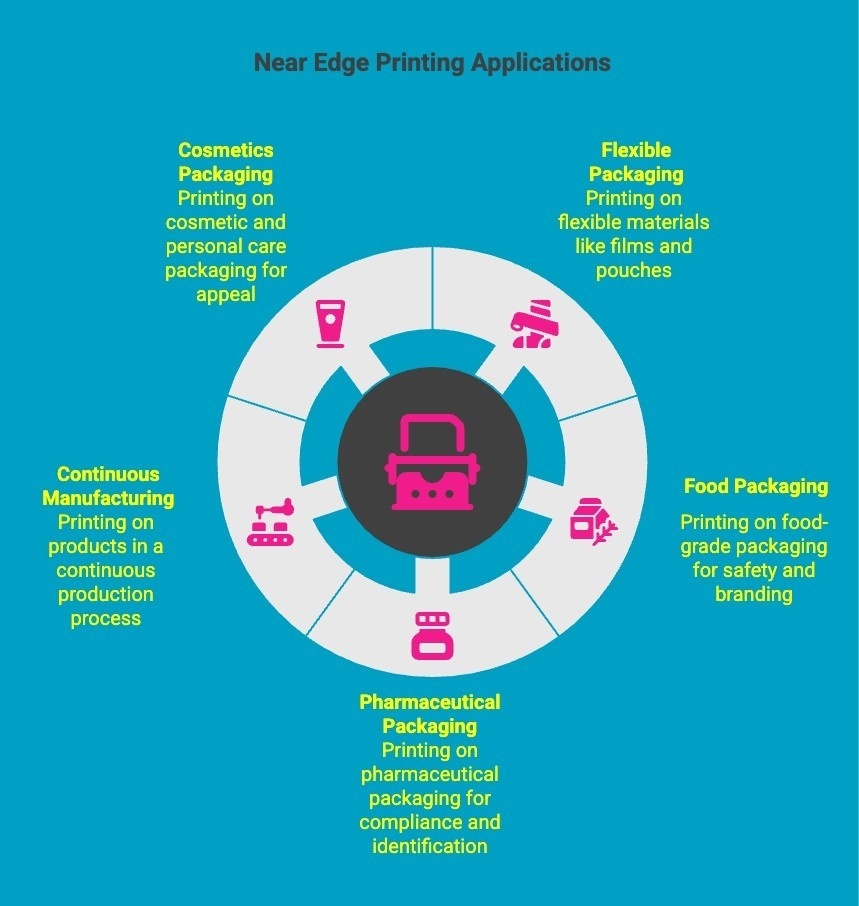
Near-edge thermal printing is designed for high-speed production environments where printing occurs directly on packaging materials during automated manufacturing. It is commonly used in systems where packaging films move continuously and variable data must be printed without slowing the line.
Here are common applications where near-edge printing performs best:
1) Flexible Packaging Printing
Near-edge printers are widely used for printing batch numbers, expiration dates, and product information on flexible packaging films. Packaging lines for snacks, frozen foods, or consumer goods often run at 15 to 30 inches per second (ips) or faster, which near-edge systems can support without interrupting production.
Industrial thermal transfer overprinting systems such as the Videojet 6330 are commonly used in flexible packaging environments because they allow manufacturers to print variable data directly on films while maintaining consistent production speeds.
2) Food Packaging Production Lines
Food manufacturers integrate near-edge printers into packaging equipment to print variable information such as date codes, lot numbers, and product identification. Many food packaging lines operate at 20 to 35 ips, requiring printing technology that keeps up with continuous packaging output.
Industrial systems like the Videojet 6330 are designed for these environments, allowing manufacturers to print variable data directly onto flexible packaging materials without slowing down production lines.
3) Pharmaceutical Packaging
Pharmaceutical packaging equipment uses near edge printing to apply expiration dates, lot numbers, and traceability information on blister packs, pouches, or flexible packaging materials. These packaging lines often run at 10 to 25 ips, where reliable variable data printing is essential for regulatory compliance.
Near edge thermal transfer printing systems are commonly used in pharmaceutical production because they can print high resolution variable data on flexible packaging films without interrupting automated packaging processes.
Manufacturers typically use near edge wax resin or resin thermal transfer ribbons to produce durable codes that remain readable throughout storage, distribution, and handling.
4) Continuous Manufacturing Lines
In automated manufacturing environments where packaging materials move continuously, near-edge printers support production speeds of 20 to 40 ips. The angled printhead design allows consistent ink transfer even as films move quickly through packaging equipment.
Industrial printers like the Videojet 6330 are commonly integrated into these automated production systems because they can maintain print clarity while supporting high speed packaging workflows.
5) Cosmetics and Personal Care Packaging
Cosmetics and personal care manufacturers frequently print lot numbers, manufacturing dates, and batch codes on flexible tubes, sachets, and film packaging. Production lines for items such as shampoos, skincare products, and single use cosmetic packets often operate between 15 and 30 ips, making near-edge printing well suited for these applications.
Near-edge printing systems help maintain consistent coding on flexible packaging materials while supporting high speed cosmetic packaging processes.
What Are the Ribbon Compatibility Differences Between Near Edge and Flat Head Printers?
Thermal transfer ribbons are specifically designed to match the printing mechanics of either near-edge or flathead printers. Because the printhead position and ribbon movement differ between these technologies, using the correct ribbon formulation is essential for maintaining print quality and protecting the printhead.
Below is a comparison of ribbon compatibility differences between near-edge and flathead printers:
|
Feature |
Near Edge Ribbons |
Flat Head Ribbons |
|---|---|---|
|
Printing Technology |
Designed for near edge thermal printing |
Designed for flat head thermal printing |
|
Ink Release Speed |
Faster ink release for high speed printing |
Standard ink transfer for consistent label printing |
|
Printer Compatibility |
Used with near edge printers like Markem or Videojet |
Used with flat head printers such as Zebra or Toshiba |
|
Common Applications |
Flexible packaging and production lines |
Barcode labels, shipping labels, product labels |
|
Ribbon Formulation |
Specialized coating for rapid transfer |
Wax, wax resin, or resin formulations |
|
Ribbon Back-Coating |
High durability back-coating designed to reduce friction and protect the printhead at high speeds |
Standard back-coating designed for steady label printing and longer printhead life |
Using the correct ribbon type ensures reliable printing performance and prevents issues such as poor print quality, ribbon breakage, or excessive wear on the thermal printhead.
What Are the Common Mistakes When Choosing Between Near Edge and Flat Head Printing?
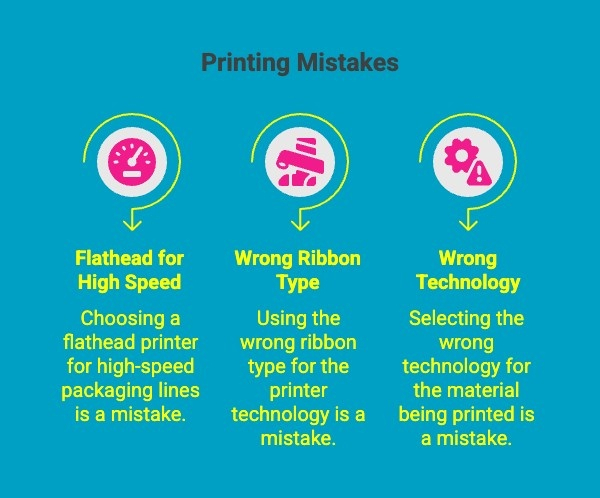
Selecting the wrong thermal printing technology can lead to printing problems, equipment damage, or costly production disruptions. Many buyers focus only on printer specifications without considering how the technology fits their actual production environment.
Below are three of the most common and costly mistakes businesses make when choosing between near-edge and flathead printing.
1) Choosing a Flathead Printer for High-Speed Packaging Lines
Flat head printers are designed for label printing speeds that typically range from 2 to 12 inches per second (ips). When they are used in high-speed packaging lines operating above this range, print quality often degrades and ribbons may wrinkle or break.
Correct decision: Packaging systems running 15 ips or faster usually require near-edge printing technology, which is designed for high-speed continuous production.
2) Using the Wrong Ribbon Type for the Printer Technology
Near-edge and flat-head printers require different ribbon formulations. Using a flathead ribbon in a near-edge printer, or vice versa, can cause poor ink transfer, faded barcodes, or ribbon breakage.
In some cases, incorrect ribbon selection can also increase printhead wear due to improper back coating and heat transfer characteristics.
Correct decision: Always match the ribbon type to the printer technology. Near-edge printers require near-edge ribbons, while flathead printers use standard wax, wax resin, or resin ribbons.
3) Selecting the Wrong Technology for the Material Being Printed
Flathead printers perform best on paper labels and synthetic barcode labels, while near-edge printers are designed for flexible packaging films and continuous packaging materials.
Using the wrong technology can result in smudged prints, inconsistent ink transfer, or reduced barcode readability, especially when printing on films.
Correct decision:
-
Use flat head printing for labels and barcode applications.
-
Use near-edge printing for flexible packaging and automated packaging lines.
Avoiding these mistakes helps businesses select the correct printing system, maintain consistent print quality, and prevent unnecessary equipment or consumable costs.
Where Can You Buy Thermal Printheads for Near Edge and Flat Head Printers?
Businesses looking for replacement thermal printheads can find compatible options from specialized suppliers that support different printer technologies. Selecting the right printhead helps maintain print quality, extend operational time, and ensure consistent performance across various substrate materials used in labeling and packaging.
DuraFast Label Company supplies thermal printer printheads and spare parts compatible with many major printer brands used in labeling systems. Their product selection supports both near-edge and flathead print heads commonly used in desktop printers and industrial printing environments.
Available options include:
1) Printheads
2) Thermal Transfer Ribbon Options
3) Brand Compatible Ribbon Categories
These replacement printheads help maintain reliable printing performance, support faster print speeds, and improve cost efficiency in labeling and packaging operations. Businesses can also request free ribbon samples to test compatibility with their printer and label materials before placing a larger order.
Conclusion
Near-edge and flat-head thermal printing technologies are designed for different production environments. Flat head printing is commonly used for barcode labels and product identification where a lot of print definition is required and ink from the carbon ribbon transfers consistently through controlled generation of heat.
Near-edge printing places the printhead near the edge of the printhead, enabling a more efficient way to print during high-speed packaging lines and supporting the maximum number of products moving through production. Understanding these differences helps businesses choose the most reliable printing solution.
Frequently Asked Questions
What is the main difference between near edge and flat head printing?
The main difference is the position of the thermal print head. Flat head printers keep the heated print head in a horizontal position against the ribbon and label, producing high print quality at slower print speeds on materials such as thermal paper.
Are near edge print heads flat?
No, near edge printheads are not flat. The heated thermal print head sits near the corner edge of the platen roller rather than across the surface. This design transfers heat across a short distance, helping create the desired image with clear serial numbers.
Is near edge printing better than flat head printing?
Neither technology is universally better because both serve different needs. Flat head printing is the standard form of printing for labels and provides high print quality for small fonts, while near edge printing supports faster packaging production environments.
Can I use the same ribbon for near edge and flat head printers?
No. Near edge printers require ribbons with a specialized release layer designed for faster ink transfer. Using standard ribbons can increase print head wear, create ink residue, and reduce print quality due to differences in ribbon usage and media thickness.
Which printer type is best for packaging applications?
Near edge printers are often used in packaging industries such as the beverage industry and other sectors producing consumer products. Their heating elements apply heat to specific areas, producing clear batch codes during high speed packaging operations.
Can I swap a flat head printhead for a near edge printhead in my printer?
No. A thermal print head designed for flat head printing will not work correctly in near edge printers. Differences in mounting design, ribbon path alignment, and electrical signals prevent compatibility between these two printing technologies.
Can I use the same thermal transfer ribbons for both near edge and flat head printers?
No, thermal transfer ribbons are designed for either near edge or flat head printers. Using the wrong ribbon can reduce print quality and increase print head wear due to differences in ribbon formulation and printing mechanics.