Which Network Label Printer Performs Best?
14th Jul 2026
Key Highlights
-
Efficient network cable labeling reduces errors, prevents accidental disconnects, and improves reliability in complex environments through consistent label printing.
-
Using a dedicated network label printer with a reliable print head ensures readable labels that speed up troubleshooting and routine maintenance.
-
Labeling both ends of cables supports faster identification without tracing runs, improving workflow efficiency during upgrades or repairs.
-
Clear text, standardized naming, proper sizing, and support for barcode labels reduce confusion in dense racks and cabinets.
-
Durable materials used in a thermal transfer printer protect labels from heat, moisture, and handling for long-term accuracy.
-
Seamless integration with existing systems helps maintain professional, audit-ready network documentation over time.
Network cable labeling is often overlooked until confusion, downtime, or costly mistakes occur. When cables are poorly identified or inconsistently labeled, even simple maintenance tasks become time-consuming and risky.
As networks grow more complex, the need for clear, durable, and standardized labeling becomes critical. Without a reliable system, technicians waste valuable time tracing cables, increasing the chance of errors and service interruptions.
This blog explains why efficient network cable labeling matters and outlines practical methods, tools, and best practices to keep network infrastructure organized, reliable, and easy to manage.
What Are the Main Benefits of Using a Network Label Printer?
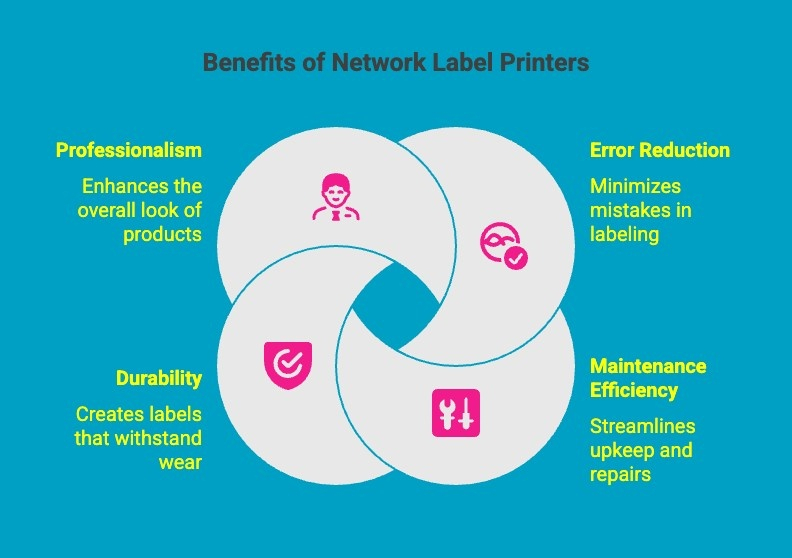
Clear network labeling reduces downtime, prevents costly mistakes, and keeps infrastructure organized as systems grow. Consistent, readable identification supports daily operations and emergencies, especially when teams rely on a network cable label printer for accuracy and consistency.
Here are the main benefits of using a dedicated network label printer in professional environments:
1) Fewer Errors and Mix-Ups
A network label printer ensures every cable, port, and rack is clearly and consistently identified. Using a network label printer custom label setup allows standardized templates that remove guesswork, reduce human error, and prevent accidental disconnections. Technicians can trace connections accurately, which is critical in dense network environments where even minor mistakes can lead to outages.
2) Faster Maintenance
Clear, durable labels speed up troubleshooting and routine maintenance. With a network thermal label printer, technicians spend less time tracing cables and more time resolving issues. During upgrades or repairs, accurate labels allow quick identification of devices and ports, reducing downtime and helping teams work efficiently under tight timelines.
3) Long-Lasting Labels
Network label printers create labels built to withstand heat, moisture, abrasion, and frequent handling. Thermal printing technology ensures labels remain legible over time. Long-lasting labels support reliable identification throughout the network lifecycle, even as systems expand, move, or change.
4) Professional Appearance
Consistent, high-quality labels give network installations a clean, professional appearance. This matters during audits, inspections, and client visits. A well-labeled network reflects strong documentation practices, attention to detail, and long-term planning, reinforcing confidence in how the infrastructure is managed.
Using a network label printer improves accuracy, efficiency, durability, and the overall professionalism of any network environment.
How Can You Label Network Cables More Efficiently?
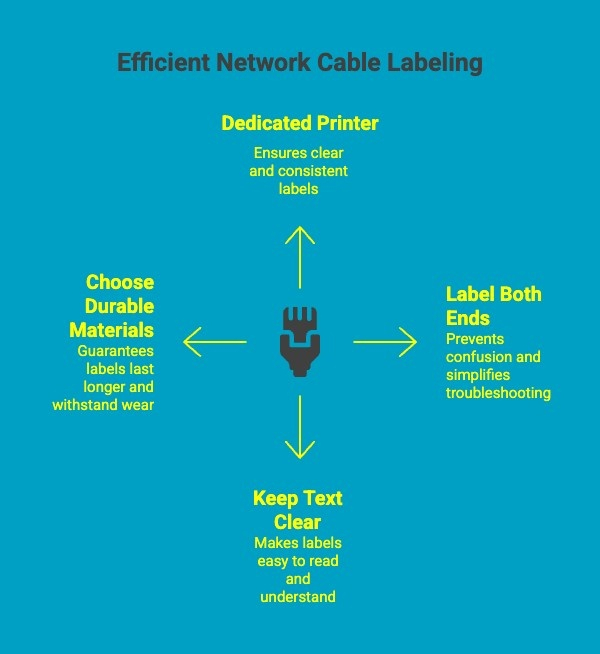
Efficient network cable labeling reduces confusion, speeds up troubleshooting, and supports long-term network reliability. Without a clear system, even small changes can create delays, especially in growing environments that depend on accurate identification.
Below are practical ways to label network cables more efficiently in any environment:
1) Use a Dedicated Printer
A dedicated network wire label printer produces consistent, readable labels designed specifically for cables. It eliminates handwritten errors and uneven formatting. When selecting the best label printer for network cables, look for built-in templates, precise sizing, and support for both small identifiers and network label printer large label formats used on racks or panels.
2) Label Both Ends
Labeling both ends of every network cable prevents guesswork during troubleshooting or reconfiguration. When cables run through racks, ceilings, or walls, dual-end labeling allows instant identification without tracing the entire run. This saves time, reduces mistakes, and improves confidence in complex or high-density networks.
3) Keep Text Clear
Clear, concise text improves readability and reduces misinterpretation. Use simple naming conventions, consistent abbreviations, and adequate font size. Avoid overcrowding labels with unnecessary details. A properly configured network wire label printer helps ensure text remains legible at a glance, even in tightly packed installations.
4) Choose Durable Materials
Durable labeling materials protect text from fading, smudging, or peeling over time. Network environments often involve heat, dust, and frequent handling. Using materials designed for cables ensures labels stay intact and readable, reducing relabeling and helping large-scale networks remain organized.
Efficient cable labeling combines the right printer, clear standards, and durable materials to keep networks organized, reliable, and easy to manage over time.
What Label Types Work Best for Network Cable Marking?
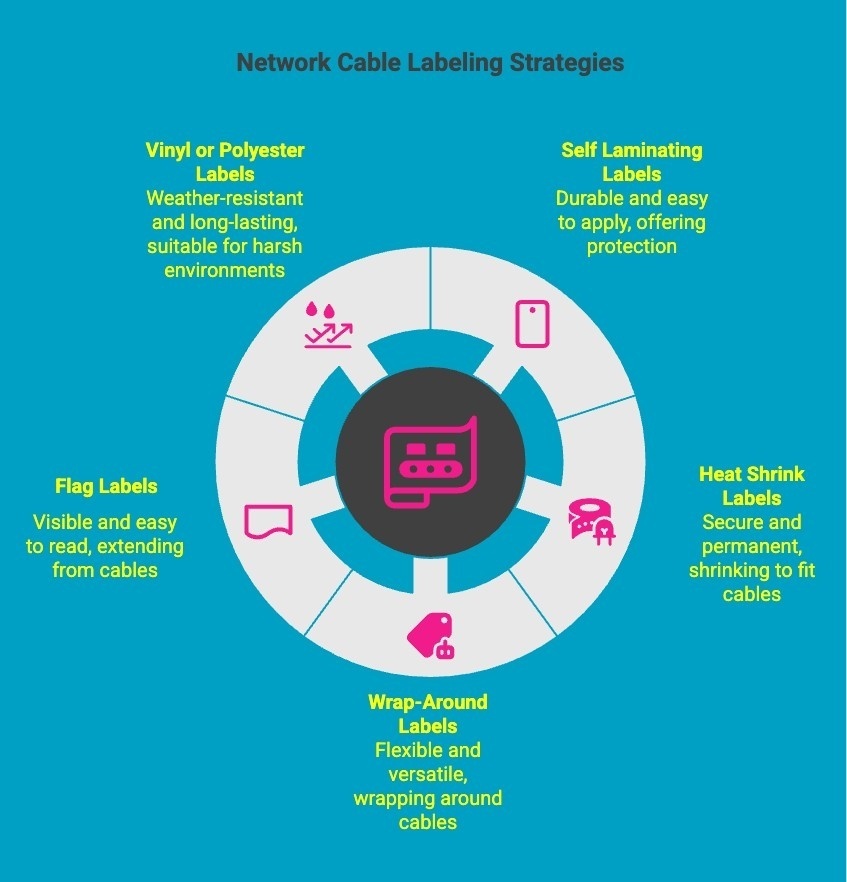
Choosing the right label type is essential for clear, reliable network cable identification. Different environments and cable sizes require different solutions.
Below are the label types that work best for network cable marking and why each one is effective:
1) Self Laminating Labels
Self laminating labels are one of the most popular choices for network cables. The printed area is protected by a clear laminate layer that wraps over the text. This shields information from moisture, abrasion, and handling, making labels easy to read long-term in busy network closets and data centers.
2) Heat Shrink Labels
Heat shrink labels provide a permanent, professional solution for cable identification. Once applied and heated, the label shrinks tightly around the cable, creating a clean, secure finish. These labels are highly resistant to wear, chemicals, and temperature changes, making them ideal for industrial networks and permanent installations.
3) Wrap-Around Labels
Wrap-around labels are flexible and easy to apply without disconnecting cables. They wrap fully around the cable surface, offering good visibility from multiple angles. This label type works well for retrofits, patch cords, and environments where cables are frequently moved or replaced but still require clear identification.
4) Flag Labels
Flag labels extend outward from the cable, creating a visible marker that is easy to read without rotating the cable. They are especially useful in tight spaces or dense racks where cable surfaces are hard to see. Flag labels work best when additional information or quick visual identification is required.
5) Vinyl or Polyester Labels
Vinyl and polyester labels are durable options designed to handle heat, moisture, and frequent handling. Polyester offers higher resistance and longevity, while vinyl provides flexibility for curved surfaces. Both materials are commonly used in network environments where long-lasting, smudge-resistant labels are essential for reliable cable marking.
Selecting the right label type improves readability, durability, and efficiency, helping keep network cables organized, traceable, and easy to manage over time.
How Do You Choose the Right Label Size for Network Cables?
Choosing the right label size ensures network cable information stays readable without interfering with cable routing or performance. Labels that are too large or too small create problems later.
Below are practical steps to select the correct label size for network cables:
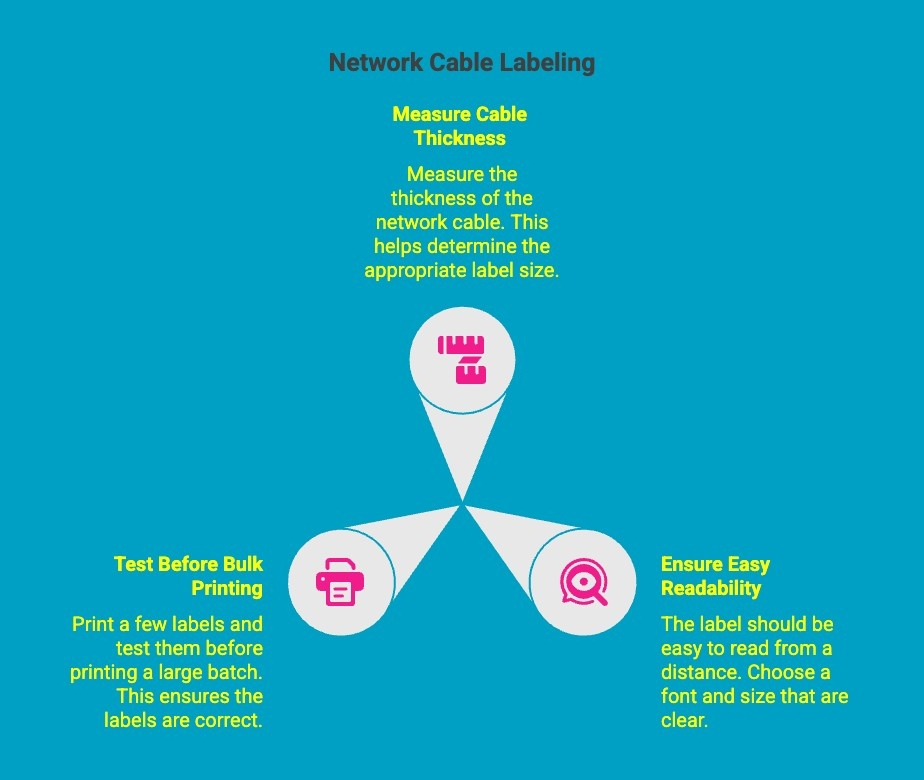
1) Measure Cable Thickness
Start by measuring the cable diameter, including insulation and any outer jacket. Different cables like Cat5e, Cat6, and fiber vary in thickness. The label must wrap securely without overlapping excessively or slipping. Accurate measurement helps you select a label width and wrap length that fits snugly and stays in place over time.
2) Ensure Easy Readability
The label size should allow text to be read at a glance without rotating the cable excessively. Choose a size that supports clear font spacing and sufficient character height. Overcrowded text reduces readability, especially in dense racks. A properly sized label balances a compact fit with enough surface area for clear, legible identification.
3) Test Before Bulk Printing
Before printing labels in large quantities, test a few samples on actual cables. Check fit, adhesion, and readability after installation. Verify that the label does not curl, peel, or obscure text once applied. Testing prevents wasted materials and ensures consistency across the entire network labeling project.
The right label size improves clarity, durability, and efficiency, making network cables easier to identify, maintain, and manage long term.
Why Are MAX Letatwin Printers Ideal for Network Cable Labeling?
Accurate network cable labeling requires printers built for durability, consistency, and professional results. General label makers often fall short in demanding environments.
Below are the key reasons why MAX Letatwin printers are ideal for reliable network cable labeling:
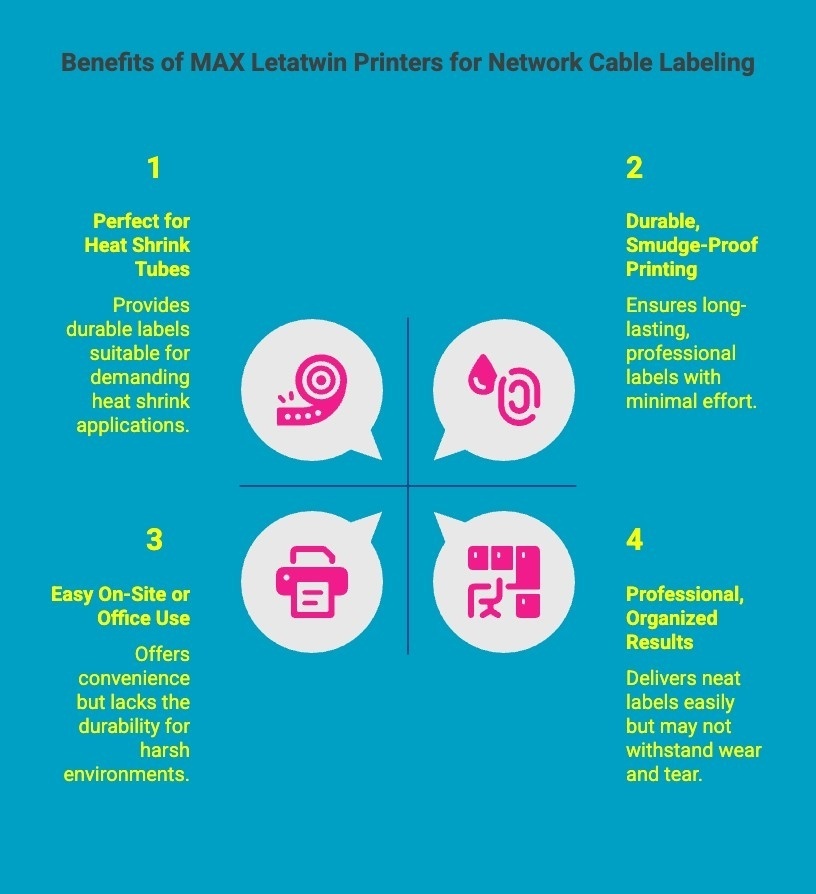
1) Perfect for Heat Shrink Tubes
MAX Letatwin printers are purpose-built for heat shrink tube labeling, which is essential for long-term network cable identification. The system prints crisp, centered text that remains readable after shrinking. This ensures a tight, professional fit around cables, preventing rotation, peeling, or fading in high-density network environments.
2) Durable, Smudge-Proof Printing
MAX Letatwin printers use high-quality thermal transfer printing that resists smudging, abrasion, and environmental exposure. Labels remain legible even after frequent handling, temperature changes, or routine maintenance. This durability is critical for network closets, data centers, and industrial settings where clear identification must last for years without reprinting.
3) Professional, Organized Results
Consistent formatting and precise alignment give MAX Letatwin labels a clean, professional appearance. Uniform text size and spacing improve readability and reduce errors during troubleshooting. Well-organized labeling reflects strong documentation practices and makes networks easier to manage, audit, and expand as infrastructure grows.
4) Easy On-Site or Office Use
MAX Letatwin printers are designed for both on-site and office-based workflows. Simple operation, fast setup, and reliable output allow technicians to label cables during installation or retrofits without slowing work. This flexibility supports efficient labeling whether you are preparing cables in advance or labeling directly at the rack.
DuraFast Label Company offers MAX Letatwin printers, compatible heat shrink tubes, and expert guidance for network labeling projects. Their team helps you select the right printer, supplies, and accessories to match your application, ensuring dependable results and long-term labeling success.
MAX Letatwin printers deliver durability, precision, and professional results for network cable labeling. For expert support and the right labeling solution, contact DuraFast Label Company today to get started with confidence.
Conclusion
MAX Letatwin printers stand out as a dependable solution for network cable labeling because they combine precision, durability, and ease of use. As a thermal label printer, they produce consistent, smudge-proof cable labels that remain readable in demanding network environments. This reliability reduces errors, speeds up maintenance, and supports better documentation across growing infrastructures. With professional-grade output and long-lasting performance, these printers help teams maintain organized, clearly identified networks. Investing in the right labeling equipment improves efficiency, reduces downtime, and builds confidence in every network cable labeling project.
Frequently Asked Questions
What features should I look for in a network label printer for cable management?
Choose a printer that supports durable industrial label options, offers Ethernet and Wi-Fi connectivity, prints clear barcodes, uses intuitive software, and meets energy efficiency or Energy Star standards for reliable, long-term cable management.
How does a network label printer differ from a regular label maker?
A network label printer connects through Ethernet or Wi-Fi for shared use and higher workloads. A regular label maker is limited to single-device use and is designed for lighter, more specific needs.
What types of labels can a network label printer make for rack and cable identification?
Network label printers can produce industrial label formats such as heat shrink tubing, wrap-around cable labels, flag labels, polyester labels, and barcodes. Some models also support food labels for cross-department use.
Is it better to connect a label printer via Ethernet or Wi-Fi?
Ethernet is better for stable, high-volume printing and energy efficiency in fixed locations. Wi-Fi offers flexibility for mobile setups or evolving workflows based on layout and specific needs.
Where can I buy a network label printer online?
You can buy network label printers from industrial suppliers, IT hardware retailers, and authorized manufacturer stores online. Reputable sellers offer warranty support, documentation, and guidance for matching printers to specific needs.
How do I set up a network label printer on a LAN?
Connect the printer via Ethernet or Wi-Fi, configure network settings, assign an IP address, and install drivers. Proper setup ensures stable sharing, efficient printing, and compliance with energy efficiency requirements.