What Is Snack Packaging and How Is Information Printed on Flexible Snack Packs?
28th Jul 2026
Key Highlights
-
Snack packaging uses flexible films to protect products from moisture and oxygen while supporting branding, regulatory labeling, and nitrogen flushing for freshness.
-
Common snack bag formats include pillow bags, stand-up pouches, flow-wrap packs, sachets, and gusseted bags, each using specific film laminates such as OPP, BOPP, PET/PE, or metallized structures.
-
Production lines rely on automated equipment such as VFFS machines, flow wrappers, multihead weighers, coding printers, and checkweighers, typically running 60-600+ packs per minute.
-
Printed information on snack packs includes expiry dates, batch numbers, barcodes, timestamps, and traceability codes applied directly to flexible films.
-
Major printing technologies include TTO, CIJ, laser, TIJ, and label applicators, with TTO widely used for high-speed flexible film coding up to 400-600 mm/sec.
-
Near-edge TTO printing supports high-speed packaging by enabling fast ribbon separation, durable prints, and reliable barcode readability on laminated snack films.
-
Print quality issues such as ribbon wrinkling, poor adhesion, and film movement during nitrogen flushing can disrupt production and require proper ribbon selection, printer calibration, and line maintenance.
Snack packaging plays a critical role in protecting food products, extending shelf life, and communicating essential product information to consumers. Whether it's potato chips, granola bars, nuts, or baked snacks, flexible packaging must be durable, attractive, and compatible with high-speed production lines.
Beyond design and branding, snack packaging also requires accurate printing of variable data, such as expiry dates, batch numbers, and production codes.
This guide explains what snack packaging is, the equipment used in production, and how printing technologies, especially near-edge thermal printing, enable efficient coding on flexible snack packs.
What Is Snack Packaging and Why Does It Require Specialized Coding?
Snack packaging refers to the specialized materials and formats designed to contain, protect, and present snack foods throughout the supply chain, from the manufacturing plant to the retail shelf. Because snacks are often highly sensitive to external conditions, this packaging is critical to maintaining product integrity.
The primary functions of modern snack packaging include:
-
Environmental Barrier: Protecting the product from moisture, oxygen, and contaminants that compromise freshness and flavor.
-
Shelf Life Extension: Using sophisticated laminated materials to keep contents stable for months.
-
Branding and Compliance: Providing high-visibility real estate for marketing, nutritional facts, and mandatory batch/expiry coding.
-
Logistics Support: Offering lightweight, durable protection that stands up to automated high-speed filling lines and transportation stress.
-
Modified Atmosphere Preservation (MAP): Many snack packages are flushed with nitrogen or controlled gas mixtures to reduce oxygen levels inside the bag. This modified atmosphere packaging (MAP) helps prevent oxidation, maintain crispness, and significantly extend product freshness during distribution and retail storage.
By combining barrier protection, atmosphere control, and clear labeling, effective snack packaging ensures products remain fresh, compliant, and visually appealing from the production line to the retail shelf.
Learn how to choose the best label printer for your small business in this detailed guide.
What Are the Most Common Types of Snack Packaging Bags?
Snack food manufacturers prioritize high-speed packaging that balances product protection with shelf appeal. Selecting the right bag format is vital for keeping items fresh while ensuring they stand out to consumers in a crowded retail environment.
Here are the most common flexible packaging formats used in the snack industry:
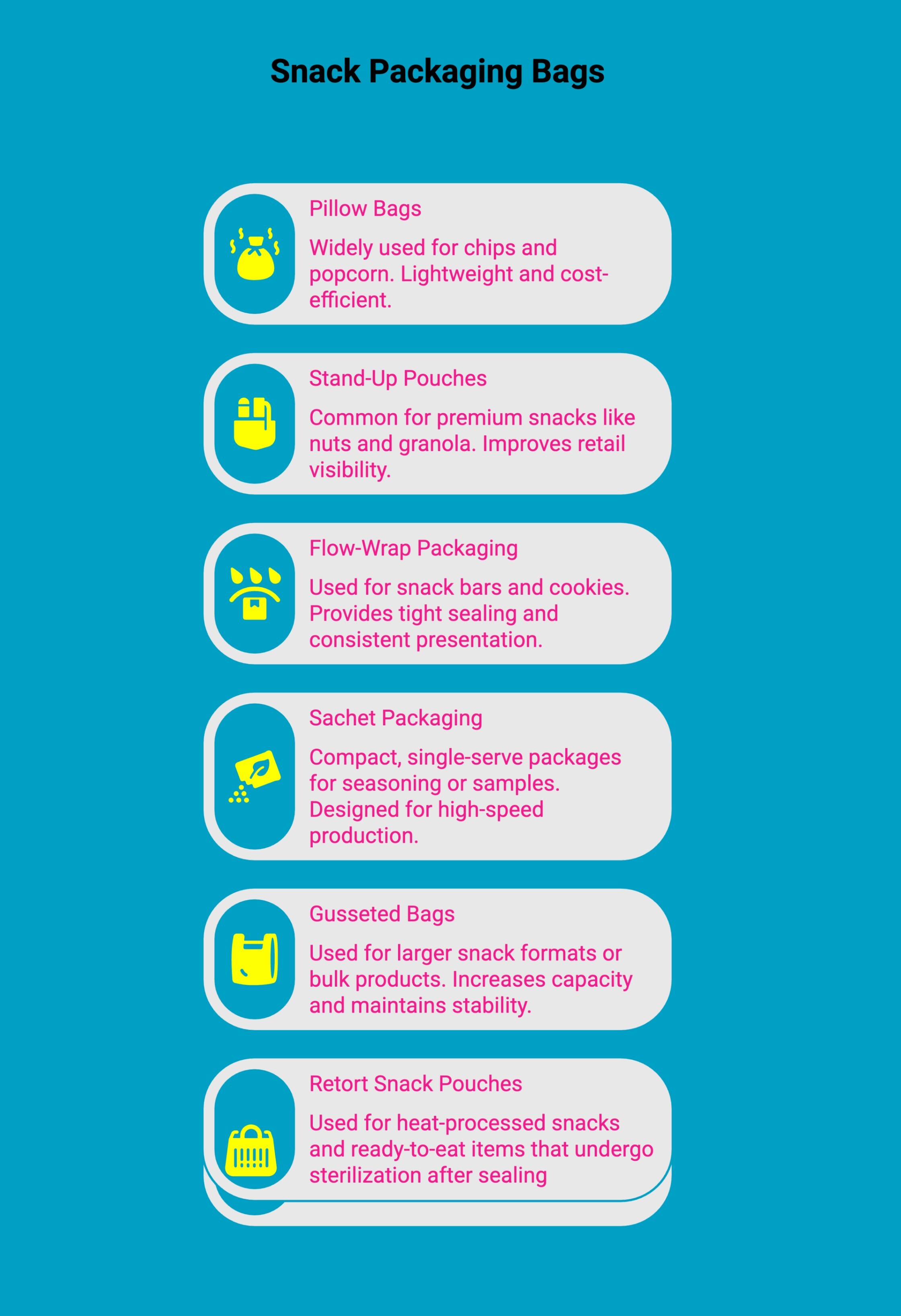
1. Pillow Bags
The most widely used format for chips, popcorn, and extruded snacks. Pillow bags are lightweight, cost-efficient, and designed for vertical form-fill-seal (VFFS) lines that produce large volumes quickly. Their flat front and back panels also provide ample branding space for graphics and product information.
Typical film substrate: Oriented Polypropylene (OPP), BOPP, or laminated OPP/CPP structures, often with metallized layers for oxygen and moisture barrier.
2. Stand-Up Pouches
Stand-up pouches, often called Doypacks, are common for premium snacks such as nuts, granola, trail mix, and health-focused products. Their bottom gusset allows the pouch to stand upright on shelves, improving retail visibility and making them ideal for resealable zipper closures.
Typical film substrate: PET/PE laminates, metallized PET laminates, or multi-layer barrier films designed to protect against moisture and oxygen.
3. Flow-Wrap Packaging
Flow-wrap packaging is typically used for individually wrapped snack bars, cookies, and baked goods. Products are wrapped horizontally in a continuous motion before the film is sealed and cut into individual packages. This format provides tight sealing and consistent presentation.
Typical film substrate: BOPP, metallized BOPP, or laminated OPP films that support high-speed horizontal wrapping and strong seal performance.
4. Sachet Packaging
Sachets are compact, single-serve packages used for seasoning packets, small snack portions, or promotional samples. These formats are designed for extremely high-speed production and minimal material usage.
Typical film substrate: PET/PE laminates, aluminum foil laminates, or multilayer barrier films for enhanced shelf-life protection.
5. Gusseted Bags
Gusseted bags are used for larger snack formats or bulk products such as family-size chips, nuts, or snack mixes. Side or bottom gussets allow the package to expand, increasing capacity while maintaining structural stability during shipping and retail display.
Typical film substrate: Laminated structures such as PET/PE, OPP/CPP, or metallized multilayer films that provide durability and barrier protection.
6. Retort Snack Pouches
Retort pouches are designed for heat-processed snacks and ready-to-eat items that undergo sterilization after sealing. These packages must withstand high-temperature retort processing while maintaining seal integrity and preserving printed codes.
Typical film substrate: Multi-layer retort laminates such as PET/Aluminum Foil/CPP or PET/Nylon/CPP, which provide strong barrier protection and thermal stability.
Format-to-Ribbon Quick Reference
Because different packaging films interact differently with thermal transfer printing systems, selecting the correct ribbon formulation is critical for print clarity and adhesion.
|
Bag Format |
Typical Film |
Recommended Ribbon Type |
|---|---|---|
|
Pillow Bags |
OPP, BOPP, metallized OPP laminates |
Near-edge wax/resin or resin ribbon |
|
Stand-up Pouches |
PET/PE laminates, metallized PET |
Near-edge resin ribbon for strong adhesion |
|
Flow-wrap Packaging |
BOPP or metallized BOPP films |
Near-edge wax/resin ribbon |
|
Sachet Packaging |
PET/PE laminates, foil laminates |
Near-edge resin ribbon for durability |
|
Gusseted Bags |
PET/PE or multilayer laminated films |
Near-edge wax/resin or resin ribbon |
|
Retort Snack Pouches |
PET/Aluminum/CPP or PET/Nylon/CPP multilayer laminates |
Near-edge high-performance resin ribbon |
Before selecting ribbons for your packaging line, identify the exact film structure used for each bag format, then test ribbon compatibility at your actual production speeds to confirm adhesion, smudge resistance, and barcode readability.
Discover how thermal transfer printing supports flexible labeling across packaging, electronics, chemicals, and industrial applications in this in-depth guide.
What Types of Snack Food Packaging Equipment Are Essential for Production?
Snack packaging lines rely on highly automated systems to maintain throughput and product integrity. These machines are engineered to handle delicate films while ensuring precise fills, tight seals, and accurate, high-speed coding for every unit.
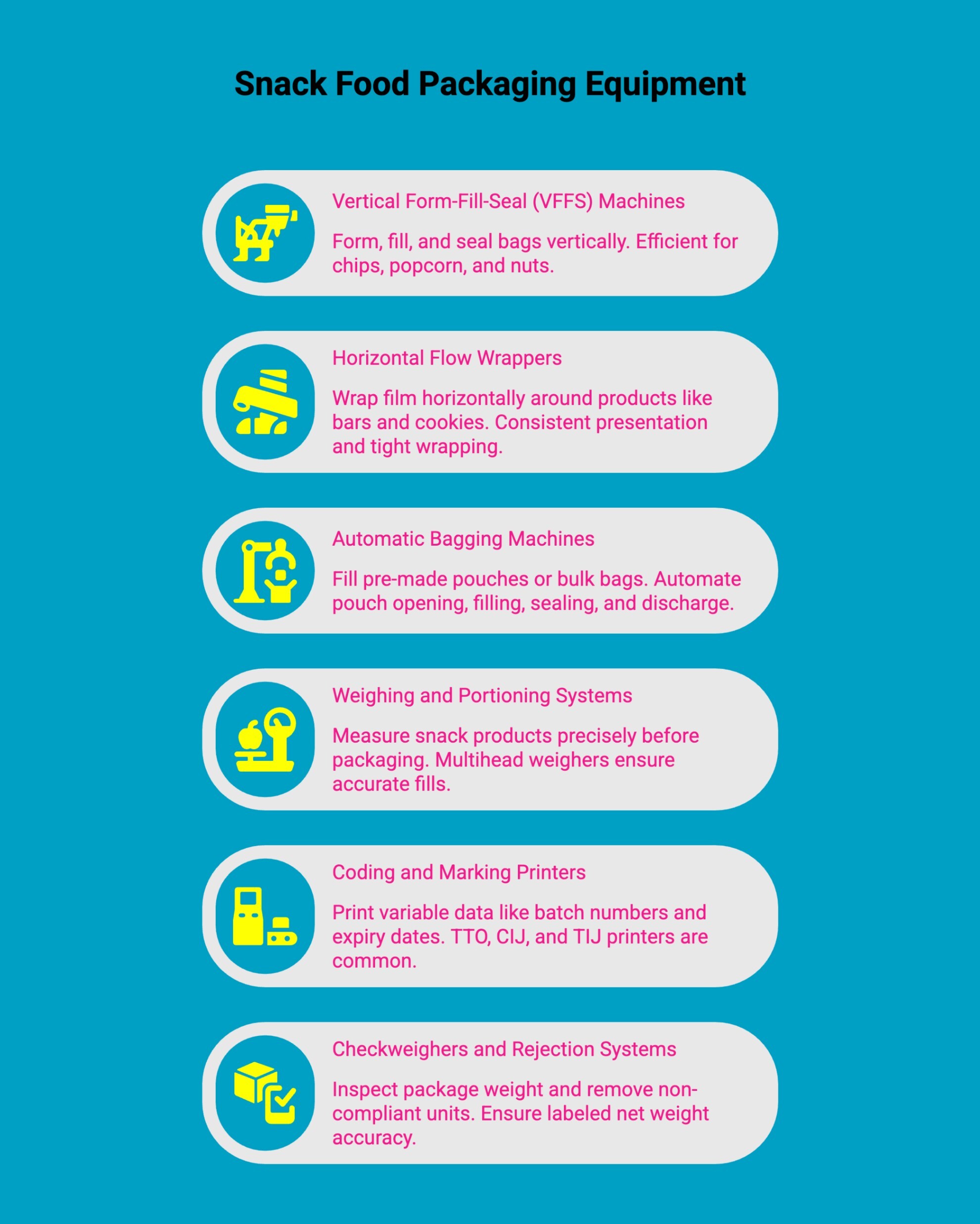
1. Vertical Form-Fill-Seal (VFFS) Machines
These machines form bags from a roll of flexible film, fill them with product, and seal them in a continuous vertical process. VFFS systems are the backbone of many snack packaging lines because they combine forming, filling, and sealing into a single automated step, making them highly efficient for products like chips, popcorn, and nuts.
Typical speed: ~60–200 bags per minute, depending on bag size and product type.
Why it matters for compliance: Proper bag formation and sealing help maintain product freshness and prevent contamination, which supports food safety programs such as HACCP and other packaging hygiene regulations.
2. Horizontal Flow Wrappers
Flow wrappers package products such as snack bars, cookies, and baked goods by wrapping film horizontally around each item before sealing it. This packaging style works well for individually wrapped snacks and multi-pack configurations that require tight wrapping and consistent presentation.
Typical speed: ~150–600 packs per minute, depending on product shape and wrapper configuration.
Why it matters for compliance: Consistent wrapping and sealing protect the product from moisture, contamination, and oxygen exposure, which helps maintain shelf life and meet food safety packaging standards.
3. Automatic Bagging Machines
Automatic bagging machines fill pre-made pouches or larger bulk-format bags, often used for family-size snack packaging. These systems automate pouch opening, product filling, sealing, and discharge to minimize manual handling.
Typical speed: ~30–80 bags per minute, depending on pouch style and fill volume.
Why it matters for compliance: Reduced manual contact during filling helps maintain hygienic processing conditions required by modern food manufacturing regulations.
4. Weighing and Portioning Systems
Multihead weighers and portioning systems measure snack products precisely before packaging. They distribute product across multiple weigh buckets to achieve accurate fills while maintaining high throughput.
Typical speed: ~60–200 weigh cycles per minute, depending on product flow characteristics.
Why it matters for compliance: Food labeling regulations require packages to meet declared net weight claims, so accurate portioning prevents underfilling violations and protects manufacturers from regulatory penalties.
5. Coding and Marking Printers
Coding systems such as Thermal Transfer Overprinters (TTO), Continuous Inkjet (CIJ), or Thermal Inkjet (TIJ) print variable data directly onto the packaging. This information typically includes batch numbers, manufacturing dates, expiry dates, and barcodes.
Typical speed: TTO systems typically support 400–600 mm/sec, while CIJ and laser systems can handle 800+ products per minute, depending on the packaging line setup.
Why it matters for compliance: Food safety regulations require clear product identification and traceability, making accurate coding essential for recalls, supply chain tracking, and retail scanning.
6. Checkweighers and Rejection Systems
Checkweighers inspect the weight of every finished package after sealing. Units that fall outside acceptable tolerance ranges are automatically removed from the line using rejection mechanisms such as pushers, air blasts, or diverter arms.
Typical speed: ~150–400+ packs per minute, depending on conveyor configuration and product size.
Why it matters for compliance: Many regulatory frameworks require manufacturers to verify packaged product weights, ensuring labeled net weight accuracy and preventing non-compliant products from reaching distribution or retail shelves.
Together, these machines form a fully integrated packaging ecosystem that enables snack manufacturers to maintain high production speeds while meeting strict food safety, labeling, and traceability requirements.
Explore how labeling evolved from traditional printing methods to modern digital and AI-driven smart labeling technologies in this comprehensive guide.
Why System Integration Matters?
These systems often operate at speeds exceeding hundreds of units per minute. Because the coding and marking printers are integrated directly into the line, they must be perfectly calibrated with the packaging film and the correct near-edge thermal transfer ribbon to prevent bottlenecks, coding errors, or ribbon wrinkles during high-speed operation.
Snack packaging must include specific information to meet regulatory and operational requirements.
Common printed elements include:
-
Expiry dates
-
Batch or lot numbers
-
Manufacturing codes
-
Barcodes and QR codes
-
Production timestamps
-
Promotional or traceability codes
Because packaging materials are often flexible films, printers must produce clear, durable marks without damaging the material.
Which Printing Technologies Are Best Suited for Flexible Snack Packaging?
In high-speed snack production, selecting the right coding technology is essential for ensuring that expiry dates, batch codes, and barcodes remain legible and durable. Different environments and materials require specific hardware to maintain efficiency and compliance.
Common printing and coding solutions include:
-
Thermal Transfer Overprinters (TTO): The industry gold standard for flexible films. TTO printers use a high-precision thermal printhead to melt specialized ink from a ribbon directly onto the film, ensuring sharp, high-resolution, and smudge-proof codes.
-
Continuous Inkjet (CIJ): Uses a pressurized ink stream to print codes without contact; often used for high-speed lines where the substrate may be uneven.
-
Laser Coding Systems: Provides a permanent "burn" onto the packaging film; ideal for environments where high-speed ink drying or ribbon management is not desired.
-
Label Applicators: Used when pre-printed pressure-sensitive labels are required instead of direct coding on the film.
-
Thermal Inkjet (TIJ): Uses disposable ink cartridges with integrated printheads to eject microscopic droplets of ink onto the packaging surface. TIJ systems are compact, easy to maintain, and ideal for high-resolution coding (typically up to 600 dpi) on cartons, labels, and some treated flexible films.
The table below compares the most common options used in snack production environments.
|
Technology |
Best Snack Application |
Max Speed |
Ongoing Cost |
Contact with Film? |
|---|---|---|---|---|
|
Thermal Transfer Overprinter (TTO) |
Flexible films such as OPP, PE, and laminated snack packaging are ideal for printing expiry dates and batch codes on form-fill-seal lines |
Up to 600 mm/sec |
Medium to high due to ribbon consumption |
Yes |
|
Continuous Inkjet (CIJ) |
Coding on uneven surfaces, rigid containers, or high-speed packaging, where direct contact printing is difficult |
Up to 1000+ products/min |
Medium to high due to ink and solvent usage |
No |
|
Laser Coding |
Permanent coding on films or labels where consumables are undesirable |
Up to 900+ products/min, depending on laser wattage |
Low after installation since no ink or ribbons are required |
No |
|
Label Applicators |
Applying pre-printed regulatory or promotional labels on snack bags or cartons |
Typically 60–120 labels/min |
Medium due to label materials and applicator maintenance |
Yes |
|
Thermal Inkjet (TIJ) |
High-resolution coding on cartons, labels, and treated films for secondary snack packaging |
Up to 300 m/min |
Medium due to cartridge replacements |
No |
Why TTO Is the Preferred Choice for Flexible Films
TTO technology is uniquely suited for form-fill-seal and flow-wrap machines. Because these printers utilize near-edge thermal technology, they provide the speed and precision required for modern, rapid-throughput packaging lines.
To ensure peak performance, you must use ribbons engineered for your specific printer brand. We offer specialized solutions for the most popular industrial TTO systems:
Toshiba Near-Edge Ribbons: View Collection
-
Designed for near-edge TTO printers used in high-speed flexible packaging lines
-
Typical width range: 22–110 mm
-
Length options: 450–900 meters, depending on cassette and printer model
-
Optimized for print speeds up to 600 mm/sec
-
Compatible with flexible films such as OPP, PE, PET, and laminated snack packaging materials
-
Provides high-contrast prints for barcodes, batch codes, and expiry dates
Markem-Imaje TTO Ribbons: View Collection
-
Engineered for Markem-Imaje SmartDate series printers
-
Available in widths from 20–110 mm
-
Lengths typically 450–900 meters to support long production runs
-
Supports high-speed printing up to ~600 mm/sec
-
Formulated for excellent adhesion on flexible films and metallized laminates
-
Produces durable, smudge-resistant variable data codes
Videojet TTO Ribbons: View Collection
-
Designed for Videojet DataFlex thermal transfer overprinters
-
Width range: approximately 22–110 mm
-
Standard ribbon lengths: 450–900 meters
-
Optimized for continuous and intermittent packaging lines running up to 600 mm/sec
-
Compatible with polypropylene, polyethylene, PET, and laminated films
-
Ensures consistent barcode clarity and resistance to abrasion or smearing
Using manufacturer-compatible ribbons ensures optimal heat transfer and precise ribbon tracking, which minimizes the risk of wrinkles, even at high production speeds.
Why Is Near-Edge Thermal Printing Preferred for Snack Packaging?
Near-edge thermal printing technology is the industry standard for flexible snack packaging because it is specifically engineered to overcome the mechanical challenges of high-speed production. Unlike flat-head printers, the printhead in a near-edge system is angled, allowing for immediate ribbon-to-media separation.
Key Advantages for High-Speed Packaging Lines
When evaluating thermal transfer overprinting (TTO) systems for snack packaging, one of the most important considerations is the printhead architecture. The two primary designs, flat-head and near-edge, behave differently in high-speed flexible packaging environments. The table below highlights how each technology performs across key operational criteria.
|
Criterion |
Flat-Head TTO |
Near-Edge TTO |
|---|---|---|
|
Ink Transfer Speed |
Ink transfers slightly after the heating point, which requires longer contact with the film. Best suited for moderate-speed lines, typically below 300 mm/sec. |
Ink transfers almost instantly at the edge of the printhead, allowing printing at 400 to 600+ mm/sec, making it suitable for high-speed snack packaging lines. |
|
Print Resolution & Clarity |
Produces 300 dpi resolution, which is sufficient for standard batch codes and date printing on slower packaging lines. |
Also supports 300 dpi, but maintains sharp clarity at higher speeds, which improves barcode readability and retail compliance. |
|
Material Compatibility |
Works well with labels, paper substrates, and some films, but may struggle with certain flexible laminates used in snack packaging. |
Optimized for flexible films, laminates, and metallized packaging, which are commonly used in snack packaging applications. |
|
Smudge Resistance |
Because the ribbon remains in contact with the film longer, there is a higher risk of drag or smudging at high speeds. |
The ribbon separates almost immediately after heating, which reduces smear and drag during rapid film movement. |
|
Variable Data Printing |
Can print batch codes, dates, and lot numbers, but frequent start stop printing may limit efficiency on continuous packaging lines. |
Designed for real-time variable data printing on continuously moving films, making it suitable for expiry dates, batch numbers, and timestamps in high-speed production. |
For most modern snack packaging lines that run flexible films at high speeds, near-edge TTO systems provide better speed, print consistency, and reduced smudging.
However, flat-head systems can still perform well in lower-speed applications or label-based packaging environments where extreme throughput is not required.
What Factors Should You Consider When Choosing the Right Printing Solution for Snack Packaging?
Choosing the ideal printing system is critical for balancing packaging speed, print durability, and operational costs. Manufacturers must evaluate their specific production requirements to ensure the chosen technology maintains uptime while meeting strict regulatory standards.
To determine the best solution for your facility, consider these variables:
-
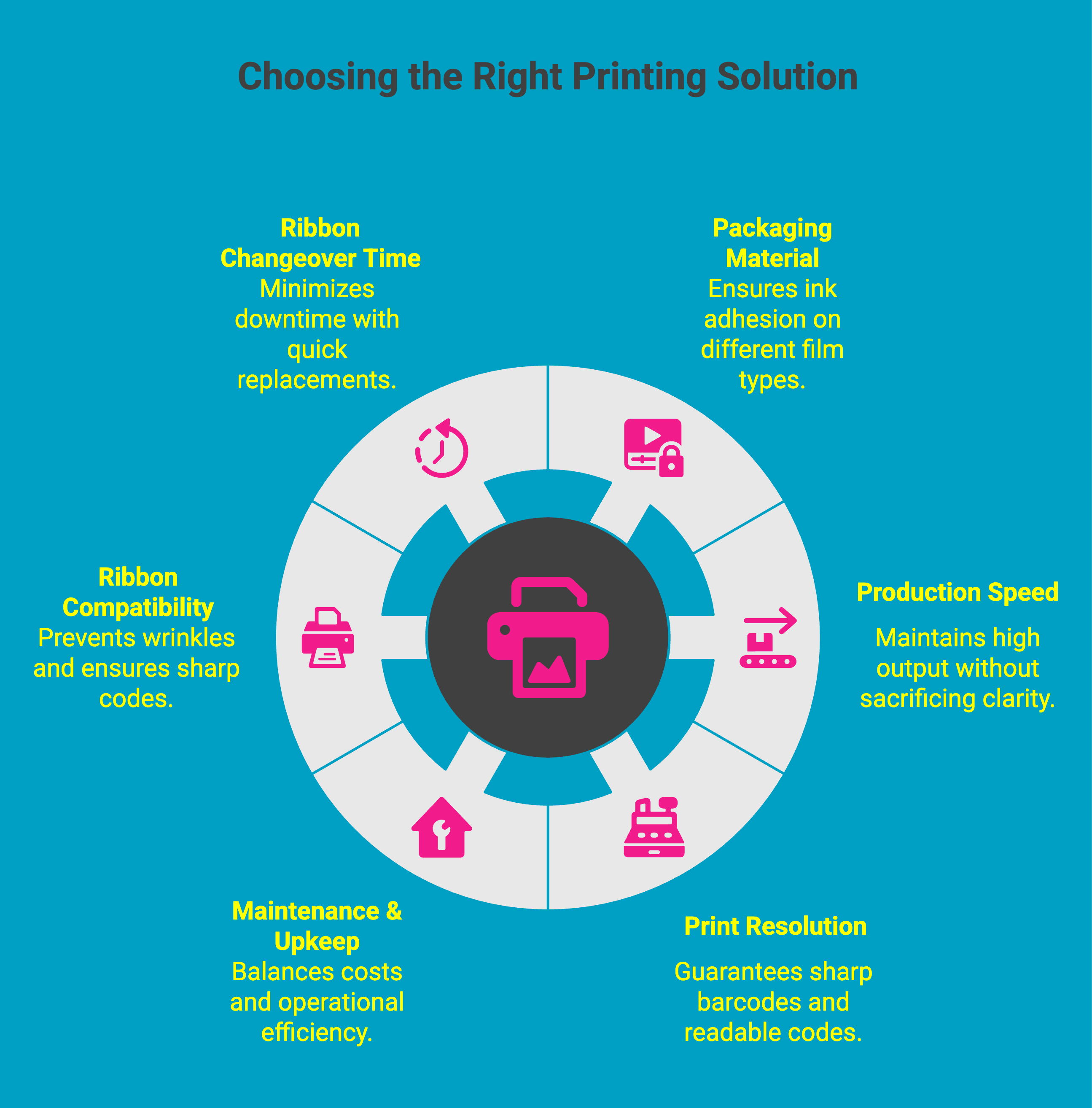
Packaging Material: The surface chemistry of your film (e.g., OPP, PE, or metallized laminates) dictates which ink-ribbon combination will provide the necessary adhesion. For reliable transfer, ribbons should be validated for films with surface energy levels above ~38 dynes/cm, which is the typical treatment level for printable flexible packaging films.
-
Production Speed: Lines running at high cycles per minute require systems with low latency and precise tension control. Snack packaging lines commonly operate between 100–300 packs per minute, so printers should reliably print at ≥400–600 mm/sec without sacrificing print clarity.
-
Print Resolution: High-speed scanning for logistics and retail compliance demands sharp, high-contrast barcodes and batch codes. A minimum 300 dpi resolution is generally required for readable barcodes, while 300–600 dpi is recommended for high-density codes and small text.
-
Maintenance & Upkeep: You must balance the cost of consumables against the time required for cleaning printheads, adjusting pressure, and replacing worn rollers. In most high-speed environments, printheads should be cleaned every 8–24 operating hours, and typical printhead lifespans range between 30–60 km of ribbon usage, depending on materials and maintenance.
-
Ribbon Compatibility: The interaction between the printhead geometry and the ribbon determines whether codes remain sharp or whether ribbons wrinkle or break. Compatible ribbons should operate within a heat range of ~70–120°C and maintain stable tracking across 450–650 mm/sec print speeds.
-
Ribbon Changeover Time: Frequent ribbon replacements can interrupt high-speed production if the system is not designed for quick swaps. Modern cassette-style TTO systems allow ribbon changes in under 60 seconds, whereas traditional setups may require 3–5 minutes, which can significantly impact uptime on continuous snack packaging lines.
Why TTO with Near-Edge Technology Wins?
For most flexible packaging, Thermal Transfer Overprinters (TTO) utilizing near-edge ribbon technology remain the industry-preferred solution. By facilitating near-instant separation of the ribbon from the film, these systems effectively mitigate common issues like ribbon drag and thermal smearing. This pairing ensures that your codes are not only accurate but also resistant to the friction of high-speed filling and sealing processes.
What Are the Most Common Printing Challenges in Snack Packaging?
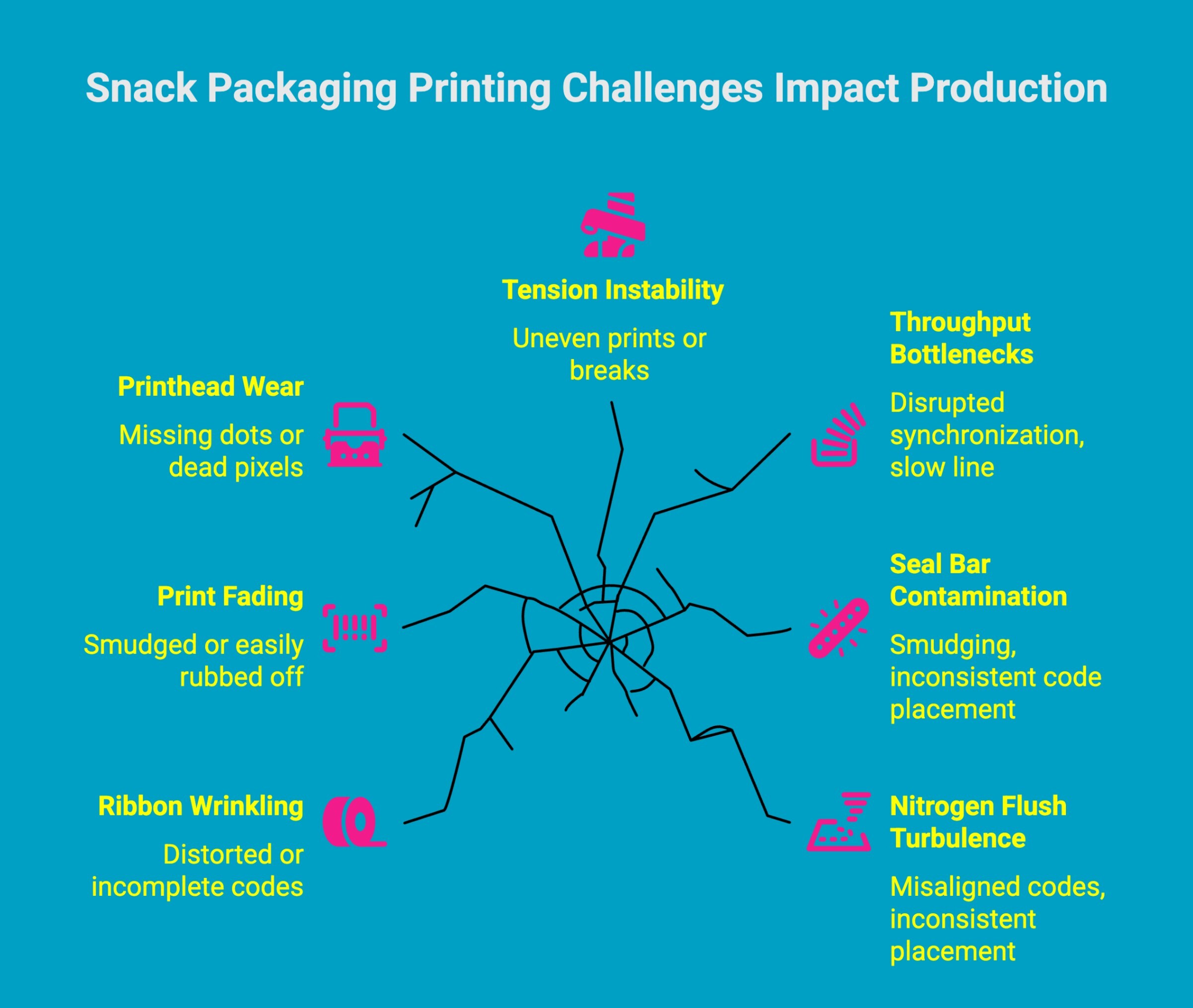
Even with the most advanced TTO systems, snack packaging lines are environments where small variables can lead to significant production headaches. Identifying these common hurdles is the first step toward maintaining consistent, high-quality output and minimizing costly downtime.
The most frequent challenges reported in high-speed snack packaging include:
1. Ribbon Wrinkling
Ribbon wrinkling is one of the most common printing problems in snack packaging lines. It typically occurs due to mechanical misalignment in the printer, incorrect ribbon-to-film tension, or incompatibility between the ribbon formulation and the flexible packaging film. When the ribbon does not move smoothly across the printhead, wrinkles form, which leads to distorted or incomplete codes.
How to fix it: Ensure the ribbon and media are correctly aligned, adjust ribbon tension settings, and use a ribbon formulation designed specifically for the packaging film used in snack production.
2. Print Fading or Poor Adhesion
Print fading or weak adhesion happens when the thermal transfer ribbon does not bond properly with the packaging material. Snack packaging often uses films such as polypropylene, polyethylene, or laminated foils, and not all ribbons adhere equally well to these surfaces. As a result, batch codes may appear faint, smudged, or easily rubbed off during handling and transport.
How to fix it: Select a ribbon compatible with the specific film type and adjust heat and pressure settings to ensure proper transfer and durability.
3. Excessive Printhead Wear
High-speed snack packaging lines generate constant friction between the ribbon, packaging film, and the printhead. Over time, this friction can wear down the printhead elements, leading to missing dots or “dead pixels” in printed codes and barcodes. Abrasive films and a lack of routine maintenance accelerate this wear.
How to fix it: Implement regular printhead cleaning routines, use high-quality ribbons designed to reduce friction, and replace worn components before they affect print quality.
4. Tracking and Tension Instability
Ribbon tracking issues occur when the ribbon path shifts slightly during operation. This instability can be caused by worn platen rollers, bent ribbon spindles, or inconsistent tension settings. When the ribbon drifts out of its intended path, it can produce uneven prints, wrinkles, or premature ribbon breaks.
How to fix it: Inspect and replace worn mechanical components, ensure proper ribbon threading, and calibrate tension controls to maintain consistent ribbon movement.
5. High-Speed Throughput Bottlenecks
Snack packaging lines often run at extremely high speeds, sometimes processing hundreds of packs per minute. If the printer’s heat, pressure, or speed settings are not precisely calibrated, the ribbon may not release smoothly after each print cycle. Even a small delay can disrupt synchronization with the packaging machine and slow down the entire production line.
How to fix it: Fine-tune printer settings to match the line speed, ensure firmware and printer configurations are optimized for high-throughput environments, and test printing performance during peak production conditions.
6. Seal Bar Contamination
Seal bar contamination occurs when oil, food particles, seasoning dust, or film residue accumulate on the sealing bars near the print area. These contaminants can transfer onto the packaging film, interfering with print clarity and causing smudging or inconsistent code placement. Over time, contamination can also affect seal integrity and packaging quality.
How to fix it: Establish regular cleaning schedules for seal bars and surrounding components, use protective covers where possible, and maintain strict sanitation practices in snack production environments.
7. Nitrogen Flush Turbulence
Many snack products use nitrogen flushing to extend shelf life and maintain crispness. However, the rapid release of nitrogen gas can create turbulence inside the packaging area, causing lightweight films to shift slightly during printing. This movement can misalign codes or create inconsistent print placement.
How to fix it: Synchronize the timing of the nitrogen flush with the printing cycle, stabilize the film path with proper guides or tension control, and adjust printer positioning to minimize airflow interference.
Understanding these common challenges and addressing them proactively helps snack manufacturers maintain consistent print quality, reduce downtime, and keep high-speed packaging lines running efficiently.
Learn how smarter printing technologies can future-proof your packaging strategy and help businesses scale production in this expert guide.
Why Is Printing Quality So Crucial for Snack Food Packaging?
In the fast-moving world of snack production, a printed code is much more than just ink on film. It is a vital data point that ensures product safety, brand reputation, and seamless logistics. When print quality suffers, the ripple effects can be felt all the way from your packaging line to the retailer's shelf.
Poor print quality isn't just an aesthetic issue; it can lead to significant operational and regulatory hurdles:
-
Product Recalls: If batch numbers or expiry dates are illegible, your ability to conduct a targeted recall is compromised, forcing a company-wide product pull that could have been avoided.
-
Traceability Failures: Without crisp, accurate prints, tracking a product back to the specific production run or raw material source becomes impossible, which is a major violation in modern food safety standards.
-
Retail Compliance Issues: Major retailers often impose strict penalties for unreadable barcodes or missing “best-before” dates. If your shipment is rejected at the warehouse, you face immediate financial loss and supply chain disruption. A rejected pallet can cost thousands in returned freight, restocking fees, and lost shelf space, while repeated compliance failures may lead to chargebacks ranging from $500 to several thousand dollars per incident, depending on the retailer.
-
Barcode Scanning Errors: Inaccurate or faded barcodes cause bottlenecks at checkout counters and distribution centers, damaging your relationship with retail partners.
Ensuring Quality Throughout the Lifecycle
High-quality printing ensures that your manufacturing codes remain readable for the entire shelf life of the product, regardless of the environment in which it is stored. By focusing on the right ribbon-to-film compatibility and maintaining your TTO equipment, you aren't just printing a date; you are protecting your brand’s integrity.
Investing in premium, manufacturer-approved ribbons ensures that every character is sharp and that your data stays exactly where it belongs: clearly visible on the package.
How Can DuraFast Label Company Elevate Your Snack Packaging Quality?
In the high-stakes world of snack production, your coding is only as good as the ribbon behind it. At DuraFast Label Company, we specialize in high-performance thermal transfer ribbons engineered specifically for the rigorous demands of flexible packaging applications.
Why Choose DuraFast Label Company for Your Production Line?
We understand that your TTO printers are the heartbeat of your packaging line. That’s why our near-edge ribbon solutions are meticulously formulated to integrate seamlessly with the leading printer brands used in snack food production:
-
Consistent Performance: Our ribbons are designed to withstand high-speed, high-heat environments, ensuring your batch codes, barcodes, and expiry dates are sharp and smudge-proof from the factory floor to the retail shelf.
-
Engineered for Speed: Whether you are operating high-speed flow wrappers or complex form-fill-seal (VFFS) machines, our ribbons provide the tension control needed to prevent wrinkles and minimize downtime.
-
Broad Compatibility: We offer ribbon grades compatible with the industry’s top TTO printer manufacturers, ensuring you get the perfect "ribbon-to-printer" match for your specific hardware.
-
Durable Results: Our ribbons are optimized to bond with a wide variety of flexible films, providing superior resistance to abrasion, moisture, and handling.
Don’t let ribbon quality be the bottleneck in your production. From flow-wrap snack bars to gusseted bags, we provide the technical expertise and the premium consumables necessary to keep your branding and regulatory compliance flawless.
View Our Full Collection of High-Performance Thermal Transfer Ribbons
Conclusion
Snack packaging combines specialized films, high-speed packaging equipment, and reliable coding systems to protect products and maintain traceability throughout the supply chain. For manufacturers running flexible packaging lines, selecting the right printing technology and ribbon formulation directly affects uptime, print clarity, and compliance.
Start by reviewing the films used across your packaging formats, then test compatible near-edge ribbons at actual production speeds. This approach helps confirm adhesion, prevent ribbon issues, and ensure that expiry dates, batch codes, and barcodes remain clear throughout the product’s shelf life.
Frequently Asked Questions
What materials are commonly used in snack packaging?
Snack packaging commonly uses laminated films made from polypropylene, polyethylene, metallized films, and aluminum foils. These materials support flexible food packaging for the salty snacks industry, enabling protection, durability, and compatibility with form-fill-seal equipment used in modern snack packaging production.
How is information printed on snack packaging bags?
Information like expiry dates, batch numbers, and codes is printed using systems designed for snack packaging printing. Technologies such as thermal inkjet, TTO, and laser systems offer reliable printing options across flexible films and integrated snack packaging solutions used in automated packaging lines.
What printers are used for flexible snack packaging?
Production lines commonly use TTO, CIJ, and laser systems as flexible packaging printers. A flexible snack package printer delivers high-quality codes and supports multiple packaging formats while integrating seamlessly with high-speed snack production equipment.
Why is near-edge printing common in snack packaging?
Near-edge printing is widely used in snack packaging because it supports fast ribbon transfer and clean separation during high-speed operations. A flexible snacks package printer ensures reliable coding performance while maintaining clarity on flexible packaging films during production.
What printing challenges are common in snack food packaging?
Common challenges include maintaining code clarity on flexible films, avoiding smudging, and ensuring barcode readability. Issues such as surface tension, fast sealing cycles, and varied packaging materials require proven coding technology to maintain reliable print results in high-speed environments.
What are the current trends in flexible snack packaging printing?
Emerging trends include digital flexible packaging, digital printing, and advanced digital press technology. These solutions allow faster design updates, shorter production runs, and customization while helping brands reduce their carbon footprint and adapt quickly to changing packaging demands.
What features should I look for in a flexible snacks package printer?
Key features include ease of use, compatibility with various films, and adjustable programmable intervals for coding. Reliable systems also provide uptime solutions and flexible settings to support high-speed production environments and different snack packaging requirements.
What are some leading brands or models of flexible snack package printers?
Leading systems are supported by strong customer service, reliable equipment, and ongoing maintenance programs. Providers offering solutions backed by Videojet’s service often deliver consistent performance, robust integration capabilities, and dependable coding systems for demanding snack packaging operations.
Are there compact or entry-level flexible package printers suitable for small snack businesses?
Yes, compact systems, including color label printers, are suitable for smaller operations. These printers support a variety of packaging types, manage total cost efficiently, and provide scalable solutions that grow alongside the unique needs of your business.
How do packaging conditions affect printing quality on containers?
Printing accuracy depends heavily on conditions of use, such as material type, humidity, and speed. Printers must handle surfaces like the shoulder of the container, reflective areas like small mirrors, and maintain clarity on stationary packaging despite packaging size constraints.
Why is choosing the right coding partner important for packaging operations?
Working with a true printing partner helps businesses choose the preferred coding technology for applications like cosmetic packaging. Reliable systems can print on containers such as a sealed jar or sealed case, using specialty inks while supporting environmental responsibility goals.