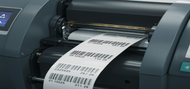
What Is an Ink Ribbon and Why Is It Key to Clear Labels?
10th Jul 2026
Key Highlights
-
Ink ribbons use heat-activated transfer to create durable, long-lasting prints that resist smudging, fading, and abrasion.
-
Wax, wax resin, and resin ribbons serve different durability needs, from short-term paper labels to harsh industrial environments.
-
Compared to toner and ink cartridges, ink ribbons offer superior adhesion and reliability on synthetic and specialty label materials.
-
Ink ribbons support a wide range of substrates, including paper, vinyl, polyester, fabric labels, and heat shrink tubing.
-
Correct ribbon selection depends on label material, exposure to heat or chemicals, and printer compatibility.
-
Most print quality issues stem from ribbon mismatch, incorrect settings, or poor maintenance rather than printer failure.
-
Ink ribbons are widely used in industrial, electrical, and compliance applications where label permanence is critical.
Label printing failures often show up at the worst possible time. Faded text, unreadable barcodes, or labels that peel away can disrupt operations, create safety risks, and force costly reprints. Many of these issues trace back to a simple but misunderstood component: the ink ribbon.
Without a clear understanding of how ink ribbons work or how they differ from toner and ink cartridges, it is easy to choose the wrong printing setup. This leads to poor durability, material incompatibility, and labels that do not survive real-world conditions such as heat, abrasion, or chemical exposure.
This blog explains what an ink ribbon is, how it works, and when it should be used. It also covers ribbon types, compatible materials, common problems, and selection tips to help you achieve consistent, long-lasting print results.
What Does an Ink Ribbon Mean in Label Printing?
An ink ribbon in label printing is a consumable used in thermal transfer printing to create durable, long-lasting labels. When heat from the printhead is applied, ink from the ribbon transfers onto the label surface, forming text, barcodes, or images. Unlike direct thermal printing, which relies on heat-sensitive paper, ink ribbons allow printing on a wider range of label materials, such as polyester, polypropylene, and vinyl.
Ink ribbons come in different formulations, including wax, wax resin, and resin, each suited for specific environments and durability needs. Choosing the right ink ribbon affects print clarity, resistance to smudging, and performance against heat, chemicals, and abrasion. In industrial and commercial settings, ink ribbons are essential for producing reliable, professional labels that remain readable over time.
Why Is an Ink Ribbon Important for Clear, Durable Labels?
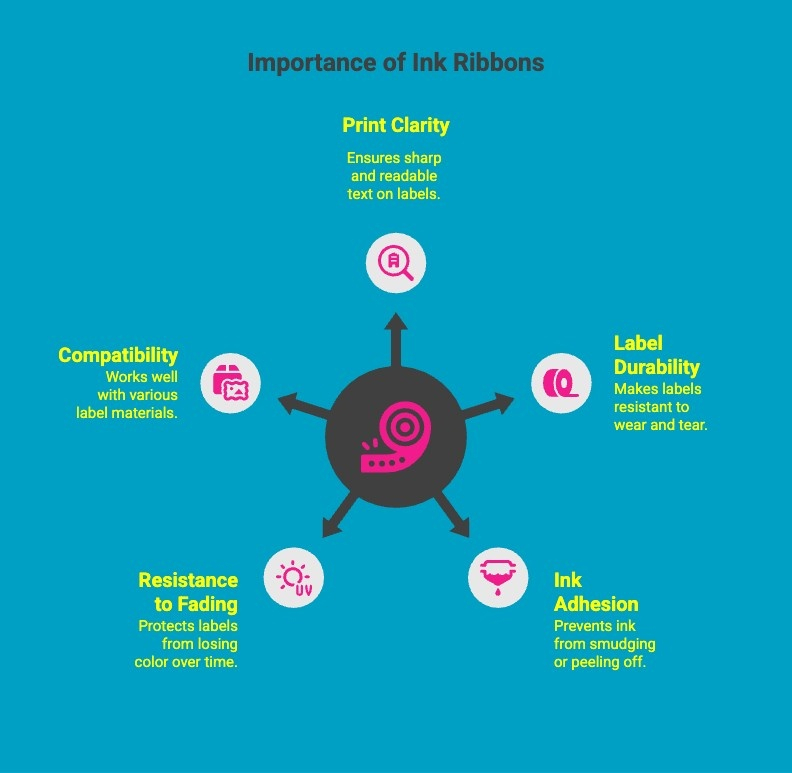
Ink ribbons play a critical role in label printing by ensuring information stays sharp, readable, and reliable under real-world conditions.
Here are the key reasons ink ribbons matter for producing clear, durable, and professional labels:
1) Print clarity
Ink ribbons deliver precise, high-contrast printing that keeps text, barcodes, and symbols easy to read. Consistent ink transfer prevents fuzzy edges and broken characters, which is essential for barcode scanning and compliance labeling.
For more on how scan quality impacts performance, see this guide on thermal label printers for industrial barcodes. Clear print quality reduces errors, rescans, and rejected labels across logistics, manufacturing, and retail environments.
2) Label durability
Using an ink ribbon helps labels withstand handling, friction, and time. Unlike heat-only printing, thermal transfer ink bonds securely to the label surface. This creates markings that resist scratching and wear, making ink ribbons ideal for asset tags, product identification, and long-term storage labels.
3) Ink adhesion
Proper ink adhesion ensures the printed image stays firmly attached to the label material. Ink ribbons are engineered to melt and bond evenly under heat, preventing peeling or flaking. Strong adhesion is critical for labels exposed to movement, packaging processes, or repeated contact during daily operations.
4) Resistance to fading
Ink ribbons protect printed information from fading caused by heat, light, or environmental exposure. Resin and wax-resin ribbons, in particular, maintain legibility even in demanding conditions. This resistance helps preserve barcodes, dates, and safety information throughout the label’s intended lifespan.
5) Compatibility with label materials
Ink ribbons allow printing on a wide range of label materials, including paper, polyester, polypropylene, and vinyl. Matching the ribbon type to the label material ensures optimal performance. This flexibility supports diverse applications, from shipping labels to chemical-resistant industrial identification.
Choosing the right ink ribbon directly impacts label quality, durability, and reliability, making it a critical component in professional label printing workflows.
How Does an Ink Ribbon Work in Thermal-Transfer Printing?
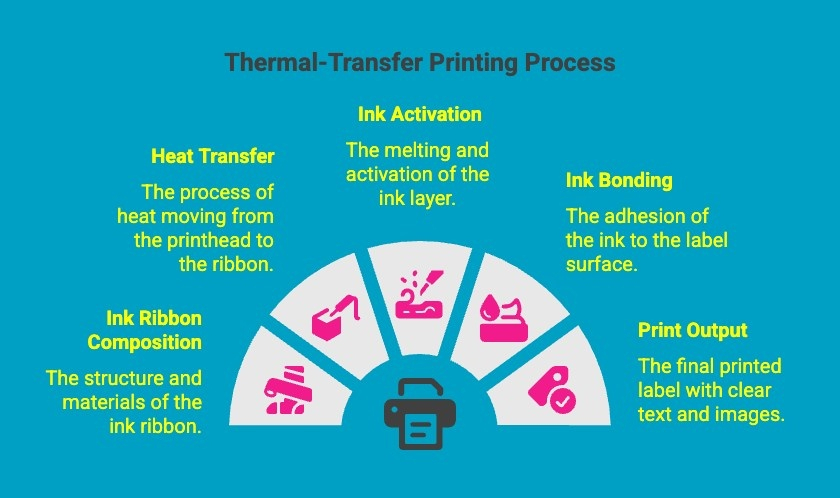
Ink ribbons are central to thermal transfer printing, controlling how images move from printer to label with accuracy and strength.
Here are the core stages that explain how an ink ribbon works to produce clean, durable print results:
1) Composition of the Ink Ribbon
An ink ribbon consists of a thin polyester backing coated with a formulated ink layer. This ink may be wax, wax resin, or resin, depending on durability requirements. The ribbon structure is designed to release ink only when heated, allowing precise control over print quality, adhesion, and resistance on different label materials.
2) Transfer of Heat From the Printhead
The thermal printhead contains tiny heating elements that activate in specific patterns. As the ribbon passes beneath the printhead, heat is applied only where printing is required. This controlled process produces sharp text and scannable output, which is essential for barcode labels that must remain accurate and readable. Precise heat application prevents excess ink transfer or distortion during printing.
3) Activation of the Ink Layer
When exposed to heat, the ink layer melts at targeted points on the ribbon. This activation causes the ink to separate from the polyester backing. Because only heated areas release ink, the process ensures sharp edges, consistent density, and accurate reproduction of even small text or detailed graphics.
4) Bonding of Ink to the Label Surface
The released ink transfers directly onto the label surface and bonds under heat and pressure. This bonding process anchors the ink securely to the material. The strength of adhesion depends on matching the correct ribbon type with the label substrate, ensuring the print remains intact during handling and use.
5) Formation of the Final Print Output
As the label exits the print area, the transferred ink cools and solidifies. This final step locks the image into place, producing crisp, durable output. The completed label is resistant to smudging, fading, and abrasion, making it suitable for scanning, storage, and long-term identification.
By combining controlled heat, precise ink release, and strong bonding, ink ribbons make thermal transfer printing reliable for professional, long-lasting label applications.
How Do Ink Ribbons, Toner, and Ink Cartridges Differ?
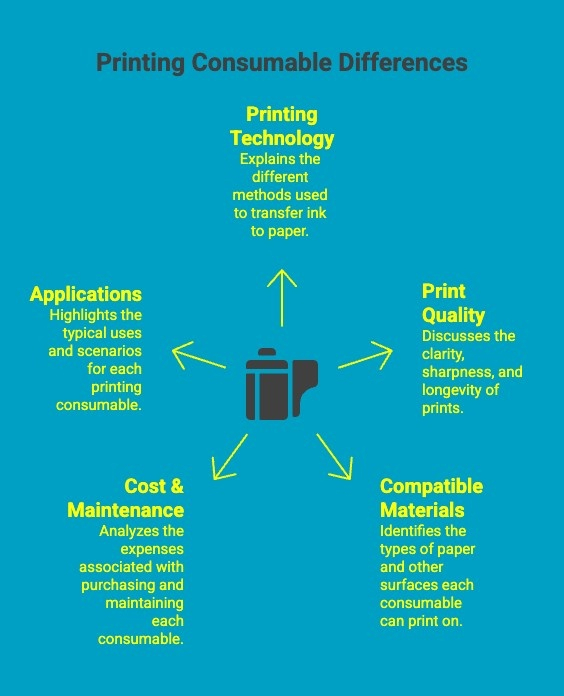
Ink ribbons, toner, and ink cartridges serve different printing needs, each designed for specific technologies and environments. From an ink ribbon printer used in industrial operations to office laser and inkjet devices, each option delivers different results in durability, compatibility, and long-term performance.
Below are the key differences that explain how they vary in real-world use:
1) Printing Technology & Ink Transfer
Ink ribbons are used in thermal transfer printers, where heat melts a thermal printer ink ribbon and transfers ink onto labels. Toner uses electrostatic charges and heat to fuse powder onto paper. Ink cartridges spray liquid ink through nozzles. A thermal ink ribbon offers controlled transfer, cleaner edges, and stronger bonding than liquid ink-based systems.
2) Print Quality & Durability
Prints produced using inks and ribbons are sharp, consistent, and highly resistant to smudging, abrasion, and environmental exposure. Toner produces clean text for documents but lacks industrial durability. Ink cartridge prints deliver vibrant color but fade faster and are more vulnerable to heat, moisture, and repeated handling in demanding environments.
3) Compatible Materials & Substrates
Ink ribbons support paper, polyester, polypropylene, and vinyl labels. Using the correct ink ribbon cartridge or ink ribbon cassette ensures reliable adhesion on synthetic materials. Toner works best on standard office paper, while ink cartridges perform mainly on coated paper and photo stock, with limited effectiveness on industrial label materials.
4) Cost, Consumables & Maintenance
Ink ribbons are cost-effective for high-volume labeling and require minimal maintenance. Replacing a ribbon cartridge is quick and predictable. Toner cartridges cost more upfront but offer steady office output. Ink cartridges are cheaper initially but need frequent replacement, increasing downtime, consumable costs, and long-term printer maintenance requirements.
5) Typical Applications & Use Cases
Ink ribbons are commonly used for barcodes, compliance labels, asset tags, wire marking, and packaging identification in industrial settings. Toner suits reports, invoices, and bulk office documents. Ink cartridges are ideal for home printing, photographs, and marketing materials where color appearance matters more than durability or resistance.
Choosing the right printing method depends on durability needs, materials, and print volume. Matching the correct technology ensures efficient workflows and reliable, long-lasting print results.
What Types of Ink Ribbons Are Available?
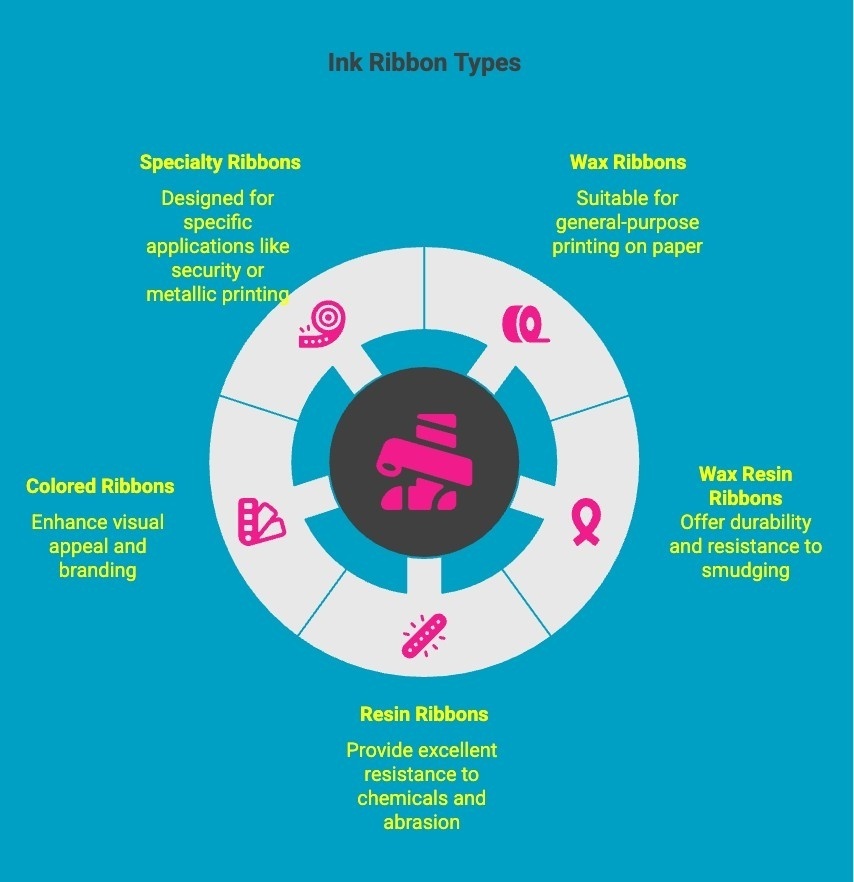
Ink ribbons are available in multiple formulations to match different label materials, environments, and durability needs.
Here are the main types of ink ribbons and how each one supports specific printing applications and performance requirements:
1) Wax Ribbons
Wax ribbons are the most common and economical option for thermal transfer printing. They melt at lower temperatures and print smoothly on paper labels. Wax ribbons deliver good print quality for shipping, retail, and inventory labels but offer limited resistance to abrasion, moisture, and heat.
2) Wax Resin Ribbons
Wax resin ribbons combine affordability with improved durability. The resin content enhances resistance to smudging, scratching, and light moisture exposure. These ribbons perform well on coated paper and synthetic labels, making them suitable for logistics, food packaging, and short-term industrial labeling applications.
3) Resin Ribbons
Resin ribbons provide the highest level of durability and chemical resistance. They require higher heat to transfer and bond strongly to synthetic materials like polyester and vinyl. Resin ribbons are ideal for harsh environments, including chemical labeling, outdoor use, medical applications, and long-term asset identification.
4) Colored Ribbons
Colored ribbons allow printing in colors such as red, blue, green, or white for visual identification. They are often used for warning labels, color-coded systems, and branding elements. Performance depends on the ribbon formulation, with colored wax, wax resin, and resin options available.
5) Specialty and High-Performance Ribbons
Specialty ribbons are engineered for demanding applications such as extreme heat, UV exposure, or solvent contact. These include near-edge ribbons, textile ribbons, and ultra-durable resin blends. They support niche uses in electronics, automotive manufacturing, flexible packaging, and compliance-driven industrial environments.
Selecting the right ink ribbon type ensures optimal print quality, durability, and performance, helping labels remain clear and reliable throughout their intended use.
What Materials Can You Print On Using Ink Ribbons?
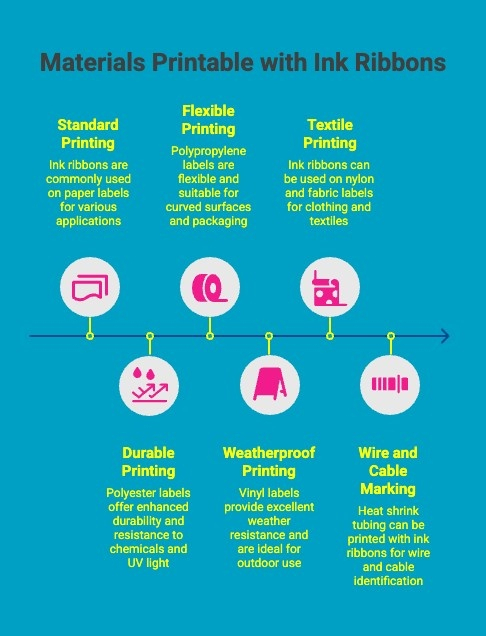
Ink ribbons enable thermal transfer printers to create durable markings on many label surfaces beyond standard paper.
Here are the most common materials you can print on using ink ribbons and how each supports different labeling applications:
-
Paper Labels: Ideal for shipping, retail, and inventory labels. Paper works well with wax or wax resin ribbons, delivering clean print quality for short-term use in controlled indoor environments.
-
Polyester Labels: Designed for durability, polyester labels resist heat, chemicals, and abrasion. Resin ribbons are typically used, making them suitable for asset tracking, compliance labels, and long-term identification.
-
Polypropylene Labels: A flexible synthetic option that balances durability and cost. Polypropylene prints well with wax resin or resin ribbons and is commonly used for food packaging, logistics, and product labeling.
-
Vinyl Labels: Vinyl labels offer strong flexibility and outdoor performance. When paired with resin ribbons, they produce labels that withstand moisture, UV exposure, and handling in demanding environments.
-
Nylon and Fabric Labels: Used for wire marking, apparel tags, and industrial identification. These materials require specialized resin ribbons to ensure proper adhesion and long-lasting legibility.
-
Heat Shrink Tubing: Common in electrical and datacom applications, heat shrink tubing requires resin ribbons. The ink remains readable even after shrinking, ensuring reliable cable and wire identification.
Matching the right label material with the correct ink ribbon ensures consistent print quality and durability. For deeper insight into performance and lifespan, see this guide on long-lasting label durability.
How To Choose the Right Ink Ribbon for Your Application?
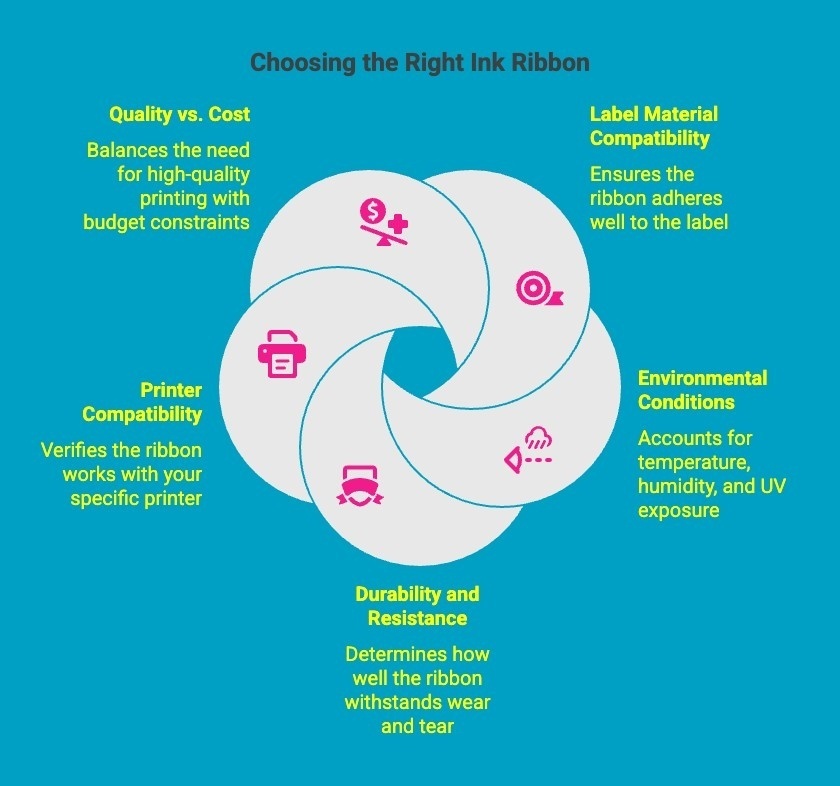
Choosing the right ink ribbon directly affects label performance, lifespan, and overall printing efficiency.
Here are the key factors to consider when selecting an ink ribbon that matches your application, environment, and budget requirements:
-
Match Ribbon Type to Label Material: Select wax for paper labels, wax resin for coated or semi-synthetic materials, and resin for synthetic labels like polyester or vinyl. Proper matching ensures strong adhesion, clean print quality, and reduced printhead wear.
-
Consider Environmental Conditions: Evaluate exposure to heat, moisture, chemicals, UV light, or abrasion. Harsh environments require resin or specialty ribbons, while controlled indoor settings often perform well with wax or wax-resin options.
-
Evaluate Durability and Resistance Needs: Determine how long the label must remain readable. Applications involving frequent handling, outdoor use, or compliance labeling need higher resistance to smudging, fading, and chemicals than short-term shipping labels.
-
Check Printer Compatibility: Confirm the ribbon width, core size, ink side orientation, and whether your printer uses flat head or near edge technology. Using compatible ribbons prevents print issues and protects the printhead.
-
Balance Quality and Cost Efficiency: Avoid overspecifying durability when it is not required. Wax ribbons reduce costs for high-volume, short-life labels, while resin ribbons justify higher costs for long-term or regulated applications.
The right ink ribbon delivers reliable print quality while controlling costs, ensuring your labels perform exactly as your application demands.
How Do You Care for and Maintain Ink Ribbons Properly?
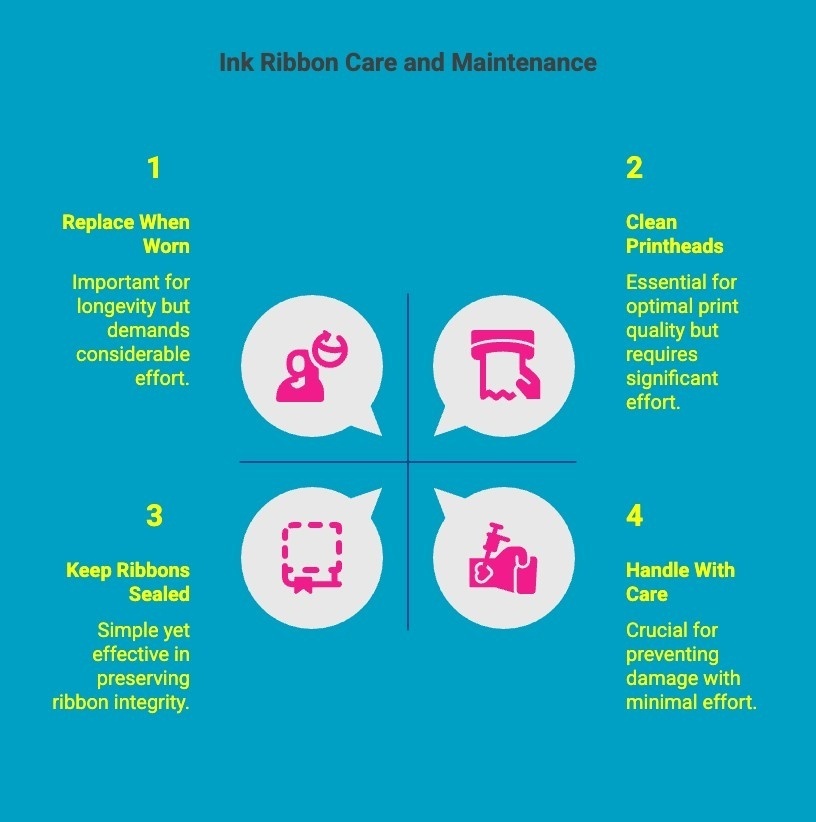
Proper care and maintenance of ink ribbons help preserve print quality, extend printer life, and reduce waste.
Here are practical steps to store, handle, and maintain ink ribbons correctly for consistent, reliable thermal transfer printing:
-
Proper Storage: Store ink ribbons in a cool, dry environment away from direct sunlight, heat, and humidity. Stable storage conditions prevent ink degradation, warping, and uneven transfer during printing.
-
Keep Ribbons Sealed: Leave ribbons in their original packaging until use. Sealed packaging protects the ink layer from dust, moisture, and contaminants that can cause poor print quality or ribbon damage.
-
Handle With Care: Avoid touching the inked surface with bare hands. Oils and debris can interfere with ink transfer. Handle ribbons by the edges or core to maintain clean, consistent printing.
-
Clean Printheads: Regularly clean the printhead to remove ribbon residue and dust buildup. A clean printhead ensures even heat distribution, protects hardware, and prevents premature ribbon wear.
-
Replace When Worn: Replace ribbons once print quality fades or streaks appear. Continuing to use worn ribbons can damage the printhead and compromise label readability.
Consistent ribbon care protects print quality, reduces downtime, and ensures reliable label output across everyday and demanding printing applications.
What Are the Most Common Ink Ribbon Problems and How Can You Avoid Them?
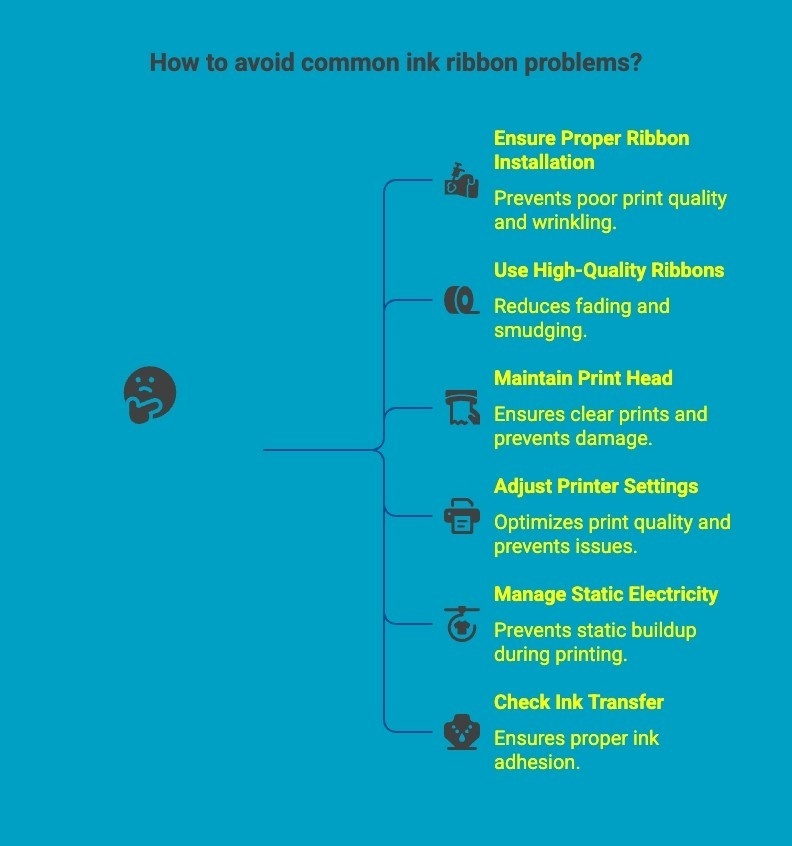
Ink ribbon issues can quickly reduce label quality, cause downtime, and increase costs if left unaddressed.
Here are the most common ink ribbon problems and practical ways to avoid them for consistent, reliable thermal transfer printing:
-
Poor Print Quality: Often caused by incorrect heat, speed, or ribbon type. Match the ribbon to the label material, and adjust print settings to ensure sharp text, clear barcodes, and consistent ink coverage.
-
Ribbon Wrinkling or Creasing: Wrinkling usually results from incorrect tension or misalignment. Ensure the ribbon is loaded properly, tension is balanced, and the ribbon width matches the label to prevent uneven pressure.
-
Fading or Smudging Over Time: Low-durability ribbons may fade when exposed to heat, light, or handling. Use wax resin or resin ribbons for applications that require longer-lasting readability and resistance.
-
Static Buildup During Printing: Static electricity can cause ribbon tracking issues and print defects. Control humidity, use anti-static materials, and ensure proper grounding to reduce static-related problems.
-
Ink Transfer or Adhesion Issues: Poor adhesion occurs when ribbon and label materials are mismatched. Select a compatible ribbon formulation and apply sufficient heat to achieve strong bonding without overheating.
-
Using Incorrect Ribbon or Printer Settings: Incorrect ribbon orientation, width, or print speed can lead to inconsistent output. Always verify printer specifications and calibrate settings when changing ribbon types.
-
Poor Print Head Maintenance: Dirty or damaged printheads cause streaking and uneven prints. Clean the printhead regularly and replace worn components to maintain consistent heat transfer.
Most ink ribbon problems are preventable with proper material matching, correct settings, and regular maintenance, ensuring dependable print quality and longer equipment life.
Why the MAX Letatwin LM-550A3BH Excels With Ink Ribbons?
The MAX Letatwin LM-550A3BH is purpose-built for professional wire and cable identification, and its performance with ink ribbons is where it truly stands out. Designed specifically for heat shrink tubing and durable marking, the printer delivers consistent ink transfer, sharp character definition, and long-lasting legibility even in demanding electrical and industrial environments.
Its controlled heat management ensures ink ribbons activate evenly without scorching or fading, which is critical for small text, alphanumeric codes, and dense cable markers. Combined with precise ribbon tensioning, the LM-550A3BH minimizes smudging, wrinkling, and wasted ribbon, helping teams maintain accuracy and efficiency on site.
For professionals who rely on reliable ribbon performance, sourcing the right printer and genuine supplies matters. That is where DuraFast Label Company adds real value. As a trusted industrial labeling supplier, DuraFast Label Company provides expert guidance, authentic MAX Letatwin printers, compatible ink ribbons, and ongoing support tailored to electrical, datacom, and industrial applications.
If you want help selecting the right ink ribbons or setting up the MAX Letatwin LM-550A3BH for your workflow, contact DuraFast Label Company today. Their team can help you achieve cleaner prints, longer-lasting labels, and fewer interruptions on the job.
Conclusion
In demanding electrical and industrial environments, reliable ink ribbon performance is critical for safety, accuracy, and long-term identification. If you are asking what printer uses ink ribbon, the MAX Letatwin LM-550A3BH is a clear example, built specifically for ribbon-based, high-durability marking. It excels because it delivers precise heat control, consistent ribbon transfer, and dependable results on heat shrink tubing and wire markers. Its design minimizes smudging, fading, and misprints, even when producing small, detailed characters.
By supporting durable ink bonding and clear output, the LM-550A3BH helps professionals maintain organized, compliant cable identification while reducing rework and downtime. The result is a dependable labeling solution built for high standards, repeatable accuracy, and real-world industrial use.
Frequently Asked Questions
How does an ink ribbon work in a thermal-transfer printer?
In this type of printing, printer ribbons are heated by the printhead, melting ribbon ink at precise points. The ink transfers onto the label surface, then cools and bonds, creating durable markings suitable for industrial settings.
Are ink ribbons compatible with MAX Letatwin printers?
Yes, ink ribbons are compatible with MAX Letatwin printers, which are purpose-built for industrial settings. These types of printers use dedicated printer ribbons to create permanent identification on heat shrink tubing and wire markers.
What’s the difference between an ink ribbon and a regular ink cartridge?
An ink ribbon uses heat to transfer solid ribbon ink onto media, while a regular ink cartridge sprays liquid ink. Ribbon cartridges offer greater durability, making them better suited for industrial settings than standard office printers.
How long does an ink ribbon typically last during printing?
Ink ribbon lifespan depends on print density, ribbon length, and type of printing. In industrial settings, printer ribbons typically last hundreds to thousands of prints before replacement, offering predictable usage compared to liquid ink systems.
Which ribbon type is best for printing on heat-shrink tubing?
Resin printer ribbons are best for heat shrink tubing in industrial settings. They resist heat, chemicals, and abrasion, ensuring ribbon ink remains legible after shrinking and throughout long-term cable identification use.
Can ink ribbons print on both vinyl and polyester labels?
Yes, ink ribbons can print on vinyl and polyester labels. Using resin ribbon cartridges ensures strong adhesion and durability, making this type of printing reliable for synthetic materials used in demanding industrial settings.
How do I know when an ink ribbon needs to be replaced?
Printer ribbons should be replaced when ribbon ink produces faded, streaked, or incomplete prints. In industrial settings, declining contrast or scan failures are common indicators that ribbon cartridges are reaching the end of their life.
Why is print clarity better with thermal-transfer ribbons?
Thermal-transfer printer ribbons deliver sharper clarity because ribbon ink is precisely melted and bonded. This type of printing produces clean edges, consistent density, and reliable readability, even when labels are exposed to industrial settings.
How do you replace or install an ink ribbon in a printer?
To install printer ribbons, open the printer, remove the used ribbon cartridges, and load the new ribbon following the guide path. Proper installation ensures smooth ribbon ink transfer and consistent results in industrial settings.
Why do POS systems often use ink ribbons for receipt printing?
Some POS systems, especially dot matrix printers, use printer ribbons because they handle multipart receipts reliably. Ribbon ink performs consistently during high-speed transactions, making this type of printing dependable for continuous commercial use.
How long does an ink ribbon usually last before needing replacement?
Ink ribbon lifespan varies by print volume and density. In industrial settings or dot matrix printers, printer ribbons may last weeks or months, depending on usage frequency and how heavily ribbon ink is applied.
How do you replace or install an ink ribbon in a printer?
To replace printer ribbons, open the printer, remove the used ribbon, and load the new thermal transfer ribbon along the guides. Ensure correct tension and alignment, then close the cover and run a test print.
How long does an ink ribbon usually last before needing replacement?
An ink ribbon usually lasts hundreds or thousands of prints, depending on density and usage. In impact printers or thermal transfer ribbon systems, higher coverage and speed increase wear, requiring replacement sooner during industrial printing.