Law Label Printing Guide: Compliance & Hardware Solutions
8th Oct 2026

What if the biggest law label challenge isn’t printing, but deciding what belongs on the label in the first place? Law labels can communicate required information about bedding, upholstered furniture, and other stuffed products. The rules may vary by product and jurisdiction.
It’s understandable to feel unsure where compliance decisions end and equipment choices begin. They’re connected, but they’re separate tasks. First, verify the information your product must carry with the applicable official authorities. Then plan how to print that approved content clearly and consistently.
This guide explains the purpose and common uses of law labels, then covers practical factors for comparing label stock, printer technology, and printing supplies. You’ll also see how blank law labels, including pillow law labels, can fit into an in-house workflow. Keep regulatory review separate from production planning so you can build a clear plan for your law label setup.
Key Takeaways
- Law labels disclose information about certain filled products. Identify your product and the rules that apply before preparing label content.
- Keep compliance review separate from print setup: approved wording is a regulatory decision, while printer settings affect how it appears on the label.
- Compare label stock, printer method, and ribbon as a combination, then verify compatibility before production.
- Use a test print to check layout and legibility, not to confirm that the label meets legal requirements.
- Build your in-house workflow around approved content, suitable blank law labels, and printing equipment that fits your production needs.
What Are Law Labels, and What Do They Tell Product Buyers?
A law label is used to disclose information about certain products made with filling materials. It helps buyers understand what is inside a covered product, while giving manufacturers and sellers a place to present information required by applicable rules. Law labels disclose information about specified filled products, but exact requirements depend on the product and jurisdiction.
The label’s purpose is disclosure, not promotion. It isn’t the same as a care label, which explains cleaning or maintenance, a marketing label that highlights product benefits, or a shipping label used to route a package. Some labels may include additional product or brand details, but those don’t replace required disclosures. For background on the term and its history, see What is a Law Label?
Which products commonly use law labels?
Bedding, pillows, mattresses, and upholstered or stuffed products are common examples to investigate. The category alone doesn’t determine the rule. Requirements can depend on how an item is constructed, what it contains, where it’s sold, and which jurisdiction applies. A pillow and an upholstered chair may both contain filling, but their label requirements may differ.
Start by identifying the specific product and its materials, then review the applicable official requirements for each market where it will be sold. Don’t assume one label format covers every product in a broad category or every jurisdiction. DuraFast’s law label options and pillow law label category can help you plan an in-house workflow, but the correct label content must come from a separate compliance review.
What information does a law label communicate?
At a general level, a law label can disclose the nature or composition of a product’s filling so buyers can better understand what the item contains. Required details may differ depending on the product and applicable rules. Don’t copy wording from another product or treat a sample label as a universal template.
Separate content into two groups before preparing artwork:
- Required disclosures: Confirm the exact information and wording with the applicable official authority for the product and jurisdiction.
- Optional information: Brand details, care guidance, or other product information may be useful, but include them only in a way that doesn’t obscure or replace required content.
This distinction keeps the label’s purpose clear for buyers and makes the production steps easier to manage. Treat label text as a compliance decision first. Verify exact wording and required details before finalizing artwork; then prepare the approved content for printing. A neat, legible print can improve readability, but print quality alone can’t confirm legal accuracy.
Law Label Content and Compliance: Separate Legal Review from Printing
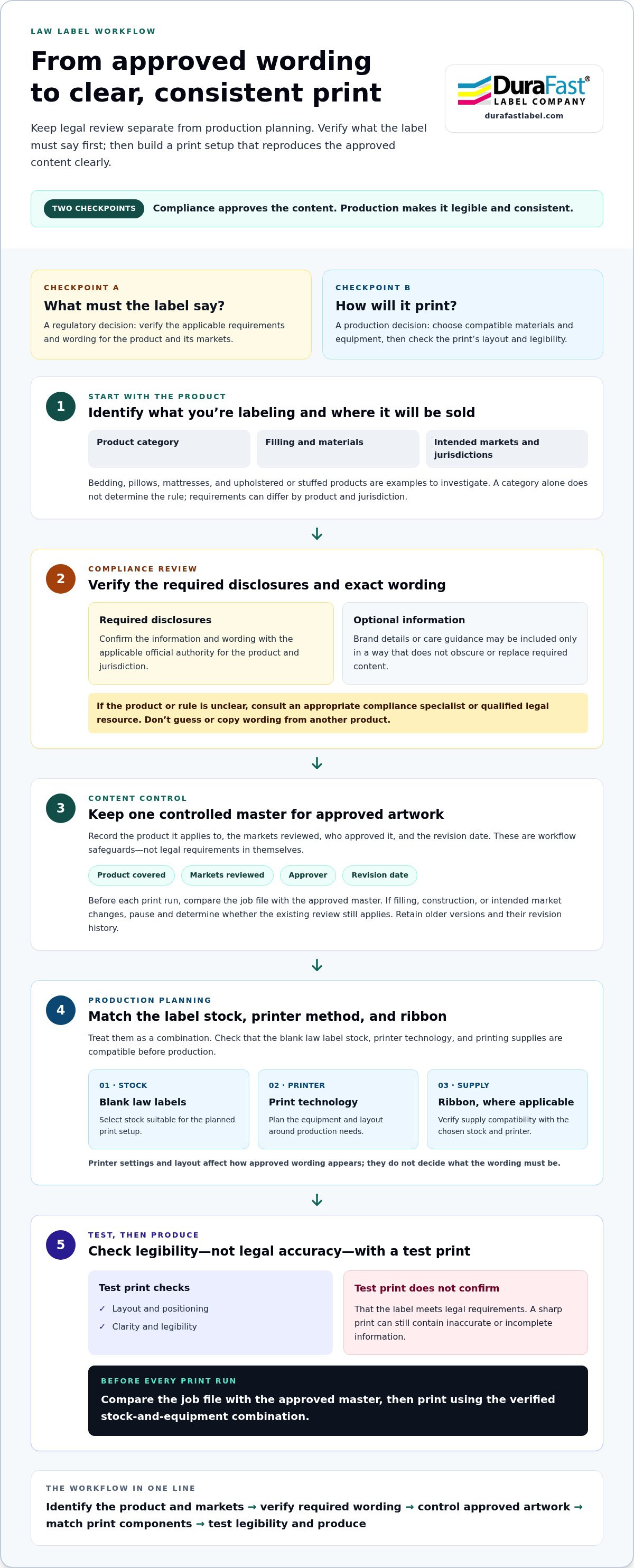
A law label workflow has two distinct checkpoints: approve what the label says, then ensure the chosen printing setup reproduces it clearly. The first is a compliance review. The second is a production task involving layout, stock, printer, and, where applicable, ribbon. A sharp, readable printout can still contain inaccurate or incomplete information, so a successful test print can’t replace review of the text.
Start the review with the product and its intended market. A pillow made with one type of filling may need a different review from an upholstered item, and requirements can vary across jurisdictions. If the product will be sold in several markets, identify each applicable jurisdiction rather than assuming one set of rules covers them all. Focus the review on what applies to this product in these markets, based on current official guidance.
Before printing, verify the applicable law label requirements and approved wording for the product and each intended market.
What should be reviewed before approving label content?
Create a short review record before finalizing artwork. Identify the product category and materials, list intended markets, and note the relevant jurisdictions. Then consult the applicable official source for current disclosure requirements and wording. If the product or rule is unclear, take the question to an appropriate compliance specialist or qualified legal resource instead of guessing or borrowing text from a label for a different item.
Keep this stage separate from printer setup. Changing a font size to fit approved text is a layout decision; deciding what a disclosure must say is not. Don’t let a printer template, an old artwork file, or a sample label serve as the authority for legal content. Avoid adding statutory language or deadlines to production documents unless they’ve been verified through an appropriate source.
How can teams keep approved label content consistent?
Use a controlled master file for approved text and artwork. As an internal process safeguard, record the product it applies to, the markets reviewed, who approved the content, and the revision date. These records help staff distinguish the current file from drafts or artwork created for another product. They’re workflow practices, not legal requirements in themselves.
Before each print run, compare the job file with the approved master. If the filling, product construction, or intended market changes, pause and determine whether the existing review still applies. If wording is revised, retain the older version and its revision history rather than overwriting it without a record. This makes it easier to trace which approved content was used for a production batch and reduces the risk of reusing outdated artwork.
Once the text is approved, production staff can focus on positioning, print clarity, and consistency. DuraFast Label Company’s blank law labels and printing supplies can be part of an in-house workflow. The company also offers printing equipment and supplies for planning a law label setup.
How to Compare Law Label Stock and Printing Methods
Choose the label and printer as a pair, not as separate purchases. Start with the product’s application, the label’s dimensions and surface, and the conditions it may encounter. Then match those needs to a printing method and verify the complete media, printer, and ribbon combination, if a ribbon is used. No single setup suits every product.
Which law label stock characteristics matter?
Blank law labels provide a surface for printing; they don’t establish or approve the text printed on them. Before selecting stock, consider the finished label size, printable area, surface, attachment method, and the environment it will face. A label applied to fabric, for example, may have different attachment needs from one applied to a firm product surface. DuraFast offers blank law labels for in-house workflows.
Consider practical conditions as well. Will the label be handled, folded, exposed to moisture, or subject to heat? These factors can affect material and print performance. Don’t assume a stock is suitable based on a broad material description alone. Review its specifications for the intended application.
How do print technologies affect the workflow?
Direct thermal printing creates an image through heat-sensitive label material and typically doesn’t use a ribbon. Thermal transfer printing uses heat to transfer ink from a ribbon onto label stock. The right method depends on the selected media, printer specifications, and intended use. For a closer look at ribbon-based printing, see this thermal transfer label guide.
Use the table as a starting point, then confirm the exact material and printer specifications before selecting supplies. Durability and legibility depend on the stock, printing setup, and conditions of use.
| Intended use | Stock to assess | Printer method to consider | Legibility check |
|---|---|---|---|
| Product label for routine indoor handling | Dimensions, surface, and attachment needs | Direct thermal or thermal transfer, based on verified media support | Check that all approved text prints clearly at the chosen size |
| Label facing more demanding conditions | Material and specifications suited to the expected environment | Thermal transfer may be considered with a verified ribbon and stock pairing | Test readability after handling that reflects intended use |
| Label with limited printable area | Layout space and printable surface | Use a method supported by the printer and selected stock | Confirm text remains readable without clipping or crowding |
Before ordering supplies or setting up production, compare the printer’s supported media dimensions and type with the stock, then check ribbon requirements for thermal transfer. Don’t assume a printer supports a particular law label material unless that combination is verified. A test print can reveal feed, layout, or clarity issues; it can’t establish that the content is legally correct.
How to Plan an In-House Law Label Printing Workflow
An in-house workflow works best when each job follows the same sequence: approved copy, prepared artwork, verified supplies, test print, and production check. This separates content decisions from printing tasks and gives staff a clear way to catch layout or equipment issues before a full run of Law labels.
What should a team prepare before printing?
Gather the approved label text, product details, finished label dimensions, and current artwork file. Confirm that the selected stock fits the printer’s supported media specifications, and include a compatible ribbon if the printing method requires one. Assign someone to review the first print for layout and readability before production begins.
- Approved copy: Use the version cleared for the product and intended market.
- Dimensions and artwork: Check the label size, printable area, and file version.
- Materials and equipment: Match the label stock and any ribbon to the printer’s specifications.
- Review owner: Name who checks the initial sample and records the result.
Choose equipment based on the job requirements, including label format, print method, and expected production volume. Use the thermal label printer guide to compare printer technologies and selection factors, then verify specifications for the exact stock and setup. Don’t assume a printer supports a particular material simply because it can print other labels of a similar size.
How can teams reduce avoidable print errors?
Build the print job from a controlled source file instead of retyping label content. Re-entry can introduce errors, such as a missing line or altered character. Keep the approved artwork and production version together, with clear file names or revision notes so staff can identify which file was used for a given run.
- Print a sample using the intended label stock and production settings.
- Check for cut-off text, alignment shifts, weak contrast, or crowded layout.
- Confirm the printed text is readable at the label’s actual size.
- Record the artwork version and sample review as internal workflow guidance.
A test print is a production check, not legal approval. It can show whether content fits and prints clearly, but it can’t verify that the wording is legally correct. If the sample fails, correct the layout or print setup and test again. If the copy itself appears wrong, stop and return it to the content review process rather than editing approved text at the printer.
Once the sample passes the team’s print checks, use the same controlled file and settings for the production run.
DuraFast Law Label Options: Choose a Practical Next Step
A practical setup connects four decisions: the product being labeled, the content approved for that product and its intended market, the label stock, and the printer method. Each has a distinct role. Compliance review establishes the approved content; stock and printer selection determine how that content is produced. Treating these as connected steps, rather than one decision, helps you plan an in-house workflow without assuming one material or printer suits every application.
DuraFast offers blank law labels, pillow law labels, printers, and printing supplies for businesses producing labels in-house. Use your product and approved artwork to guide material and equipment selection. Before production, verify that the chosen stock, printer, and any ribbon work together according to their specifications. A product category is a useful starting point, not a substitute for checking the exact setup.
When are pillow law labels relevant?
If your product is a pillow, focus planning on its particular application and intended market. The label’s content and use should follow the requirements that apply to that product in those markets. DuraFast’s pillow law labels are a relevant product option for teams planning an in-house pillow-label workflow.
What information helps scope a label setup?
Bring practical details together before choosing supplies or equipment. Note the product type, finished label dimensions, and planned production volume. Include the printer model and label stock you’re considering, plus any ribbon used in the print process. These details help frame the workflow and make it easier to compare components.
A short setup brief can clarify the next steps. Organize it around these points:
- Application: What product will carry the label, and where will it be sold?
- Content: Is the artwork based on text reviewed and approved for that product and market?
- Format: What are the label dimensions, stock, and artwork file?
- Production: What printer model and print method will you use, and what volume do you expect?
- Verification: Have you checked the printer, stock, and ribbon specifications as a combination?
This preparation separates product and compliance questions from everyday print decisions. If the label text or applicable rules are uncertain, resolve that review before production. If the content is approved, focus on making the workflow repeatable: select supplies and equipment, run a sample, review print quality, and retain the production artwork for reference.
Turn Your Label Plan into a Repeatable Workflow
Turn your decisions into a process your team can follow consistently. Set a clear handoff from content approval to artwork preparation, sample review, and production. That way, changes to a product or market can prompt the right review before outdated files reach the printer.
Keep the first setup simple: document the approved artwork, identify the stock and equipment used, and assign someone to check each initial print. As your needs change, revisit the workflow rather than relying on memory or old settings. A thoughtful process helps your team handle law labels with greater confidence and makes future production easier to manage.
Ready to plan equipment and supplies for your workflow? Contact DuraFast to discuss your law label setup. Share the product application, printer, stock, and supplies you’re considering to plan a practical in-house workflow.
Frequently Asked Questions
Are law labels the same as care labels?
No. A law label addresses product disclosures that may apply to certain filled goods, while a care label tells users how to clean or maintain an item. For example, a pillow may carry information about its filling and separate washing instructions. One label shouldn’t be assumed to replace the other. Check the rules and labeling needs for the specific product, and keep care guidance distinct from required disclosures.
Which products commonly have law labels?
Bedding and other filled or stuffed goods are common categories to review, including pillows, mattresses, and some upholstered products. The product name alone doesn’t settle whether a label is required or what it must say. Construction, filling, and intended sales market can affect the analysis. A decorative cushion, mattress, and upholstered chair may need separate review rather than being treated as one interchangeable product group.
Do law label requirements differ between states?
They can. Requirements for covered products may vary by jurisdiction, so a label prepared for one market shouldn’t automatically be used in another. Before distributing a product across state lines, map the markets where it will be sold and review the current official requirements that apply to the product. Keep a record of the sources and review date so your team knows what informed its decision.
Can a law label be removed after a product is sold?
Don’t assume it can be removed. Whether a label must remain attached, and for how long, depends on the applicable rules and the product. If a label is damaged, detached, or obscured, preserve the product and packaging details and seek guidance from the authority responsible for the relevant requirements before deciding what to do. Avoid giving customers blanket removal instructions unless those instructions have been verified.
What does “all new material” mean on a law label?
The phrase generally signals that the filling is represented as new material rather than previously used or reclaimed material. Its precise meaning and whether it is appropriate for a particular product depend on applicable rules and the facts about the filling. Don’t add the phrase just because it appears on another label. Confirm the product’s material details and verify the required wording before including it in label artwork.
Can one law label cover a product with removable parts?
Sometimes a product’s parts have different materials or uses, so one label may not accurately describe the complete item. Consider a sofa with removable cushions: the cushions and frame could have different construction or filling. Whether one label can cover the product depends on the product details and applicable rules. Document each component and have the labeling approach reviewed before applying the same disclosure across the set.
Can I print law labels in-house?
Yes, in-house printing is an option if your team has approved content and a suitable label-and-printer setup. For example, a manufacturer can keep controlled artwork on file, print a sample, and check that text is clear and correctly positioned before producing a batch. DuraFast offers blank law labels, pillow law labels, printers, and supplies. Verify the exact stock, printer, and ribbon combination before printing.