GHS Label Printer Essentials: The 2026 Guide to Chemical Compliance
7th Jul 2026
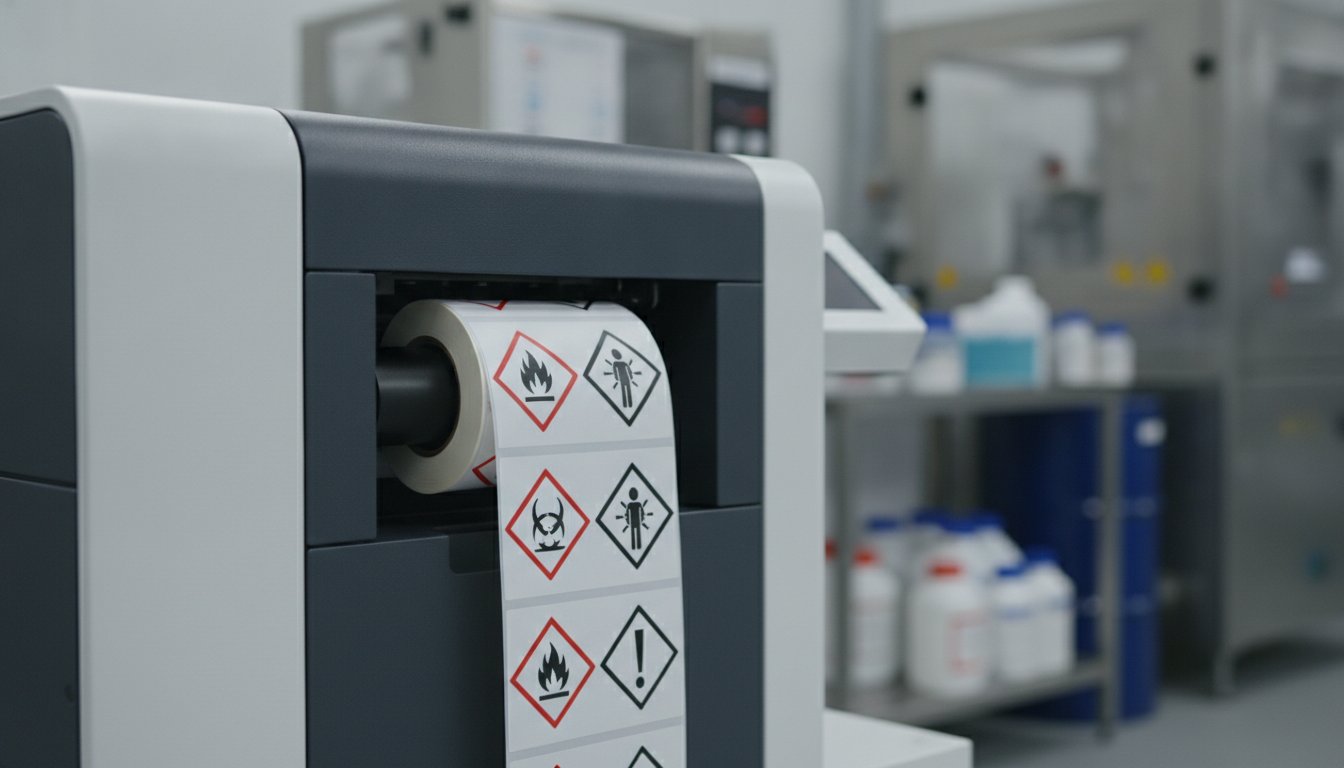
Is your facility fully ready for the July 20, 2026, OSHA deadline to update workplace labeling for substances? If you're still relying on expensive pre-printed stocks or struggling with the latest BS 5609:2024 requirements, you aren't alone. Most safety managers feel the pressure of rising costs and the constant fear of heavy non-compliance fines. It's frustrating to wait weeks for a shipment of labels only to find a regulation changed while they were in transit. You need a GHS label printer strategy that puts control back in your hands and cuts out the middleman.
We've designed this guide to simplify your transition to in-house production. You'll learn how to achieve full GHS and BS 5609 compliance using a reliable three-part system of hardware, pigment-based ink, and certified media. We'll break down the specific 2026 regulatory updates and provide hardware recommendations that fit your specific print volume. Whether you're managing small batches or high-speed industrial lines, you'll finish this guide with a clear, confident strategy to eliminate waste and keep your facility compliant.
Key Takeaways
- Understand how a modern GHS label printer system helps you meet OSHA's latest 2026 deadlines for substance and mixture labeling.
- Learn why BS 5609 compliance depends on the specific combination of pigment-based ink and certified media rather than just the printer hardware.
- Compare the "one-step" efficiency of color inkjet technology against traditional thermal transfer to find the right fit for your chemical hazard pictograms.
- Discover the essential steps to building a "certified system" in-house to eliminate the high costs and long lead times of pre-printed labels.
- Explore vetted hardware solutions like the Epson ColorWorks C6000A that bring professional quality and full regulatory compliance to your facility.
What is a GHS Label Printer? Understanding Chemical Compliance
A GHS label printer isn't just a standard piece of office equipment. It's a specialized system designed to produce labels that meet the strict standards of the Globally Harmonized System (GHS). Historically, chemical labeling relied on pre-printed templates or simple black-and-white thermal labels. Those days are gone. Modern regulations require high-contrast color to ensure safety icons are instantly recognizable. By 2026, the ability to print these complex designs on-demand has become a competitive necessity rather than a luxury.
The Core Requirements of GHS Labeling
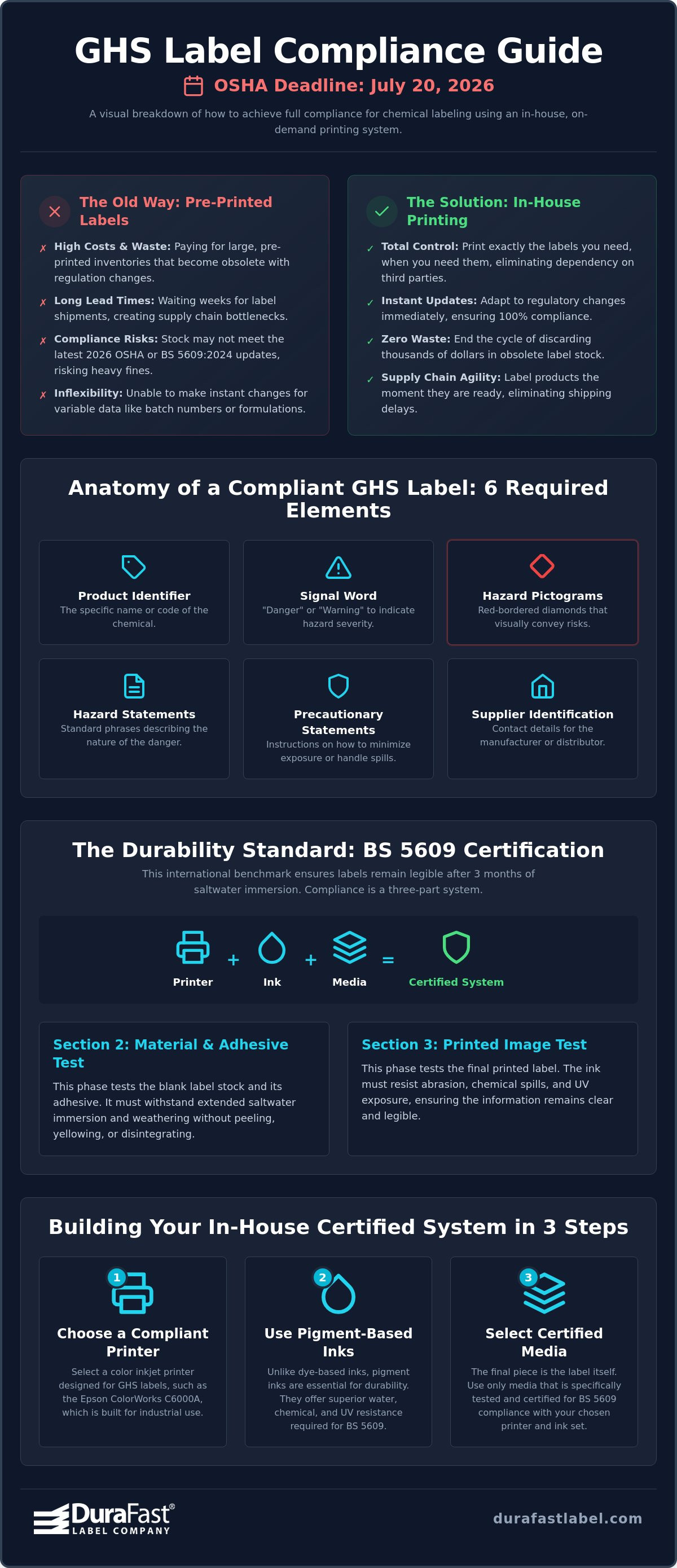
OSHA requires specific elements on every primary chemical container. You can't just slap a name on a bottle and call it compliant. A proper GHS label must include six specific components to communicate risk effectively:
- Product Identifier: The specific name or code of the chemical.
- Signal Word: Either "Danger" or "Warning" to indicate the severity of the hazard.
- Hazard Pictograms: The iconic red-bordered diamonds that visually represent the danger.
- Hazard Statements: Standardized phrases describing the nature of the danger.
- Precautionary Statements: Instructions on how to handle spills or minimize exposure.
- Supplier Identification: The contact details for the manufacturer or distributor.
Color is the most critical mandatory change in this system. Under GHS, pictograms must have a red border. Printing these in-house using a color label printer allows you to generate these symbols exactly when you need them. It also makes handling variable data easy. You can update batch numbers or supplier info for every run without changing your physical label stock.
Why In-House Printing is the Standard for 2026
Why are so many facilities moving away from third-party print houses? The answer lies in the 2026 regulatory deadlines. With substance labeling requirements updating by July 20, 2026, many businesses found their old inventory was suddenly illegal. In-house systems allow you to update your designs instantly as laws evolve. You don't have to throw away thousands of dollars in obsolete pre-printed stock. On-demand printing eliminates lead times for chemical shipments, ensuring your products are labeled and ready for transit the moment they're bottled. This level of agility is vital for maintaining a smooth supply chain in a tightening regulatory environment. It transforms compliance from a bottleneck into a seamless part of your daily workflow.
The Critical Link: BS 5609 Certification and Durability
A GHS label printer alone doesn't guarantee your facility is compliant. True safety in chemical labeling comes from a certified system where the printer, the ink, and the label material work together. The international benchmark for this durability is BS 5609. This British Standard specifically measures how well a pressure-sensitive label performs in harsh marine environments. If a chemical drum falls overboard, the label must remain attached and legible after three months of saltwater immersion. Without this level of durability, your safety information could literally wash away when it's needed most.
Meeting OSHA's labeling requirements isn't just about having the right icons. It's about ensuring those icons stay visible through abrasion, UV exposure, and chemical spills. Standard retail labels often fail these tests because they use weak adhesives or paper-based materials. In a chemical environment, these labels peel, yellow, or disintegrate. This is why matte chemical labels have become the industry baseline. They offer the rugged construction needed to survive the 2026 regulatory landscape.
Understanding the Two Parts of BS 5609
The BS 5609 standard is divided into two distinct testing phases. Section 2 focuses on the blank label material and the adhesive. It tests how well the "sandwich" of face stock and glue holds up against seawater and weathering. Section 3 tests the actual printed image. This involves checking the ink's resistance to abrasion and lightfastness. A common mistake is assuming a printer is "BS 5609 compliant" on its own. Compliance is only achieved when you use a specific ink set on a specific certified material. The new BS 5609:2024 revision, which took effect on December 31, 2024, has even stricter requirements for testing on high-density polyethylene (HDPE) surfaces.
Why Standard Inkjet Labels Fail Chemical Tests
Most desktop printers use dye-based inks because they produce vibrant colors for photos. However, dye ink is essentially watercolor; it smears the moment it touches a solvent or even a stray drop of water. For GHS compliance, you must use pigment-based inks. Pigment particles act like tiny stones that bond to the surface of DuraFast Matte Chemical Labels. This creates a "smear-proof" finish that resists solvents and heavy handling. If your current labels smudge when you rub them with a thumb, they won't pass a Section 3 durability test. If you're unsure if your current setup meets these standards, it's a good idea to speak with a compliance specialist to audit your media and ink combination.
Comparing GHS Printing Technologies: Inkjet vs. Thermal Transfer
Choosing the right hardware for your facility involves more than just picking a brand. You need to decide between two primary technologies: pigment inkjet and thermal transfer. Each has a specific role in chemical labeling; the right choice usually depends on how much color variability you need and your typical print volume. While both can produce compliant results, they handle the mandatory red pictograms and durability requirements in very different ways.
Pigment Inkjet: The One-Step Color Solution
Modern pigment inkjet technology has revolutionized chemical labeling by offering a "one-step" process. Printers like the Epson ColorWorks C6000A allow you to print your entire label, including the red GHS diamonds, black text, and branding, all in a single pass. This eliminates the need to buy and manage a massive inventory of pre-printed label shells with various pictogram configurations. It's the most efficient choice for "high-mix" environments where you might switch between dozens of different chemicals in a single day.
Beyond convenience, inkjet offers superior clarity for technical data. These Color Label Printers can reach resolutions up to 1200 dpi. This is vital when you need to fit lengthy hazard statements or precautionary instructions onto small containers. The text remains crisp and legible even at tiny font sizes, ensuring you don't compromise on compliance just because your bottle is small. Since the pigment ink bonds directly with the media, you get a finish that resists the "smear factor" we discussed in previous sections.
Thermal Transfer: Durability for Industrial Environments
If your facility operates in extreme industrial conditions, Thermal Transfer Label Printers remain a powerful option. These machines use a heated printhead to melt a resin ribbon onto the label surface. This creates a bond that is incredibly resistant to heat, intense abrasion, and aggressive chemicals. For high-volume runs of a single product, thermal transfer can be very cost-effective.
However, thermal transfer has a significant limitation: it's a single-color technology. To meet GHS standards, you generally have two choices. You can use pre-printed label shells that already have the red diamonds on them, or you can use a specialized dual-head printer that uses two different ribbons. Most businesses find that managing pre-printed shells is a logistical headache that leads to wasted inventory. If a regulation changes, those pre-printed diamonds might become obsolete overnight. Thermal transfer is best suited for high-speed, high-volume operations where the label design rarely changes, while inkjet is the clear winner for flexibility and on-demand updates.
Building Your In-House GHS Labeling System
Setting up an in-house station is the most effective way to gain control over your compliance workflow. It's not just about buying a machine and plugging it in. You're building a certified system where your GHS label printer, pigment-based inks, and chemical-resistant media work in perfect harmony. If any one of these components isn't vetted for the others, your labels won't stay compliant when exposed to moisture or solvents. Transitioning to an on-demand setup ensures you're ready for the 2026 deadlines without the headache of managing external print vendors.
Selecting Hardware for Compliance
Your choice of hardware must reflect your facility's daily output and physical environment. For smaller labs or facilities with moderate needs, a desktop GHS label printer like the Epson ColorWorks C6000A provides high-resolution color in a compact footprint. If you're operating on a high-speed production line, you'll likely need the ruggedness of an industrial barcode printer or a high-volume inkjet unit like the Afinia L801. These machines are built for 24/7 reliability and can handle the dust and vibration of a warehouse floor. Always verify that your chosen model uses pigment-based inks; this is the only way to ensure your printed images pass the BS 5609 Section 3 durability tests we discussed earlier.
The Role of BarTender Software in GHS Management
Software is often the "missing link" in a compliance strategy. We recommend using BarTender Professional to manage your label designs. This software automates the placement of GHS pictograms based on the specific hazards of each chemical. Instead of manually drawing red diamonds for every new product, you can link your templates directly to a central chemical database or Excel sheet. This "single source of truth" prevents data entry errors and ensures that every container leaving your facility is perfectly labeled. You can find more detail on this in our guide on how to choose and set up a label printer for chemical containers.
Finally, don't overlook the importance of verification. Integrating Datalogic barcode scanners into your labeling station allows your team to scan a chemical batch and automatically trigger the correct print job. This loop eliminates the risk of a worker accidentally applying a "Warning" label to a "Danger" substance. By combining the right hardware, software, and verification tools, you create a fail-safe environment that protects both your workers and your bottom line. If you're ready to build your station but aren't sure which components fit your volume, request a personalized compliance audit from our team today.
Top GHS Label Printer Solutions from DuraFast Label Company
Finding a reliable GHS label printer shouldn't be a guessing game. At DuraFast Label Company, we've done the heavy lifting by vetting the industry's top hardware and media combinations. We position ourselves as your primary North American partner for fully compliant systems. We don't just sell boxes; we provide the exact printer, ink, and label stock required to meet the 2026 OSHA standards. Our goal is to make your transition to in-house printing as simple and stress-free as possible.
Epson ColorWorks C6000A: The GHS Gold Standard
The Epson ColorWorks C6000A is often cited as the premier choice for chemical facilities. It's a workhorse that fits perfectly into a desktop environment while delivering industrial-grade results. This model handles labels up to 4 inches wide, which is the sweet spot for most standard chemical containers and jugs. A built-in auto-cutter allows you to create custom lengths on the fly, reducing waste and improving workflow efficiency. Because it uses specialized pigment inks, it delivers the smudge-free, durable output required for BS 5609 Section 3 compliance. For the best results, pair this machine with our Epson Inkjet Labels to ensure your pictograms stay vibrant and legible through the life of the product.
For facilities that need a bit more versatility, the Afinia L502 is an excellent alternative. It features a unique dual-ink system that allows you to swap between dye and pigment cartridges. While you'll always use pigment for your GHS runs to ensure chemical resistance, the ability to switch gives you more flexibility for standard retail branding. If your volume is significantly higher, we also offer the Afinia L801, which uses Memjet technology to produce high-speed results without compromising on the durability your safety managers demand.
Specialized Media: DuraFast Matte Chemical Labels
Even the best GHS label printer will fail a compliance audit if the media isn't up to the task. Our DuraFast Matte Chemical Labels are engineered specifically for the rigors of BS 5609 certification. These labels feature an exceptionally aggressive adhesive designed to bond with high-density polyethylene (HDPE) and metal drums. They won't peel, flag, or yellow even when exposed to harsh weather, UV light, or chemical spills. We've tested these materials in the toughest conditions to ensure they meet the 2024 BS 5609 revisions. We encourage you to request samples to test against your specific chemical exposure. It's the most reliable way to ensure your facility is ready for the July 2026 OSHA deadlines and beyond.
Future-Proof Your Chemical Labeling Strategy
Achieving full chemical compliance doesn't have to be a complex or overwhelming process. By bringing your labeling in-house, you eliminate the high costs of pre-printed inventory and the stress of waiting on external vendors. Just remember that true compliance is a complete system. It requires the right GHS label printer, pigment-based inks, and BS 5609 certified media working together to withstand harsh environments.
As an authorized dealer for industry leaders like Epson, Afinia, and Zebra, DuraFast Label Company has already done the hard work of vetting these systems for you. We specialize in providing BS 5609 certified media and offer expert technical support to help you set up your GHS station correctly from day one. Whether you're meeting the July 2026 OSHA deadlines or just looking to streamline your warehouse, we have the tools to help you succeed.
Don't let regulatory changes slow down your production. Our team is here to simplify your decision-making process and provide the reliability your business depends on. We're ready to help you transform your labeling workflow into a seamless, cost-effective operation.
Browse our GHS-compliant color label printers and start saving today.
Frequently Asked Questions
What makes a label printer GHS compliant?
A printer becomes GHS compliant when it's part of a certified system that produces mandatory red pictograms and durable hazard text. It isn't just about the hardware; it's about the combination of the machine, pigment based ink, and specialized media. The system must be capable of printing high resolution safety data that remains perfectly legible under harsh conditions. This ensures you meet all OSHA standards for hazard communication in industrial environments.
Do I need a special ink for GHS labels?
Yes, you must use pigment based ink to achieve GHS and BS 5609 compliance. Dye based inks are prone to smearing and fading when they touch water or chemicals. Pigment ink contains solid particles that bond with the label surface, creating a smudge proof finish that resists UV light and aggressive solvents. This is a non negotiable requirement for passing Section 3 durability testing in chemical facilities.
What is the difference between GHS and BS 5609?
GHS is the regulatory standard for the content and design of the label, while BS 5609 is the standard for the physical durability of the label. GHS dictates what symbols and words you use to warn about hazards. BS 5609 ensures that those warnings don't fall off or fade if a container is lost at sea. You need both to be fully compliant for international chemical shipping.
Can I use a standard laser printer for GHS labels?
You can use some laser printers, but a dedicated GHS label printer using pigment inkjet technology is far more reliable for chemical environments. Laser toner often flakes or cracks when the label is bent or exposed to specific industrial solvents. Specialized inkjet printers are designed to handle the thick, synthetic media required for chemical containers. They ensure the ink bonds deeply with the surface for maximum durability.
Is color printing required for all GHS labels?
Color is mandatory for the red bordered pictograms on all primary chemical containers. OSHA requires these red diamonds to be clearly visible to ensure immediate hazard recognition by workers. While some secondary containers have fewer requirements, any label using GHS pictograms must use the correct color scheme. Printing these in house allows you to stay compliant without stocking dozens of different pre printed label rolls.
How much can I save by printing GHS labels in-house?
Savings vary by facility, but most businesses significantly reduce costs by eliminating pre printed label waste and rush shipping fees. You stop paying for inventory that might become obsolete and only print what you need for today's production. Some industry data suggests that thermal transfer labels cost between 1 and 3 cents each. In house systems provide a much lower total cost of ownership than buying small batches.
What software is best for designing GHS labels?
BarTender Professional is widely considered the industry standard for GHS label design. It features built in templates and automation tools that correctly place pictograms based on your specific chemical data. This software reduces the risk of human error by linking directly to your existing databases. It ensures that every container leaving your facility has the correct hazard statements and precautionary instructions without any manual data entry.
Does the Epson ColorWorks C6000A support BS 5609 Section 3?
Yes, the Epson ColorWorks C6000A supports BS 5609 Section 3 when you pair it with certified media like DuraFast Matte Chemical Labels. This GHS label printer uses UltraChrome DL pigment ink which was specifically engineered to pass rigorous saltwater immersion and abrasion tests. Using this machine as part of a vetted system ensures your facility meets the highest international standards for label legibility. It provides peace of mind for global shipping.