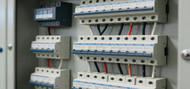
Why Is the Control Panel Wire Numbering Standard Important?
24th Feb 2026
Key Highlight
-
Proper control panel wire numbering ensures every conductor, terminal, and connection point is easily identifiable, improving safety and reducing maintenance errors.
-
Industry standards like NEC, UL 508A, and IEC define how wires, circuit breakers, and terminals should be numbered and labeled.
-
Manual labeling can cause human error, fading, or inconsistent markings, slowing troubleshooting and risking equipment damage.
-
MAX Letatwin printers create durable, heat-resistant labels, supporting industrial control panel wire numbering and consistent control panel wire labeling.
-
Consistent numbering, clear labels, and correct control panel wire colors reduce downtime, improve efficiency, and maintain compliance with industry regulations.
-
Best practices include durable materials, standardized numbering sequences, ferrule marking, and periodic label inspection to ensure long-term readability and safety.
Industrial control panels contain numerous wires, terminals, and relays. Without a clear numbering system, technicians struggle to identify control circuits, AC/DC lines, and connection points. This confusion increases the risk of mistakes, downtime, and equipment damage.
Complex systems with multiple circuit breakers, PLCs, and power supply connections make the problem even worse. Inaccurate or missing labels slow maintenance and troubleshooting. Manual labeling often leads to errors, illegible markings, and inefficiency. This creates costly delays for electricians and facility managers.
This blog covers the control panel wire numbering standard, key industrial control panel wire numbering schemes, effective labeling practices, and tools like MAX Letatwin printers that streamline compliance, improve clarity, and enhance operational safety across electrical systems.
What Happens When Wire Numbering Goes Wrong in Control Panels?
Industrial control panels contain countless wires, terminals, and relays!
Without a clear numbering system, technicians are forced to guess which conductor does what. This leads to confusion, delays, and unsafe working conditions.
When control circuits, AC/DC lines, and connection points aren’t labeled accurately, even simple maintenance becomes risky. Misidentifying a wire can trigger downtime, damage equipment, or cause costly mistakes.
The problem grows in complex systems with multiple circuit breakers, PLCs, and power supply connections. Missing or faded labels slow troubleshooting dramatically. Manual marking methods increase errors and inefficiencies, creating expensive delays for electricians and facility managers.
What Are the Common Industry Standards for Wire Numbering and Identification?
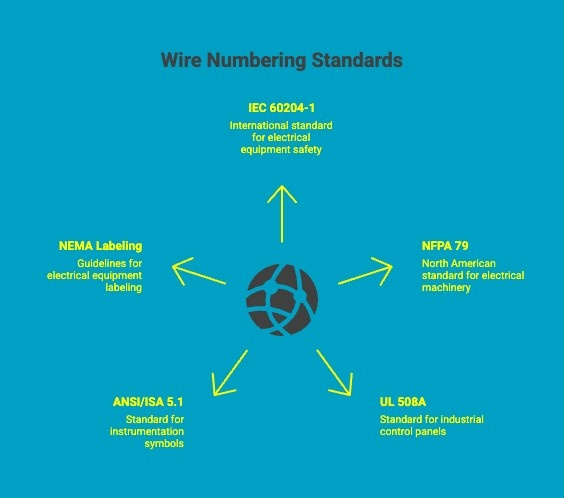
Control panels across industrial, commercial, and manufacturing environments must follow established wire numbering standards to ensure safety, clear identification, and regulatory compliance.
While different industries use different approaches, these core standards outline how wires must be labeled, documented, and maintained throughout their lifecycle.
Here’s what each standard means and why it matters:
1. IEC 60204-1
Defines global safety and identification requirements for electrical equipment used in industrial machines. It focuses on consistent numbering and labeling practices to support safe operation and international manufacturing environments.
2. NFPA 79
The primary US standard for industrial machinery wiring. It specifies how wires must be identified to minimize electrical hazards and improve serviceability. Essential for facilities operating electrically powered machinery.
3. UL 508A
Lists construction and labeling requirements for industrial control panels, including durability expectations and label placement rules. This is critical for passing panel inspections and achieving UL certification.
4. ANSI/ISA 5.1
Covers standardized naming and identification practices for instrumentation and control systems. Widely used in process industries such as oil and gas, water treatment, and chemical facilities.
5. NEMA Labeling Guidelines
Provide durability and environmental performance criteria, ensuring labels remain readable in harsh environments involving heat, vibration, or chemical exposure.
Following these standards ensures consistency, improves technician safety, reduces downtime, prevents miswiring, and supports compliance during audits and inspections. They help control panels remain well-organized, serviceable, and trusted throughout years of operation.
What Are the Challenges of Manual Wire Labeling in Industrial Control Panels?
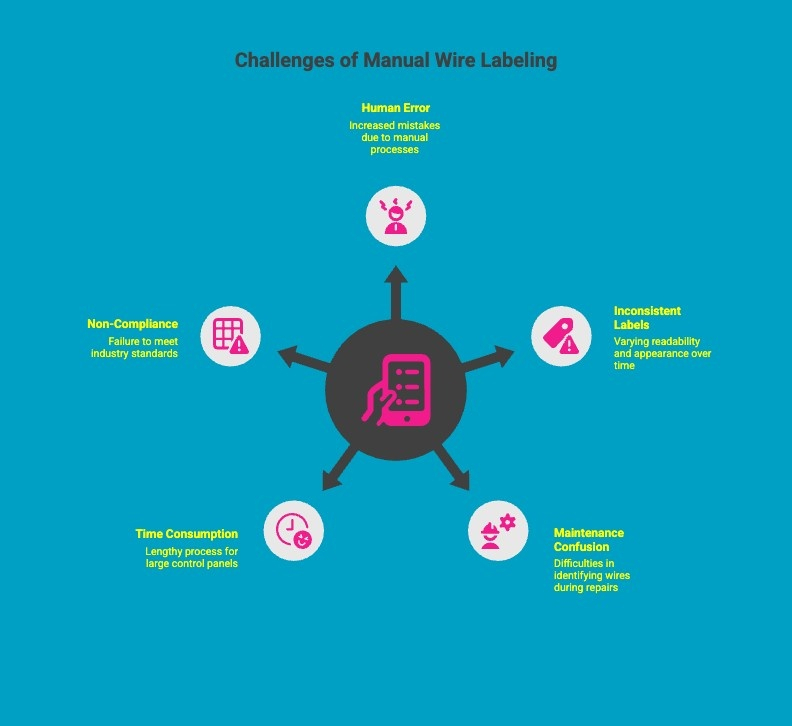
Manual wire labeling may seem simple, but in real industrial environments it often leads to serious problems that slow down operations and increase risk.
These issues become especially obvious during emergency troubleshooting, PLC commissioning, or audit inspections, where clarity and speed are critical.
Below are the most common challenges technicians face on the job:
1. Emergency Fault Troubleshooting
Manual labels are vulnerable to mistakes when work is done quickly under pressure.
Miswritten numbers, skipped wires, or inconsistent markings can cause technicians to disconnect or test the wrong conductor. This extends downtime, increases safety risks, and disrupts critical repair windows where every minute counts.
2. Commissioning a New PLC Panel
Large control panels may include hundreds or thousands of wires feeding PLCs, relays, and field devices.
Handwriting labels for every conductor slows commissioning and project delivery. Time spent writing, cutting, and applying labels manually becomes a bottleneck that drives up labor costs and delays production startup.
3. Audit and Compliance Inspections
Manual labels often fail durability expectations and readability requirements under UL, NFPA, IEC, or customer standards.
Faded or inconsistent labels can trigger audit failures and require rework before equipment can be approved. Poor labeling is a top reason panels fail acceptance inspections and require expensive corrective work.
4. Faded Markings Leading to Maintenance Confusion
Heat, motion, and dust quickly degrade ink-based handwriting in industrial environments.
Once markings fade, technicians must manually trace conductors to identify circuits, turning a simple task into hours of unnecessary troubleshooting and risking accidental disconnection or equipment damage.
5. Non-Standard Formats Increasing Miscommunication
Without standardized numbering rules, different technicians may use different methods, abbreviations, or placement.
When team members rotate or new contractors take over, unclear labels create confusion, slow maintenance, and increase the chance of wiring errors that affect system performance or safety.
How the MAX Letatwin Printer Simplifies Compliance With Wire Numbering Standards?
Meeting UL 508A, NFPA 79, IEC 60204-1, and NEC requirements requires clear, permanent, and standardized wire identification.
Manual handwritten labels often fail durability, readability, and consistency expectations, leading to audit failures, safety concerns, and costly rework.
The MAX Letatwin printer directly addresses these compliance pain points by replacing inconsistent manual marking with uniform, code-ready labeling designed for industrial control panels.
The printer automates sequencing, cutting, and printing, ensuring every label matches required standards for placement, legibility, and long-term durability. This makes it easier to document circuit paths, support electrical inspections, and pass acceptance testing without delays.
For audit teams and field technicians, printed labels eliminate ambiguity, improve fault tracing, and reduce the risk of disconnecting the wrong conductor during emergency troubleshooting or PLC commissioning.
How Does MAX Letatwin Supports Regulatory Compliance?
Achieving compliance with UL, NFPA, IEC, and NEC requirements means maintaining clear, standardized, and durable wire identification throughout a control panel’s lifetime.
The MAX Letatwin helps meet these expectations by supporting labeling consistency and long-term traceability.
Here’s how it strengthens compliance:
-
Produces permanent, smudge-proof markings that meet UL/NFPA/IEC durability requirements
-
Ensures standardized numbering formats for accurate documentation during audits
-
Maintains legibility in harsh environments where handwritten labels fade
-
Supports panel traceability required for UL and ISO quality documentation
-
Reduces error-related downtime and labor costs by eliminating manual relabeling
What Are the Key Functional Advantages?
Beyond compliance, the MAX Letatwin offers powerful tools that improve efficiency and accuracy during installation, commissioning, and maintenance. These features make labeling faster, more reliable, and scalable for complex or large industrial control panels.
Key capabilities include:
-
Automatic number sequencing for error-free labeling
-
Auto-cutting for clean ferrules and consistent finish
-
Heat- and chemical-resistant output suitable for industrial environments
-
Compatible with heat-shrink tubing, ferrules, and wrap-around labels
What Are the Key Benefits of Proper Wire Numbering in Control Panels?
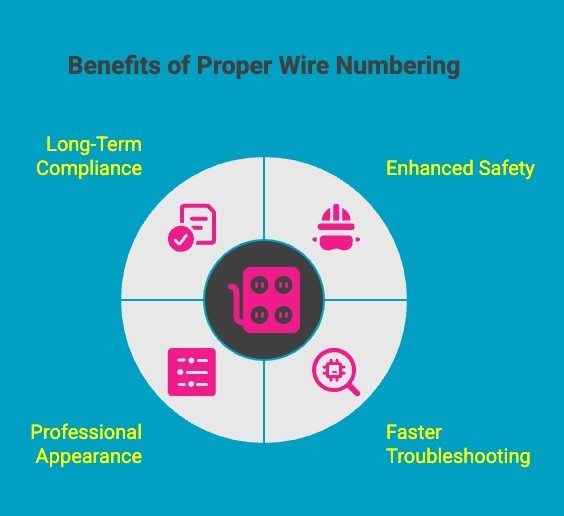
Proper wire numbering isn’t just about neatness! It directly affects safety, troubleshooting speed, compliance, and long-term reliability.
The difference between a well-numbered panel and a poorly labeled one becomes obvious during real-world scenarios such as emergency shutdowns, PLC failures, or audit inspections.
Manual Labeling vs Proper Wire Numbering: What’s the Real Difference?
Before we look at the individual benefits, it helps to compare what actually happens when wire numbering is done correctly versus manually or poorly. Here’s a quick side-by-side snapshot showing the real-world impact:
|
Criteria |
Manual / Poor Labeling |
Proper Automated Wire Numbering (e.g., MAX Letatwin) |
|---|---|---|
|
Safety |
Higher risk of miswiring and accidental contact with live circuits due to unclear markings |
Clear identification prevents electrical hazards and supports safer lockout/tagout procedures |
|
Troubleshooting Time |
Can take hours tracing wires manually during emergency shutdowns |
Circuits identified instantly, reducing downtime and speeding repairs |
|
Audit & Compliance |
Likely to fail UL 508A, NFPA 79, or IEC inspections due to unreadable or missing labels |
Meets durability and formatting standards required for regulatory compliance and approval |
|
Durability |
Ink smears, fades with heat/vibration, labels peel off or fall |
Heat-resistant, permanent, chemical-proof industrial labels stay readable for years |
|
Project Timelines |
Slow and labor-intensive; handwritten labels delay commissioning |
Automatic sequencing and cutting support fast completion of large control panel projects |
|
Accuracy |
Prone to human error, inconsistent handwriting, skipped wires |
Automated print reduces mistakes with uniform, precise labeling |
|
Professional Appearance |
Messy layout creates confusion and poor perception during inspections |
Clean, orderly appearance improves clarity and trust among customers, auditors, and technicians |
|
Long-Term Cost |
Expensive rework, downtime losses, failed inspections, emergency relabeling |
Lower lifecycle cost through reliability, safety, and reduced maintenance labor |
Here’s how correct wire identification delivers real, measurable value compared to manual or inconsistent labeling:
1. Enhanced Safety and Reduced Risk of Electrical Accidents
With handwritten or missing labels, technicians may disconnect the wrong conductor or access a live circuit without realizing it.
Clear printed numbering eliminates guesswork, reducing electrical hazards, preventing accidental contact with energized wiring, and supporting safer lockout/tagout procedures, especially in high-voltage industrial environments.
2. Faster Troubleshooting and Maintenance
When labels are faded, inconsistent, or handwritten, technicians waste time tracing wires manually.
With correct numbering, circuits are immediately identifiable, reducing hours of downtime during emergency fault repairs or equipment stoppages. Faster fault resolution translates into lower labor costs and improved production continuity.
3. Professional and Organized Control Panel Appearance
Disorganized wiring and mismatched labels cause confusion for new team members, contractors, or inspectors.
Clean, consistent numbering makes control panels readable at a glance, supports standardization across facilities, and reflects professional craftsmanship that builds trust during commissioning or handover.
4. Long-Term Compliance and Reduced Audit Issues
Regulations such as UL 508A, NFPA 79, and IEC 60204-1 require durable, legible, and standardized wire identification.
Poor labeling can lead to failed inspections, delays in acceptance testing, and costly rework. Proper wire numbering ensures documentation accuracy, audit readiness, and worry-free compliance throughout the equipment lifecycle.
What Are the Best Practices for Wire Numbering and Labeling?
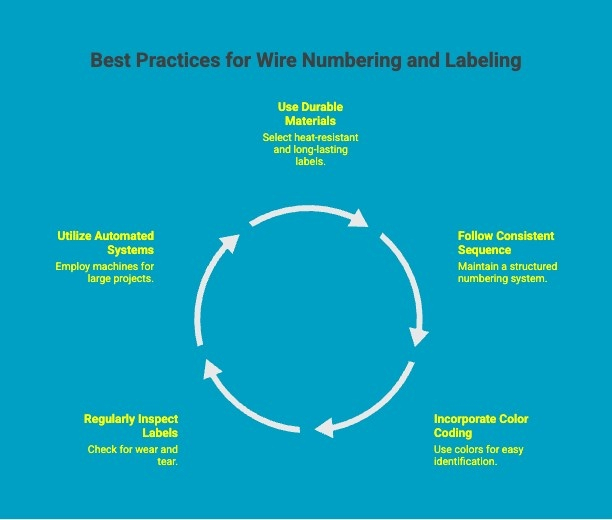
Proper wire numbering doesn’t just support organization, it ensures long-term safety, easier maintenance, and compliance with major industry standards.
Following proven methods helps keep wiring consistent, readable, and dependable throughout a control panel’s life cycle.
Below are the best practices to implement:
1. Use Durable and Heat-Resistant Labeling Materials
Industrial control panels often operate in environments with high temperatures, vibration, and moisture. Using durable, heat-resistant labeling materials ensures wire markers remain legible over time, preventing confusion and maintaining compliance with industry standards even in demanding operating conditions.
2. Follow a Consistent Numbering and Labeling Sequence
A consistent numbering sequence helps technicians trace circuits quickly and reduces the chance of misidentification. Standardized labeling improves documentation accuracy, supports smoother installations, and ensures the entire control panel follows the same clear structure from end to end.
3. Incorporate Color Coding and Ferrule Marking for Clarity
Color coding adds an extra layer of clarity by visually grouping wires based on function, voltage, or system type. When paired with ferrule marking, it enhances organization, reduces wiring mistakes, and improves overall readability within complex control panels.
4. Regularly Inspect and Replace Worn or Damaged Labels
Labels can fade, peel, or degrade over time, especially in harsh industrial environments. Regular inspections ensure all wire markings remain clear, accurate, and attached securely. Replacing damaged labels promptly helps maintain safety, organization, and compliance.
5. Utilize Automated Printing Systems for Large-Scale Projects
Automated printing systems save time and deliver consistent, professional wire markers for large control panel projects. These tools reduce human error, improve readability, and ensure durable labeling that meets industry standards while speeding up production and installation processes.
How Can DuraFast Help You Meet Wire Numbering Standards?
If you want consistent, accurate, and compliant wire identification, you need labeling tools engineered for industrial environments.
DuraFast Label Company provides genuine MAX Letatwin tube and tape printers, designed specifically for control panel wire numbering tasks.
These printers create crisp, permanent markings on heat-shrink tubing, ferrules, and wrap-around labels, helping you meet any control panel wire numbering standard with ease. Their durable materials resist heat, vibration, moisture, and long-term wear, ensuring your labels remain readable and reliable.
Whether you're building new panels or upgrading existing systems, DuraFast delivers the high-performance tools you need for professional control panel wire labeling and long-term compliance.
Conclusion
Proper wire numbering is not just a technical requirement, it is essential for safety, efficiency, and compliance in industrial and commercial control panels.
Following a recognized control panel wire numbering standard ensures every conductor is clearly identifiable, reducing the risk of electrical hazards and mistakes during troubleshooting or maintenance.
Consistent labeling, combined with the correct control panel wire colors and professional control panel wire labeling, makes systems easier to manage and inspect.
Using reliable tools, such as MAX Letatwin printers, ensures durable, legible, and compliant markings that last over time.
Implementing these best practices improves safety, accelerates maintenance, maintains professional organization, and guarantees long-term compliance with UL, NFPA, and IEC standards.
Frequently Asked Questions
Where should wire numbers be placed on wires inside an electrical panel?
Wire numbers should be placed at both ends near terminal blocks, connection points, and circuit breakers. Proper placement ensures electricians can quickly trace control circuits, power supply lines, and AC or DC wiring during maintenance or troubleshooting.
Are there any industry standards or guidelines for control panel wire numbering?
Yes. Standards like NEC, UL 508A, NFPA 79, and IEC 60204-1 define how wires, terminals, and control circuits must be identified. They specify numbering, labeling, and documentation requirements to maintain safe, organized electrical systems.
How do you choose wire numbers for control panel wiring in industrial electronics?
Wire numbers should reflect the control circuits, power supply, relays, PLC connections, and terminal blocks per schematics or CAD diagrams. Consistent numbering simplifies troubleshooting, reduces downtime, and ensures compliance with NEC and company standards.
Why Is MAX Letatwin the Best Option for Control Panel Labeling?
MAX Letatwin printers produce clear, durable labels for AC, DC, relays, PLCs, and new wire terminations. Their precision helps maintain readable numbering on terminal blocks, conduits, and circuit breakers, ensuring compliance with industry standards and safe electrical systems.
Where can I buy genuine MAX Letatwin printers and consumables?
Genuine MAX Letatwin printers, new wire labels, tubes, and ferrules are available from DuraFast Label Company, a trusted supplier for electricians managing control circuits, PLCs, AC/DC lines, and industrial control panels needing durable, compliant labeling.
How do labeling standards like British Electricity Boards S12 affect wire numbering?
Standards such as British Electricity Boards S12 provide guidance on labeling control circuits, AC/DC wiring, circuit breakers, and terminal blocks, ensuring consistent wire numbering, clear connection points, and safer, more efficient operation of industrial control panels.