What Makes Halogen Free Wire a Safer Modern Wiring Choice?
8th Jul 2026
Key Highlights
• Wire and cable designed without halogen-based compounds reduce toxic and corrosive gas release during fires.
• Low smoke insulation improves visibility and evacuation safety in enclosed and high-occupancy environments.
• These cables are commonly specified for public buildings, industrial sites, transit systems, and data centers.
• Performance and safety are governed by international standards for flame retardancy, smoke density, and material testing.
• Clear, durable labeling is essential for correct identification during installation, inspection, and maintenance.
• Proper identification supports long-term compliance, traceability, and overall electrical system reliability.
Fire safety, regulatory compliance, and long-term reliability are major concerns when selecting wire and cable for modern electrical installations. Many projects struggle with understanding which materials truly reduce risk during fire events while still meeting performance and code requirements.
Standard cables can introduce hidden dangers, including toxic smoke and corrosive gas release, which threaten occupants, first responders, and sensitive equipment. Without clear knowledge of safer alternatives, these risks often go unaddressed until inspections, upgrades, or emergencies expose the consequences.
This blog explains what halogen-free wire is, why it is increasingly specified, where it is commonly used, and how proper identification and standards help ensure safer, compliant electrical systems from installation through ongoing operation.
How Do Halogen Free Wires Differ From Standard Cables?
Halogen-free wires differ from standard cables mainly in how they behave during a fire. Traditional cables often contain halogens like chlorine, which release dense, corrosive smoke and toxic gases when burned. Halogen-free wires use alternative compounds that produce very low smoke and no corrosive fumes.
This difference matters most in enclosed or high-occupancy spaces such as data centers, hospitals, tunnels, and commercial buildings. Reduced smoke improves visibility during evacuation, while noncorrosive gases help protect people, electronics, and infrastructure.
Standard cables may still be acceptable in less critical environments, but halogen-free wiring is increasingly preferred where safety, compliance, and asset protection are priorities. Many building codes now recommend or require halogen-free cabling for public installations.
What Types of Halogen Free Wires Are Available?
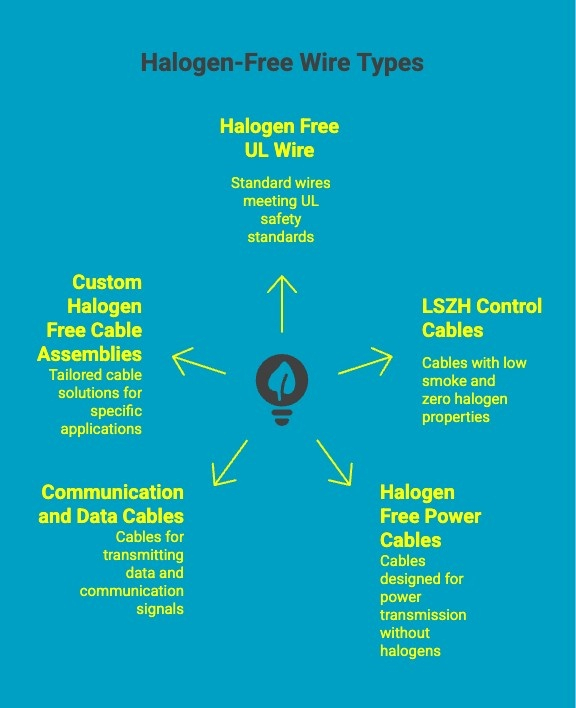
Halogen-free wires are available in several specialized formats to meet different electrical, control, and data transmission needs. Each type is designed to minimize toxic emissions while maintaining performance, durability, and compliance in safety-critical environments.
Below are the most common types of halogen-free wires and cables used across industrial, commercial, and infrastructure applications:
• Halogen Free UL Wire: Approved for equipment wiring, offering flame resistance and low smoke performance in control panels and machinery
• LSZH Control Cables: Used for automation and signaling where flexibility, fire safety, and reliability are required
• Halogen-Free Power Cables: Designed for safe power distribution in buildings, transit systems, and public spaces
• Communication and Data Cables: Support network and signal transmission with reduced smoke and zero corrosive gas output
• Custom Halogen-Free Cable Assemblies: Built to specific voltage, insulation, and environmental requirements
Choosing the right halogen-free cable type ensures safer installations, better compliance, and long-term protection for people and equipment.
What Are the Key Benefits of Using Halogen Free Wire?
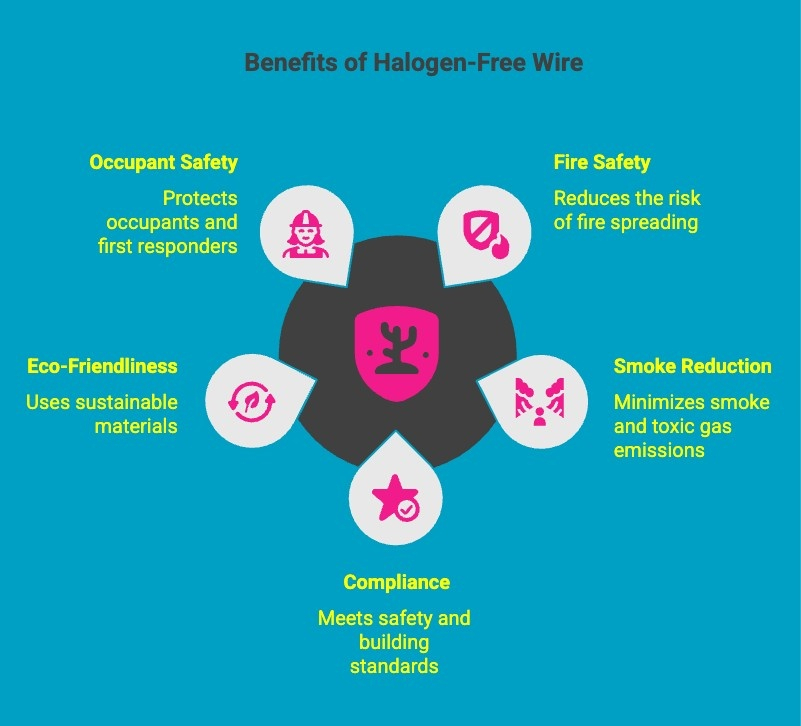
Halogen-free wire offers important safety, environmental, and compliance advantages in modern electrical systems. Its design reduces secondary fire risks and long-term hazards.
Here are the key benefits that explain why halogen-free wiring is increasingly preferred across industries:
1) Improved Fire Safety
Improved fire safety is the primary advantage of halogen-free wire. Traditional halogen-based insulation releases acidic gases when burned, creating additional hazards during a fire. Halogen-free materials are engineered to resist flame spread while avoiding these toxic byproducts. This approach slows combustion, reduces flame propagation, and supports self-extinguishing behavior without compromising occupant safety.
2) Reduced Smoke and Toxic Gas Emissions
Halogen-free wire produces significantly less smoke and no corrosive gases during combustion. Standard PVC cables can emit dense smoke and hydrogen chloride, which impairs visibility and damages lungs and equipment. Low smoke output keeps escape routes clearer and air quality safer, improving evacuation outcomes and reducing damage to sensitive electronics and structural components.
3) Better Compliance With Safety and Building Standards
Using halogen-free wire simplifies compliance with modern safety and construction regulations. Many standards now restrict hazardous substances and promote low-smoke solutions. Regulations such as the RoHS directive and IEC testing standards support this shift, making halogen-free cables a future-ready choice for regulated environments.
4) Eco-Friendly and Sustainable Material Use
Halogen-free wires support sustainability by using cleaner materials that are easier to recycle. Halogen-based plastics can contaminate recycling streams and create toxic byproducts during disposal. In contrast, halogen-free insulation reduces environmental impact throughout the cable lifecycle. This contributes to responsible waste management, supports circular economy goals, and lowers long-term environmental risk.
5) Safer for Occupants and First Responders
In emergencies, halogen-free wiring improves conditions for both occupants and first responders. Lower smoke density preserves visibility, helping people locate exits quickly. The absence of toxic gases reduces the risk of respiratory injury and suffocation. Firefighters and rescue teams can operate more safely inside affected buildings, improving rescue effectiveness and reducing exposure-related injuries.
Halogen-free wire delivers a broader safety and sustainability advantage than standard cables. By reducing toxic emissions, supporting compliance, and protecting people and assets, it has become a preferred solution for modern electrical installations where safety and responsibility matter most.
Where Are Halogen Free Wire and Cable Commonly Used?
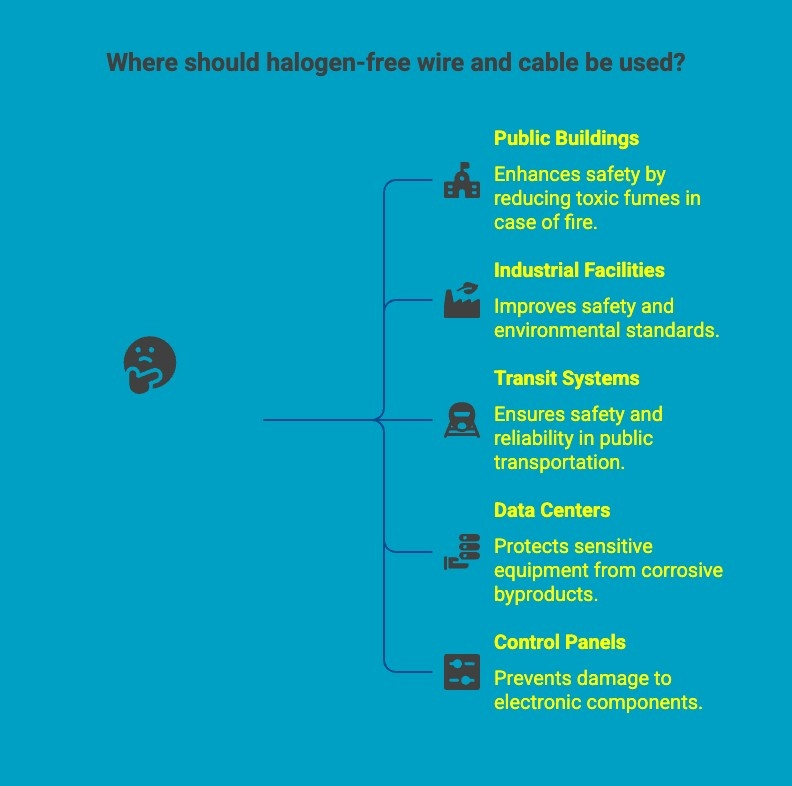
Halogen-free wire and cable are widely used in environments where fire safety, low smoke output, and protection of people and equipment are critical. Their performance during emergencies makes them especially suitable for enclosed, high-occupancy, and technology-heavy spaces.
Here are the most common applications where halogen-free wire and cable are specified to meet safety, compliance, and reliability requirements:
• Public Buildings and Commercial Spaces: Offices, shopping centers, hospitals, and schools use halogen-free cables to improve evacuation safety and reduce toxic smoke exposure.
• Industrial and Manufacturing Facilities: Applied in factories and plants to protect workers and machinery and control systems from corrosive fire byproducts
• Railways, Airports, and Transit Systems: Essential for tunnels, platforms, and vehicles where confined spaces demand low smoke and zero corrosive gas emission
• Data Centers and IT Infrastructure: Safeguards sensitive servers and network equipment while maintaining visibility and air quality during fire incidents
• Control Panels and Automation Equipment: Ensures clear identification, system reliability, and safer maintenance in electrical and automation installations
By reducing fire-related risks and protecting both people and assets, halogen-free wire and cable have become a standard choice across safety-critical applications and regulated environments.
What Standards Govern Halogen Free Wire and Cable?
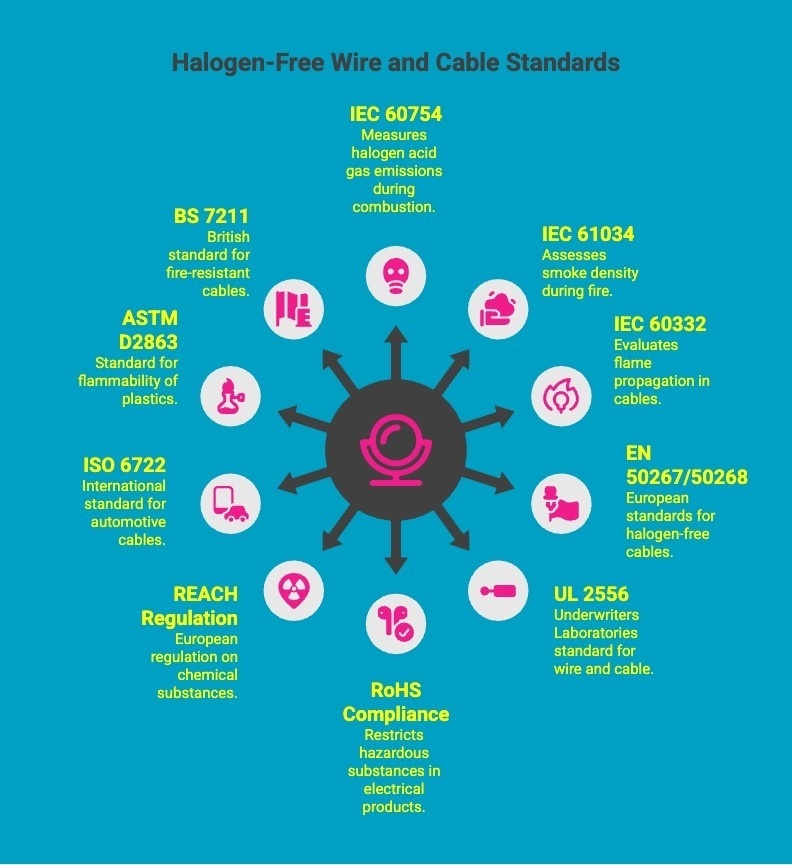
Halogen-free wire and cable are governed by a range of international standards designed to verify fire behavior, smoke output, material safety, and environmental compliance. These standards ensure cables perform safely in critical environments and meet regulatory expectations across different regions and industries.
Here are the key standards that define how halogen-free wire and cable are tested, certified, and approved for use:
• IEC 60754: Tests cables for halogen acid gas emissions during combustion, confirming zero or very low corrosive gas release, set by the International Electrotechnical Commission
• IEC 61034: Measures smoke density produced by burning cables to assess visibility during fire conditions
• IEC 60332: Evaluates flame retardancy and fire propagation behavior of electrical cables
• EN 50267 and EN 50268: European standards covering halogen content, smoke density, and gas acidity for LSZH cables
• UL 2556: Defines fire, smoke, and material performance test methods under Underwriters Laboratories
• RoHS Compliance: Ensures restricted hazardous substances are not used, enforced across the EU
• REACH Regulation: Controls chemical safety and material transparency for cable components
• ISO 6722: Specifies performance requirements for halogen-free automotive wiring from the International Organization for Standardization
• ASTM D2863: Uses oxygen index testing to measure material flammability, developed by ASTM International
• BS 7211: British standard for low-smoke, halogen-free power cables issued by British Standards Institution
Together, these standards provide a comprehensive framework for evaluating safety, fire performance, and environmental responsibility, ensuring halogen free wire and cable meet the demands of modern, safety-critical installations.
What Are the Best Practices for Labeling Halogen Free Wire for Safety and Compliance?
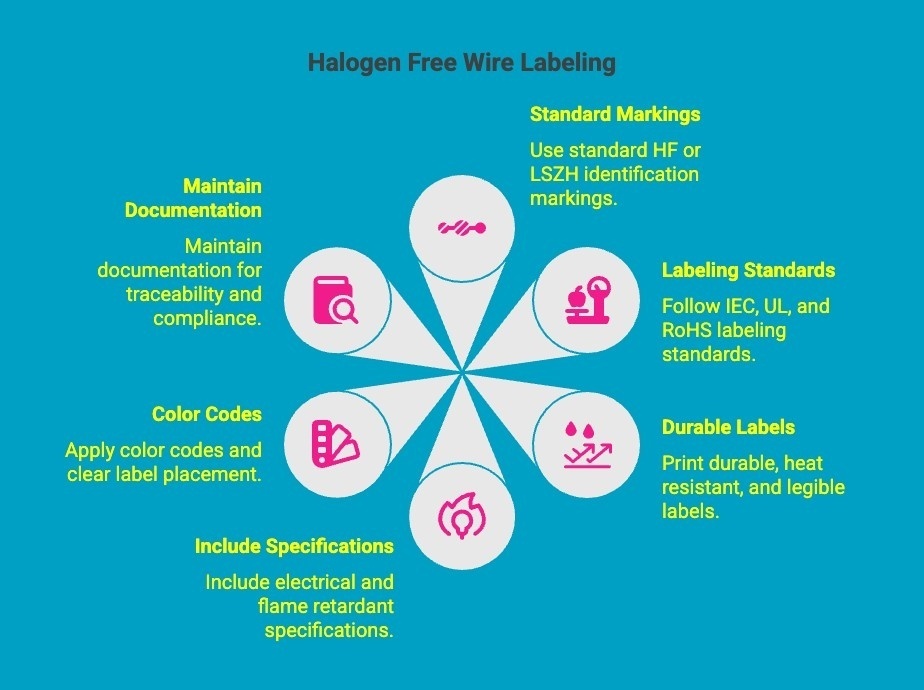
Proper labeling of halogen free wire is essential for safety, regulatory compliance, and long-term system reliability. Clear, durable identification helps technicians quickly verify cable properties, including halogen free wire insulation and the use of halogen free flame retardants for wire and cable applications. This prevents installation errors and supports inspections across industrial, commercial, and public environments.
Here are the best practices for labeling halogen-free wire to meet safety expectations and compliance requirements:
• Using Standard HF or LSZH Identification Markings: Clearly mark cables as HF or LSZH to indicate low smoke and zero halogen performance at a glance.
• Following IEC, UL, and RoHS Labeling Standards: Align labels with requirements set by the International Electrotechnical Commission, Underwriters Laboratories, and RoHS
• Printing Durable, Heat-Resistant, and Legible Labels: Use materials and printing methods that remain readable under heat, abrasion, oil, and cleaning chemicals.
• Including Electrical and Flame Retardant Specifications: Add voltage ratings, conductor size, temperature class, and flame performance details for accurate identification
• Applying Color Codes and Clear Label Placement: Follow recognized color-coding schemes and place labels where they are visible without removing insulation or components.
• Maintaining Documentation for Traceability and Compliance: Keep records linking cable labels to test reports, certifications, and material data for audits and inspections.
Consistent labeling practices improve safety, simplify compliance checks, and reduce maintenance risks. When halogen-free wire is clearly identified and properly documented, it supports safer installations and long-term regulatory confidence.
What Makes the MAX LETATWIN LM-550A3BH the Best Printer for Halogen-Free Wire Identification?
The MAX LETATWIN LM-550A3BH is considered one of the best printers for halogen-free wire identification because it is designed specifically for high-accuracy, high-durability wire marking. It prints directly onto heat shrink tubing and wire markers that stay legible on HF and LSZH insulation, even when exposed to heat, abrasion, oil, and cleaning chemicals. This makes it ideal for clearly marking voltage ratings, conductor size, and flame retardant specifications required for safety and compliance.
Professionals sourcing the LM-550A3BH often choose DuraFast Label Company because they provide more than just the printer. DuraFast offers application-specific guidance, genuine MAX supplies, and support tailored to halogen-free wire labeling in industrial and regulated environments. This ensures the printer and materials are correctly matched to real-world compliance needs.
To get pricing, technical guidance, or help selecting the right halogen-free wire labeling setup, contact DuraFast Label Company directly. Their team can help you implement a reliable, compliant labeling solution with confidence.
Conclusion
What is halogen free wire and why it matters becomes clear when considering fire safety and compliance. Halogen free wire plays a critical role in improving fire safety, protecting occupants, and meeting modern compliance requirements across commercial, industrial, and infrastructure environments. Selecting the correct cable type is only part of the process. Clear, durable identification ensures those safety benefits are preserved during installation, inspection, and ongoing maintenance.
Using purpose-built wire marking solutions such as the MAX LETATWIN LM-550A3BH helps maintain legibility, accuracy, and consistency on halogen free insulation. Proper labeling reduces confusion, supports regulatory compliance, and strengthens long-term electrical safety by ensuring critical cable information remains visible and reliable throughout the system’s lifecycle.
Frequently Asked Questions
What does “low smoke zero halogen” mean for wire and cable products?
“Low Smoke Zero Halogen,” or LSZH, describes wire and cable materials engineered to emit little smoke and no gases during fire exposure. This reduces toxicity, corrosion, and visibility loss, improving evacuation safety in enclosed spaces.
What materials are commonly used in halogen-free cable insulation?
Halogen-free cable insulation avoids PVC and instead uses materials like polyethylene, silicone rubber, polyurethane, and compound plastics. These materials provide flexibility, durability, and flame resistance while eliminating halogens that release toxic gases during fires.
How do halogen-free cables perform during a fire compared to standard cables?
During a fire, halogen-free cables outperform standard PVC cables by producing less smoke and no corrosive gases. This improves visibility, reduces inhalation risk, and helps protect electronic equipment and structural components from fire damage.
How can I tell if a wire or cable is truly halogen-free?
To verify a cable is halogen-free, check printed markings such as "LSZH" or "HF" on the jacket. Review datasheets for compliance with standards like IEC 60754, which confirm halogen content testing and material performance.
What is the difference between halogen-free cable and PVC cable?
PVC cables contain chlorine and additives that release toxic fumes and corrosive acids when burned. Halogen-free cables use compounds that avoid these byproducts, improving fire safety and environmental protection for people and equipment overall.