
What Makes Industrial Wiring Safe, Efficient, and Reliable?
8th Jul 2026
Key Highlights
-
Industrial electrical wiring must follow structured planning and installation practices to reduce risks, improve efficiency, and support long-term system reliability.
-
Compliance with the National Electrical Code and OSHA regulations is essential to minimize hazards such as electrical shock, fire, and equipment damage.
-
Proper grounding, overcurrent protection, and correctly rated electrical components are critical for maintaining electrical safety in demanding environments.
-
Effective labeling and documentation simplify electrical work, reduce troubleshooting time, and support ongoing maintenance and upgrades.
-
Safety-focused procedures, including appropriate protective equipment, help ensure occupational safety for technicians working on industrial wiring systems.
Industrial wiring failures often stem from poor planning, incorrect material choices, or unclear identification. These issues can lead to safety risks, prolonged downtime, difficult maintenance, and costly operational disruptions, especially in complex or automated industrial environments.
As facilities grow more advanced, wiring systems become denser and harder to manage. Harsh operating conditions, frequent modifications, and aging equipment further increase the risk of errors, making safety, reliability, and traceability harder to maintain without structured practices.
This blog explains the fundamentals of industrial wiring, best practices for installation and maintenance, and the role of effective labeling in improving efficiency, safety, and long-term system reliability.
What Is Industrial Wiring and Why Is It Important?
Electrical wiring industrial systems forms the backbone of power distribution across industrial settings in various industries. They consist of cables, conductors, and components that deliver power to heavy electrical equipment, designed to withstand high loads and harsh conditions such as heat, moisture, chemicals, and mechanical stress.
The importance of proper industrial wiring cannot be overstated. A well-designed system reduces potential hazards such as electric shock, fire, and equipment failure. Adhering to wiring regulations and safety best practices helps minimize downtime, protect assets, and maintain a safe, reliable work environment for personnel.
What Are the Main Types of Industrial Wiring Systems?
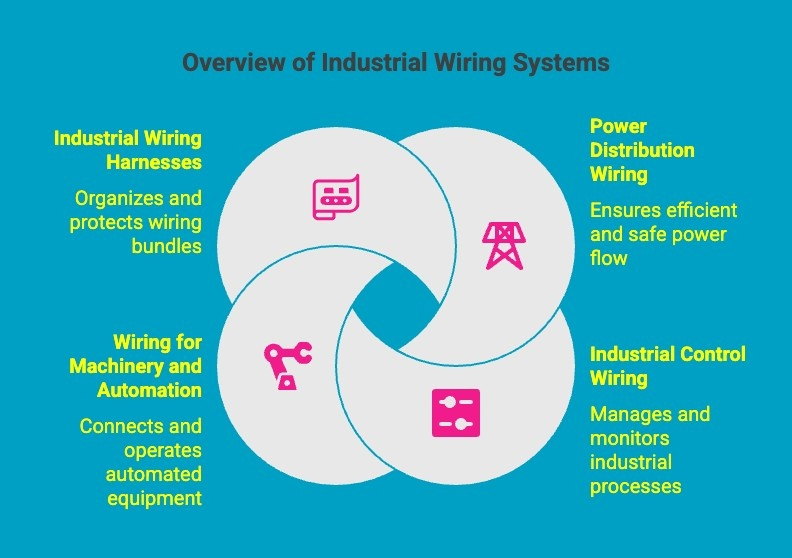
Industrial wiring systems are designed to meet different power, control, and operational demands within a facility. Each type plays a specific role in keeping equipment running safely and efficiently.
Below are the main types of industrial wiring systems used across industries:
1. Power Distribution Wiring
Power distribution wiring delivers electricity from the main supply to panels, equipment, and subsystems across an industrial facility. It uses heavy-duty cables, switchgear, and transformers to handle high electrical loads safely. Proper overcurrent protection through breakers and fuses is essential to prevent faults, reduce downtime, and protect the entire electrical infrastructure.
2. Industrial Control Wiring
Industrial control panel wiring carries low-voltage signals between sensors, switches, relays, and programmable controllers that manage automated machine functions. Careful routing, separation from power cables, and clear identification are essential. Proper organization reduces interference, improves reliability, and makes troubleshooting and maintenance faster and more accurate.
3. Wiring for Machinery and Automation
Machinery and automation wiring connects control systems directly to motors, drives, and automated equipment. It must withstand vibration, movement, heat, and harsh operating conditions. Cable selection depends on the application, such as flexible wiring for moving parts or resistant insulation for chemicals. Secure installation ensures consistent performance and long-term operational safety.
4. Industrial Wiring Harnesses
Industrial machinery wiring relies on organized, durable connections to support continuous operation in demanding environments. An industrial wiring harness bundles multiple wires into a single organized assembly, reducing individual wire runs, minimizing connection errors, and improving consistency. Custom built for specific equipment, it speeds up installation while protecting wiring from abrasion and vibration, resulting in cleaner layouts and improved long-term reliability.
When installed in line with industrial control panel wiring standards, these systems ensure proper routing, protection, and identification. Together, they create a safe, efficient, and dependable electrical foundation that supports modern industrial operations and reliable automation control.
How Do Industrial Wiring Standards Ensure Safety and Reliability?
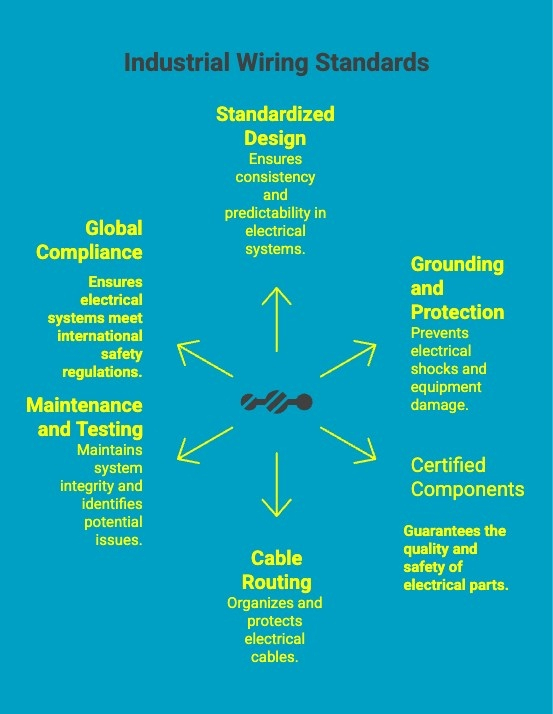
Industrial wiring standards exist to protect people, equipment, and operations. By setting clear rules for design, installation, and maintenance, these standards reduce risk, prevent failures, and ensure electrical systems perform reliably in demanding industrial environments.
Here are the key ways industrial wiring standards ensure safety and long-term reliability:
-
Standardized Design and Installation: Clear design and installation rules create consistency across industrial electrical systems. This reduces errors, prevents unsafe practices, and ensures predictable performance regardless of facility size or complexity.
-
Grounding and Overcurrent Protection: Proper grounding and correctly rated protection devices limit shock, fire, and fault risks. Standards ensure electrical faults are safely diverted or interrupted before they cause damage or safety incidents.
-
Certified Components and Wire Identification: Using approved components and standard wire identification improves safety and compatibility. Clear labeling reduces connection errors, speeds troubleshooting, and supports safer maintenance and emergency response.
-
Cable Routing and Enclosure Control: Rules for cable routing, separation, and enclosures protect wiring from damage and interference. Keeping power and control cables properly separated helps maintain signal integrity and system reliability.
-
Maintenance, Inspection, and Testing: Defined inspection and testing requirements support safe servicing and ongoing system integrity. Technicians can verify performance, identify issues early, and maintain compliance throughout the system lifecycle.
-
Global Compliance and Reliability: Widely adopted standards support international compliance and long-term reliability. Consistent requirements simplify audits, support expansion, and help electrical systems remain safe and dependable over time.
By enforcing consistency and protection at every stage, industrial wiring standards help ensure safe operations, efficient maintenance, and long-lasting electrical performance.
What Are the Best Practices for Industrial Machine Wiring?
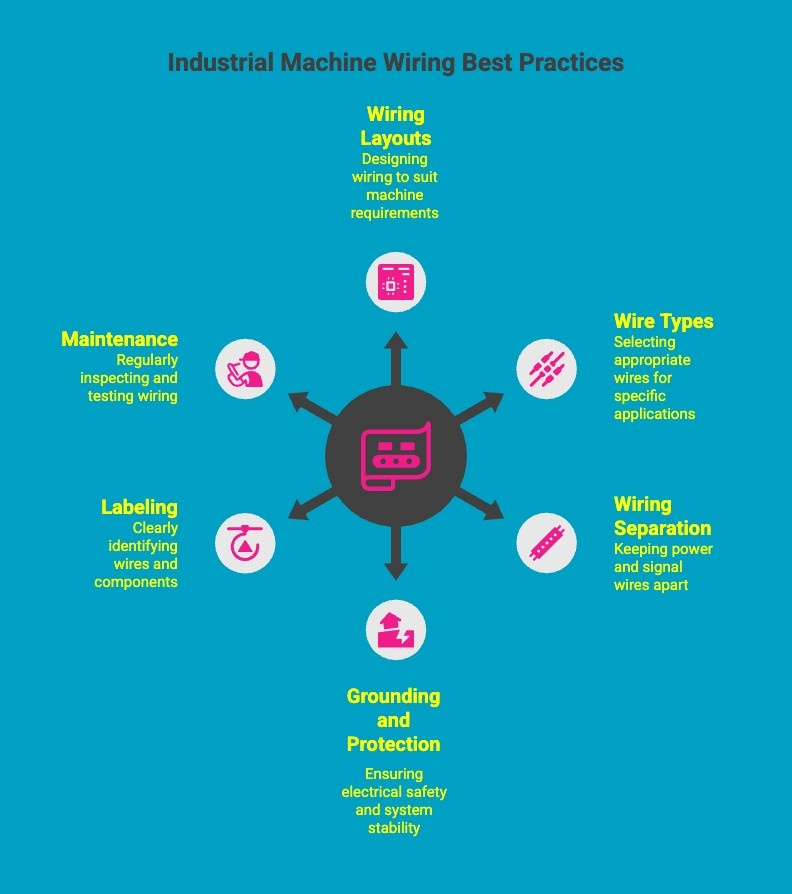
Best practices turn industrial machine wiring from basic compliance into long-term reliability. They focus on planning, protection, and maintainability to prevent failures before they occur.
Here are the best practices for industrial machine wiring that improve safety and performance:
1. Plan Wiring Layouts Around Machine Needs
Effective machine wiring starts with detailed layout planning based on operational and environmental requirements. Mapping wire paths in advance helps prevent congestion, overheating, and physical damage. A clear plan improves airflow, simplifies installation, and supports future maintenance by ensuring components and terminations remain accessible, organized, and easy to trace throughout the machine’s service life.
2. Use Correct Wire Types and Ratings
Selecting proper wire types, gauges, and insulation is essential for safe machine operation. Conductors must handle expected current without overheating, while insulation must resist heat, moisture, chemicals, or abrasion. Using correctly rated materials prevents premature failure, reduces fire risk, and ensures wiring performs reliably under continuous industrial operating conditions.
3. Separate Power and Signal Wiring
Power, control, and communication wiring should never be bundled together. High-current power cables generate interference that disrupts sensitive control signals. Physical separation, perpendicular crossings, and shielded cables reduce electromagnetic interference. This practice improves signal stability, prevents erratic machine behavior, and minimizes unexpected downtime caused by electrical noise.
4. Apply Proper Grounding and Protection
Grounding provides a safe path for fault currents and prevents dangerous voltages on equipment frames. Combined with correctly sized circuit breakers or fuses, it protects machines from overloads and short circuits. Proper grounding and overcurrent protection reduce shock hazards, prevent fires, and ensure faults are isolated before causing equipment damage.
5. Label Wires and Components Clearly
Clear and consistent labeling improves safety, troubleshooting, and maintenance efficiency. Identifying both ends of every wire and all components eliminates guesswork during servicing. Accurate labels aligned with drawings help technicians isolate circuits quickly, avoid accidental shutdowns, and perform modifications safely without disrupting nearby equipment or systems.
6. Inspect, Test, and Maintain Regularly
Industrial wiring requires ongoing inspection and testing to remain safe. Routine checks identify loose connections, insulation damage, corrosion, or overheating. Thermal scans, breaker testing, and visual inspections help detect problems early. Preventive maintenance extends system lifespan, reduces unexpected failures, and ensures continued compliance with safety requirements.
By applying these best practices consistently, industrial machine wiring remains safe, reliable, and easier to maintain throughout its operational life.
How Does Proper Labeling Improve Industrial Wiring Efficiency?
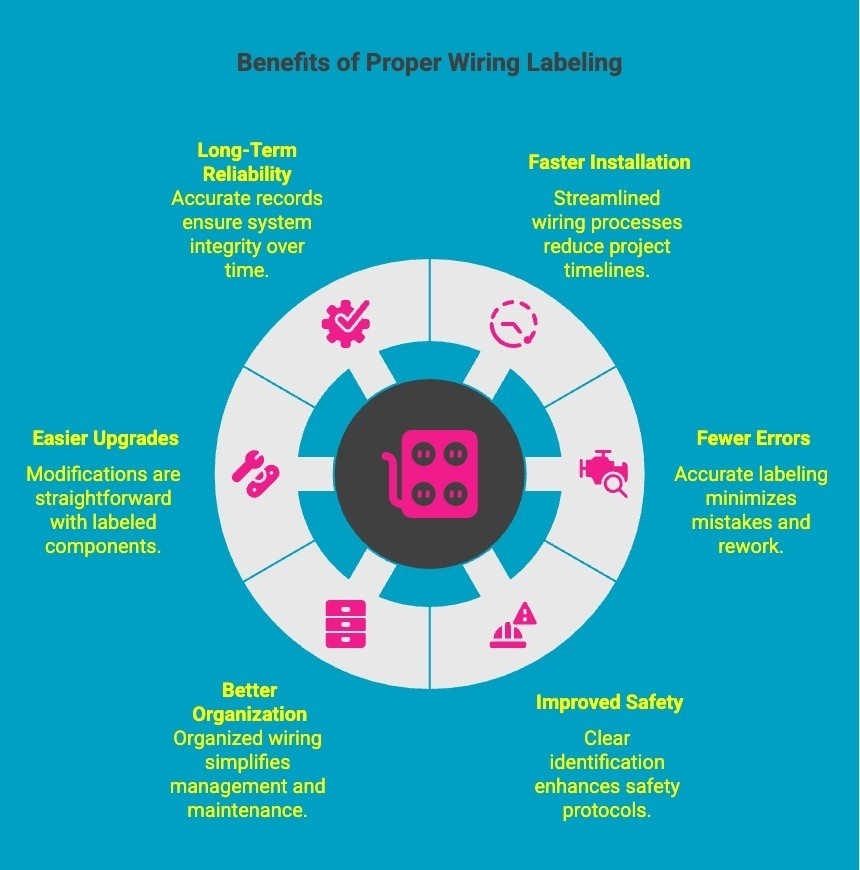
In complex industrial environments, wiring systems can quickly become difficult to manage without clear identification. Proper labeling brings structure and clarity to electrical installations, helping teams work faster, safer, and with greater confidence throughout the system’s lifecycle.
Here are the key ways proper labeling improves industrial wiring efficiency:
-
Faster Installation and Maintenance: Clear labels allow technicians to identify circuits, cables, and components instantly. This reduces installation time, minimizes delays during maintenance, and eliminates unnecessary trial and error when working inside crowded panels or machine enclosures.
-
Fewer Errors and Faster Troubleshooting: Accurate labeling reduces the risk of connecting or disconnecting the wrong wire. When issues arise, technicians can trace circuits quickly, diagnose faults efficiently, and restore operations with minimal downtime.
-
Improved Safety and Compliance: Proper labels help prevent accidental contact with live circuits and support compliance with electrical and workplace safety standards. Clearly identified wiring ensures safer lockout procedures and easier verification during inspections or audits.
-
Better Organization and Traceability: Labelling creates a structured wiring layout where cables can be followed from source to load without confusion. This improves overall panel organization and makes tracing circuits far more efficient during repairs or system reviews.
-
Easier Upgrades and Modifications: Well-labeled systems simplify future expansions and equipment changes. Technicians can integrate new components without disturbing existing wiring, reducing installation errors and avoiding unnecessary system shutdowns.
-
Long-Term Reliability and Accurate Records: Consistent labeling supports accurate documentation and as-built drawings. This ensures wiring information remains reliable over time, even as personnel change, helping maintain system integrity and operational efficiency.
By turning complex wiring into a clearly identified system, proper labeling improves efficiency, safety, and long-term reliability across industrial electrical installations.
What Labeling Challenges Commonly Occur in Industrial Wiring?
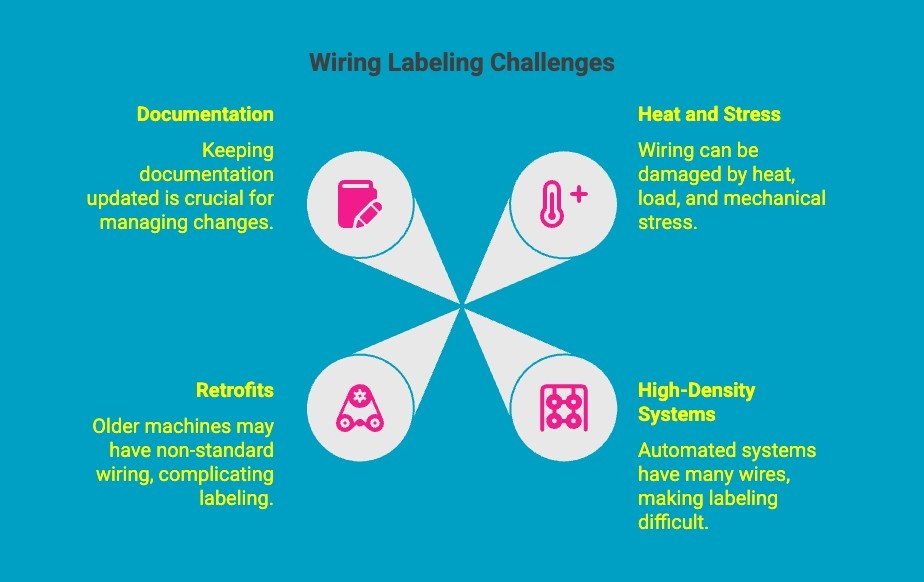
Industrial wiring labels play a critical role, but applying and maintaining them is not always straightforward. Harsh environments and complex systems create real obstacles that impact clarity and safety.
Below are the most common labeling challenges in industrial wiring:
1. Heat, Load, and Mechanical Stress
Industrial labels are exposed to heat from motors, electrical loads, and nearby equipment, which can weaken adhesives and fade print. Vibration, abrasion, oils, and chemicals further accelerate wear. Standard labels often fail under these conditions, leading to unreadable markings. Without durable, industrial-grade materials, labels deteriorate quickly and compromise identification and safety.
2. High-Density and Automated Systems
Automated machinery often uses tightly packed, high-density wiring that leaves little space for readable labels. Thin conductors and bundled cables make placement difficult, while thousands of connection points require precise identification. Managing this complexity demands small-format, high-resolution labels and a well-planned strategy to ensure every wire remains clearly and logically marked.
3. Retrofits and Older Machinery
Older equipment frequently lacks clear or consistent labeling due to age, wear, or outdated practices. During upgrades, technicians may encounter unidentified wires, increasing tracing time and safety risks. Manual identification slows progress and raises error potential. Re-establishing a complete labeling system is essential before retrofitting to restore clarity and reduce hazards.
4. Documentation and Change Management
Labels must stay aligned with schematics and electrical documentation to remain useful. When system changes are made without updating labels and drawings, inaccuracies emerge. This mismatch can mislead technicians, cause incorrect connections, and create unsafe conditions. Maintaining accurate labels alongside updated documentation is a continual challenge that requires disciplined change-tracking processes.
Addressing these labeling challenges with the right materials and processes is essential for maintaining safe, efficient, and dependable industrial wiring systems.
Why Is the MAX LETATWIN LM-550A3BH the Ideal Label Printer for Industrial Wiring?
The MAX LETATWIN LM-550A3BH is purpose-built for demanding industrial wiring environments where durability, clarity, and speed matter. It produces precise, long-lasting wire and cable labels that resist heat, chemicals, abrasion, and vibration, making it ideal for control panels, machinery, and electrical enclosures.
This is exactly why professionals trust DuraFast Label Company. As an industrially focused supplier, DuraFast pairs the LM-550A3BH with expert guidance, genuine supplies, and application-specific support to ensure your labeling system works reliably from day one.
Whether you are upgrading existing wiring, standardizing labels across a facility, or managing high-density automation projects, DuraFast helps you select the right printer, sleeves, and consumables for long-term performance and compliance.
Looking to improve wiring accuracy, safety, and efficiency? Contact DuraFast Label Company today to get expert advice on the MAX LETATWIN LM-550A3BH and professional labeling solutions tailored to your industrial application.
Conclusion
In industrial environments, clear and durable labeling is essential for safety, efficiency, and long-term system reliability. The right labeling tools reduce errors, support compliance, and simplify maintenance across complex wiring installations.
A purpose-built solution like the MAX LETATWIN LM-550A3BH provides the precision, durability, and consistency needed for demanding industrial applications. From new installations to retrofits and ongoing maintenance, reliable labeling helps ensure electrical systems remain organized, traceable, and dependable throughout their operational life.
Frequently Asked Questions
What Are the Basic Principles of Industrial Wiring?
The basic principles of industrial wiring focus on safety, reliability, and efficiency, including compliance with NEC standards, proper grounding, suitable materials for harsh environments, accurate load calculations, and designs that safely handle high currents consistently.
What Guidelines Should I Follow for Wiring Industrial Control Panels?
When wiring industrial control panels, follow NEC requirements by separating power and control circuits, using correct wire gauges, securely mounting and grounding components, and clearly labeling all wires and terminals to simplify troubleshooting, maintenance, and operation.
What Types of Cables and Harnesses Are Commonly Used in Industrial Wiring?
Industrial wiring uses cables suited to the application, including THHN or THWN conductors, multi-conductor control cables, and flexible automation cables. Wiring harnesses are assembled bundles that simplify complex connections and provide protection from stressful conditions.
What Tips Can Help With Routing Connections Inside Industrial Control Panels?
For effective routing inside industrial control panels, use wire ducts to organize cables, separate high voltage and low voltage wiring, leave service loops for future changes, and secure all conductors neatly to reduce interference risks.
What Is the Difference Between Commercial and Industrial Wiring?
Industrial wiring is built for harsher conditions than commercial wiring, handling higher voltages and currents, extreme temperatures, moisture, chemicals, and vibration. It follows stricter safety requirements to ensure reliable operation in demanding environments worldwide facilities.
How Often Should Industrial Wiring Systems Be Inspected for Safety?
Industrial wiring should be inspected regularly as part of preventive maintenance. Annual inspections are common, but systems in harsh, high-load, or critical environments may require more frequent checks to ensure safety, reliability, and compliance.
Why Is Adherence to Industrial Wiring Standards Important?
Adhering to industrial wiring standards such as NEC and OSHA reduces shock and fire risks, ensures regulatory compliance, improves system reliability, lowers maintenance costs, and protects personnel and equipment from serious electrical hazards and failures.
How Do I Choose the Right Wiring Method for Industrial Machinery?
Choose the right wiring method by evaluating electrical load, environment, movement, and vibration. Use properly rated wiring that meets regulations, includes suitable insulation, allows flexibility where required, and ensures safe, reliable long-term machinery operation.