What Is Synthetic Label Material Used For?
7th Jul 2026
Key Highlights
-
Synthetic label materials are plastic-based substrates designed to resist moisture, chemicals, abrasion, and extreme temperatures in demanding environments.
-
Common materials such as polyester, polypropylene, polyethylene, and vinyl are selected based on durability requirements and application conditions.
-
Compared with paper labels, synthetic labels provide a longer lifespan, stronger tear resistance, and better performance in harsh industrial or outdoor environments.
-
Thermal transfer printing with wax resin or resin ribbons is commonly used to produce durable barcodes and long-lasting labels on synthetic materials.
-
Synthetic labels play a critical role in regulated industries such as food, pharmaceuticals, and chemicals where label durability, readability, and compliance are essential.
Many businesses rely on labels to carry essential information such as product identification, safety instructions, compliance details, and tracking codes. When labels tear, smudge, or degrade due to moisture, chemicals, or heavy handling, it can disrupt operations and lead to costly relabeling.
As supply chains become more automated and compliance standards grow stricter, businesses increasingly need labels that remain readable in demanding environments. Synthetic label materials are designed to meet these challenges, especially in industries such as logistics, pharmaceuticals, manufacturing, and food packaging.
This guide explains what synthetic label material is, how it compares to paper labels, the different types available, and when businesses should choose synthetic labels for more durable and reliable labeling performance.
What Is Synthetic Label Material?
Synthetic label material is a label substrate made from plastic-based materials rather than traditional paper. These materials are engineered to provide greater durability, resistance to moisture, and improved performance in demanding environments.
Unlike paper labels, synthetic labels are designed to withstand water exposure, abrasion, chemicals, and temperature changes. Plastic-based materials such as polypropylene or polyester have stronger molecular structures than paper fibers, which allows them to resist tearing, moisture damage, and surface wear.
Below are key characteristics of synthetic label materials:
-
Resistant to moisture, oils, and many industrial chemicals
-
Strong tear resistance compared to paper labels
-
Compatible with thermal transfer printing when paired with resin ribbons
-
Ideal for synthetic barcode labels used in industrial, logistics, and outdoor environments
Some applications may also require a highly reflective synthetic label to improve visibility and scanning accuracy, particularly in low light environments or high-speed barcode scanning systems.
Because synthetic materials are plastic-based rather than fiber-based like paper, they maintain structural strength and print durability even when exposed to moisture, friction, and harsh environmental conditions.
What Types of Synthetic Labels Are Used in Label Printing?
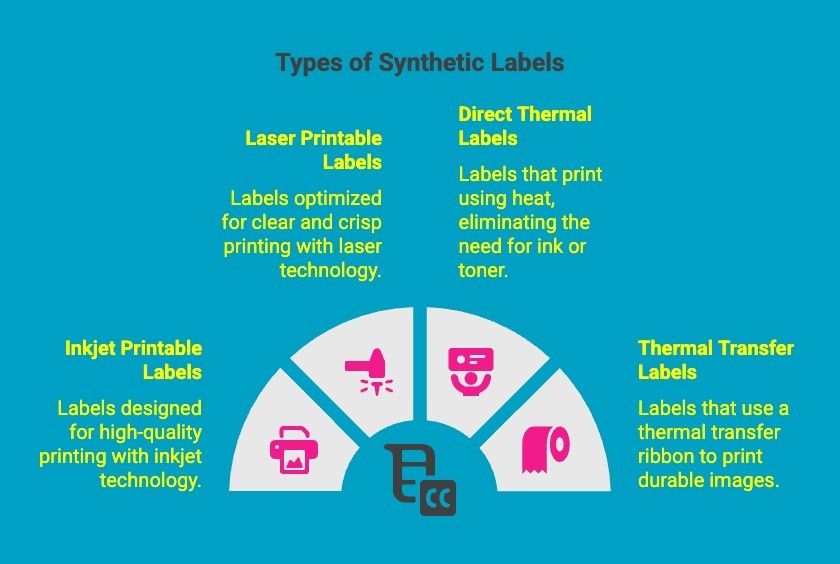
Different synthetic materials are designed to work with different printing technologies. Selecting the correct label material ensures compatibility with your printer and ribbon type.
Below are common synthetic label materials categorized by printing technology:
1) Inkjet Printable Synthetic Label Materials
Inkjet printers require synthetic materials that are specially coated to absorb ink and maintain print clarity. These materials are often used for product packaging, retail labels, and applications that require color printing with moderate durability.
Common inkjet-printable synthetic materials include the following:
-
Polypropylene: A smooth, flexible plastic film that supports vibrant color printing and works well for product packaging labels.
-
Polyester: A durable synthetic material that provides excellent print sharpness and improved resistance to moisture and handling.
-
Vinyl: A flexible material often used for labels that require stretch, durability, and strong adhesion on uneven surfaces.
2) Laser Printable Synthetic Label Materials
Laser printers generate high temperatures during the printing process, so synthetic materials used with these printers must be heat resistant and stable under laser fusing conditions.
Common laser-printable synthetic materials include the following:
-
Polyester: Highly heat resistant, making it suitable for laser printing applications where labels must withstand high fusing temperatures.
-
Vinyl: Provides flexibility and durability while maintaining stability during the laser printing process.
3) Direct Thermal Printable Synthetic Label Materials
Direct thermal printing does not use a ribbon. Instead, the label material itself contains a heat-sensitive coating that produces the image when exposed to heat from the printhead. Synthetic materials used for direct thermal printing provide better durability than paper direct thermal labels.
Common direct thermal synthetic materials include:
-
Polypropylene: Offers better moisture resistance than paper, making it suitable for refrigerated or short-term logistics labels.
-
Polyester: Provides improved durability and tear resistance for direct thermal labels used in demanding environments.
4) Thermal Transfer Printable Synthetic Label Materials
Thermal transfer printing uses a ribbon to transfer ink onto the label surface. This method is widely used for synthetic labels because it produces highly durable barcodes that resist abrasion, moisture, and environmental exposure.
Common thermal transfer printable synthetic materials include:
-
Polypropylene: A versatile material that balances durability and flexibility for packaging, logistics, and warehouse labels.
-
Polyester: Extremely durable and resistant to chemicals, abrasion, and heat, making it ideal for industrial labels.
-
Vinyl: Flexible and weather-resistant, often used for outdoor labeling and curved-surface applications.
-
Valeron: A strong, tear-resistant material designed for heavy-duty tags and industrial labeling.
-
Polyolefin: A lightweight synthetic material commonly used for packaging labels and product identification.
-
Tyvek: A high-strength synthetic material known for its tear resistance and durability in rugged environments.
-
HDPE: High-density polyethylene provides moisture resistance and flexibility for labels used in chemical or industrial environments.
Overall, the type of synthetic label material you choose should match both your printing technology and application requirements. Using the correct material ensures better print quality, stronger durability, and reliable barcode performance. By aligning the label substrate with the right printer and ribbon combination, businesses can achieve consistent results and longer-lasting labels in demanding environments.
How Do Synthetic Labels Compare to Paper Labels?
Synthetic labels and paper labels serve different purposes depending on the environment and durability requirements.
Below is a comparison of the key differences between the two materials:
|
Feature |
Synthetic Labels |
Paper Labels |
|---|---|---|
|
Durability |
High |
Low to moderate |
|
Moisture Resistance |
Excellent |
Poor |
|
Tear Resistance |
High |
Low |
|
Chemical Resistance |
Strong |
Limited |
|
Typical Lifespan |
Months to several years depending on environment |
Short term use, typically days to a few months |
|
Temperature Range |
Wide tolerance, often from approximately -40°C to 150°C depending on material |
Limited tolerance, usually suitable only for moderate indoor temperatures |
|
Cost |
Higher |
Lower |
Synthetic labels are generally chosen when labels must remain readable in harsh environments.
Are Synthetic Labels Sustainable?
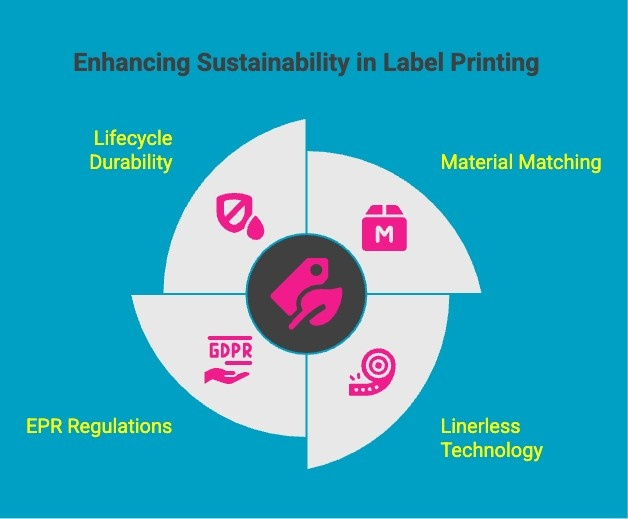
Sustainability has become an important consideration in packaging and labeling decisions, particularly in consumer packaged goods (CPG), food production, and logistics. While synthetic labels are plastic-based, several factors can make them compatible with modern recycling and waste reduction strategies.
1) Matching Label Material to Container
One of the most effective ways to improve recyclability is to match the label material to the container polymer. For example, polypropylene labels used on polypropylene (PP) containers reduce contamination during recycling because the label and container share the same material family. This approach is increasingly recommended in food packaging and consumer goods to support recycling system compatibility.
2) Linerless Label Technology
Linerless labels eliminate the traditional release liner that backs most pressure-sensitive labels. By removing the liner, businesses can reduce label material waste by up to 50% per roll, while also increasing the number of labels per roll and reducing shipping volume. Linerless labeling is becoming more common in high-volume packaging, food service, and logistics operations.
3) Extended Producer Responsibility (EPR) Regulations
Regulations such as California SB 54 and emerging Extended Producer Responsibility (EPR) laws in several US states are encouraging manufacturers to design packaging systems that are easier to recycle and generate less waste. As these regulations evolve, label material compatibility with container recycling streams is becoming an increasingly important factor in packaging design.
4) Synthetic Labels and Lifecycle Durability
Although synthetic labels are plastic-based, they often last significantly longer than paper labels. In many applications, this durability means fewer label replacements and less total material consumption over the label's lifecycle, which can reduce overall waste in industrial and logistics environments.
By selecting recyclable materials, matching label polymers to packaging, and using waste-reducing technologies such as linerless labels, businesses can integrate synthetic labels into more sustainable labeling systems.
How Do You Choose the Right Printer for Synthetic Labels?
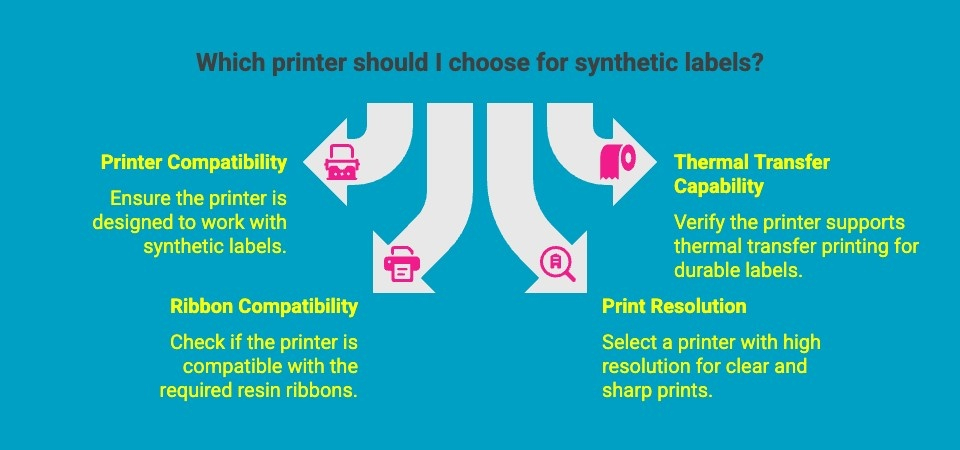
Selecting the correct printer is important when printing on synthetic materials. The right printer ensures clear print quality, strong ink adhesion, and reliable label performance in demanding environments.
Below are key factors to consider when choosing a printer for synthetic labels.
-
Printer Compatibility: Not all printers are designed to handle synthetic materials. Confirm that the printer supports synthetic label substrates and can accommodate the label thickness and adhesive type commonly used with plastic-based materials.
-
Thermal Transfer Capability: Thermal transfer printers are commonly used for synthetic labels because they provide stronger durability compared to direct thermal printing. When paired with wax resin or resin ribbons, thermal transfer printing produces labels that resist abrasion, moisture, and chemicals.
-
Ribbon Compatibility: Synthetic labels typically require wax resin or resin ribbons for optimal ink adhesion and print durability. Resin ribbons are often recommended for polyester, polypropylene, or vinyl labels used in industrial or outdoor environments.
-
Print Resolution: Higher print resolution helps produce clear barcodes and detailed graphics on synthetic materials. For synthetic labels with small barcodes, 2D codes, or fine text, a 300 DPI printhead is recommended. 203 DPI is sufficient for standard shipping label barcodes but may not produce clean edges on small text or high-density barcodes on smooth synthetic surfaces.
Selecting the right printer and ribbon combination ensures consistent performance when printing on synthetic label materials.
Looking to reduce labeling costs while improving efficiency? In-house label printing allows businesses to control production, reduce outsourcing expenses, and scale labeling operations with the right printers and materials.
When Should You Use Synthetic Labels?
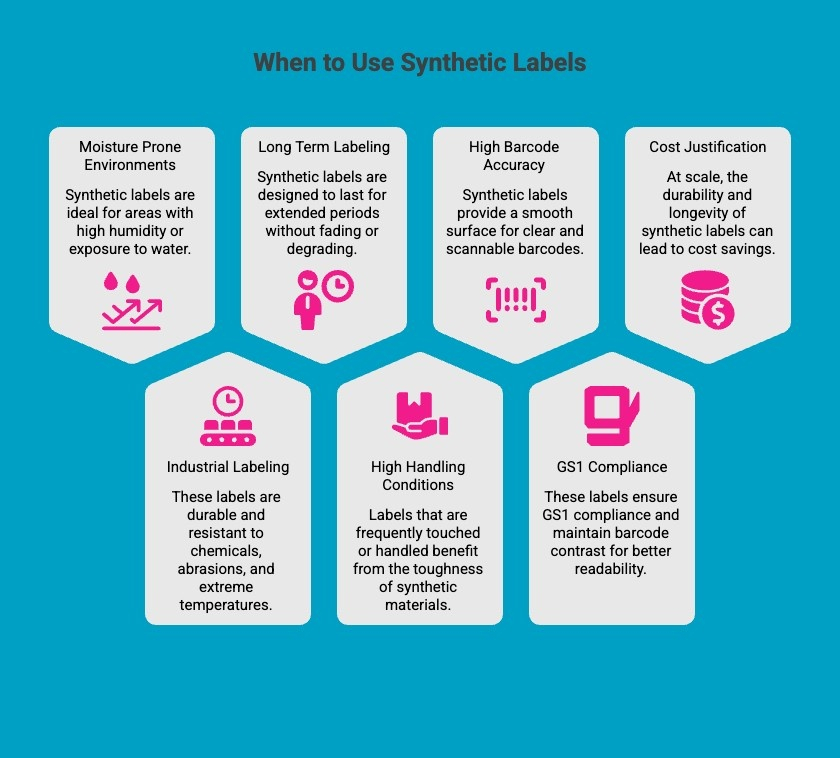
Synthetic labels are most useful when labels must withstand environmental exposure, heavy handling, or long-term use.
Below are situations where synthetic labels are the better choice:
-
Moisture Prone Environments: Synthetic labels resist water and humidity, making them ideal for refrigerated storage, cold chain logistics, or outdoor applications where paper labels can quickly degrade.
-
Industrial Labeling: Manufacturing environments often require labels that resist chemicals, oils, solvents, and abrasion. Synthetic materials such as polyester or polypropylene paired with resin ribbons maintain legibility in these demanding conditions.
-
Long-Term Labeling Applications: Asset tags, equipment labels, compliance labels, and product identification labels often need to remain readable for months or years. Synthetic labels maintain print clarity and structural integrity far longer than paper alternatives.
-
High Handling Conditions: Shipping containers, warehouse inventory, and logistics labels frequently experience friction and repeated handling. Synthetic labels resist tearing and smudging, helping barcodes remain readable throughout the supply chain.
-
High Barcode Accuracy Requirements: Synthetic labels maintain smoother surfaces and more consistent print quality, which can improve first scan read rates. In many industrial scanning environments, properly printed synthetic labels can achieve first scan read rates above 99%, reducing scanning errors and workflow interruptions.
-
GS1 Compliance and Barcode Contrast: Many supply chains follow GS1 barcode standards, which require a minimum symbol contrast level for reliable scanning. Synthetic labels typically maintain higher and more stable contrast ratios than paper labels, helping businesses meet GS1 barcode quality requirements over longer periods.
-
Cost Justification at Scale: Synthetic labels become cost-effective when paper labels begin failing frequently. For example, synthetic labels are typically cost-justified when the expected paper label failure rate exceeds 2–3%. At 10,000 labels per week, a 3% failure rate equals 300 relabeling events, and even modest labor costs can quickly exceed the price difference between paper and synthetic materials.
When Are Paper Labels Still the Right Choice?
Paper labels remain a practical option for many short-term applications. For example, shipping labels, retail price labels, and short-term warehouse labels often perform well with paper materials when environmental exposure is limited.
Using paper labels in these situations can reduce material costs while still providing reliable performance. Choosing between paper and synthetic labels should depend on the expected environment, handling conditions, and required label lifespan.
When durability and reliability are important, synthetic labels provide a stronger alternative to traditional paper labels.
What Regulatory and Compliance Applications Require Synthetic Labels?
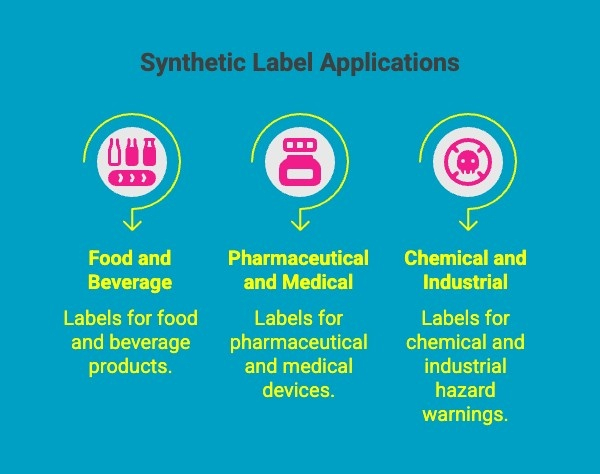
Many industries must follow strict regulatory standards that require labels to remain readable throughout manufacturing, storage, transport, and product use. In these environments, synthetic label materials are often required to maintain compliance because paper labels may deteriorate under moisture, chemicals, or temperature changes.
Below are common regulatory environments where synthetic labels are widely used:
1) Food and Beverage Labeling
Food packaging labels must often remain intact during refrigeration, freezing, and moisture exposure. In the United States, adhesives used in food packaging applications must comply with FDA 21 CFR regulations for food contact materials.
Synthetic labels such as polypropylene or polyester help maintain barcode readability and product information when labels are exposed to condensation, cold storage, or repeated handling in food processing and distribution environments.
2) Pharmaceutical and Medical Device Labeling
Pharmaceutical labeling must remain legible throughout the product lifecycle under FDA Good Manufacturing Practice (GMP) requirements. Labels used on medical devices and pharmaceutical packaging must also maintain barcode readability for UDI (Unique Device Identification) systems.
Synthetic materials such as polyester labels paired with resin ribbons are commonly used because they resist sterilization processes, temperature changes, and distribution handling while preserving barcode clarity.
3) Chemical and Industrial Hazard Labels
Industrial products and chemicals must comply with the OSHA Hazard Communication Standard (HazCom 2012), which aligns with the Globally Harmonized System (GHS) for hazard labeling. These labels must clearly display hazard warnings, pictograms, and safety information.
For chemicals transported by sea, labels often require BS 5609 certification, which tests label durability after prolonged saltwater immersion and abrasion. Synthetic label materials combined with durable resin ribbons are commonly used to meet these performance requirements.
How Do You Match Thermal Transfer Ribbons to Synthetic Label Materials?
Choosing the correct ribbon for your synthetic label material is critical for print durability and barcode readability. Different synthetic materials require specific ribbon formulations to ensure the ink bonds properly and resists abrasion, chemicals, and environmental exposure.
Below is a practical ribbon-to-material matching guide used in many industrial labeling environments.
|
Synthetic Label Material |
Recommended Ribbon Type |
Why This Combination Works |
Typical Applications |
|---|---|---|---|
|
Polypropylene (PP) |
Wax Resin |
Provides strong adhesion while maintaining flexibility and moderate abrasion resistance |
Packaging labels, warehouse labels, logistics labeling |
|
Polyester (PET) |
Resin |
Polyester surfaces require strong resin bonding for durability and chemical resistance |
Asset tags, electronics labels, compliance labels |
|
Vinyl |
Resin |
Resin ribbons provide flexibility and strong adhesion on curved or flexible vinyl surfaces |
Outdoor labels, warning labels, equipment labels |
|
Polyolefin |
Wax Resin or Resin |
Supports good adhesion while maintaining flexibility for packaging applications |
Product packaging labels, retail labeling |
|
Tyvek |
Wax Resin |
Wax resin provides durable print while preserving the strength of the material |
Shipping tags, durable logistics labels |
|
Valeron |
Resin |
Strong resin adhesion ensures durability on tear resistant industrial tag materials |
Industrial tags, heavy duty equipment labeling |
|
HDPE |
Resin |
Resin ribbons provide strong bonding and resistance to chemicals and abrasion |
Chemical drum labels, industrial container labels |
Why Does Ribbon to Material Matching Matter?
Using the wrong ribbon formulation can lead to smudging, poor barcode readability, and label failure during handling or environmental exposure.
For example, wax ribbons often do not adhere properly to smooth synthetic materials, while resin ribbons create a stronger bond that resists scratching, moisture, and chemicals.
Matching the correct ribbon to the label material helps ensure:
-
Longer lasting label durability
-
Higher barcode scanning accuracy
-
Better resistance to chemicals, abrasion, and moisture
-
Reduced relabeling and operational errors
How durable are your labels in real world conditions? Label durability depends on the material, printing method, and ribbon used. Understanding these factors can help you produce longer lasting labels for packaging, logistics, and industrial applications.
Where Can You Buy Synthetic Labels and Compatible Thermal Transfer Ribbons?
Businesses that rely on durable labeling systems need reliable supplies that match both the printer and the label material. Choosing a supplier that offers compatible ribbons, synthetic label materials, and expert support helps ensure consistent print quality and long-term label performance.
DuraFast Label Company provides a wide selection of synthetic labels and thermal transfer ribbons designed for industrial, warehouse, logistics, healthcare, and manufacturing applications. Their product range includes materials such as polypropylene, polyester, vinyl, and other durable synthetic substrates compatible with thermal transfer printing.
In addition to synthetic labels, DuraFast offers a broad range of ribbon formulations, including wax, wax resin, and resin ribbons that can be matched to specific label materials for optimal durability and barcode clarity.
If you need help selecting the right synthetic labels or thermal transfer ribbons for your printer and application, the DuraFast team can assist.
Contact DuraFast Label Company today to speak with a labeling specialist, request free samples, or get a custom quote for your labeling needs.
Conclusion
Synthetic label materials provide a durable alternative to paper labels in environments where moisture, abrasion, and chemicals can damage standard labels. Materials such as polyester TT labels deliver reliable barcode performance and long-lasting readability for logistics, packaging, and manufacturing applications.
Selecting the right combination of label material, adhesive, and surface finish helps ensure consistent print quality and durability. In applications requiring improved visibility, options like high-reflective synthetic labels can also enhance barcode scanning and label recognition.
Frequently Asked Questions
What is synthetic label material used for?
Synthetic label material is used for durable labeling where paper labels may fail. It is widely used for synthetic label printing in packaging, logistics, and manufacturing environments where labels must resist moisture, abrasion, and extreme temperatures while maintaining a clear, professional appearance.
Are synthetic labels better than paper labels?
Synthetic labels are often better than paper labels when durability is required. Materials such as vinyl labels, polypropylene film labels, and matte polyester provide high durability, stronger resistance to water and chemicals, and improved visual appeal across various industries.
Can synthetic labels be printed with thermal printers?
Yes. Many synthetic materials are compatible with thermal printing. A synthetic label printer can produce durable labels on materials like polypropylene or polyester, creating reliable barcodes and graphics through synthetic label printing using thermal transfer technology.
What ribbon should I use for thermal transfer synthetic labels?
For synthetic thermal labels, wax resin or resin ribbons are typically recommended. These ribbons adhere well to materials like matte polyester or polypropylene, delivering high durability, clear barcodes, and strong resistance to abrasion and environmental exposure.
Are direct thermal synthetic labels durable?
Direct thermal synthetic thermal labels provide moderate durability and moisture resistance. However, in applications involving heavy handling, chemicals, or extreme temperatures, thermal transfer-printed labels typically provide stronger long-term durability and better barcode readability.
How do synthetic roll labels differ from sheet labels?
Synthetic roll labels are designed for automated synthetic label printer systems and are supplied on rolls with a specific outer diameter, inch core, and liner. Sheet labels are printed manually, while roll labels support faster synthetic label printing for high-volume applications.