What Is Wax Ribbon & When Should You Use It?
23rd Jul 2026
Key Highlights
-
Wax thermal transfer ribbons use a wax-based ink that melts under the printer’s heat and transfers onto labels to create text, graphics, and scannable barcodes.
-
They work best with uncoated or matte paper labels and are widely used for shipping labels, retail price tags, warehouse barcodes, and carton labeling.
-
Wax ribbons print quickly and require lower printhead heat, which reduces wear on the printer and keeps labeling costs low in high-volume operations.
-
Compared with wax-resin and resin ribbons, wax ribbons offer the lowest cost but provide lower resistance to heat, abrasion, chemicals, and outdoor exposure.
-
Wax ribbons should not be used on synthetic materials such as polyester or polypropylene, or for labels that must survive harsh environments.
-
Selecting the right ribbon involves confirming printer model, ribbon orientation (ink-in or ink-out), label material, durability requirements, and ribbon width compatibility.
-
Standard wax, wax-resin enhanced, and color wax ribbons are available in different configurations to match printer types and labeling workflows.
If you print shipping labels, retail tags, warehouse barcodes, or inventory labels, wax ribbon is often the most economical and practical choice.
In thermal transfer printing, selecting the right ribbon directly impacts print clarity, durability, and overall cost efficiency. Wax ribbons are widely used for paper label applications because they deliver reliable barcode readability while keeping printing costs low.
This guide explains what a wax ribbon is, how it works, when to use it, and when another ribbon type may be a better fit for your labeling needs.
What Is a Wax Thermal Transfer Ribbon?
In thermal transfer printing, the ribbon is the material that carries the ink used to create barcodes, text, and graphics on labels. A wax thermal transfer ribbon is the most commonly used ribbon type for printing on paper labels.
Think of it like a modern version of a typewriter ribbon, designed specifically for barcode printers and label printing systems.
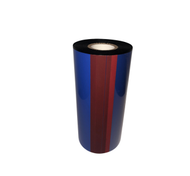
A wax thermal transfer ribbon consists of a thin polyester film coated with a wax-based ink formulation. When the printer’s heated printhead touches the ribbon, the wax melts and transfers onto the label surface, producing clear text, barcodes, and graphics.
Wax ribbons are also manufactured with different ink orientations, known as ink-in or ink-out, depending on how the ink layer faces the label during printing. In an ink-out ribbon, the ink coating faces outward toward the label, which is common for many desktop barcode printers.
In an ink-in ribbon, the ink layer faces inward toward the core, which is typical for many industrial printers. Using the correct orientation ensures the ribbon contacts the label surface properly and transfers ink effectively during printing.
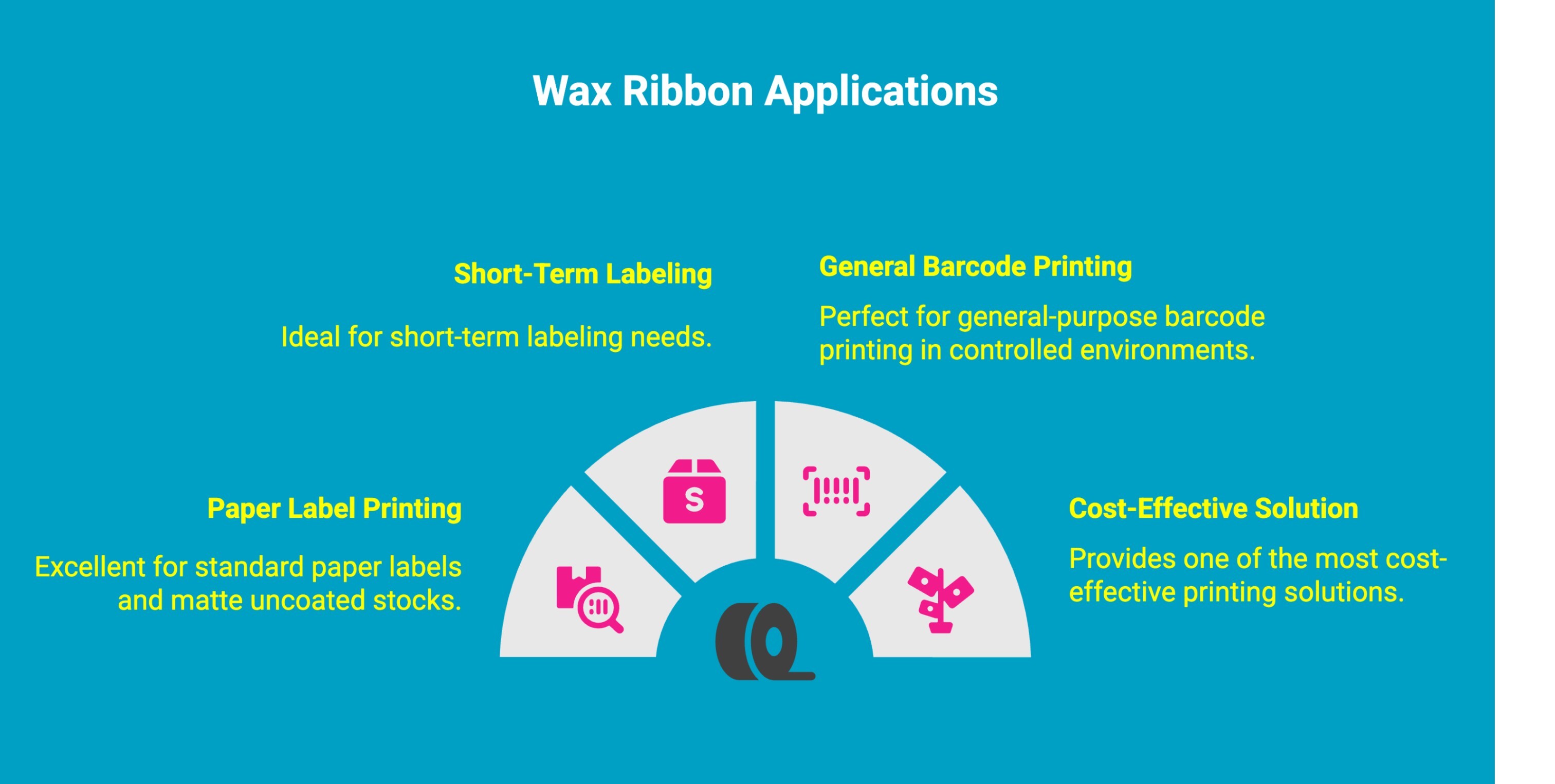
These ribbons excel in several common labeling applications because of their composition:
-
Excellent for standard paper labels and matte uncoated stocks.
Wax ribbons bond well with paper label materials used in shipping, warehouse, and retail labeling. -
Ideal for short-term labeling needs.
Since wax prints are designed for temporary or indoor use, they are perfect for labels that only need to remain readable during storage, shipping, or short-term inventory cycles. -
Perfect for general-purpose barcode printing in controlled environments.
Warehouses and distribution centers frequently use wax ribbons to print scannable barcodes for product tracking and order fulfillment. -
Provides one of the most cost-effective printing solutions.
Wax ribbons require lower printhead energy and are typically the most economical ribbon type for high-volume labeling.
Wax ribbons are best suited for efficient, budget-friendly printing on paper labels where extreme heat, abrasion, or chemical resistance is not required.
Trying to choose the right ribbon type? Read our guide on Types of Thermal Ribbons: Wax, Wax/Resin, and Resin.
How Does a Wax Ribbon Work in a Thermal Printer?
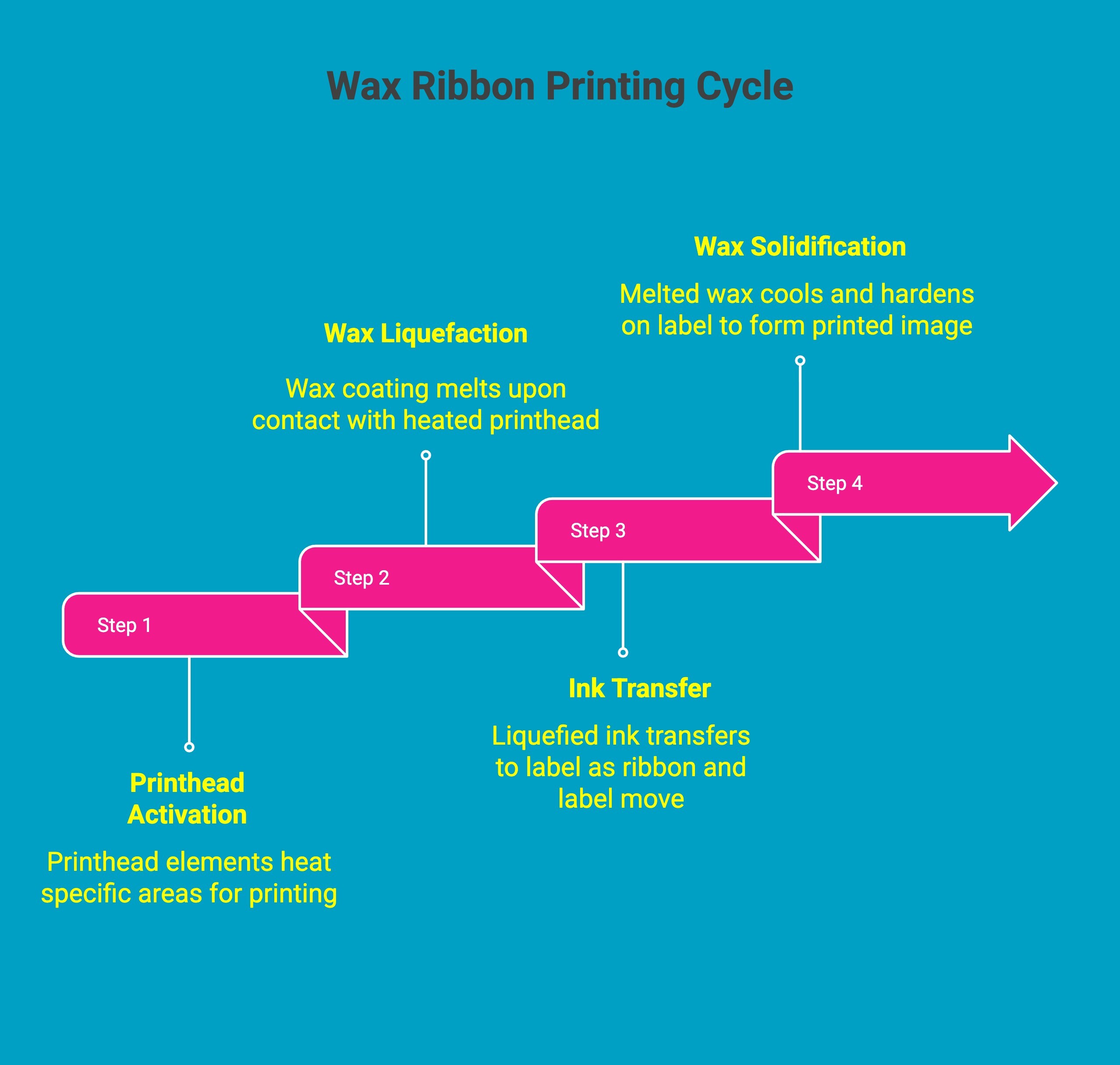
Wax ribbon operation centers on precise heat application within thermal transfer print engines. When the printhead activates, it selectively heats microscopic elements, liquefying the wax ink layer. This molten ink adheres to the label, hardening upon contact to form permanent, high-contrast text and scannable barcodes.
The following sequence details the mechanical journey of ink transfer during the printing cycle:
-
Step 1: The printhead activates and selectively heats specific elements for the printing process.
Tiny heating elements inside the printhead activate only where text, barcodes, or graphics need to be printed. -
Step 2: The specialized wax coating liquefies instantly when it contacts the heated printhead.
The heat melts the wax ink coating at precise points. It works similarly to a hot glue gun. Heat liquefies the material, it sticks to the surface, and then hardens as it cools. -
Step 3: The liquefied ink transfers directly onto the label surface as the label and ribbon move together through the printer.
The pressure between the printhead and platen roller ensures the melted ink adheres cleanly to the label. -
Step 4: The ribbon continues moving forward and separates from the label, leaving the melted wax behind to cool and solidify into the final printed image.
As the wax cools, it hardens on the label surface and forms the finished text, barcode, or graphic.
Using lower heat settings for wax-based ribbons significantly decreases printhead stress and maintenance.
How Do Wax Ribbons Compare to Wax-Resin and Resin Alternatives?
Selecting the right ribbon depends on your labeling needs, such as durability and environment. Wax ribbons offer cost-effective solutions for paper labels, whereas wax-resin and resin ribbons provide enhanced performance for synthetic materials and demanding conditions. Understanding these key performance differences ensures you choose the optimal print solution.
The table below highlights how these thermal transfer ribbon technologies perform across critical categories:
|
Feature |
Wax Ribbon |
Wax-Resin Ribbon |
Resin Ribbon |
|---|---|---|---|
|
Best For |
High-volume paper label printing |
Labels needing moderate durability |
Harsh environments and long-life labels |
|
Label Material |
Uncoated paper, matte paper |
Coated paper, semi-gloss paper, some synthetics |
Polyester, polypropylene, vinyl, PET |
|
Typical Labels |
Shipping labels, retail price tags, warehouse inventory labels |
Product labels, shelf labels, compliance labels |
Chemical labels, outdoor asset labels, durable equipment labels |
|
Print Speed |
High speed printing |
Medium to high speed printing |
Medium speed printing |
|
Durability |
Moderate |
High |
Very high |
|
Cost |
Lowest |
Medium |
Highest |
|
Scratch Resistance |
Basic |
Good |
Excellent |
|
Heat Resistance |
Low |
Moderate |
High |
If you print on synthetic labels or need extreme durability, resin is better. For standard shipping and warehouse labels, wax is typically sufficient.
Where Are Wax Thermal Transfer Ribbons Commonly Used in Business?
Wax thermal transfer ribbons are a fundamental tool in modern supply chain management and retail environments. They provide a high-contrast, cost-effective printing solution specifically optimized for paper-based labels. By offering exceptional readability for barcodes and text, they ensure smooth, efficient identification processes within high-volume, rapid-turnover business operations.
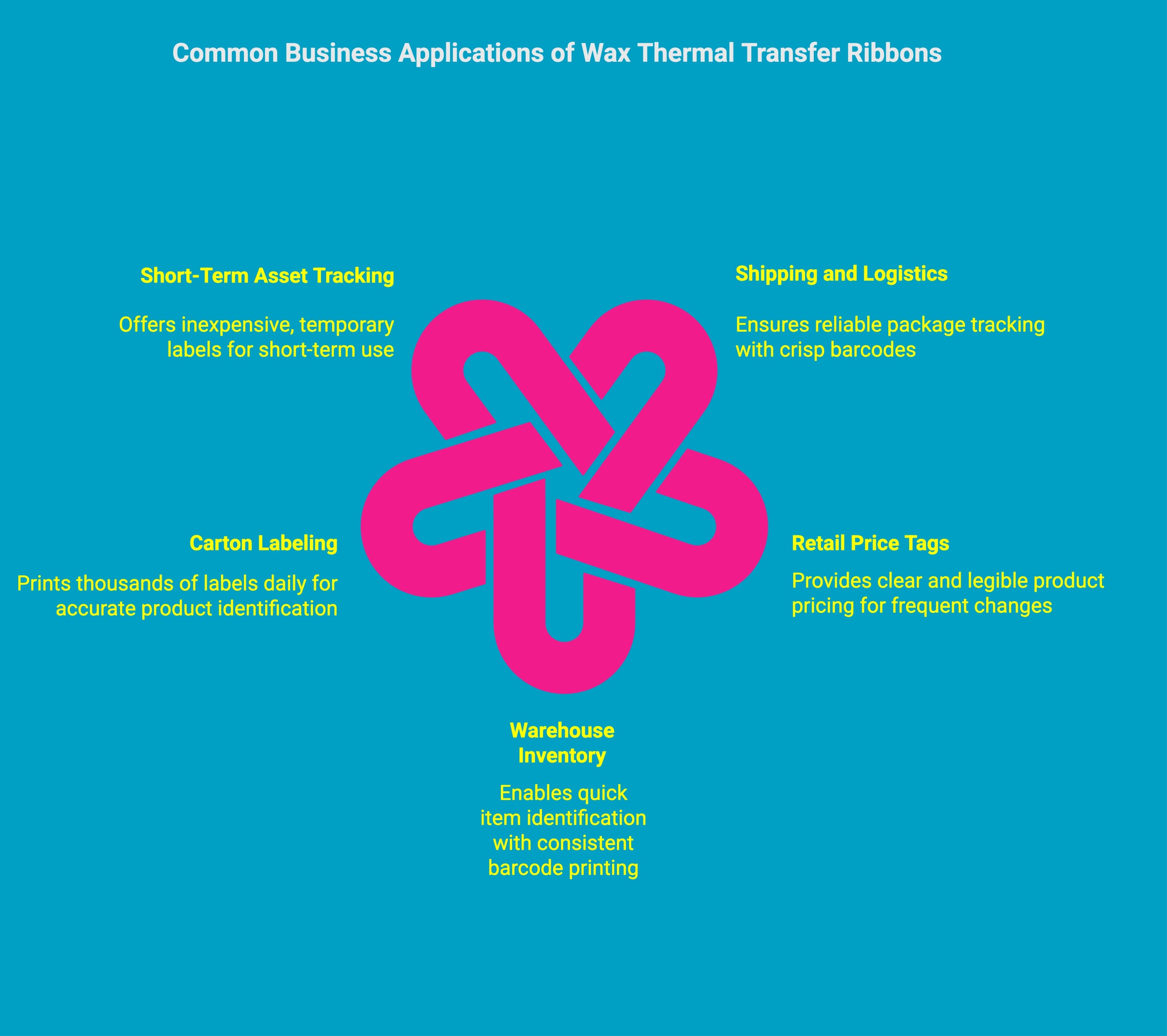
The following examples highlight common real-world applications where wax ribbons are widely used:
-
Shipping and logistics labels require crisp barcodes for reliable package tracking: For example, shipping labels for USPS, UPS, and FedEx packages are typically printed using wax ribbons because the barcode only needs to remain readable until the package reaches its destination.
-
Retail price tags rely on wax ribbons for clear and legible product pricing: Grocery stores, clothing retailers, and electronics stores commonly print shelf labels and price tags with wax ribbons since the labels are replaced frequently as pricing or promotions change.
-
Warehouse inventory labels require consistent, reliable barcode printing: Distribution centers use wax ribbons to print location labels and product barcodes that allow scanners to quickly identify items during picking, packing, and restocking operations.
-
Carton labeling systems depend on high-volume printing for accurate identification: Manufacturing facilities often print thousands of carton labels daily with wax ribbons to identify product SKUs, shipment destinations, and internal tracking codes.
-
Short-term asset tracking applications benefit from inexpensive, temporary labels: Offices and event organizers often print temporary asset or equipment labels with wax ribbons because the labels only need to remain readable for short-term use.
These versatile ribbons remain the primary choice for organizations prioritizing high-volume efficiency.
Comparing printing technologies? Learn the Key Differences Between Thermal Transfer and Laser Printers in this guide.
What Types of Wax Thermal Transfer Ribbons Are Available?
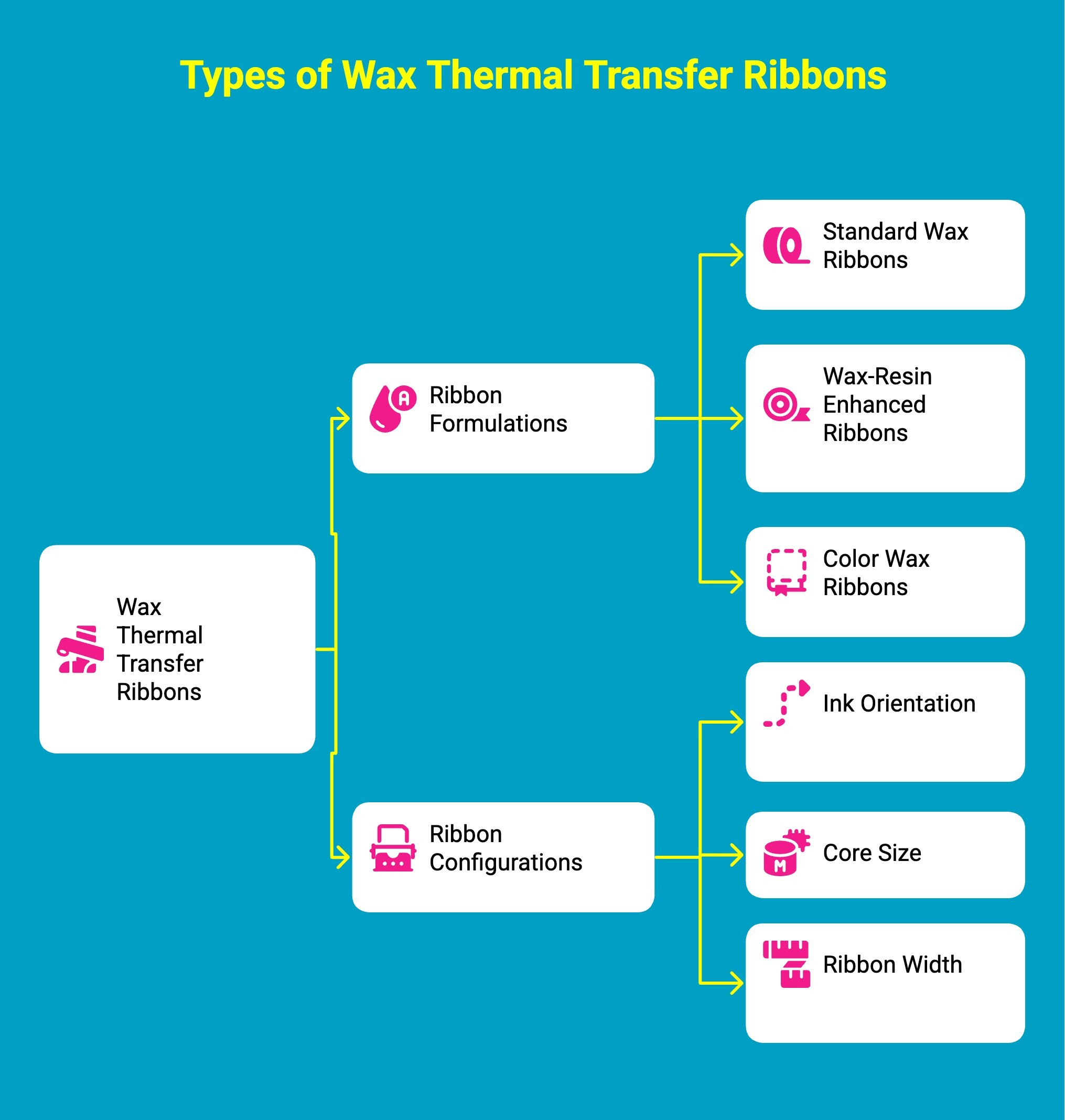
Wax ribbons are available in various formulations designed to meet specific printing requirements and hardware compatibility. From standard wax to enhanced wax-resin blends, manufacturers offer diverse options, including unique ink-in or ink-out configurations, different core sizes, and varied widths to ensure seamless integration with your printer.
1. Ribbon Formulations: Wax, Wax-Resin, and Color
Wax thermal transfer ribbons are available in several ink formulations, each designed for different durability levels and labeling environments. Choosing the right formulation ensures optimal print clarity, barcode readability, and label longevity.
Common ribbon formulations include:
-
Standard wax ribbons: These provide the most economical solution for printing on uncoated or matte paper labels commonly used for shipping, warehouse, and retail labeling.
-
Wax-resin enhanced ribbons: These blends offer greater durability and improved resistance to smudging and abrasion compared with standard wax ribbons. They are often used for higher-quality barcode labels and semi-coated label stocks.
-
Color wax ribbons: Color ribbons support specialty workflows such as color-coded inventory, branding elements, or visual identification systems used in warehouses and manufacturing environments.
Selecting the correct formulation depends primarily on the label material and durability requirements of your application.
2. Ribbon Configurations: Ink Orientation, Core Size, and Width
Beyond formulation, thermal transfer ribbons must also match the physical configuration requirements of the printer. These factors determine whether the ribbon can be installed and used correctly.
Important configuration considerations include:
-
Ink orientation (Ink-In or Ink-Out): Different printers require the ribbon coating to face either inward or outward during printing.
-
Core size: Desktop printers commonly use 0.5-inch cores, while industrial printers typically use 1-inch cores.
-
Ribbon width: The ribbon should normally be slightly wider than the label, which protects the printhead and ensures full print coverage.
Ensuring the correct configuration prevents installation issues, print errors, and unnecessary printer wear.
Common Printer Ribbon Orientations
Ribbon orientation is one of the most common compatibility questions when selecting a new ribbon. The table below provides a general guideline for widely used printer brands.
|
Printer Brand |
Ribbon Orientation Required |
|---|---|
|
Zebra Desktop Printers |
Ink-Out |
|
Zebra Industrial Printers |
Ink-In |
|
SATO Printers |
Ink-In |
|
Datamax Printers |
Ink-In |
|
Intermec Printers |
Ink-In |
|
TSC Printers |
Ink-Out |
Always confirm the orientation in your printer documentation or ribbon specifications before purchasing, as specific models may vary.
Which Wax Ribbons Are Best Suited for Zebra Thermal Printers?
Zebra Technologies printers are industry leaders, powering critical operations across healthcare, retail, and manufacturing. Selecting the correct ribbon is vital for maintaining machine longevity and ensuring crisp, scannable output. Because Zebra models vary by width and duty cycle, matching your specific printer to the compatible ribbon length is essential for peak performance.
The following list organizes Zebra ribbon types by printer class and capacity:
-
Use 74m ribbons for 2-inch desktop models like the TLP 2824 series.
-
Select 74m (243 ft) ribbons for 4-inch desktops like the GX420/GK420/ZD420 series.
-
Utilize cartridge-based 4.33-inch ribbons for ZD420c and ZD421c to simplify installation.
-
Choose 300m length ribbons for mid-volume industrial operations to reduce changeovers.
-
Apply 450m industrial ribbons for mission-critical, high-volume production to minimize downtime.
Always verify your specific printer series to ensure proper compatibility with core size and ink orientation.
Zebra Compatibility & Product Reference
|
Printer Class |
Compatible Models |
Recommended Ribbon |
Recommended Darkness Setting |
Product Link |
|---|---|---|---|---|
|
2" Desktop |
TLP 2824, ZD411t, ZD611t |
2.20” x 243 ft TDW121 Wax |
8–12 |
|
|
4" Cartridge |
ZD420c, ZD421c |
4.33” x 243 ft Cartridge Ribbon |
8–12 |
|
|
4" Desktop |
GX420, GX430, GK420, GC420, ZD220, ZD420, ZD500, ZD620t |
4.33” x 243 ft TDW121 Wax |
10–14 |
|
|
Industrial |
Zebra Industrial Series |
4.33” x 1476 ft TDW121 Wax |
12–16 |
While many of our ribbons are designed for Zebra desktop and industrial printers, DuraFast Label Company also supplies thermal transfer ribbons compatible with other major barcode printer brands, including SATO, Datamax-O'Neil, and Intermec systems, ensuring reliable performance across a wide range of labeling environments.
When Should You NOT Use a Wax Ribbon?
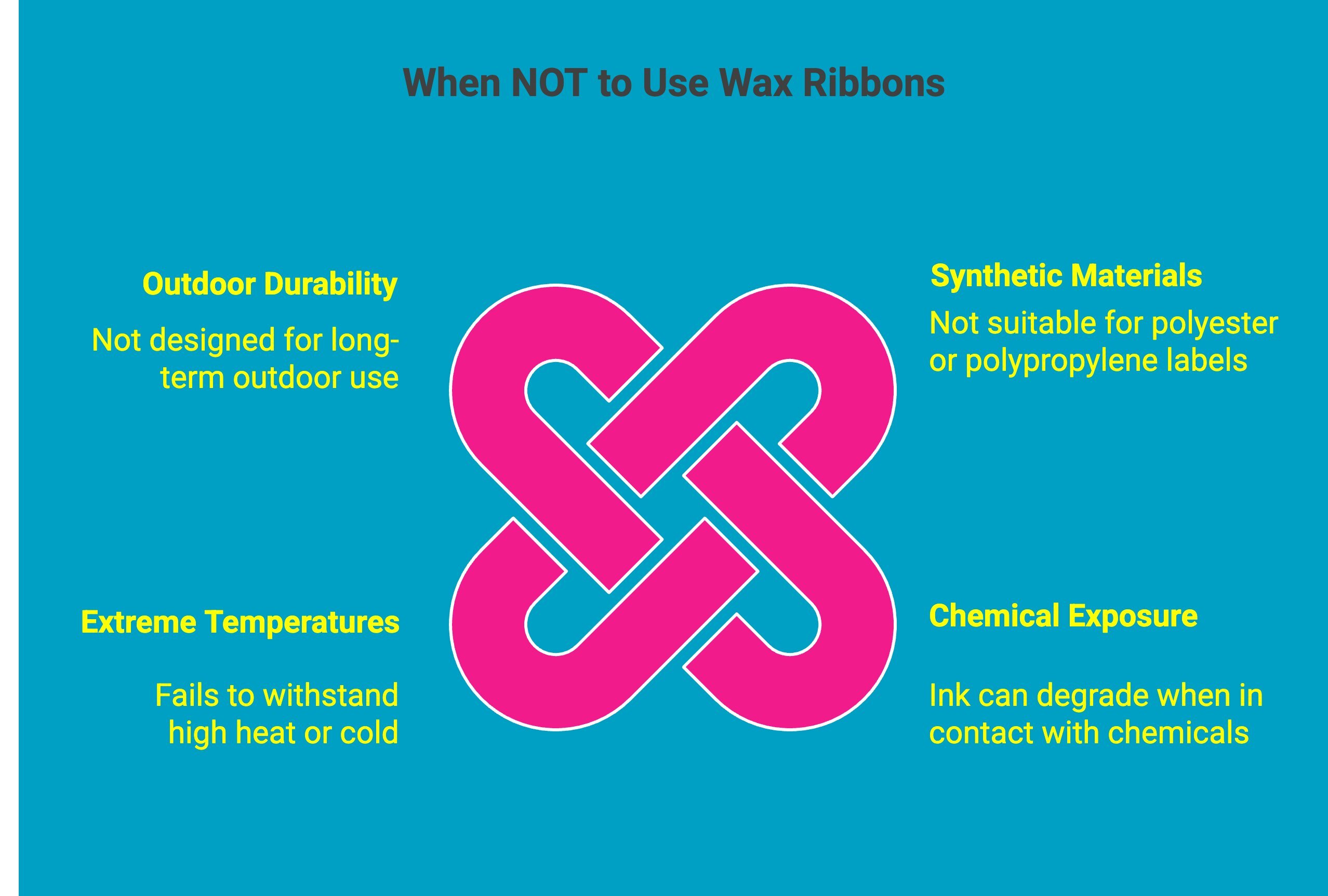
Wax ribbons are excellent for paper-based tasks, but they have distinct performance limitations in harsh environments. When your application involves synthetic materials, chemical exposure, or extreme temperatures, the wax-based ink lacks the necessary adhesion. Choosing the wrong ribbon type will lead to premature label degradation and failed scans.
These specific conditions indicate that a more robust ribbon formulation is required:
-
Avoid using wax ribbons when printing on synthetic labels like polyester or polypropylene.
-
Do not use wax ribbons if the labels come into contact with chemicals or solvents.
-
Skip wax ribbons when labels must withstand high heat or extreme environmental temperatures.
-
Never select wax ribbons for applications requiring long-term durability in outdoor weather conditions.
Consider upgrading to wax-resin or full resin ribbons for these demanding industrial requirements.
How to Choose the Right Wax Ribbon?
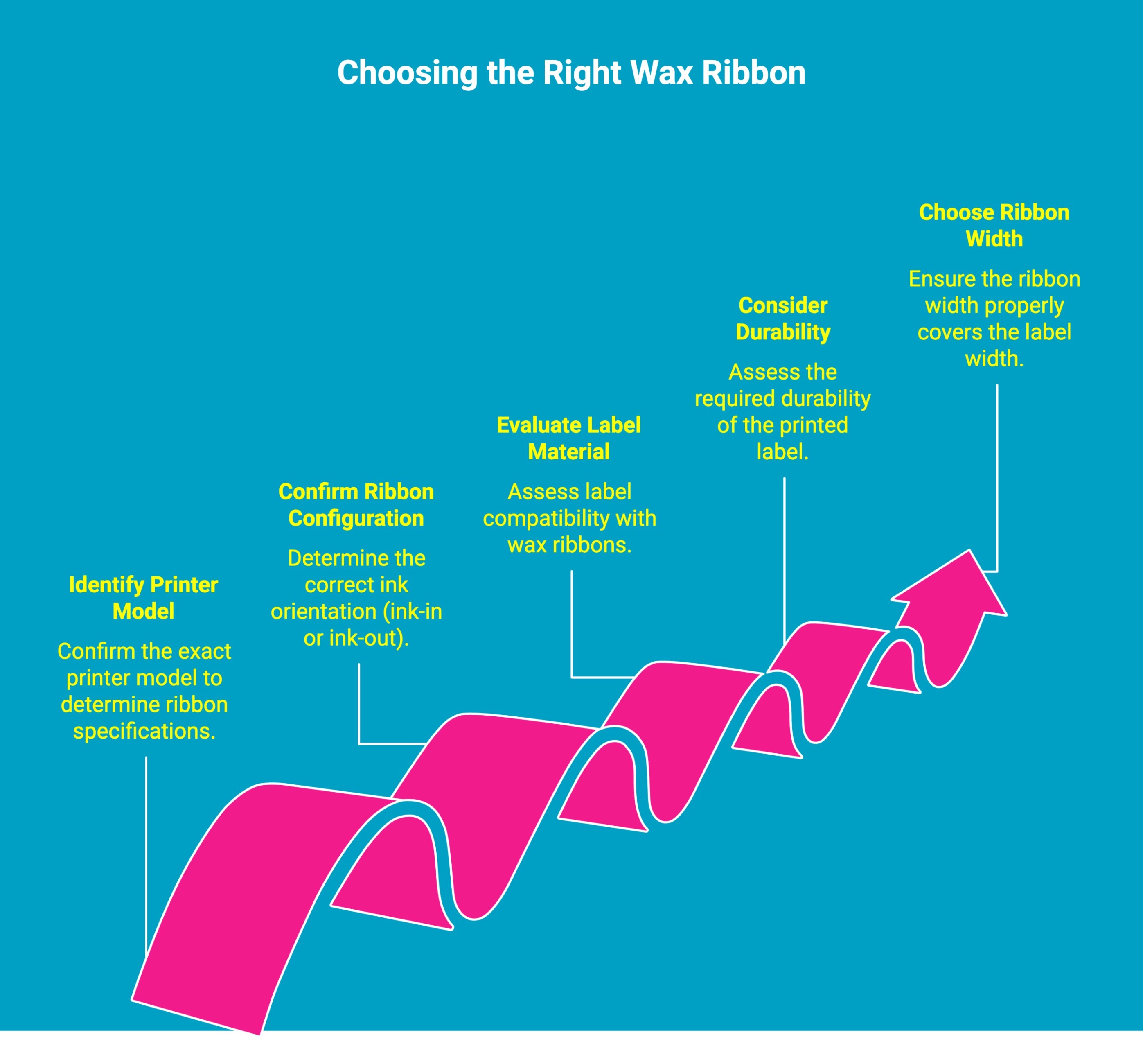
Choosing the correct wax ribbon is easier when you follow a structured sequence. By moving step by step from identifying your printer to confirming ribbon width, you can ensure proper compatibility, consistent print quality, and reliable barcode performance.
Step 1: Identify Your Printer Model
Start by confirming the exact printer model you are using. Your printer determines the ribbon specifications required for proper operation.
Key things to check:
-
The core size required by your printer (commonly 0.5" for desktop printers and 1" for industrial printers).
-
The maximum ribbon length supported (such as 74m, 300m, or 450m ribbons).
-
The maximum ribbon width your printer can accommodate.
Identifying the printer model first ensures the ribbon will physically fit and function correctly.
Step 2: Confirm the Ribbon Configuration (Ink-In or Ink-Out)
Once the printer model is confirmed, determine the ribbon ink orientation required by the printer.
Important factors include:
-
Whether your printer requires an ink-in ribbon configuration.
-
Whether your printer requires an ink-out ribbon configuration.
-
Verifying the ribbon orientation in your printer manual or specifications.
Using the wrong configuration may cause printing failures or improper ribbon loading.
Step 3: Evaluate Your Label Material
Next, review the type of label material you are printing on to confirm compatibility with wax ribbons.
Consider the following:
-
Whether your labels are uncoated paper labels.
-
Whether they are matte or coated paper stocks.
-
Whether the labels are synthetic materials such as polypropylene or polyester.
Wax ribbons perform best on paper labels. Synthetic materials may require wax-resin or resin ribbons instead.
Step 4: Consider Durability Requirements
After confirming the label material, assess how durable the printed label needs to be in its working environment.
Key durability considerations include:
-
Whether labels will be used for shipping or short-term identification.
-
Whether labels will face handling, friction, or mild abrasion.
-
Whether labels must withstand chemicals, moisture, or heat exposure.
Wax ribbons are ideal for general labeling but may not be suitable for harsh environments.
Step 5: Choose the Correct Ribbon Width
Finally, confirm that the ribbon width properly covers the label width.
Important sizing guidelines include:
-
The ribbon should be slightly wider than the label.
-
A good rule is 2 to 5 mm wider than the label width.
-
This prevents printhead wear and uneven printing.
Proper ribbon width ensures full ink coverage and protects the printer’s printhead.
Following this structured process helps ensure your wax ribbon delivers consistent print quality, reliable barcode readability, and optimal printer performance.
Getting started with thermal printing? Learn the basics in our guide on What a Thermal Transfer Ribbon Is and How It Works.
Why Wax Ribbons Matter in the Thermal Ribbon Ecosystem?
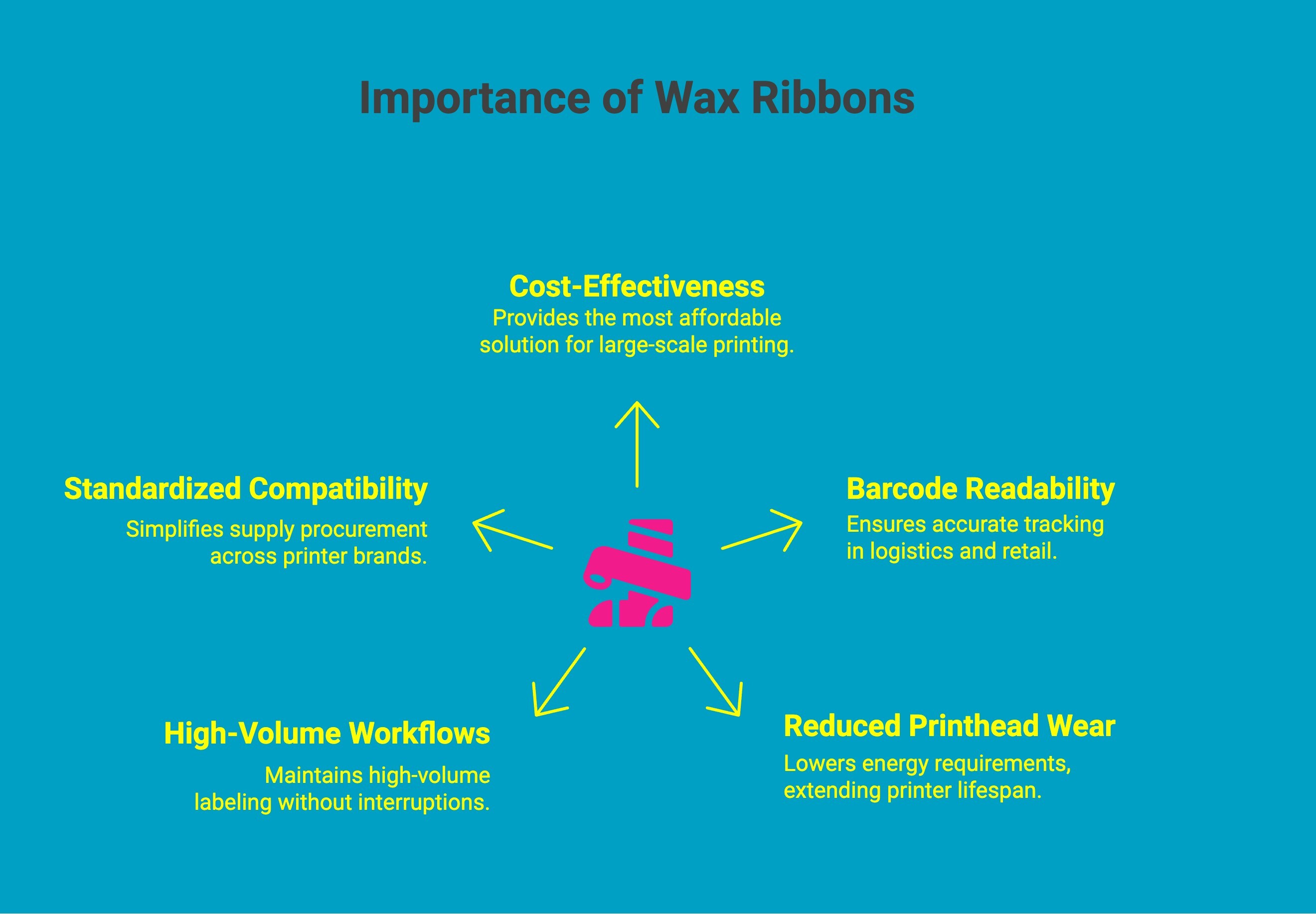
Wax ribbons function as the reliable foundation for high-volume thermal transfer printing across global supply chains. By balancing cost-efficiency with high-contrast performance, they allow businesses to generate millions of barcodes and shipping labels daily, ensuring seamless inventory movement while simultaneously preserving the integrity of printer printheads.
The following points outline why these ribbons remain indispensable for standard business operations:
-
Wax ribbons offer the most affordable solution for printing at a massive scale.
-
They ensure reliable barcode readability required for accurate tracking in logistics and retail.
-
Lower energy requirements reduce printhead wear and extend the lifespan of printer equipment.
-
Efficient production cycles allow companies to maintain high-volume labeling workflows without constant interruption.
-
Standardized compatibility across various printer brands simplifies supply procurement for busy warehouse managers.
Relying on wax ribbons ensures your operations remain both cost-effective and highly productive.
How Can DuraFast Label Company Support Your Thermal Ribbon Needs?
At DuraFast Label Company, we help businesses select thermal transfer ribbons that are verified compatible with widely used Zebra printer models, ensuring reliable performance across warehouse, logistics, manufacturing, and retail environments.
For example, our TDW121 Wax Ribbon is verified compatible with printers such as Zebra ZD420, GX420, GK420, ZD620, and TLP 2844 series, providing consistent barcode clarity on standard paper labels used in shipping, inventory, and carton labeling.
Our goal is to make ribbon sourcing simple while ensuring you receive the correct ribbon size, formulation, and length for your printer and label material.
What We Provide:
-
Verified printer compatibility: Many of our TDW121 wax and wax-resin ribbons are tested for compatibility with popular Zebra desktop and industrial printers including ZD420, ZD620, GX420, GK420, ZD500, and GT800 models.
-
Multiple ribbon lengths for different production needs: Available options include 74m desktop ribbons, 300m mid-range ribbons, and 450m industrial ribbons, helping reduce ribbon changeovers in high-volume operations.
-
Ribbon formulations designed for common labeling applications: Our wax and wax-resin ribbons are optimized for shipping labels, warehouse barcode labels, carton labeling, and inventory tracking.
-
Reliable barcode readability: TDW121 ribbons are designed to produce sharp text, dense black barcodes, and consistent print contrast, helping maintain reliable barcode scanning in distribution environments.
-
Compatibility with common paper label materials: Our ribbons are engineered to work well with uncoated and coated paper label stocks, commonly used in logistics and fulfillment workflows.
By choosing the correct ribbon for your Zebra printer and label material, you can maintain consistent print quality, reliable barcode scanning, and smoother labeling operations across your facility.
Contact us today to simplify your ribbon sourcing and improve your printing efficiency. Our team can help you find the right ribbon for your Zebra printer in under 60 seconds.
Frequently Asked Questions
What is a wax ribbon used for?
Common wax ribbon uses cover many sectors. These are a popular choice for paper labels, as they offer a wide range of applications. The best use cases for wax ribbons definitely include shipping, retail, and carton labels.
What is the difference between wax ribbon and resin ribbon?
While pure wax ribbons are economical for paper, resin thermal transfer ribbons provide high durability on synthetics. Wax is less durable, making it unsuitable for harsh conditions where labels face heat, moisture, or chemical exposure daily.
Can wax ribbons print barcodes clearly?
A barcode wax ribbon prints clean codes on paper. To meet specific needs, consider the conditions of use at your facility. Always monitor environmental factors, as humidity or heat can affect the final scan quality significantly for you.
Are wax ribbons compatible with all thermal printers?
The type of ribbon you choose matters greatly. A wax printer ribbon only works with transfer printers, not direct thermal models. Ensure your wax ribbon roll fits your machine, especially when your facility experiences rough handling during shipping.
Are color wax ribbons available?
Yes, a color wax ribbon is available for branding or visual sorting. While a standard black wax ribbon is most common for text and barcodes, colored options provide creative ways to organize your warehouse inventory system effectively today.
Are wax ribbons compatible with all thermal transfer ribbon types?
No, wax ribbons are not compatible with all thermal transfer types because each formulation serves distinct purposes. You must match the material to the correct ribbon for your printer. Using the wrong type often results in poor print quality.
Are wax ribbons suitable for printing labels that need high durability?
No, wax ribbons are not suitable for labels requiring high durability as they lack the necessary chemical resistance. They easily smudge or fade when exposed to moisture or heat. For such demanding tasks, always choose high-performance resin-based options.
Are wax ribbons suitable for printing labels that need high durability?
Wax ribbons are not ideal for labels that require high durability. They work best on paper labels for short-term use. For labels exposed to heat, chemicals, moisture, or abrasion, wax-resin or resin ribbons provide stronger, longer-lasting print performance.