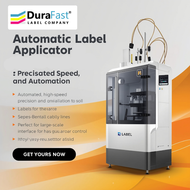
How Automatic Label Applicators Support High-Volume Packaging
23rd Oct 2025
Modern packaging lines need to run smoothly and label products accurately in order to meet growing demand. That’s why many businesses are upgrading their packaging lines with an auto label applicator. These machines take the guesswork out of labeling by applying labels quickly, accurately, and consistently across hundreds or even thousands of products per hour.
Whether you’re labeling bottles, boxes, or pouches, the right labeling system ensures smooth operations and high-quality output.
What Is an Automatic Label Applicator?
An automatic label applicator is a machine designed to apply pre-printed or blank labels to products without the need for manual handling. Unlike manual or handheld label applicator systems, automatic applicators work seamlessly with conveyor belts or packaging lines, automatically detecting, peeling, and applying each label precisely in the correct position.
These systems are widely used in industries such as food and beverage, pharmaceuticals, cosmetics, and logistics, where large-scale, consistent labeling is required.
Automatic labeling systems have become a must-have for businesses that deal with mass production. Here’s how they support high-volume operations:
1. Speed and Efficiency
One of the biggest advantages of an automatic applicator is speed. These machines can apply hundreds or even thousands of labels per hour, depending on the model and production setup. This speed ensures your packaging line keeps up with demand without bottlenecks.
2. Precision Label Placement
Label placement accuracy is vital, no matter how fast your production line runs. Automatic systems use sensors and advanced controls to ensure each label is perfectly aligned, avoiding wrinkles, misplacements, or air bubbles.
3. Reduced Labor Costs
Manual labeling requires staff to spend hours applying labels one by one. Automation drastically reduces this need. Operators only need to load labels, monitor performance, and perform occasional maintenance, freeing up labor for other critical tasks.
4. Consistency Across Every Product
Uniformity matters for branding and compliance. Automatic applicators ensure every product looks identical on the shelf, giving your packaging a polished, professional finish.
5. Integration with Production Lines
Most modern automatic applicators easily integrate with other production equipment like conveyors, barcode scanners, and coding machines. They are perfect for businesses that want to optimize operations and boost productivity.
Common Types of Automatic Label Applicators
Different products and packaging needs call for different types of label applicators. Here are a few of the most common systems used in high-volume packaging:
- Top Label Applicators: Apply labels on the top surface of boxes, trays, or flat containers.
- Bottom Label Applicators: Perfect for packages that need labeling on the underside, such as frozen meals or baked goods.
- Wrap-Around Applicators: Ideal for cylindrical containers like bottles or jars.
- Front and Back Applicators: Designed for items that need dual labeling for branding and compliance information.
- Corner-Wrap Applicators: Commonly used in logistics for cartons or shipping boxes.
Each type serves a unique purpose, helping businesses identify their ideal labeling solutions.
Benefits Beyond Speed and Accuracy
While efficiency is a major advantage, automatic labeling also offers other long-term benefits:
- Less Waste: With precision application, fewer labels are wasted due to misplacement or tearing.
- Better Quality Control: Automated systems detect errors early and can stop the process before problems escalate.
- Scalability: As production demands grow, your labeling system can easily be upgraded or expanded.
- Cleaner Work Environment: Reduced manual handling means less clutter and better workflow organization.
The Role of Automatic Label Rewinders
In large-scale operations, accessories like an automatic label rewinder play an essential role. A rewinder automatically collects the backing liner after labels are dispensed, keeping the workspace clean and preventing tangles or jams. It’s a small but essential tool that enhances overall labeling efficiency, particularly in continuous production lines.
How to Choose the Right Automatic Label Applicator
Selecting the ideal label applicator depends on a few important factors:
- Product Shape and Material: Bottles, boxes, and pouches each require specific machines.
- Label Type: Transparent, pressure-sensitive, or textured labels may need special handling.
- Speed Requirements: Match the applicator speed to your production line to avoid delays.
- Integration Capabilities: Choose a system that connects easily with existing equipment.
- Maintenance and Support: Go for a model that’s easy to service and supported by a reliable supplier.
Investing in the right equipment ensures your labeling process remains consistent, reliable, and scalable.
The Future of Automatic Labeling
The labeling industry is moving toward smarter, greener, and more connected systems. Expect innovations such as:
- AI-driven label alignment and inspection
- Cloud monitoring for production analytics
- Energy-efficient designs for sustainability
- Modular systems for easy upgrades
Automation continues to evolve, making labeling faster, more accurate, and eco-friendly than ever before.
Conclusion
An auto label applicator is not just a machine; it is a productivity enhancer that can transform your packaging line. Whether you’re labeling thousands of products daily or scaling up for larger operations, automation ensures precision, consistency, and speed at every step.
At DuraFast Label Company, we specialize in advanced labeling solutions designed to fit your business needs. From compact systems for small batches to high-speed applicators for industrial use, we provide technology that helps you label smarter, not harder.
FAQs
- What is an automatic label applicator?
It’s a machine that applies labels to products automatically, eliminating the need for manual handling and increasing production efficiency.
- How is an automatic label applicator different from a handheld label applicator?
A handheld applicator is ideal for small-scale or mobile labeling tasks, while an automatic one handles high-speed labeling in large production lines.
- What types of products can automatic label applicators handle?
They can apply labels to bottles, boxes, jars, and various other packaging materials across industries.
- How does an automatic label rewinder help in labeling?
It collects the waste liner from the labels, maintaining a clean and organized workspace during long labeling runs.
- Are automatic label applicators suitable for small businesses?
Absolutely. Compact and semi-automatic models are perfect for growing small businesses looking to improve efficiency.
- How do I maintain an automatic label applicator?
Regular cleaning, calibration, and inspection of sensors ensures long-term performance and minimal downtime.
- What industries use automatic labeling systems?
Food, beverage, cosmetics, pharmaceuticals, and logistics are the main sectors using these systems for high-volume packaging.